6sense is an account-based marketing and revenue-intelligence platform that captures buying signals, resolves identities and predicts buying stages, turning raw data into cited GTM intelligence delivered to sales, marketing, ads and AI agents via APIs and MCP.
B2B buyers do most of their research anonymously before they ever talk to sales, which leaves revenue teams guessing who is in-market. 6sense exists to turn that invisible activity into something teams can act on.
It is an account-based marketing and revenue-intelligence platform that captures buying signals, resolves identities, predicts buying stages, and pushes the resulting cited intelligence into ads, email, sales tools and AI agents. It sits at the enterprise end of GTM, where lighter data tools like Clay serve the prospecting layer rather than the full signal-to-activation platform.
This review covers how 6sense knows who is buying, where it fits and the privacy line that runs through it, how it is sold, and who it is the wrong scale for.
6sense resolves buying signals into intelligence that teams, tools and agents can act on.
6sense, The GTM Brief
6sense is an ABM and revenue-intelligence platform: it turns buying signals into go-to-market intelligence.
It answers why, not just what: identity resolution and predictive models say which account, why now and who's deciding.
Intelligence travels: it flows into ads, email and sales tools, and to AI agents, via APIs and MCP.
A privacy line runs through it: intent data and website de-anonymisation mean responsible, compliant use matters.
Turning Buying Signals Into GTM Intelligence
6sense's premise is that signals alone are noise: knowing a company visited your site tells you 'what', not 'why' or 'who'. Its value is resolving scattered signals into intelligence, which account, what stage, who is deciding, that a team can actually act on.
It builds that from three layers: its own long-running proprietary intent data, your first-party data (CRM, web, product), and third-party signals like job changes and funding, combined and resolved into a single picture of an account.
It is firmly an enterprise platform, with a demo-led motion and deep integration ambitions, aimed at revenue teams running serious account-based go-to-market, not a solo seller looking for a few leads.
Signals alone are noise: knowing a company visited your site tells you 'what', not 'why' or 'who'. 6sense's value is resolving them into intelligence a team can act on.
How Does 6sense Know Who Is Buying?
Two capabilities underpin the claim: resolving identity from signals, and predicting intent, with activation on top.
Intent Signals And Identity Resolution
6sense combines keyword-level intent, verified B2B data and technographics, and uses identity resolution, including website de-anonymisation, to tie anonymous activity to accounts and buying groups. That resolution is the hard technical core.
It is also where the privacy line sits, which we flag plainly: de-anonymising website visitors and processing intent data must be done within privacy law and your own policies. The platform provides capability; compliant, responsible use is the buyer's responsibility, as it is for any GTM-data tool like Clay.
Predictive Models And Agentic Activation
On top, per-customer predictive models trained on B2B purchase behaviour estimate buying stage with context, and the resulting intelligence flows into ads, email and sales tools, and to AI agents, via APIs and MCP, so the whole stack reasons from one source.
That activation layer is what turns intelligence into action. A sales-agent tool like Artisan works one channel; 6sense aims to be the context layer feeding many, including a customer-success tool like Gainsight downstream.
Where 6sense Fits, And The Privacy Line
6sense fits enterprise and upper-mid-market B2B revenue teams running account-based go-to-market: marketing, sales and RevOps that need to know which accounts are in-market and coordinate across channels against them.
The depth, resolving and predicting across many signals, pays off only at a scale where there are enough accounts and enough spend to act on the intelligence. For such teams, the lift in targeting and timing can be substantial, though 6sense's own ROI figures are vendor-stated.
The privacy line bears repeating: intent data and de-anonymisation are powerful and legitimate marketing capabilities, but they touch personal data, so they must be used within applicable laws and your own governance. That responsibility is the buyer's, not something the platform removes.
How 6sense Is Sold To Revenue Teams
6sense is enterprise and demo-led: engagement runs through a book-a-demo and explore-platform motion rather than public self-serve pricing. We do not publish prices; there are none listed.
The value question is whether better account targeting and timing, across coordinated ads, email and sales, generates enough additional pipeline and efficiency to justify a significant platform commitment.
Because that depends entirely on your market, data and go-to-market maturity, a scoped evaluation with your own accounts, and your own compliance team involved given the data, is the only honest way to size it.
A Grounded Way To Evaluate 6sense
Because the payoff is targeting and timing at scale, evaluate 6sense on your real accounts, with privacy reviewed up front.
Involve your compliance team early on the intent-data and de-anonymisation handling.
Have 6sense resolve and score a real segment of your target accounts.
Check whether its 'why this account, why now' predictions match accounts you know are in-market.
Test the activation path into one channel (ads, email or your sales tool) and measure lift.
Confirm the intelligence flows via API or MCP into the tools and agents you actually use.
Pass/fail: 6sense is worth it if sharper targeting and timing generate real pipeline at your scale.
Treat its ROI and accuracy figures as vendor claims to validate on your own data.
6sense ABM Terms
ABM
Account-based marketing: targeting and coordinating go-to-market around specific high-value accounts rather than broad leads.
Intent data
Signals that a company is researching a topic or category, used to infer that it may be in-market.
Identity resolution
Tying scattered or anonymous signals to a specific account or buying group; includes website de-anonymisation.
Buying stage
Where an account is in its purchase journey; 6sense predicts this to time outreach.
6sense ABM Platform Facts
What it is
An ABM and revenue-intelligence platform
Core
Buying signals turned into GTM intelligence
Signals
Proprietary intent, your data, third-party
Resolution
Identity resolution and website de-anonymisation
Predicts
Buying stage, which account and why now
Activation
Ads, email, sales tools, and AI agents
Access
APIs, MCP and a data-warehouse layer
Model
Enterprise, demo-led
Key features of 6sense
Keyword-level intent signals
First- and third-party data integration
Identity resolution and de-anonymisation
Per-customer predictive models
Account and buying-group insight
Ad, email and sales activation
APIs and MCP for agents
RevvyAI conversational intelligence
Pros & cons
Pros
5
Resolves noisy signals into actionable intelligence
Predicts which account and why now
Feeds intelligence to tools and agents, not just a UI
Combines proprietary, first- and third-party data
Deep account-based coordination at scale
Cons
5
Enterprise scale; overkill for small teams
Intent data and de-anonymisation carry privacy duties
ROI and accuracy figures are vendor-stated
Demo-led, no public pricing
Value depends on GTM maturity and spend
Best For
Enterprise B2B revenue teams
Account-based go-to-market
RevOps and marketing coordination
Signal-driven targeting
Agent-fed GTM stacks
6sense Against Other GTM Platforms
The useful comparison is with other GTM data and activation tools, on scale and scope.
Marketing, sales and RevOps coordinating across channels
Organisations with enough accounts and spend to act on signals
Teams that want intelligence fed to tools and agents
When 6sense Is Oversized
Solo sellers or small teams wanting a few leads
Businesses without account-based go-to-market
Teams that cannot handle intent-data privacy duties
Anyone wanting cheap, self-serve prospecting
Those who take ROI figures as guaranteed
How We Pulled Apart 6sense
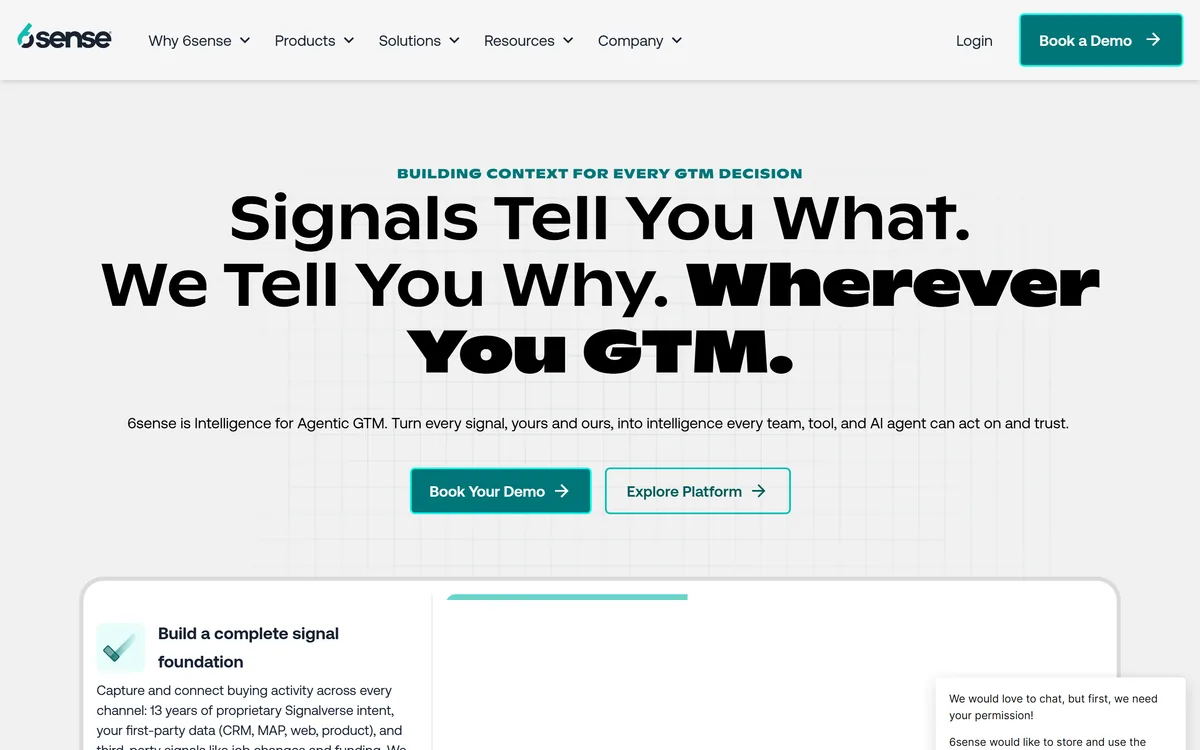
Last checked . Read from 6sense.com during this check, with the screenshot above captured at the same time.
An account-based marketing and revenue-intelligence platform
A signal foundation of proprietary intent, first-party and third-party data
Identity resolution including website de-anonymisation
Per-customer predictive models for buying stage
Activation across ads, email and sales tools
Delivery to AI agents via APIs and MCP
A conversational AI (RevvyAI) grounded in account context
An enterprise, demo-led go-to-market
No plan prices reproduced here, in line with this site's pricing policy
6sense uses intent data and website de-anonymisation, which touch personal data; compliant, responsible use within privacy law and your own policy is the buyer's responsibility. Its ROI and accuracy figures are vendor-stated.
Other GTM And Sales Tools
A prospecting-data tool, a sales agent and a customer-success platform to weigh alongside 6sense.
6sense earns 4.1 as a serious enterprise ABM and revenue-intelligence platform that resolves intent, first-party and third-party signals into cited, predictive intelligence, which account, why now, who's deciding, and feeds it to ads, sales tools and AI agents. Its ROI figures are vendor-stated, it is overkill below real account-based scale, and its intent data and de-anonymisation carry privacy duties the buyer must own, but for enterprise GTM it is a powerful context layer. AInexfinder Editor Score: 4.1/5.
6sense pricing
AInexfinder does not list plan prices or billing details. For current pricing, plans, and trials, visit the official 6sense website.
Vendor pricing, credits, and billing policies change over time. Always confirm on the official site before you buy.
Frequently asked questions
What is 6sense?
6sense is an account-based marketing and revenue-intelligence platform. It captures buying signals, resolves identities, and predicts buying stages, turning raw data into cited go-to-market intelligence that it delivers to sales, marketing, ads and AI agents via APIs and MCP. It is an enterprise platform.
How does 6sense know which accounts are in-market?
It combines its own proprietary intent data, your first-party data and third-party signals, then uses identity resolution, including website de-anonymisation, and per-customer predictive models to estimate which account is buying, what stage it is at and who is deciding, rather than leaving you with raw signals.
Does 6sense raise privacy concerns?
It uses intent data and website de-anonymisation, which touch personal data, so responsible, compliant use within privacy law and your own governance matters. These are legitimate B2B marketing capabilities, but the platform provides capability, not compliance, so that responsibility sits with the buyer.
Who is 6sense for?
Enterprise and upper-mid-market B2B revenue teams, marketing, sales and RevOps, running account-based go-to-market at a scale with enough accounts and spend to act on the intelligence. It is oversized for a solo seller or small team just wanting a handful of leads.
How is 6sense priced?
It is enterprise and demo-led, with a book-a-demo and explore-platform motion rather than public self-serve pricing. We do not publish prices; evaluate it with a scoped test on your own accounts, and weigh it against the pipeline and efficiency better targeting could generate at your scale.
Can 6sense feed my other tools and AI agents?
Yes, that is a core part of its pitch. Its intelligence flows into ads, email and sales tools and to AI agents via APIs, MCP and data-warehouse connections, so your whole stack reasons from one trusted source rather than the context being locked inside 6sense's own interface.
Are 6sense's results claims reliable?
Figures like ROI, click-through and conversion uplift are vendor-stated and based on selected customers, so treat them as claims. The honest test is a scoped evaluation on your own accounts: do its 'why this account, why now' predictions match accounts you know are in-market, and does activation lift pipeline?
What is website de-anonymisation in 6sense?
It is identity resolution that ties anonymous website activity to a company or buying group, so you can see which accounts are researching you even before they identify themselves. It is powerful for timing outreach, and it is also why privacy and consent handling must be done carefully.
How is 6sense different from a prospecting tool?
A prospecting-data tool helps you build and enrich lists for outreach. 6sense is a broader platform that resolves and predicts intent across many signals and activates it across channels and agents. It operates at the strategy-and-coordination layer, not just the list layer.
Is 6sense worth it for a small business?
Usually not. Its depth and cost assume account-based go-to-market at enterprise or upper-mid-market scale, with enough accounts and spend to act on predictive intelligence. A small business is better served by a lighter prospecting-data tool than by a full ABM platform.
Daniel reviews AI tools the slow way — by actually using them on real projects. His reviews cover what works, what breaks, and who each tool is genuinely a good fit for.
Daniel and the AInexfinder editorial team research 6sense using public product information, listing evidence, and (when available) hands-on checks. Scores reflect listing completeness and transparency — not paid placement.
Listings may include affiliate or sponsored placements, which are labeled when present. Editorial scores and cons are not sold. See our affiliate disclosure and review methodology.
Livestorm is a browser-based, all-in-one webinar and video-engagement platform that runs the full event lifecycle, registration, live engagement, AI transcription, on-demand replays and analytics, with CRM integrations and an EU-hosted, ISO 27001 posture, aimed at marketing teams.
Artisan builds AI workers it calls Artisans. The first, Ava, is an autonomous business development rep that sources and enriches B2B leads, writes and sends personalised outreach across email and LinkedIn, handles replies and books meetings — consolidating the data, deliverability and sequencing stack into one product.
Listomize is an Etsy SEO platform that generates titles, tags, and descriptions within Etsy's own limits, scores listings, optimises 100+ listings from a CSV, tracks competitors and trends, and auto-generates Pinterest pins.
Lahjty (لهجتي) is an Arabic-first marketing platform for MENA campaigns. From one brief it produces dialect-aware ad copy, headlines, campaign images with Arabic text rendered in, dialect-aware voice, and SEO articles grounded in your own brand sources — with a Partner API and an MCP server for teams that want it inside their own workflow.
MaxAEO is an answer engine optimisation platform from HIII PTE. LTD. It tracks how ChatGPT, Gemini, Claude, Perplexity, Copilot, Grok and Google's AI surfaces mention a brand, with sentiment, competitor benchmarking and citation tracing.