
Eve builds EveOS for plaintiff-side firms in personal injury, employment, medical malpractice, workers' compensation and Social Security disability. It runs intake, structures medical records, drafts demands and discovery, audits open matters nightly, and answers plain-English questions about the firm's own numbers.
Solve Intelligence
Verified
Solve Intelligence is an AI platform for patent work, covering application drafting, office action responses, invalidity and claim-mapping charts, freedom-to-operate reviews and portfolio analysis. It is used by over 700 in-house IP teams and law firms, with SOC 2 Type II and ISO 27001 certification and no training on customer data.
4.4Editor Score
solveintelligence.com9 viewsAdded March 23, 20261K visitors
Patent work has a shape that suits this technology unusually well. It is document-heavy, highly structured, governed by strict formal conventions, and enormously repetitive at the level of language while being entirely bespoke at the level of substance.
It also has a property that makes automation genuinely risky: a drafting error can be discovered years later, in litigation, when it is unfixable and expensive. Claim language that seemed fine at filing can turn out to have given away the invention.
Solve Intelligence sits precisely on that tension. This review covers what the drafting tools actually handle, why examiner statistics change prosecution strategy, what the security posture means for a firm's professional obligations, and where the attorney's responsibility remains untouched.
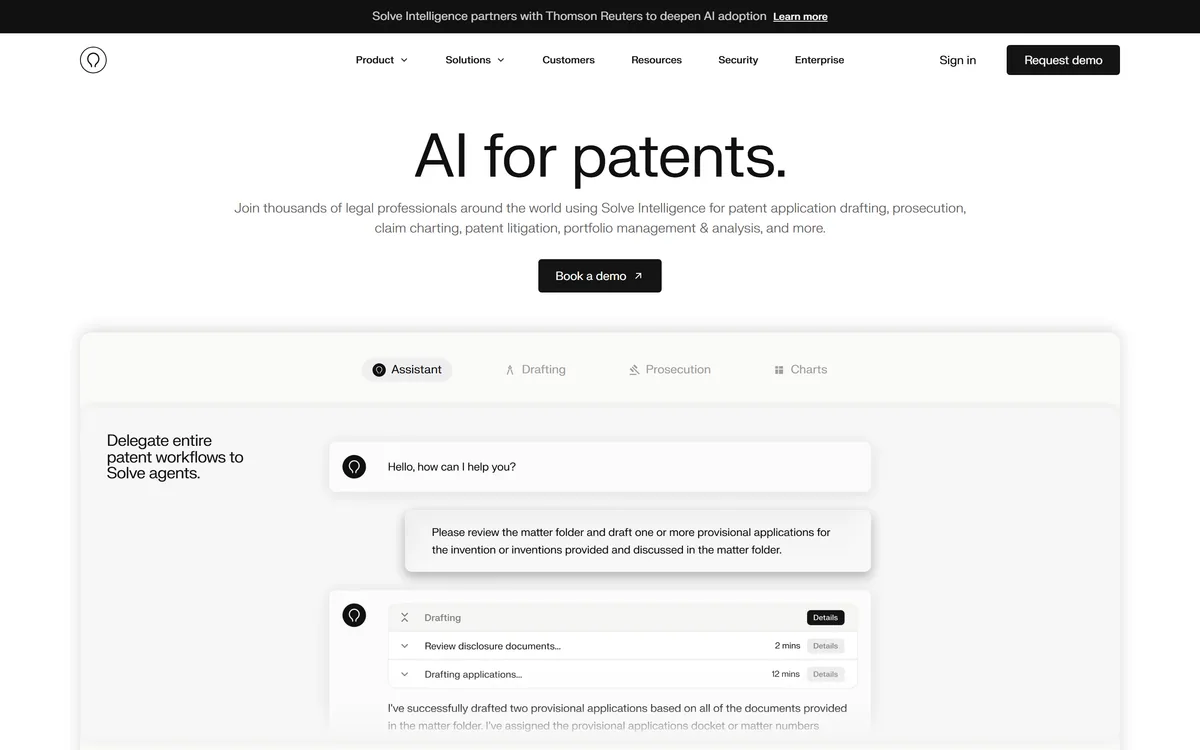
What It Does For A Patent Practice
- Solve Intelligence is an AI platform built for patent professionals, covering the work from drafting an application through prosecution, litigation support and portfolio management.
- Drafting is the flagship, including figure generation from your files, chemical structure and Markush claim handling, and biological sequence listings — the specialised parts, not just the prose.
- Prosecution tooling is equally deep: office action analysis and response drafting, amendments and arguments, with examiner statistics folded in.
- Over 700 in-house IP teams and law firms are cited as users, including Intel, Siemens, DLA Piper, Finnegan and Quinn Emanuel.
- The assurance posture is unusually strong — SOC 2 Type II, ISO 27001, ISO 42001, stated no training on user data and zero-retention options with model providers.
Drafting Is Where The Specialised Work Is
General legal AI such as Harvey can write patent-shaped prose. What separates a serious platform in this field is the material that is not prose at all.
Figure generation from provided files addresses a genuinely tedious cost. Patent drawings follow strict formal conventions — numbered reference elements, consistent labelling across views, specific line conventions — and are usually outsourced to draughtspeople, adding days and expense to every filing.
Chemical structures and Markush claims are a specialism inside a specialism. A Markush claim covers a family of related compounds through a generic structure rather than listing each one, and getting its scope right is among the harder problems in chemical patent drafting. A general tool has no concept of it.
Biological sequence analysis and listings are a compliance requirement in biotech filings, with prescribed formats and their own submission standards. It is exacting, mechanical work that consumes qualified time.
Handling these three signals a product built with patent attorneys rather than adapted for them. They are also, notably, the parts of a filing where automation carries the least judgement risk, because correctness is largely formal rather than strategic.
The prose itself — specification, background, detailed description — is the part where a first draft saves real hours and where the attorney's revision is doing the actual work.
The prose in a patent is the part a model drafts well. The claims are the part that decides what you own, and that is not a drafting problem.
Examiner Statistics Change How You Prosecute
Of everything on the feature list, examiner statistics integration is the one most likely to change a decision rather than save time.
Patent prosecution is not uniform. Applications are assigned to individual examiners who have their own patterns — allowance rates, how many office actions they typically issue before allowance, how they respond to interviews, which rejection types they lean on.
Experienced practitioners have always known this informally, and firms with long histories at a particular art unit carry it as institutional knowledge. Making it explicit and queryable levels that considerably.
The practical effect is strategic. Whether to request an interview, whether to amend narrowly or argue, whether to file a continuation or appeal — these decisions have different expected outcomes depending on who is examining. Knowing that an examiner rarely allows without an interview is worth more than any drafting speedup.
The caution is the ordinary one about base rates: examiner statistics describe historical patterns across other people's applications, not a prediction about yours. They are an input to judgement, and the risk is treating them as a forecast.
The related tooling — invalidity charts, freedom-to-operate reviews, claim-overlap monitoring, portfolio pruning recommendations — follows the same logic. It is systematising work that was previously done by expensive people reading documents.
Security Is Not Optional Here, And They Have Treated It That Way
Most software reviews treat a certifications list as procurement filler. In this field it is closer to a threshold requirement, and Solve Intelligence's is unusually complete.
The reason is specific. An unfiled patent application is one of the most sensitive documents a company produces. Public disclosure before filing can destroy patentability outright in most jurisdictions. Attorneys also carry professional confidentiality obligations to clients that are not negotiable and do not bend for a software vendor's convenience.
So no training on user data and zero data retention options with the model providers are not features here, they are entry conditions. A platform that sent draft claims to an API that retained them would be unusable by any competent practice regardless of output quality.
The certification set is broad — SOC 2 Type II, ISO 27001, and ISO 42001, which is the newer AI management systems standard and still relatively uncommon to hold. GDPR and CCPA compliance, AES-256 and TLS 1.3, and enterprise AWS infrastructure round it out.
Contract-focused tools like LegalOn make similar assurances for a different practice area. The Thomson Reuters partnership is worth noting alongside this. Established legal information providers are conservative about who they associate with, and that association functions as a form of diligence in a market where a great deal is asserted.
- Take a granted patent you drafted yourself and have the platform draft the same application from the disclosure.
- Compare the claims specifically — that is where value or damage lives, not in the specification.
- Run a real office action you have already responded to and compare its analysis with yours.
- Check examiner statistics against an art unit where you have your own experience to test them.
- Have your own counsel review the data processing terms before any live client matter touches it.
How A Firm Pays For This
This site does not publish plan prices and neither does the vendor. The structure is what a practice can plan around.
The model is contact-sales, with demo requests as the entry point rather than a signup form. In legal technology this almost always means seat-based licensing with firm-level agreements and annual terms.
The variables that usually drive the quote are the number of fee earners with access, which modules are included — drafting, prosecution, charting and portfolio analysis are distinct bodies of work — and whether the deployment needs specific data handling arrangements.
For a firm, the arithmetic is unusually legible compared with most software. Patent drafting is billed work with a known hourly value, so a time saving converts directly into either capacity or margin. That is a rarer situation than it sounds and it is why this category can sustain enterprise pricing.
The harder budgeting question is the one nobody puts on a page: if drafting time falls substantially, what happens to fixed-fee arrangements and to client expectations about cost? That is a business model question for the practice rather than a procurement one, and it is worth thinking about before the efficiency arrives.
The Responsibility That Does Not Transfer
This deserves stating plainly, because it is the one thing no platform in this category can change.
Claim drafting is where the value sits and where judgement is irreducible. Claims define the legal boundary of what you own. Too narrow and competitors design around them; too broad and they are invalid over prior art. That balance depends on commercial strategy, the specific prior art landscape, and what the client actually intends to sell — none of which is fully in the disclosure document.
The attorney signs it. Professional responsibility for what is filed does not move to a vendor. Duties of candour to the patent office, competence obligations, and malpractice exposure all remain exactly where they were.
Search platforms like Cypris sit upstream of this and face the same constraint. Prior art coverage is never complete. Applications stay unpublished for around eighteen months, so the most relevant prior art may not be visible to any system at the time you draft.
The realistic and still substantial value is compression of the mechanical hours — the specification prose, the figures, the sequence listings, the first pass at an office action response. That is a large share of the time and a small share of the judgement, which is exactly the right thing to automate.
- Claim scope remains a strategic judgement, not a drafting task
- Professional responsibility and malpractice exposure stay with the attorney
- Recent applications are unpublished for around eighteen months and invisible to everyone
- Examiner statistics describe history, not a prediction about your application
- Client confidentiality obligations bind you regardless of vendor assurances
Patent Vocabulary Used Above
Five terms that this listing assumes and that decide what the product is actually doing.
- Office action
- The patent office's written objection to an application. Responding to it — with amendments, arguments or both — is the bulk of prosecution work.
- Claims
- The numbered statements at the end of a patent that define the legal scope of what is owned. Everything else in the document supports them.
- Invalidity chart
- A table mapping each element of a patent claim to prior art disclosing it, used to argue a patent should not have been granted.
- Markush claim
- A chemistry claim covering a family of compounds through a generic structure rather than an explicit list. Notoriously difficult to scope correctly.
- Prosecution
- The back-and-forth with the patent office between filing and grant. Distinct from litigation, despite the name.
Coverage, Customers And Assurance
| Category | AI for patent drafting, prosecution and portfolio management |
|---|---|
| Drafting capabilities | Full application generation, figure generation from files, chemical structures and Markush claims, biological sequence analysis and listings |
| Prosecution capabilities | Office action analysis and response drafting, amendments and arguments, examiner statistics |
| Charting and analysis | Invalidity charts, freedom-to-operate reviews, claim-overlap detection and monitoring, portfolio and landscape analysis, patentability assessments |
| Other tooling | Patent law research across jurisdictions, invention disclosures, portfolio pruning, translations, non-patent literature search |
| Stated user base | More than 700 in-house IP teams and law firms globally |
| Named in-house customers | Intel, Nielsen, Avery Dennison, 10x Genomics, Schott, Siemens |
| Named law firm customers | DLA Piper, Finnegan, Quinn Emanuel, Wolf Greenfield, Foley Hoag, Quarles & Brady |
| Partnership | Thomson Reuters |
| Investors named on site | Microsoft, Y Combinator, 20VC, Visionaries Club |
| Certifications | SOC 2 Type II, ISO 27001, ISO 42001, with GDPR and CCPA compliance |
| Data handling | Vendor states no AI model training on user data, no third-party data monitoring, and zero data retention options with model providers |
| Charging model | Contact sales, demo-led, typically seat-based firm licensing; no prices published here |
Key features of Solve Intelligence
Full patent application drafting
Patent figure generation from provided files
Chemical structure generation and Markush claim handling
Biological sequence analysis and sequence listings
Office action analysis and response drafting
Amendment and argument generation
Examiner statistics integrated into prosecution decisions
Invalidity charts
Freedom-to-operate reviews and patentability assessments
Claim-overlap detection and monitoring across products in market
Portfolio and landscape analysis, with pruning recommendations
Cross-jurisdiction patent law research and translations
Non-patent literature search
Pros & cons
Pros
6- Handles the specialised parts — figures, Markush claims, sequence listings — not just the prose
- Examiner statistics turn informal institutional knowledge into a queryable input
- Security posture is genuinely strong, including the newer ISO 42001 AI management standard
- Explicit no-training and zero-retention terms meet a threshold requirement in this field
- A named customer list spanning Intel, Siemens and major IP firms is credible diligence
- Coverage spans the whole lifecycle rather than one task, which suits a practice rather than an individual
Cons
6- Contact-sales licensing with no self-serve route in
- Claim scope, where the commercial value sits, remains irreducibly a human judgement
- Prior art coverage cannot include applications unpublished for around eighteen months
- Client consent for third-party processing may be a blocker in some engagements
- Efficiency gains raise fixed-fee and client expectation questions the software does not answer
- Headquarters and founding details are not published on the site
Best For
- In-house IP teams managing large patent portfolios
- Patent prosecution firms with high filing volume
- Chemistry and biotech practices needing Markush and sequence handling
- IP litigation support teams building invalidity and claim-mapping charts
- Corporate legal departments assessing freedom to operate
Where This Sits Beside Other Legal AI
Only one of these does the same job; the rest sit adjacent in legal or research work.
| Tool | Focus | Stage of the lifecycle | Buyer |
|---|---|---|---|
| Solve Intelligence | Patent drafting, prosecution and charts | Filing through to portfolio management | IP teams and patent firms |
| Cypris | Search and intelligence across patents and papers | Before filing — scouting and prior art | R&D and IP teams |
| Harvey | General legal work across practice areas | Not patent-specific | Large law firms |
| LegalOn | Contract review and drafting | Transactional, not IP | In-house legal teams |
| LegalFly | Legal drafting and review with anonymisation | General legal work | In-house and firms |
Should A Patent Practice Adopt This?
A Patent Practice Benefits If
- Drafting and prosecution volume is high enough that mechanical hours are a real cost
- You file in chemistry or biotech, where the specialised handling saves the most
- Office action responses consume qualified time that should go elsewhere
- Your procurement requires SOC 2, ISO 27001 and explicit no-training terms
- You want examiner statistics available rather than held informally by senior partners
Hold Back If
- You file occasionally and the licensing would not be justified
- You cannot get client consent for matters to touch a third-party platform
- Your practice is litigation rather than prosecution
- You would let drafted claims go out without full attorney review
- You need a general legal tool rather than a patent-specific one
Other Tools For IP And Legal Work
Patent work touches search before filing and general legal tooling around it, which is where these fit.
- Cypris — the search and intelligence layer that precedes drafting
- Harvey — general legal AI across practice areas rather than IP specifically
- LegalOn — contract review, for the transactional side of an in-house team
- LegalFly — legal drafting and review with client data anonymisation
- Elicit — scientific literature search, which frequently supplies non-patent prior art
Assurance And Customer Claims Checked
Last checked . Read from solveintelligence.com during this check, with the screenshot above captured at the same time.
- Drafting capabilities stated on site including full application generation, figure generation, chemical structures with Markush claims, and biological sequence listings
- Prosecution capabilities stated including office action analysis and response drafting, amendments, arguments and examiner statistics
- Charting and analysis stated including invalidity charts, freedom-to-operate reviews, claim-overlap monitoring, portfolio and landscape analysis
- Additional tooling stated including cross-jurisdiction patent law research, invention disclosures, portfolio pruning, translations and non-patent literature search
- User base stated as more than 700 in-house IP teams and law firms globally
- Named customers on site: Intel, Nielsen, Avery Dennison, 10x Genomics, Schott, Siemens, DLA Piper, Finnegan, Quinn Emanuel, Wolf Greenfield, Foley Hoag and Quarles & Brady
- Thomson Reuters partnership stated, with backing named from Microsoft, Y Combinator, 20VC and Visionaries Club
- Certifications stated as SOC 2 Type II, ISO 27001 and ISO 42001, with GDPR and CCPA compliance
- Data handling stated as no model training on user data, no third-party monitoring, and zero data retention options with LLM providers
- Encryption stated as AES-256 and TLS 1.3 on enterprise AWS infrastructure
- Access is demo-led through contact sales; no plan prices published here, in line with this site's pricing policy
- Headquarters and founder details were not stated on the pages reviewed
Customer counts, certifications and data handling claims are the vendor's own and were not independently audited — verify the contractual terms with your own counsel before any client matter touches the platform. Nothing here removes an attorney's professional responsibility for what is filed, and claim scope in particular remains a strategic judgement rather than a drafting output.
Editor's Verdict
4.4/5Solve Intelligence has an AInexfinder Editor Score of 4.4/5.
Solve Intelligence pricing
AInexfinder does not list plan prices or billing details. For current pricing, plans, and trials, visit the official Solve Intelligence website.
Visit official website for pricingVendor pricing, credits, and billing policies change over time. Always confirm on the official site before you buy.
Frequently asked questions
What does Solve Intelligence do for patent attorneys?
It covers the patent lifecycle — drafting full applications including figures, chemical structures and sequence listings, analysing and responding to office actions, building invalidity charts, and running freedom-to-operate and portfolio analysis.
Can AI draft a patent application?
It can draft the specification, figures and formal elements competently, which is a large share of the hours. Claims are different — they define the legal boundary of what you own, and getting their scope right depends on commercial strategy and prior art rather than on drafting skill.
Is it safe to put unfiled patent applications into an AI platform?
Only with the right terms, which is why this vendor states no model training on user data and zero-retention options with LLM providers, alongside SOC 2 Type II, ISO 27001 and ISO 42001. Public disclosure before filing can destroy patentability, so verify the contract with your own counsel.
How does Solve Intelligence charge?
Contact sales, demo-led, typically seat-based firm licensing on annual terms. The variables are usually how many fee earners need access and which modules — drafting, prosecution, charting, portfolio — are included.
What are examiner statistics and why do they matter?
Individual patent examiners have distinct patterns — allowance rates, how many actions before allowance, how they respond to interviews. Knowing those shifts prosecution strategy, and it was previously informal knowledge held by senior practitioners at particular art units.
Who uses Solve Intelligence?
The site states more than 700 in-house IP teams and law firms, naming Intel, Nielsen, Avery Dennison, 10x Genomics, Schott and Siemens on the in-house side, and DLA Piper, Finnegan, Quinn Emanuel, Wolf Greenfield, Foley Hoag and Quarles & Brady among firms.
Does using AI change an attorney's professional responsibility?
No. Duties of candour to the patent office, competence obligations and malpractice exposure all remain with the attorney who signs the filing. The tool compresses mechanical hours; it does not absorb any part of the responsibility.
Reviews
Log in to write a review.
User Reviews
No reviews yet. Be the first to share your experience with Solve Intelligence.
Reviewed by Daniel Reed
Assigned reviewer
Daniel ReedSenior AI Tools Reviewer
Daniel reviews AI tools the slow way — by actually using them on real projects. His reviews cover what works, what breaks, and who each tool is genuinely a good fit for.
Hands-on reviewsProduct testingAI software
Daniel and the AInexfinder editorial team research Solve Intelligence using public product information, listing evidence, and (when available) hands-on checks. Scores reflect listing completeness and transparency — not paid placement.
- Last verified
- Methodology
- How we review AI tools
- Sources used
- solveintelligence.com
- AInexfinder listing fields (features, pros/cons, description)
- Public vendor pages when available
- Editorial policy
- Listings may include affiliate or sponsored placements, which are labeled when present. Editorial scores and cons are not sold. See our affiliate disclosure and review methodology.
Related tools

Harvey is an AI platform for legal and professional services — agents, a Vault for documents, Knowledge, Spaces, and Contract Intelligence — used by firms including A&O Shearman, Latham & Watkins, and Norton Rose Fulbright.
Ivo is AI contract review for in-house legal teams. It applies redlines directly in Microsoft Word or Google Docs, evaluates agreements against your playbooks and historical contracts, benchmarks clauses by governing law and industry, and queries executed contracts in plain language.
Spellbook reviews and drafts contracts inside Word and Google Docs, redlining against a firm's own playbooks, comparing terms to thousands of similar agreements, and indexing signed contracts for search — used by a stated 5,000-plus legal teams in 80-plus countries.
LegalOn is a contract lifecycle platform from LegalOn Technologies, Inc. covering intake, review, redlining, storage and analysis, built on more than 135 attorney-authored playbooks across industries and countries, with a Microsoft Word integration and agentic workflows.
Paxton AI is a legal assistant covering research, drafting and document analysis, with medical chronology and billing summary tools for personal injury work. It serves personal injury, family, employment, defence and corporate practices, and states SOC 2, ISO and HIPAA compliance.
Compare:Solve Intelligence vs EveSolve Intelligence vs Harvey AISolve Intelligence vs IvoSolve Intelligence vs Spellbook
Solve Intelligence alternatives Explore More
Embed this listing on your site
Featured on AInexfinder