Eve builds EveOS for plaintiff-side firms in personal injury, employment, medical malpractice, workers' compensation and Social Security disability. It runs intake, structures medical records, drafts demands and discovery, audits open matters nightly, and answers plain-English questions about the firm's own numbers.

Harvey AI
Verified
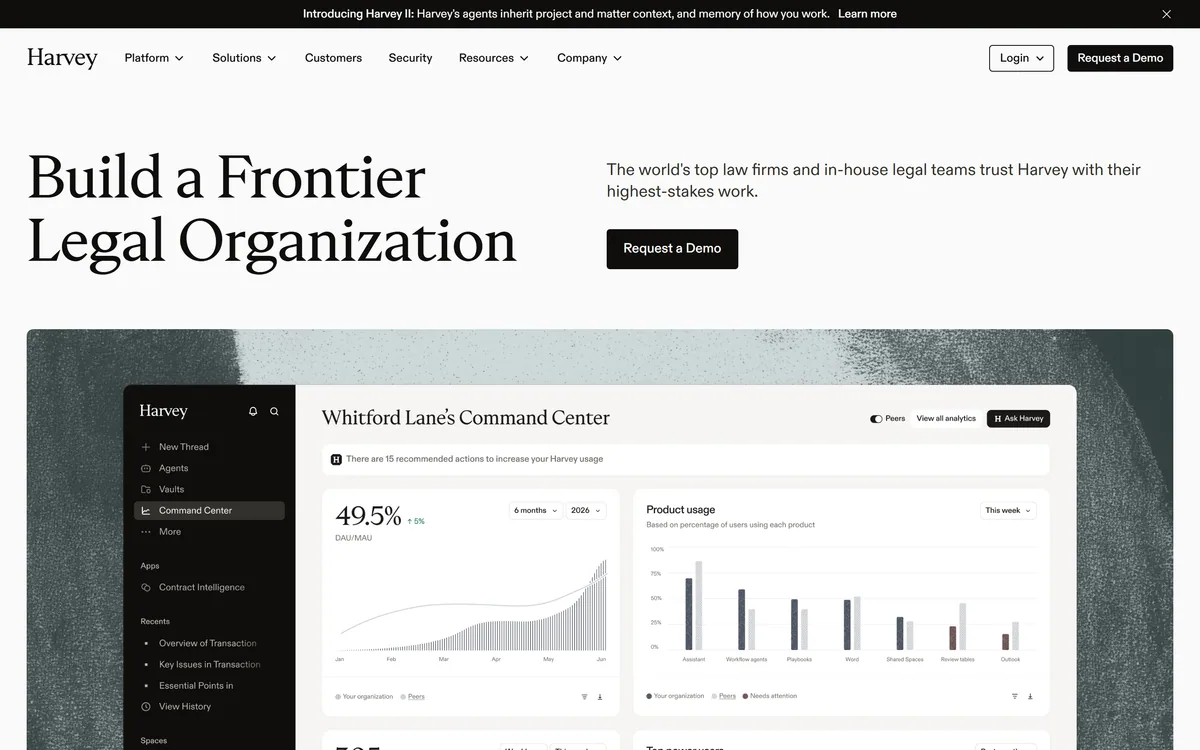
Harvey is an AI platform for legal and professional services — agents, a Vault for documents, Knowledge, Spaces, and Contract Intelligence — used by firms including A&O Shearman, Latham & Watkins, and Norton Rose Fulbright.
4.5Editor Score
Harvey AIharvey.ai23,007 viewsAdded October 30, 2025150K visitors
Harvey is AI for legal work, and the distinction that matters is not the model but everything wrapped around it. Any assistant can summarise a contract; almost none can do it inside a system a magic circle firm's risk committee has approved.
The product covers agents that carry out legal tasks, a Vault for documents, a Knowledge layer, Spaces for collaborative matters, and Contract Intelligence for the review work that dominates transactional practice.
This review covers what the platform does, why its compliance posture is the actual selling point, who is using it, and the limits that no amount of certification removes.
Harvey AI: What You Need To Know
- What it is: an AI platform built specifically for legal and professional services work, not a general assistant with a legal prompt.
- Why firms buy it: the compliance stack. SOC 2 Type II, ISO 27001, ISO 27701, and ISO 42001, with SAML SSO, audit logs, and IP allow-listing.
- Core pieces: Agents, Vault for documents, Knowledge, Spaces, Contract Intelligence, Command Center, and a mobile app.
- Adoption is real: Harvey cites 2,400+ organisations including A&O Shearman, Latham & Watkins, Norton Rose Fulbright, Bayer, and Deutsche Telekom.
- Not for individuals. There is no self-serve trial path advertised — this is an institutional purchase with an implementation behind it.
Is Harvey The Right Legal AI For You?
A Good Match When
- You are a firm or in-house team with a formal security review process
- Document review and due diligence consume significant hours
- Firm precedent exists but nobody can reliably find it
- ISO 42001 or comparable AI governance is being asked for
- There is budget and appetite for an implementation, not just a subscription
The Wrong Tool When
- You are a solo practitioner or a very small practice
- You want to try something today without a procurement process
- Your billing model cannot absorb faster document review
- Your jurisdiction is outside where the platform is strongest
- You expect output that does not need lawyer verification
Harvey AI Platform Profile
| Company | Harvey AI Corporation |
|---|---|
| Category | AI platform for legal and professional services |
| Core products | Agents, Vault, Knowledge, Spaces, Contract Intelligence, Command Center, Memory |
| Mobile | Harvey Mobile |
| Built for | Law firms, in-house legal teams, professional services organisations |
| Stated adoption | 2,400+ organisations |
| Named users | A&O Shearman, Latham & Watkins, Norton Rose Fulbright, Reed Smith, Ashurst, Cuatrecasas, O'Melveny |
| Corporate users | Deutsche Telekom, Bayer, KKR, Booking.com, Procter & Gamble, Bridgewater, Repsol |
| Certifications | SOC 2 Type II, ISO 27001, ISO 27701, ISO 42001, GDPR, CCPA |
| Access controls | SAML SSO, audit logs, IP allow-listing, data lifecycle management |
Confidentiality Is The Product
Legal work has a constraint most software categories do not: the material is privileged. A tool that leaks a draft, retains a document it should not, or cannot prove who accessed what is not a bad tool — it is a professional liability.
Harvey's certification list is unusually long for an AI vendor, and the composition is telling. ISO 42001 is the AI management standard specifically, which is still uncommon and directly answers the question a risk committee now asks.
Alongside it sit SOC 2 Type II, ISO 27001, ISO 27701 for privacy, GDPR and CCPA, with SAML SSO, audit logs, IP allow-listing, and data lifecycle management.
For most software, security is a checkbox on the way to a purchase. In legal AI, it is the purchase.
The Pieces And What They Do
Harvey is assembled from components that map onto how legal work is actually organised — by matter, by document set, by precedent.
- Agents — carry out multi-step legal tasks rather than answering one question
- Vault — the document repository the agents reason over
- Knowledge — the firm's own precedent and institutional material
- Spaces — collaborative areas, closest to how a matter is run
- Contract Intelligence — review and analysis across contract sets
- Command Center — oversight of what is running and who is using it
- Memory — context carried across sessions rather than re-established
- Harvey Mobile — access away from the desk
Where It Earns Its Keep
The work Harvey targets is high-volume, high-cost, and structurally repetitive — exactly the combination that makes legal services expensive.
Document Review At Scale
Due diligence and contract review are the clearest cases. Reading two thousand contracts for a specific clause is work that consumes junior time and produces no insight in the reading itself.
Contract Intelligence is aimed squarely at that, and it is where firms typically see a measurable change first.
Institutional Knowledge
The Knowledge layer addresses a problem every firm has: precedent exists but nobody can find it. Work gets redone because locating the previous version costs more than rewriting.
An AI that can reason across a firm's own history is doing something no general assistant can, because the material is not public.
In-House Legal Teams
For corporate legal departments the calculation differs — the goal is handling more internally rather than billing less. Named corporate users include Deutsche Telekom, Bayer, KKR, and Procter & Gamble.
That group is often the faster adopter, because there is no billable-hour tension to resolve first.
How A Firm Should Approach It
Legal AI rollouts fail on process far more often than on technology, and the sequence below reflects where firms typically get stuck.
- Get risk and compliance involved before the demo, not after — they will decide this regardless.
- Pick one practice area and one task type, ideally contract review, where the output is checkable against a known answer.
- Run Harvey alongside the existing process on real matters and compare, rather than testing on synthetic examples.
- Establish the verification rule explicitly: who checks the output, and what happens before anything reaches a client.
- Load the Knowledge layer with genuine precedent — thin institutional context produces generic legal answers.
- Only then widen to other practice areas, and revisit the billing model, because the economics change.
The Adoption Signal
Harvey states more than 2,400 organisations, and the named list is unusually specific for a vendor page: A&O Shearman, Latham & Watkins, Norton Rose Fulbright, Reed Smith, Ashurst, Cuatrecasas, and O'Melveny among the firms.
That matters as evidence rather than as marketing. Firms of that size do not deploy tools into privileged work without a security review, and each named deployment is effectively a passed audit.
It is still a vendor claim, and we report it as one — but it is the kind that would be conspicuous if wrong.
The Caveats No Certification Fixes
Verification remains a human obligation. AI output in legal work must be checked, and the profession has already produced cautionary cases of filings containing fabricated citations. Harvey does not remove that duty; it changes what you are checking.
The economics are genuinely awkward for firms billing by the hour. A tool that makes document review dramatically faster reduces billable time, and resolving that tension is a business model question rather than a software one.
There is no advertised self-serve trial. Harvey is an institutional purchase with implementation and training behind it, which puts it out of reach of solo practitioners and very small firms.
And jurisdiction matters. Legal reasoning does not generalise across systems the way general knowledge does, so coverage quality varies by where you practise.
Key features of Harvey AI
Agents that carry out multi-step legal tasks
Vault document repository the agents reason across
Knowledge layer holding firm precedent and institutional material
Spaces for collaborative work organised by matter
Contract Intelligence for review and analysis at scale
Command Center for oversight of usage and activity
Memory carrying context between sessions, plus Harvey Mobile
SAML SSO, audit logs, IP allow-listing, and data lifecycle management
Pros & cons
Pros
5- Compliance stack is genuinely exceptional, including ISO 42001 for AI governance
- Built for legal work specifically rather than adapted to it
- Reasons over firm precedent that no general assistant can access
- Adoption by major firms functions as evidence of passed security reviews
- Contract Intelligence targets the highest-volume, lowest-insight legal work
Cons
5- Institutional purchase with no self-serve route for small practices
- Output still requires lawyer verification — the professional duty does not move
- Faster review conflicts directly with hourly billing economics
- Coverage quality varies by jurisdiction, since legal reasoning does not generalise
- Adoption figures and customer names are vendor claims, not audited
Best For
- Law firms running high-volume due diligence and contract review
- In-house legal teams trying to handle more work without external counsel
- Firms whose precedent is extensive but effectively unsearchable
- Organisations required to demonstrate AI governance to a risk committee
- Professional services groups with formal procurement and security processes
Harvey Against The Alternatives Firms Consider
The realistic shortlist for legal work looks quite different from a general AI comparison.
| Tool | Built for legal | Reads firm documents | Buying model |
|---|---|---|---|
| Harvey AI | Yes, exclusively | Yes — Vault and Knowledge | Institutional, with implementation |
| Claude | No — general assistant | Only what you supply per session | Self-serve or enterprise |
| Ironclad | Contract lifecycle focus | Yes, within contract workflow | Enterprise |
| Luminance | Yes, legal document analysis | Yes | Enterprise |
| Paxton AI | Yes, legal research focus | Partial | More accessible to smaller firms |
Adjacent Legal And Document Tools
These overlap with parts of what Harvey does.
- Luminance — legal document analysis with a long track record in review work
- Ironclad — contract lifecycle management rather than general legal work
- Paxton AI — legal research aimed at smaller firms and solo practitioners
- Claude — a general assistant that handles long documents well but carries no legal-specific controls
Sources Behind This Listing
Last checked . Read from Harvey's own site during this check, with the screenshot above captured at the same time.
- Product names — Agents, Vault, Knowledge, Spaces, Contract Intelligence, Command Center, Memory — as Harvey lists them
- The certification list (SOC 2 Type II, ISO 27001, ISO 27701, ISO 42001, GDPR, CCPA) taken from Harvey's stated compliance
- Named firms and the 2,400+ organisation figure reported as Harvey presents them, not independently confirmed
- No free trial is advertised on the site, so none is claimed here
- No plan prices published, in line with this site's pricing policy
The caution about verifying AI output in legal filings reflects known professional incidents across the industry, not any specific finding about Harvey.
Editor's Verdict
4.5/5Harvey AI has an AInexfinder Editor Score of 4.5/5.
Harvey AI pricing
AInexfinder does not list plan prices or billing details. For current pricing, plans, and trials, visit the official Harvey AI website.
Visit official website for pricingVendor pricing, credits, and billing policies change over time. Always confirm on the official site before you buy.
Frequently asked questions
What makes Harvey different from using a general AI assistant for legal work?
The controls and the context. Harvey holds firm documents and precedent in Vault and Knowledge, and carries SOC 2 Type II, ISO 27001, ISO 27701, and ISO 42001 certifications with SSO, audit logs, and IP allow-listing — the things a risk committee asks about before privileged material goes anywhere.
Which firms use Harvey?
Harvey names A&O Shearman, Latham & Watkins, Norton Rose Fulbright, Reed Smith, Ashurst, Cuatrecasas, and O'Melveny, alongside corporate users including Deutsche Telekom, Bayer, KKR, and Procter & Gamble, and cites 2,400+ organisations overall.
Can I try Harvey as an individual lawyer?
Not really. No self-serve trial is advertised — Harvey is sold as an institutional platform with implementation behind it, which puts it out of reach of solo practitioners and very small firms.
Does Harvey's output still need checking by a lawyer?
Yes, always. AI output in legal work must be verified, and the profession has already seen filings containing fabricated citations. Harvey changes what you are checking, not whether you check.
What is Contract Intelligence used for?
Review and analysis across contract sets — the due diligence work of reading large volumes of contracts for specific clauses. It is high-volume, structurally repetitive, and where firms typically see the first measurable change.
Why does ISO 42001 matter for legal AI?
It is the AI management standard specifically, rather than general information security. Risk committees increasingly ask about AI governance as a separate question from infosec, and few vendors can answer it with a certification.
How does Harvey affect a firm's billing model?
Uncomfortably, if you bill hourly. A tool that makes document review dramatically faster reduces billable time, so the economics need resolving as a business question before rollout rather than after.
Reviews
Log in to write a review.
User Reviews
No reviews yet. Be the first to share your experience with Harvey AI.
Reviewed by Daniel Reed
Assigned reviewer
Daniel ReedSenior AI Tools Reviewer
Daniel reviews AI tools the slow way — by actually using them on real projects. His reviews cover what works, what breaks, and who each tool is genuinely a good fit for.
Hands-on reviewsProduct testingAI software
Daniel and the AInexfinder editorial team research Harvey AI using public product information, listing evidence, and (when available) hands-on checks. Scores reflect listing completeness and transparency — not paid placement.
- Last verified
- Methodology
- How we review AI tools
- Sources used
- harvey.ai
- AInexfinder listing fields (features, pros/cons, description)
- Public vendor pages when available
- Editorial policy
- Listings may include affiliate or sponsored placements, which are labeled when present. Editorial scores and cons are not sold. See our affiliate disclosure and review methodology.
Related tools
Solve Intelligence is an AI platform for patent work, covering application drafting, office action responses, invalidity and claim-mapping charts, freedom-to-operate reviews and portfolio analysis. It is used by over 700 in-house IP teams and law firms, with SOC 2 Type II and ISO 27001 certification and no training on customer data.
Ivo is AI contract review for in-house legal teams. It applies redlines directly in Microsoft Word or Google Docs, evaluates agreements against your playbooks and historical contracts, benchmarks clauses by governing law and industry, and queries executed contracts in plain language.
Spellbook reviews and drafts contracts inside Word and Google Docs, redlining against a firm's own playbooks, comparing terms to thousands of similar agreements, and indexing signed contracts for search — used by a stated 5,000-plus legal teams in 80-plus countries.
LegalOn is a contract lifecycle platform from LegalOn Technologies, Inc. covering intake, review, redlining, storage and analysis, built on more than 135 attorney-authored playbooks across industries and countries, with a Microsoft Word integration and agentic workflows.
Paxton AI is a legal assistant covering research, drafting and document analysis, with medical chronology and billing summary tools for personal injury work. It serves personal injury, family, employment, defence and corporate practices, and states SOC 2, ISO and HIPAA compliance.
Explore More
Embed this listing on your site
Featured on AInexfinder