Blue J answers tax research questions in seconds and returns verifiable sources with every answer, drawing on primary authoritative content plus Tax Notes and IBFD. It covers the United States, Canada and the United Kingdom, and is used by more than 6,000 firms from sole practitioners upward.
bluej.com8 viewsAdded September 26, 20258K visitors
Tax research has a quality that makes it unusually suited to AI and unusually dangerous for it. The questions are precise, the answers exist in a defined body of authority, and there is a right answer — which is exactly the shape of problem a language model handles well.
The danger is that a wrong answer looks identical to a right one — the same reason Harvey AI built its legal product around citations. A confidently stated tax position with no citation behind it is worse than no answer at all, because it invites reliance. And the consequences do not land on the software: they land on the professional who signed the return and on the client who paid the penalty.
Blue J's central design decision addresses this directly. Every answer comes with the authority cited, so the professional can go and read it. That is a smaller promise than answering the question, and a far more useful one.
What Does Blue J Answer?
Tax research questions, with the authority cited — the product promise is defensible answers complete with verifiable sources, not just fast ones.
It reasons over licensed professional material: primary authoritative content plus Tax Notes and IBFD, rather than whatever a general model absorbed from the web.
Three jurisdictions: the United States, Canada and the United Kingdom, each with its own regional site.
Used by more than 6,000 firms, from sole practitioners through to national accounting practices.
Four stated use cases — advisory, compliance, tax writing and training — with a 7-day free trial and no card required.
Why Citations Are The Whole Product
Blue J describes delivering defensible answers complete with verifiable sources. Read that as the specification rather than as marketing, because it is what separates a usable professional tool from an unusable one.
A tax professional cannot act on an assertion. They need to know which statute, which regulation, which ruling or which case says so, both because their judgement depends on reading it and because their file needs to show why the position was taken if it is ever questioned.
An AI answer without citations fails that test completely. It might be correct, and there is no way to establish that short of doing the research yourself — at which point the tool has saved nothing.
An AI answer with citations changes the task from research to verification. You are handed a proposed answer and the authority behind it, and your job is to check that the authority says what the answer claims. That is genuinely faster than starting from a blank search box, and it keeps the professional judgement where it belongs.
The failure mode to guard against is subtle. A citation makes an answer feel checked even when you have not checked it, and fluent prose with a section number attached is more persuasive than either alone. Following the citation is the discipline the entire product depends on, and it is the step under time pressure that is easiest to skip.
An uncited AI answer saves nothing, because verifying it means doing the research anyway. A cited one changes the job from research to verification.
Licensed Sources Beat A General Model
Blue J states its answers are powered by primary authoritative content, Tax Notes and IBFD. That sourcing decision matters more than any model choice.
Narrower tools such as TaxGPT compete here too, and general-purpose assistants have absorbed a great deal of tax material, but with three problems a practitioner cannot work around. It is of unknown vintage, which is fatal in a field where a rate or a threshold changed last April. It is of unknown provenance, so a confident answer may be reasoning from a blog post. And it cannot be cited, because the model does not know where it learned something.
Licensing Tax Notes and IBFD means the system is reasoning over material a firm would already subscribe to and already trust — commercial analysis alongside the primary sources, with the currency that comes from a maintained publication.
IBFD's presence signals the international dimension specifically, which is what makes cross-border questions tractable rather than guesswork.
The practical implication for a buyer is to ask about currency rather than coverage. How quickly does new legislation, a new ruling or a budget change appear? In tax, an answer that was right last quarter is simply wrong, and update cadence is the specification that matters most.
How Much Time Does It Actually Save?
The site publishes two figures: three hours saved per user every week, and 75 per cent less time spent on research.
These are plausible in shape and unverifiable in detail, and it is worth being precise about why. Neither carries a stated methodology, sample or baseline. Saved against what — a junior researcher starting cold, or a specialist who already knows where to look? Measured over which mix of questions?
The mechanism, though, is entirely credible. Most tax research time is not spent reasoning; it is spent locating the relevant authority among a great deal of nearly-relevant authority. A tool that puts you within reading distance of the right section removes exactly that, and it is the largest single block of time in the task.
The saving will also be unevenly distributed in a way the averages hide. Routine questions with settled answers should improve dramatically, much as Elicit accelerates literature review without replacing the reading. Genuinely novel or contested positions will improve much less, because the work there is judgement rather than retrieval — and that is the work you would least want automated anyway.
The honest way to evaluate this is to use the free trial on questions you have already researched, where you know both the answer and how long it took you. That comparison is worth more than any published percentage.
Test on questions you have already answered, so you can grade both accuracy and speed.
Include one question where the answer is genuinely contested, not only settled ones.
Follow every citation on at least the first ten answers, without exception.
Check a question involving a recent change, to test how current the sources are.
Ask a cross-border question if you handle any, since that is where IBFD should show its value.
Does It Change Who Is Responsible?
No, and this deserves stating plainly rather than as a footnote, because the temptation runs the other way.
Professional responsibility for advice sits with the professional. No software licence transfers it, and no vendor claim about accuracy changes what a regulator, a client or a court expects from the person who signed the work. Using a research tool is like using a treatise: it informs your judgement, it does not replace it.
The practical consequences are concrete. Read the authority the tool cites before relying on it. Record in the file what you relied on and why, as you would with any source. Apply the same review process you would to work produced by a junior — not less, because AI output is fluent, and fluency is not accuracy.
There is a second consideration specific to this technology. Client information entered into a research tool is confidential, and where it goes matters. Blue J publishes a security page and a subscriber agreement; a firm should read both, and should ask specifically whether queries are used to develop the product and where data is held.
None of this argues against the tool. It argues for using it the way the profession already uses every other authority: as an input to judgement that gets checked.
Testing Blue J On Work You Already Did
A 7-day trial with no card required is enough to answer the question properly, provided you test against known outcomes rather than exploring.
The bar is step four. A citation that does not support the answer it was attached to is the one failure that disqualifies a research tool outright.
Choose five research questions you completed in the last year, where you have both the conclusion and a rough sense of the hours.
Run each through Ask Blue J without looking at your own notes first, so you are testing it rather than confirming yourself.
Compare its conclusion with yours. Where they differ, work out which is right — that investigation is the most informative part of the exercise.
Open every cited source and confirm it actually supports the proposition it is cited for. This is the check that matters most.
Include one question touching a rule that changed in the last twelve months, to test source currency directly.
Time one fresh question end to end, including your verification, and compare that with your normal process. That number is your real saving.
Subscribing To Blue J
Access is a subscription with a 7-day free trial and no credit card required, sold to practices ranging from sole practitioners to national firms.
Serving that range usually means tiering by seats and by which content is included, and the second is the variable to examine. Because the value here depends on licensed material — Tax Notes, IBFD, primary sources across three jurisdictions — the question is not what the tool costs but which content your tier actually reaches.
For a firm already subscribing to those publications separately, the calculation is different again and worth doing properly: some of the cost may be replacing spend you already carry rather than adding to it.
The other question to settle is jurisdiction. Coverage spans the US, Canada and the UK, and a firm working across two of those should confirm that both are included rather than assuming.
We do not publish amounts, since terms change and are quoted per firm. Use the trial first — with 6,000 firms as customers, the reference calls are available if you ask for them.
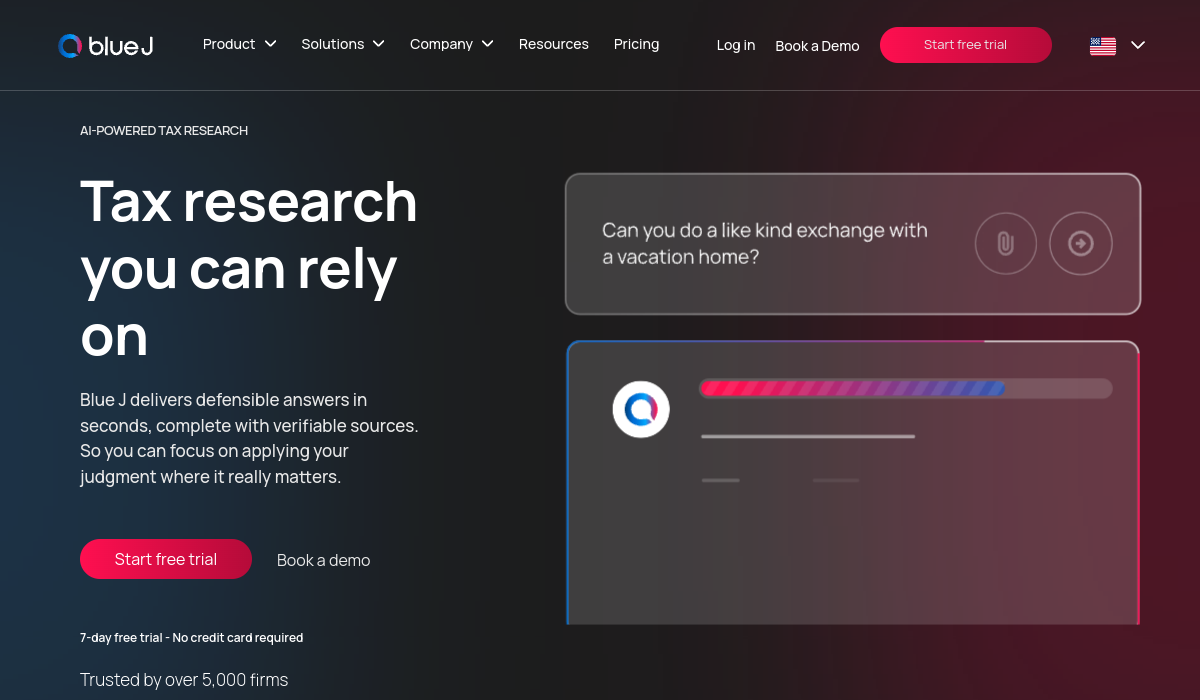
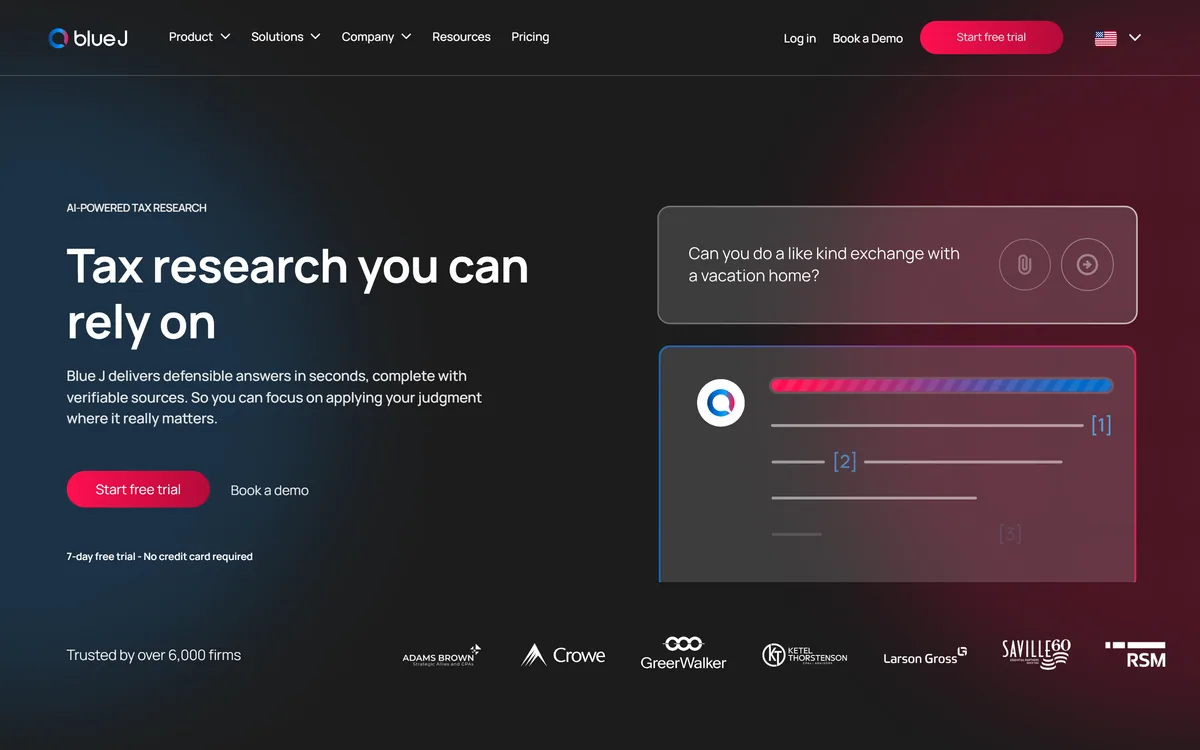
Blue J's homepage, captured 9 September 2026. Defensibility and cited sources lead the pitch rather than speed, which is the right emphasis for this audience.
Blue J: Sources And Coverage
Product type
AI tax research with cited authority
Core product
Ask Blue J
Content sources
Primary authoritative content, Tax Notes, IBFD
Jurisdictions
United States, Canada, United Kingdom
Use cases stated
Advisory, compliance, tax writing, training
Users
Sole practitioners, local, regional and national accounting and tax firms, CPAs, enrolled agents
Stated adoption
Over 6,000 firms
Stated time saving
3 hours per user per week; 75% less time on research
You do genuine tax research and the time goes into locating authority rather than reasoning about it.
You need every answer to arrive with a citation you can put in the file and defend later.
You already rely on Tax Notes or IBFD, so the tool is reasoning over material you trust.
You work across the US, Canada or the UK and want one tool covering the jurisdictions you practise in.
You are training junior staff, where seeing the authority alongside the answer is the teaching.
Not the right tool when
You practise outside the three covered jurisdictions, where the source material simply does not apply.
Your bottleneck is producing returns rather than researching positions — that is a different category of product.
You would rely on an answer without opening the citation, which is the one usage that makes this dangerous.
Your questions are almost entirely settled and routine, where a good internal precedent file may already serve.
You need a definitive answer on a genuinely contested position, where the work is judgement and no tool substitutes for it.
Key features of Blue J
Ask Blue J, returning tax research answers with verifiable citations
Answers grounded in primary authoritative content plus Tax Notes and IBFD
Coverage across United States, Canadian and United Kingdom tax law
Source verification built into every answer rather than offered separately
Advisory and compliance research workflows
Support for tax writing, where cited authority is the raw material
Training use, letting junior staff see the authority alongside the answer
7-day free trial requiring no payment details
Pros & cons
Pros
6
Every answer arrives with the authority cited, which is what makes AI usable in regulated advice at all
Licensed professional sources rather than general web material, so provenance and currency are managed
IBFD inclusion makes cross-border questions tractable rather than guesswork
Three jurisdictions in one tool, covering the main English-language tax markets
More than 6,000 firms as customers, which means reference calls are genuinely available
A no-card trial lets you test against research you have already completed
Cons
6
Time-saving figures carry no stated methodology, sample or baseline
No accuracy or citation-precision figure is published anywhere we could read
Source update cadence is not stated, and in tax an answer that was right last quarter is simply wrong
A fluent cited answer is more persuasive than an uncited one, which makes skipping verification easier
Only three jurisdictions, so practices outside them get no benefit
Content coverage may vary by tier, and licensed material is where the value sits
Best For
Tax professionals whose research time goes into locating authority
Firms that need citations in the file to defend a position later
Practices already subscribing to Tax Notes or IBFD
Cross-border work spanning the US, Canada and the UK
Training junior staff by showing the authority alongside the answer
Blue J Among Professional AI Research Tools
Professional research tools are judged on their sources and their citations, not on their model. A tool that cannot show its authority cannot be used for regulated advice.
Tool
Domain
Sources
Cites authority?
Blue J
Tax research and analysis
Primary authority plus Tax Notes and IBFD, across three jurisdictions
Last checked . Read from bluej.com, including the footer, with the screenshot above captured in the same session.
Product described as delivering defensible tax answers in seconds, complete with verifiable sources
Ask Blue J confirmed as the core research product
Content sources stated on the site as primary authoritative content, Tax Notes and IBFD
Jurisdictional coverage confirmed across the United States, Canada and the United Kingdom via regional site options
Stated time savings read from the site: 3 hours saved per user per week and 75% less time spent on research
Target users listed as sole practitioners, local, regional and national firms, CPAs and enrolled agents
Use cases confirmed as advisory, compliance, tax writing and training
Adoption stated on the site as over 6,000 firms
Legal entity given as Blue J Legal Inc., with offices in New York and Toronto
Trial confirmed as 7 days with no credit card required
Footer read directly and confirmed to carry Privacy Policy, Terms of Use, Cookie Notice, Subscriber Agreement, contact and careers links, alongside a security page
What we could not confirm: the time-saving figures carry no stated methodology, sample or baseline; no accuracy or citation-precision figure is published; the specific security claims on the security page were not readable in what we retrieved, so request them directly; how quickly new legislation and rulings reach the system is not stated, which is the specification that matters most in tax; and we did not use the product, so nothing here reflects tested answer quality.
Other Professional Research And Tax Tools
Different jobs inside a tax or professional practice — research, preparation and analysis are not interchangeable.
TaxGPT — the closest comparison for tax questions; compare citation depth directly
Black Ore — return preparation rather than research, for firms whose bottleneck is production
Harvey AI — the equivalent for legal work in large firms
Elicit — citation-first research in academic literature, a useful comparison on method
Solve Intelligence — another regulated professional workflow where the practitioner stays accountable
Editor's Verdict
4.4/5
Blue J scores highly because it got the one thing right that decides whether AI belongs in tax research at all: every answer arrives with the authority cited, so a professional can verify it rather than trust it. Licensing Tax Notes and IBFD alongside primary sources means it is reasoning over material a firm would already rely on, not over whatever was scraped from the web. More than 6,000 firms and coverage across three jurisdictions back that up. It loses ground because the time-saving figures carry no stated methodology, and because a fluent cited answer is more persuasive than an uncited one — which makes the professional obligation to actually read the authority easier to skip. AInexfinder Editor Score: 4.4/5.
Blue J pricing
AInexfinder does not list plan prices or billing details. For current pricing, plans, and trials, visit the official Blue J website.
Vendor pricing, credits, and billing policies change over time. Always confirm on the official site before you buy.
Frequently asked questions
What is Blue J?
Blue J is an AI tax research platform that answers questions in seconds and returns verifiable sources with every answer. It reasons over primary authoritative content plus the Tax Notes and IBFD databases, covers the United States, Canada and the United Kingdom, and states more than 6,000 firms as customers.
Does Blue J cite its sources?
Yes, and that is the core of the product rather than a feature. Every answer arrives with the authority cited, which changes the professional's task from research to verification. An uncited AI answer saves a tax professional nothing, because establishing whether it is right means doing the research anyway.
Which jurisdictions does Blue J cover?
The United States, Canada and the United Kingdom, each with its own regional site. If you practise across two of them, confirm both are included in your subscription rather than assuming — and if you practise outside all three, the underlying source material simply does not apply to your work.
Is Blue J free?
There is a 7-day free trial with no credit card required, after which it is a subscription. Amounts are not published. Because the value depends on licensed content — Tax Notes, IBFD, primary sources — the question to ask is not the price but which content and which jurisdictions your tier actually includes.
How accurate is Blue J?
No accuracy figure is published, and the design deliberately shifts that question. Because every answer carries its authority, you verify rather than trust: open the cited source and confirm it supports the proposition. Test this properly during the trial by running five questions you have already researched and checking every citation.
Does using Blue J reduce my professional responsibility?
No. Responsibility for advice sits with the professional, and no software licence transfers it. Treat it as you would a treatise: read the authority it cites before relying on it, record in the file what you relied on and why, and apply the same review you would to a junior's work — more carefully, if anything, because fluent output is persuasive.
How current are Blue J's tax sources?
Update cadence is not stated on the site, and it is the specification that matters most in tax, where a rate or threshold changing in April makes last quarter's correct answer wrong. Ask directly how quickly new legislation, rulings and budget changes reach the system, and test it during the trial with a question touching a recent change.
How is Blue J different from ChatGPT for tax questions?
Three ways that matter. Blue J reasons over licensed professional material rather than whatever a general model absorbed; that material is maintained, so currency is managed; and it cites authority, which a general model cannot reliably do because it does not know where it learned something. For regulated advice, the citation is the difference between usable and unusable.
Can Blue J replace a tax specialist?
No, and the gap is exactly where you would expect. Routine questions with settled answers should improve dramatically, because the work there is retrieval. Genuinely novel or contested positions improve far less, because the work there is judgement — and that is the work you would least want automated in the first place.
Is client information safe in Blue J?
Blue J publishes a security page, a privacy policy and a subscriber agreement, and those are the documents that bind. We could not read the specific security claims in what we retrieved, so request them directly — along with written answers on whether queries are used to develop the product, where data is held, and what the retention terms are.
Daniel reviews AI tools the slow way — by actually using them on real projects. His reviews cover what works, what breaks, and who each tool is genuinely a good fit for.
Daniel and the AInexfinder editorial team research Blue J using public product information, listing evidence, and (when available) hands-on checks. Scores reflect listing completeness and transparency — not paid placement.
Listings may include affiliate or sponsored placements, which are labeled when present. Editorial scores and cons are not sold. See our affiliate disclosure and review methodology.
Instead is an AI agent platform for tax work spanning research across 1,500+ authoritative sources, document extraction from K-1s, W-2s and 1099s, multi-entity planning, and e-filing with the IRS, 48 states and cities across all five entity types. The platform is free, with agent work charged per credit.
Puzzle is AI accounting software that automates categorisation, reconciliation and journal entries while keeping accountant oversight. It covers AI Close, accrual automation, invoicing and revenue recognition, and connects to Stripe, Brex, Ramp, Mercury, Gusto, Deel and Rippling.
Black Ore's Tax Autopilot runs the administrative, preparation, review and audit stages of a US tax return, plugging into the tax software firms already use. It is sold to large CPA firms, backed by a notable investor group, and currently focused on individual returns with entity forms following.