Tamarind Bio is a cloud platform that puts the state of the art in computational biology, AlphaFold, RFdiffusion, ProteinMPNN, GROMACS and over a hundred more tools, behind one web interface and API, so scientists can design antibodies, peptides, enzymes and small molecules without deploying anything.
Taranis
Verified
Taranis provides AI crop intelligence from leaf-level aerial imagery, detecting stand counts, weeds, insect damage, nutrient deficiencies and disease pressure across whole fields. Its products include Taranis Yield Impact and Ag Assistant, with a mobile app and web dashboard.
4.0Editor Score
taranis.com8 viewsAdded February 2, 20264K visitors
Crop scouting has always been a sampling problem dressed up as an inspection. An agronomist walks a field, looks at a handful of plants, and extrapolates from them to several hundred acres.
That works remarkably well and fails in a specific way: the problem is wherever you did not walk. A weed escape, an insect pressure point or a nutrient deficiency in the corner of a field is invisible until it is large enough to see from the road, by which point it has cost you.
Taranis replaces the sample with something closer to a census — imagery at leaf level across every acre — which is a different activity rather than a faster version of the same one.
Taranis: Products And Reach
| Product type | AI crop intelligence from aerial imagery |
|---|---|
| Imagery | Submillimetre resolution across every acre, described as clear enough to count the spots on a ladybird |
| Detection | Stand counts, weed detection, insect damage, nutrient deficiencies, disease pressure, field health |
| Taranis Yield Impact | Converts leaf-level insights into bushels |
| Ag Assistant | Described as the agriculture industry's first generative AI-powered agronomy engine |
| Taranis Connect | Mobile app for iOS and Android |
| Interface | Web app and dashboard |
| Audience | Advisors and growers |
| Offices | United States and Israel |
| Site languages | Portuguese and English |
| Footer sections | Solutions, How it Works, Success, Resources, About Us, Connect, Contact, legal and privacy links |
What Does Submillimetre Crop Imagery Show You?
Taranis describes submillimetre image resolution of every acre, with imagery clear enough to count the spots on a ladybird, used to detect stand counts, weeds, insect damage, nutrient deficiencies, disease pressure and general field health.
The resolution claim is what makes the detection list possible, and the connection is worth spelling out. Satellite imagery shows you that an area of a field is stressed; it cannot tell you why, because the pixel is larger than the symptom.
At leaf level the symptom itself is visible. Insect damage has a characteristic appearance, nutrient deficiencies show as specific patterns of discolouration, and a weed is identifiable as a species rather than as an anomaly. That is the difference between knowing something is wrong and knowing what is wrong.
Stand counts are the least glamorous item on the list and possibly the most valuable. Knowing how many plants actually emerged, precisely, across an entire field, informs every subsequent decision — and counting by hand is a sampling exercise with all the same limitations as scouting.
The honest boundary is that detection is not diagnosis. An image showing damage tells you damage exists and what it looks like; deciding what caused it, whether it is spreading, and whether the economics justify treating it remains an agronomist's judgement, informed by things no camera records.
The greenhouse version of the same ambition works from sensors instead. Source.ag can measure a contained crop directly, which is why it forecasts where this one observes.
Satellite imagery tells you an area is stressed. Leaf-level imagery tells you why, because the pixel is finally smaller than the symptom.
Yield Impact Ties Images To Bushels
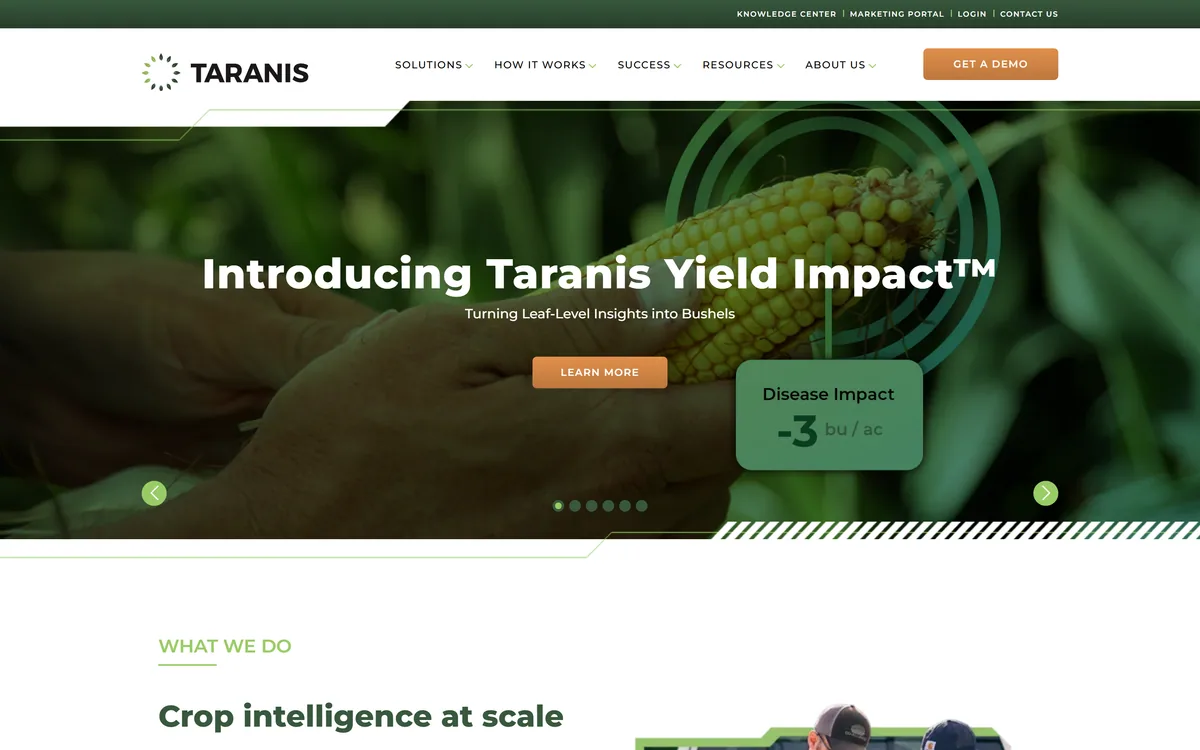
Taranis Yield Impact converts leaf-level insights into bushels, and this is the most commercially intelligent thing in the product.
The reason is that detection alone does not drive action. An agronomist told there is insect pressure in a section of a field still has to decide whether it is worth treating, and that decision is economic rather than biological: what does the damage cost, and what does the treatment cost.
Expressing findings in bushels answers the first half in the unit the industry actually uses. A grower who knows a problem is costing a specific yield across specific acres can weigh that against an input cost immediately, without an intermediate translation step.
It also changes the sales conversation for the platform itself. Software justified by capability has to be believed; software expressed in bushels can be checked against the season, which is a far stronger position.
The caveat is that a yield impact figure is a model output, and its accuracy is unpublished. It is an estimate built on assumptions about how a given problem affects a given crop under given conditions — useful for prioritising between problems, and not a number to treat as measured.
Ag Assistant And The Agronomy Question
Taranis describes Ag Assistant as the agriculture industry's first generative AI-powered agronomy engine, which is a substantial claim and worth reading carefully.
What a generative layer plausibly adds is interpretation. The platform generates an enormous volume of detections across many fields, and turning that into a prioritised set of recommendations — this field first, this problem matters, this one does not — is exactly the summarising and reasoning task these models handle well.
It also addresses a real bottleneck. Agronomic expertise is scarce, advisors are stretched across more acres than they can properly consider, and a tool that drafts the analysis leaves the human to check and decide rather than to compile.
The claim of being first is unverifiable and largely beside the point. What matters is whether the recommendations are good, and that depends on whether the model has agronomic knowledge grounded in something or is producing plausible-sounding advice from general text.
The question to put to the vendor is therefore simple and specific: what is Ag Assistant grounded in? Trial data, extension research, agronomist review — any of those would make the output defensible. Without an answer, a recommendation about a crop worth six figures is a recommendation you should verify yourself.
This is the pattern behind every image-recognition product that has to be trusted commercially — Restb.ai faces the identical question about property photographs, and the answer is always what the model was grounded in.
- Confirm your crops and region are covered before anything else, since the site does not state them.
- Treat a Yield Impact figure as a prioritisation tool, not a measured loss.
- Ask what Ag Assistant's recommendations are grounded in.
- Verify a sample of detections on the ground before trusting the whole set.
- Judge the platform on problems found early, not on total detections.
Running A Season With Leaf-Level Scouting
The value of aerial scouting is early detection, which means the evaluation has to run across a season rather than a demonstration.
Ground-truthing in the first weeks is what tells you whether to trust anything later.
- Confirm coverage for your crops and your region before signing anything, since neither is stated publicly.
- In the first flight, walk to five detections yourself and confirm what the imagery said is actually there.
- Walk to two areas the system reported as healthy, since false negatives matter as much as false positives.
- Compare Yield Impact figures against what you would have estimated, and note where they diverge.
- Track how early a problem was flagged versus when you would have found it — that gap is the product's actual value.
- At season end, compare treated and untreated areas where you acted on a detection, which is the only real measurement.
Who Buys Crop Intelligence, And Why
Taranis positions itself for advisors and growers, and those are meaningfully different customers with different reasons to buy.
For a grower the case is direct: find problems earlier, treat them more precisely, lose less yield. The value is measured against their own fields and their own season, and it is easy to assess after the fact.
For an advisor the case is leverage. An agronomist covering a large territory cannot physically walk every field often enough, and aerial coverage lets them prioritise where to be — which turns their scarce time into a resource allocated on evidence rather than on a rota.
The advisor market is also why the platform matters commercially. One advisor brings many growers, which is a far more efficient distribution model than selling farm by farm, and it explains the emphasis on dashboards and reporting alongside detection.
The gap in what is published is coverage, and it is a significant one. The pages we read name no crops and no regions, which are the first two questions any grower asks. The offices listed in the US and Israel suggest where the company operates rather than where the models are trained, and those are not the same thing.
The business side of a farm sits outside all of it. A ledger platform such as Puzzle handles the accounting that a saved crop eventually shows up in.
Taranis: Leaf-Level, Not Field-Level
- Submillimetre image resolution of every acre — the site's claim is imagery clear enough to count the spots on a ladybird.
- Detection across five problem classes: stand counts, weeds, insect damage, nutrient deficiencies and disease pressure.
- Taranis Yield Impact converts those findings into bushels, which is the number that decides whether anyone acts.
- Ag Assistant is described as the industry's first generative AI agronomy engine.
- Built for advisors as well as growers, with a web dashboard and the Taranis Connect mobile app for iOS and Android.
Key features of Taranis
Submillimetre aerial imagery across whole fields
Detection of stand counts, weeds, insect damage, nutrient deficiencies and disease
Taranis Yield Impact expressing findings in bushels
Ag Assistant, a generative agronomy engine
Taranis Connect mobile app for iOS and Android
A web dashboard for advisors covering multiple growers
A Portuguese-language site alongside English
Pros & cons
Pros
6- Replaces sampling with something closer to a census across every acre
- Resolution is high enough to identify the symptom rather than the stress
- Stand counts across a whole field inform every subsequent decision
- Yield Impact expresses findings in the unit the industry actually decides on
- Serves advisors as well as growers, which is the efficient distribution model
- Mobile app means findings reach someone standing in the field
Cons
6- No crops are named on the pages we read, which is the first question a grower asks
- No regions or geographic coverage are stated either
- Detection is not diagnosis — cause, spread and economics remain human judgement
- Yield Impact is a model estimate with no published accuracy
- What Ag Assistant's recommendations are grounded in is not disclosed
- Pricing, capture frequency and integrations are all unpublished
Best For
- Growers farming more acres than they can scout on foot
- Agronomic advisors prioritising a large territory
- Operations that have lost yield to a problem found too late
- Anyone needing accurate stand counts across a whole field
- Advisors who need reporting across many growers in one dashboard
Taranis Against Other Crop Platforms
Agricultural AI divides by environment and by what it can actually see.
| Tool | Environment | Data source | Best for |
|---|---|---|---|
| Taranis | Open fields | Submillimetre aerial imagery | Finding problems in acres nobody can walk |
| Source.ag | High-tech greenhouses | Sensors and plant data | Forecasting and controlling a contained crop |
| Restb.ai | Property imagery | Photographs | The same image-recognition pattern, elsewhere |
| Puzzle | The farm business | Transactions | Accounting rather than agronomy |
| Kuse | Office workflows | Connected apps | The reporting around an operation |
Is Taranis Right For Your Acres?
Worth the flights when
- You farm more acres than anyone can realistically walk during the critical window.
- You have lost yield to a problem found too late at least once.
- You advise growers across a territory and need to prioritise where to be.
- Your crops and region are covered, which is the first thing to confirm.
- You will act on findings rather than collect them.
Scout it yourself when
- Your operation is small enough to scout properly on foot.
- Your crops or region are not covered, which the site does not state either way.
- You grow in a controlled environment, where greenhouse software fits better.
- Nobody will ground-truth the detections in the first weeks.
- You need a measured yield figure rather than a model estimate.
Other Agriculture Technology
Indoor and outdoor growing need different data, and the business behind both needs something else again.
- Source.ag — the greenhouse equivalent, working from sensors rather than imagery
- Restb.ai — the same image-recognition pattern applied to property
- Puzzle — the accounting side of an agricultural business
- Kuse — scheduled reporting around a field operation
- Collov AI — another image-first product where resolution decides usefulness
Taranis: Reading The Claims Carefully
Last checked . Read from taranis.com and its footer navigation, with the screenshot above captured in the same session.
- Positioned as providing AI-powered crop intelligence through leaf-level imagery analysis for advisors and growers
- Imagery claim stated on the site as submillimetre resolution of every acre, described as clear enough to count the spots on a ladybird
- Detection capabilities confirmed for stand counts, weed detection, insect damage, nutrient deficiencies, disease pressure and field health
- Taranis Yield Impact confirmed as converting leaf-level insights into bushels
- Ag Assistant confirmed and described on the site as the agriculture industry's first generative AI-powered agronomy engine
- Taranis Connect confirmed as a mobile app for iOS and Android
- A dashboard and web app confirmed
- Offices confirmed in the United States and Israel
- Site language options confirmed as Portuguese and English
- Footer sections confirmed for Solutions, How it Works, Success, Resources, About Us, Connect, Contact, plus legal and privacy links and social profiles
What we could not confirm: which crops are supported, or which regions are served — neither is stated on the pages we read, and both are the first questions a grower would ask; the operating company's registered name; pricing or how flights are charged; how imagery is captured, and at what frequency; the accuracy of detections or of Yield Impact estimates; what Ag Assistant's recommendations are grounded in; and any third-party integrations. We did not use the platform, so nothing here reflects tested detection accuracy.
Editor's Verdict
4.0/5Taranis solves a sampling problem that nothing else addresses. An agronomist walking a field inspects a fraction of a percent of it and extrapolates, which works until the problem is somewhere they did not walk. Submillimetre imagery across every acre changes scouting from sampling to census, and that is a genuinely different activity. Yield Impact is the right product framing, because a detection nobody costs is a detection nobody acts on. It scores below the top because detection is not diagnosis, and because the site does not state which crops or regions are covered — the first question any grower would ask. AInexfinder Editor Score: 4.0/5.
Taranis pricing
AInexfinder does not list plan prices or billing details. For current pricing, plans, and trials, visit the official Taranis website.
Visit official website for pricingVendor pricing, credits, and billing policies change over time. Always confirm on the official site before you buy.
Frequently asked questions
What is Taranis?
Taranis provides AI crop intelligence from leaf-level aerial imagery, detecting stand counts, weeds, insect damage, nutrient deficiencies and disease pressure across whole fields. Its products include Taranis Yield Impact, which converts findings into bushels, and Ag Assistant, described as a generative AI agronomy engine.
Why does submillimetre resolution matter?
Because it changes what you can see. Satellite imagery shows that an area of a field is stressed and cannot tell you why, since the pixel is larger than the symptom. At leaf level the symptom itself is visible — insect damage has an appearance, deficiencies show specific patterns, and a weed is identifiable as a species.
How is this different from walking a field?
Walking a field is sampling: you inspect a fraction of a percent and extrapolate. That works well until the problem is somewhere you did not walk, which is precisely where problems are found too late. Imagery across every acre is closer to a census, which is a different activity rather than a faster one.
What is Taranis Yield Impact?
It converts leaf-level findings into bushels. That matters because detection alone does not drive action — the decision to treat is economic rather than biological. Expressing a problem in bushels lets a grower weigh it against an input cost immediately, in the unit the industry already thinks in.
Should I trust the yield impact numbers?
As a prioritisation tool rather than a measurement. A yield impact figure is a model output built on assumptions about how a given problem affects a given crop under given conditions, and no accuracy figure is published. It is useful for deciding which problem to address first, not for insurance arithmetic.
What does Ag Assistant do?
It is described as a generative AI agronomy engine, which plausibly means turning a large volume of detections into prioritised recommendations. That is a real bottleneck — agronomic expertise is scarce and advisors cover more acres than they can consider. The question worth asking is what its recommendations are grounded in.
Which crops does Taranis support?
The pages we read do not say, and neither do they state regional coverage. Those are the first two questions any grower would ask, and their absence is the most significant gap in what is published. Confirm both with the vendor before any evaluation, because nothing else matters if your crop is not covered.
Does detection replace an agronomist?
No. Detection tells you a problem exists and what it looks like; deciding what caused it, whether it is spreading, and whether the economics justify treating it remains judgement informed by things no camera records — field history, weather ahead, what happened in the same block last year.
How should I evaluate it across a season?
Ground-truth early. On the first flight, walk to five detections and confirm what the imagery said is there, then walk to two areas reported as healthy, since false negatives matter as much as false positives. Then track how early a problem was flagged versus when you would have found it.
Is Taranis for growers or for advisors?
Both, with different value. For a grower it is earlier detection on their own fields, easy to assess after a season. For an advisor it is leverage — aerial coverage across a territory lets them prioritise where to physically be, turning scarce time into a resource allocated on evidence rather than a rota.
Reviews
Log in to write a review.
User Reviews
No reviews yet. Be the first to share your experience with Taranis.
Reviewed by Daniel Reed
Assigned reviewer
Daniel ReedSenior AI Tools Reviewer
Daniel reviews AI tools the slow way — by actually using them on real projects. His reviews cover what works, what breaks, and who each tool is genuinely a good fit for.
Hands-on reviewsProduct testingAI software
Daniel and the AInexfinder editorial team research Taranis using public product information, listing evidence, and (when available) hands-on checks. Scores reflect listing completeness and transparency — not paid placement.
- Last verified
- Methodology
- How we review AI tools
- Sources used
- taranis.com
- AInexfinder listing fields (features, pros/cons, description)
- Public vendor pages when available
- Editorial policy
- Listings may include affiliate or sponsored placements, which are labeled when present. Editorial scores and cons are not sold. See our affiliate disclosure and review methodology.
Related tools
Iktos is an AI and robotics drug-discovery company combining generative molecular design (Makya), AI retrosynthesis (Spaya) and automated synthesis and testing robotics into a design-make-test-analyse loop aimed at shortening early drug discovery, offered to pharma and biotech research teams.
EOSDA Crop Monitoring is a satellite-based precision agriculture platform from EOS Data Analytics. It combines Sentinel-2 and PlanetScope imagery with ten vegetation indices, growth-stage tracking, risk maps, yield estimation and variable-rate application maps.
FreemiumEmerging & Specialized
Insilico Medicine pairs the Pharma.ai software suite — PandaOmics, Chemistry42, inClinico and more — with its own clinical pipeline. Its lead candidate rentosertib, a TNIK inhibitor for idiopathic pulmonary fibrosis, has Phase IIa results published in Nature Medicine.
Persefoni is a carbon-accounting and sustainability-management platform for measuring, reporting and decarbonizing emissions across Scopes 1-3, with a financed-emissions module for financial services and a native AI copilot built on its own carbon-accounting model.
FreemiumEmerging & Specialized
CO2 AI is an enterprise sustainability platform that measures, reduces and reports corporate, product and supply-chain emissions in one system, with AI-driven emission-factor matching, product footprints at scale, abatement-cost curves and a supplier hub.
Compare:Taranis vs Tamarind BioTaranis vs IktosTaranis vs EOSDA Crop MonitoringTaranis vs Insilico Medicine
Taranis alternatives Explore More
Embed this listing on your site
Featured on AInexfinder