Tamarind Bio is a cloud platform that puts the state of the art in computational biology, AlphaFold, RFdiffusion, ProteinMPNN, GROMACS and over a hundred more tools, behind one web interface and API, so scientists can design antibodies, peptides, enzymes and small molecules without deploying anything.
Source.ag
Verified
Source.ag builds AI software for greenhouse cultivation: a workspace with real-time KPI dashboards, Harvest Forecast for yield prediction, cultivation strategy simulation and automated irrigation control. It covers tomatoes, bell peppers and cucumbers, with named growers as customers.
4.1Editor Score
source.ag7 viewsAdded October 25, 202515K visitors
A high-tech greenhouse is one of the most controlled production environments in existence. Temperature, humidity, light, CO2, water and nutrients are all adjustable, and the crop responds to every one of them.
That control is also the problem. A grower makes hundreds of decisions a week across variables that interact, on a crop that will not reveal whether they were right for another six weeks — and by then the decisions have compounded.
Source.ag builds software for exactly that gap: forecasting what the crop will actually produce, simulating strategies before committing to them, and automating the daily adjustments that used to depend on someone's judgement at seven in the morning.
What Does A Harvest Forecast Actually Predict?
Harvest Forecast predicts yield with dynamic, data-driven adjustment, and understanding why that number matters explains the whole product.
Greenhouse produce is sold forward. A grower commits volumes to buyers weeks ahead of harvest, and those commitments are made on an estimate of what the crop will produce — an estimate that has traditionally rested on experience and counting.
Being wrong is expensive in both directions, which is the part people outside the industry miss. Over-forecast and you cannot supply what you sold, which costs money and costs the relationship. Under-forecast and you have produce with no buyer, on a crop that does not wait.
A model that updates continuously from actual conditions and plant data is doing something a weekly walk-through cannot: adjusting the estimate as the crop develops, rather than at the points a person happened to look.
The honest caveat with any forecast is that it is a prediction, and biological systems produce surprises. A disease outbreak, an equipment failure, an unusual weather run — all of these break a forecast, and none of them are visible in the data before they happen. Better forecasting narrows the error; it does not eliminate it.
The open-field equivalent works from a completely different data source. Taranis flies imagery over acres nobody can walk, because outdoors there is nothing to control and everything to observe.
Greenhouse produce is sold before it exists. Over-forecast and you cannot supply what you sold; under-forecast and you have fruit with no buyer.
Three Crops Is A Deliberate Limit
Source.ag covers tomatoes, bell peppers and cucumbers, and that narrowness is a design decision worth crediting rather than a gap in coverage.
The reason is that crop models are crop-specific in a way that does not generalise. A tomato plant's response to light, temperature and nutrient concentration is not a parameterised version of a cucumber's — the growth stages differ, the fruiting behaviour differs, and the failure modes differ.
A platform claiming to handle every greenhouse crop is therefore either using a very general model that performs poorly on all of them, or has quietly built depth for two and marketing for the rest. Naming three is more honest and more likely to work.
The three chosen are also the right three commercially. Tomatoes, peppers and cucumbers are the dominant high-tech greenhouse crops by volume in the markets where this kind of facility is concentrated, which means the addressable market is large despite the narrow list.
For a grower outside those three, the implication is straightforward: this is not your product yet, and no amount of general capability compensates for a model that has not learned your crop.
Irrigation Control Is Where Software Touches The Crop
Irrigation Control automates precise water and nutrient delivery, and this is the module that changes from advising to acting.
Everything else in the platform produces information a person then uses. Irrigation control produces an action, applied to a living crop, on a schedule nobody is watching — and that is a categorically different level of trust.
The case for it is strong. Irrigation is the most consequential daily variable in greenhouse growing and the one most sensitive to timing, and automated delivery responding to actual plant and environment data outperforms a fixed schedule set at the start of the week.
The case for caution is equally strong and simpler. A watering system that malfunctions damages a crop within hours, and the recovery time is measured in weeks. This is not a domain where a software failure is an inconvenience.
The questions to ask are therefore operational rather than technical: what happens when the connection drops, what the safe default is, who is alerted and how fast, and whether a grower can override immediately from wherever they are. A vendor with good answers has thought about it; one that has not is asking you to find out.
The same discipline appears wherever measurement precedes improvement. An observability platform like Langfuse makes the identical argument about software: you cannot improve what you have not instrumented.
- Confirm the safe default when connectivity or the platform fails.
- Establish who is alerted, how, and how quickly, before automation is enabled.
- Run forecasting alongside your existing method for a full crop cycle before trusting it.
- Judge a forecast on error narrowing over a season, not on any single week.
- Check the retirement notice on Source Plant App if your workflow depends on it.
Reading The Grower List
Source.ag names Harvest House, Thanet Earth, Rainbow International, Agrocare, Mularski Group, Royal Pride, Greenbalance Bryte and Breugem Horticulture among its customers.
That list is more meaningful than a customer count would be, and specifically because of who is on it. These are substantial commercial growing operations rather than pilot sites, and horticulture is an industry where reputation travels fast and nobody adopts software casually.
The geographic pattern is also informative. Several are Dutch operations and Thanet Earth is British, which places the product squarely in the Northern European high-tech greenhouse cluster — the most technically advanced concentration of this kind of growing anywhere.
That matters for a prospective customer outside that region. Software developed against Dutch glasshouse conditions carries assumptions about climate, light levels, structure and growing practice, and those assumptions may not transfer cleanly to a different latitude or a different style of facility.
The Source Plant App is listed as retiring in September 2026, which is worth noting rather than reading anything into. Products being retired is normal; a grower whose workflow depends on one should confirm what replaces it and when.
Piloting Greenhouse Software Across A Season
Agricultural software cannot be evaluated in a fortnight, because the feedback loop is the length of a crop cycle.
The only honest test is running it alongside what you do now for long enough to compare.
The commercial half of a growing business sits outside all of this — a ledger platform such as Puzzle handles the accounting that a good harvest eventually turns into.
- Start with forecasting only, in parallel with your existing method, and change nothing about how you grow.
- Record both forecasts weekly against actual harvest, so you have a comparison rather than an impression.
- Judge on whether the error narrows across the season, not on whether any single week was closer.
- Add the workspace and dashboards second, once forecasting has earned some confidence.
- Introduce irrigation control last, on one compartment rather than the whole facility, with alerting configured first.
- Confirm the failure behaviour by testing it deliberately, rather than discovering it during a connectivity outage.
Source.ag: Greenhouses, Measured
- Harvest Forecast predicts yield with dynamic, data-driven adjustment — the number the whole commercial operation depends on.
- Irrigation Control automates water and nutrient delivery, which is where software touches the crop directly.
- Source Workspace centralises real-time data and KPI dashboards across the operation.
- Three crops: tomatoes, bell peppers and cucumbers, which is a deliberate limit rather than a gap.
- Named growers including Harvest House, Thanet Earth, Agrocare and Royal Pride, with Source APIs and cloud modules for integration.
Key features of Source.ag
Harvest Forecast with dynamic yield prediction
Irrigation Control automating water and nutrient delivery
Source Workspace with real-time data and KPI dashboards
Cultivation Management for simulating strategies before committing to them
Source Intelligence analytics across the operation
A mobile app for use inside the facility
Source Cloud Modules and APIs for integration with other systems
Pros & cons
Pros
7- Harvest Forecast targets the commercial problem that defines greenhouse growing
- Continuous adjustment beats forecasts made when a person happened to look
- Restricting to three crops is honest, since crop models do not generalise
- The three chosen are the dominant high-tech greenhouse crops by volume
- Named commercial growers rather than a customer count
- Strategy simulation lets a decision be tested before a season is committed to it
- APIs and cloud modules mean it can sit alongside existing systems
Cons
6- Nothing for growers outside tomatoes, peppers and cucumbers
- Automated irrigation is software acting on a living crop, with hours-to-damage failure modes
- Assumptions likely reflect Northern European glasshouse conditions
- No forecast accuracy figure or validation method is published
- Sensor and data requirements are not stated
- Source Plant App is retiring in September 2026 with no stated replacement
Best For
- High-tech greenhouse operations growing tomatoes, peppers or cucumbers
- Growers selling forward who need reliable volume estimates
- Facilities where climate decisions rest on one person's experience
- Operations with existing sensor infrastructure
- Businesses able to pilot across a full crop cycle
Source.ag Against Other Agriculture AI
Agricultural AI splits sharply by environment: a controlled greenhouse and an open field are different problems.
| Tool | Environment | What it measures | Best for |
|---|---|---|---|
| Source.ag | High-tech greenhouses | Plant data, climate and yield | Forecasting and controlling a controlled crop |
| Taranis | Open fields | Leaf-level aerial imagery | Scouting acres nobody can walk |
| Puzzle | The business behind the crop | Transactions and the ledger | Accounting rather than agronomy |
| Kuse | Office workflows | Connected app data | The reporting around an operation |
| Langfuse | AI applications | Model calls and evaluations | The same measure-then-improve pattern, in software |
Source.ag: Products And Growers
| Company | Source.ag |
|---|---|
| Product type | AI software for greenhouse cultivation |
| Source Workspace | Centralised real-time data access with KPI dashboards |
| Harvest Forecast | Yield prediction with dynamic, data-driven adjustment |
| Cultivation Management | Strategy simulation and validation before committing |
| Irrigation Control | Automated, precise water and nutrient delivery |
| Source Intelligence | Analytics platform |
| Source App | Mobile application |
| Source Plant App | Digital plant representation — stated as retiring September 2026 |
| Integration | Source Cloud Modules and Source APIs |
| Crops covered | Tomatoes, bell peppers, cucumbers |
| Named growers | Harvest House, Thanet Earth, Rainbow International, Agrocare, Mularski Group, Royal Pride, Greenbalance Bryte, Breugem Horticulture |
| Footer sections | About us, Vision, Partners, Careers, Solutions, Cases, News, FAQ, Press kit, Contact, Privacy Statement, Cookie Policy |
Other Agriculture And Field Tools
Growing indoors and growing outdoors are different problems with different software.
- Taranis — the open-field equivalent, using leaf-level aerial imagery
- Puzzle — the accounting side of a growing business
- Kuse — scheduled reporting workflows around an operation
- Langfuse — the same measure-then-improve discipline applied to software
- Helicone — another example of instrumenting a system before trying to improve it
Is Source.ag Built For Your Greenhouse?
A fit for your site when
- You grow tomatoes, bell peppers or cucumbers in a high-tech greenhouse.
- Forward selling means a wrong yield forecast costs you money in both directions.
- Your climate and irrigation decisions currently rest on one person's judgement.
- You have the sensor infrastructure a data-driven model needs.
- You can run a parallel pilot across a full crop cycle before committing.
Not your operation when
- You grow crops outside the three covered, where the model has nothing to work from.
- Your operation is field-based rather than a controlled environment.
- Your facility differs substantially from the Northern European glasshouse the product grew up in.
- You cannot answer the failure-mode questions about automated irrigation.
- You need results within a quarter, which a crop cycle does not allow.
Source.ag: What The Grower Pages State
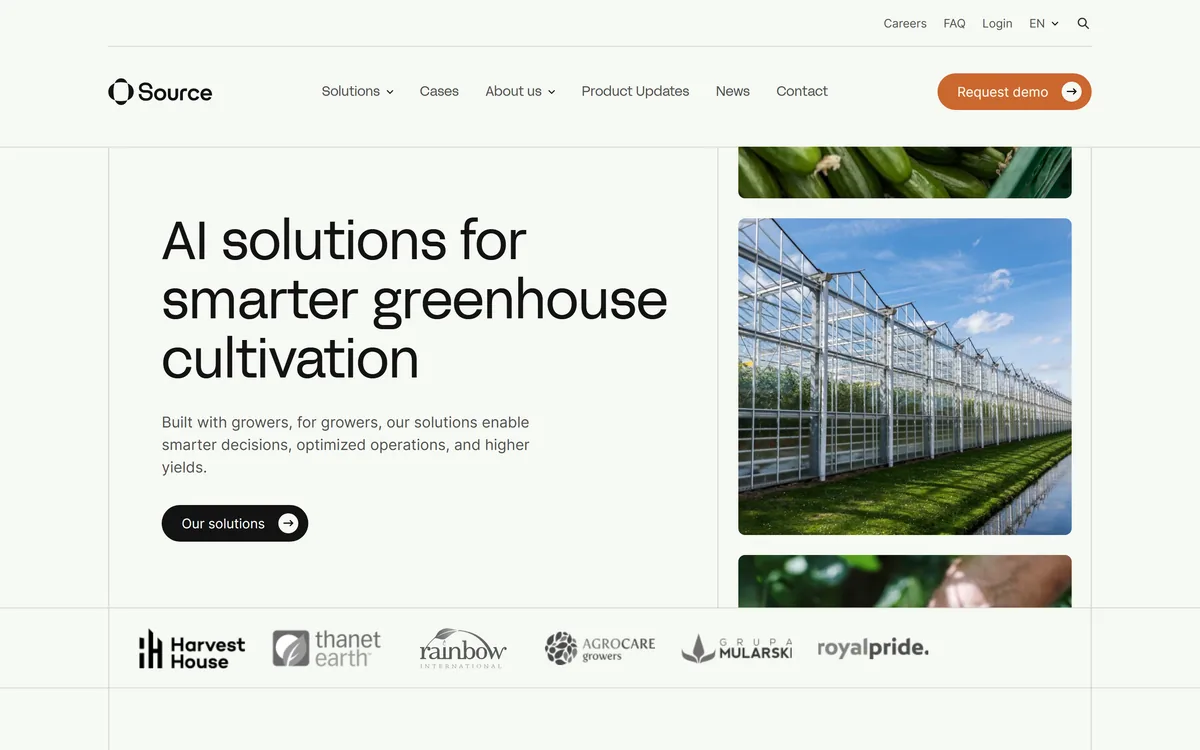
Last checked . Read from source.ag and its footer navigation, with the screenshot above captured in the same session.
- Positioned as AI-powered software for greenhouse cultivation, enabling data-driven decisions, yield optimisation and automated operations
- Source Workspace confirmed for centralised real-time data access and KPI dashboards
- Harvest Forecast confirmed as yield prediction with dynamic, data-driven adjustments
- Cultivation Management confirmed for strategy simulation and validation
- Irrigation Control confirmed as automated, precise water and nutrient delivery
- Source Intelligence confirmed as an analytics platform
- Source App confirmed as a mobile application
- Source Plant App confirmed as a digital plant representation, stated as retiring September 2026
- Source Cloud Modules and Source APIs confirmed for integration
- Crops covered confirmed as tomatoes, bell peppers and cucumbers
- Named customers confirmed as Harvest House, Thanet Earth, Rainbow International, Agrocare, Mularski Group, Royal Pride, Greenbalance Bryte and Breugem Horticulture
- Footer sections confirmed for About us, Vision, Partners, Careers, Solutions, Cases, News, FAQ, Press kit, Contact, Privacy Statement and Cookie Policy
What we could not confirm: the operating company's registered name or headquarters location, which were not stated on the pages we read; a customer count; pricing or licensing structure; what sensor hardware or data sources the models require; measured forecast accuracy, or how it is validated; which climate computers or greenhouse control systems it integrates with; what replaces the retiring Source Plant App; and what the failure behaviour of automated irrigation is. We did not use the platform, so nothing here reflects tested performance.
Editor's Verdict
4.1/5Source.ag is a specialist product doing something genuinely hard, and the specialism is the strength rather than a limitation. Harvest Forecast addresses the commercial problem that defines greenhouse growing — a crop is sold forward before it exists, and being wrong about volume is expensive in both directions. Restricting to tomatoes, peppers and cucumbers is the right decision, because crop models are crop-specific and a system claiming to cover everything covers nothing well. The named growers are the evidence that matters. It scores where it does because irrigation control means software touching a living crop, and that is a serious thing to hand over. AInexfinder Editor Score: 4.1/5.
Source.ag pricing
AInexfinder does not list plan prices or billing details. For current pricing, plans, and trials, visit the official Source.ag website.
Visit official website for pricingVendor pricing, credits, and billing policies change over time. Always confirm on the official site before you buy.
Frequently asked questions
What is Source.ag?
Source.ag builds AI software for greenhouse cultivation. Its products include Source Workspace with real-time KPI dashboards, Harvest Forecast for yield prediction, Cultivation Management for strategy simulation, Irrigation Control for automated water and nutrient delivery, Source Intelligence analytics, a mobile app, cloud modules and APIs.
Why does harvest forecasting matter so much?
Because greenhouse produce is sold forward — volumes are committed to buyers weeks before harvest, on an estimate. Being wrong costs money in both directions: over-forecast and you cannot supply what you sold; under-forecast and you have produce with no buyer, on a crop that does not wait.
Which crops does Source.ag support?
Tomatoes, bell peppers and cucumbers. That narrowness is a design decision rather than a gap: crop models do not generalise, because a tomato's response to light, temperature and nutrients is not a parameterised version of a cucumber's. A platform claiming every crop has either a poor general model or depth in two.
Is automated irrigation risky?
It is the module where software acts rather than advises, on a living crop, on a schedule nobody is watching. A malfunctioning watering system damages a crop within hours and recovery takes weeks. Ask what the safe default is when connectivity fails, who is alerted and how fast, and whether a grower can override immediately.
How accurate are the forecasts?
No accuracy figure or validation method is published, which is worth asking about directly. The right way to judge is a parallel pilot: record the platform's forecast and your existing method weekly against actual harvest, and look at whether the error narrows across a season rather than whether one week was closer.
Who uses Source.ag?
Named growers include Harvest House, Thanet Earth, Rainbow International, Agrocare, Mularski Group, Royal Pride, Greenbalance Bryte and Breugem Horticulture. These are substantial commercial operations rather than pilot sites, which matters in an industry where reputation travels fast and nobody adopts software casually.
Will it work outside Northern Europe?
Worth establishing before committing. Several named customers are Dutch and one is British, placing the product in the Northern European glasshouse cluster. Software developed there carries assumptions about climate, light levels and facility design that may not transfer cleanly to a different latitude or growing style.
How long does a proper pilot take?
A full crop cycle, because that is the feedback loop. Agricultural software cannot be evaluated in a fortnight — a forecast is only assessable against an actual harvest. Start with forecasting only, in parallel, changing nothing about how you grow, and add the acting modules once the predicting ones have earned confidence.
What is happening to the Source Plant App?
The site states it is retiring in September 2026. Products being retired is normal, and nothing should be read into it beyond the practical point: a grower whose workflow depends on the digital plant representation should confirm what replaces it and on what timeline before that date arrives.
Does Source.ag integrate with existing greenhouse systems?
Source Cloud Modules and Source APIs are both listed, which implies it is designed to sit alongside rather than replace. What is not stated is which climate computers or control systems are supported by name — an important question, since a greenhouse's existing control infrastructure is not something anyone replaces casually.
Reviews
Log in to write a review.
User Reviews
No reviews yet. Be the first to share your experience with Source.ag.
Reviewed by Daniel Reed
Assigned reviewer
Daniel ReedSenior AI Tools Reviewer
Daniel reviews AI tools the slow way — by actually using them on real projects. His reviews cover what works, what breaks, and who each tool is genuinely a good fit for.
Hands-on reviewsProduct testingAI software
Daniel and the AInexfinder editorial team research Source.ag using public product information, listing evidence, and (when available) hands-on checks. Scores reflect listing completeness and transparency — not paid placement.
- Last verified
- Methodology
- How we review AI tools
- Sources used
- source.ag
- AInexfinder listing fields (features, pros/cons, description)
- Public vendor pages when available
- Editorial policy
- Listings may include affiliate or sponsored placements, which are labeled when present. Editorial scores and cons are not sold. See our affiliate disclosure and review methodology.
Related tools
Iktos is an AI and robotics drug-discovery company combining generative molecular design (Makya), AI retrosynthesis (Spaya) and automated synthesis and testing robotics into a design-make-test-analyse loop aimed at shortening early drug discovery, offered to pharma and biotech research teams.
EOSDA Crop Monitoring is a satellite-based precision agriculture platform from EOS Data Analytics. It combines Sentinel-2 and PlanetScope imagery with ten vegetation indices, growth-stage tracking, risk maps, yield estimation and variable-rate application maps.
FreemiumEmerging & Specialized
Insilico Medicine pairs the Pharma.ai software suite — PandaOmics, Chemistry42, inClinico and more — with its own clinical pipeline. Its lead candidate rentosertib, a TNIK inhibitor for idiopathic pulmonary fibrosis, has Phase IIa results published in Nature Medicine.
Persefoni is a carbon-accounting and sustainability-management platform for measuring, reporting and decarbonizing emissions across Scopes 1-3, with a financed-emissions module for financial services and a native AI copilot built on its own carbon-accounting model.
FreemiumEmerging & Specialized
Taranis provides AI crop intelligence from leaf-level aerial imagery, detecting stand counts, weeds, insect damage, nutrient deficiencies and disease pressure across whole fields. Its products include Taranis Yield Impact and Ag Assistant, with a mobile app and web dashboard.
Compare:Source.ag vs Tamarind BioSource.ag vs IktosSource.ag vs EOSDA Crop MonitoringSource.ag vs Insilico Medicine
Source.ag alternatives Explore More
Embed this listing on your site
Featured on AInexfinder