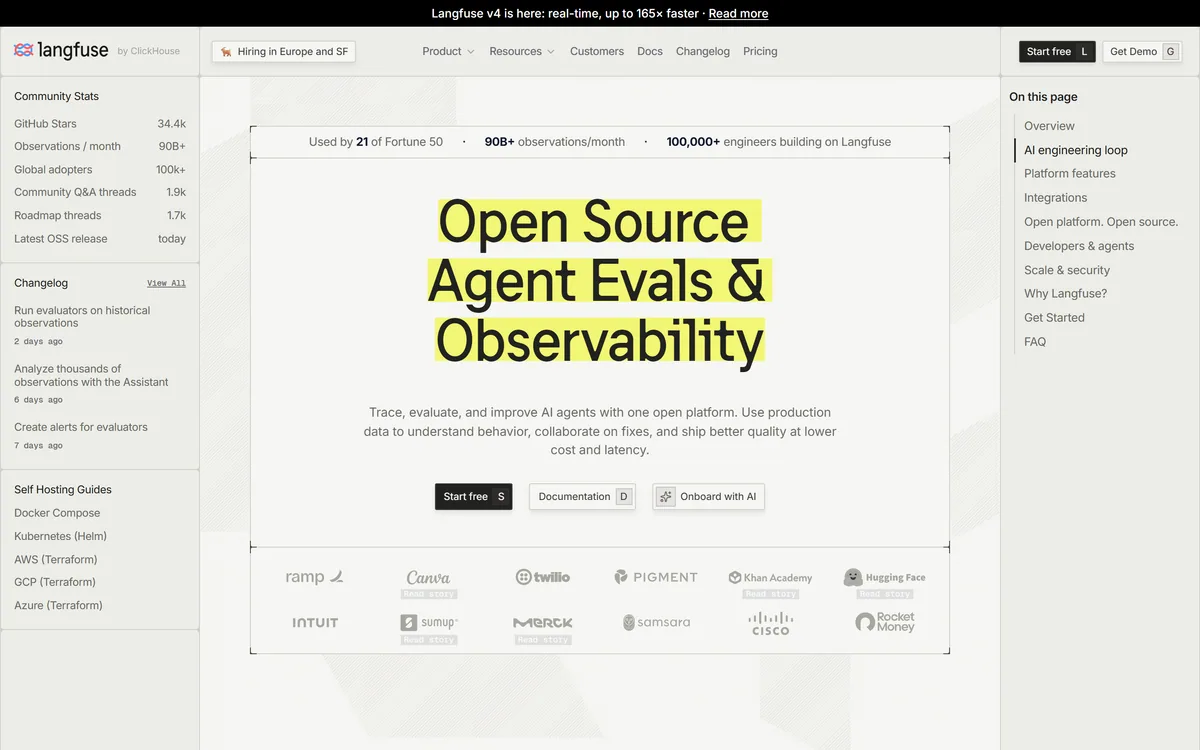
Langfuse is an open-source LLM engineering platform covering tracing, evaluation, prompt management, experiments and human annotation. Every product feature is MIT licensed, with self-hosting via Docker Compose, Kubernetes or Terraform alongside a managed cloud in US and EU regions.
langfuse.com10 viewsAdded September 2, 202561K visitors
Debugging a language-model application is unlike debugging anything else, and the reason is that the failure is usually not an error.
The request succeeded, the response came back, the status code was 200, and the answer was wrong. Nothing in a conventional monitoring stack notices that, because nothing in a conventional monitoring stack reads the content.
Langfuse exists for that gap, and its most consequential decision is not technical. Every product feature is MIT licensed, which changes who can adopt it and what happens if the company's plans and yours diverge.
The Langfuse Summary
All product features are MIT licensed — not a cut-down community edition, which is the unusual part.
Hierarchical tracing captures LLM calls, tool invocations and retrieval steps as a tree, rather than logging completions in isolation.
Evaluation three ways: LLM-as-a-judge, heuristic functions, and human review with collaborative annotation workflows.
Self-host or use the cloud — Docker Compose, Kubernetes via Helm, or Terraform for AWS, GCP and Azure; managed cloud in US and EU regions.
SOC 2 Type II and ISO 27001, GDPR compliance, and a HIPAA-ready region.
Langfuse's homepage, captured 9 September 2026, showing the tracing, evaluation and prompt-management positioning.
Why Does MIT Licensing Matter Here?
Langfuse states that all product features are MIT licensed and that you can fork, modify and contribute. That sentence is doing a great deal of work, and it is worth unpacking against how this category normally operates.
The standard arrangement is open core: a permissively licensed base with the features you actually need — SSO, audit logs, retention controls, sometimes the evaluation tooling — held behind a commercial licence. The open version exists to get you in, and the interesting part is not open at all.
MIT across the product means the escape hatch is real rather than theoretical. If the pricing changes, the roadmap moves away from you, or the company is acquired by someone whose plans you dislike, you can run what you already have indefinitely and modify it.
That matters more for observability than for most software, because observability is where your history lives. Migrating a year of traces, evaluations and prompt versions to a different platform is not a weekend, and a vendor knows it — which is precisely why lock-in in this category is so valuable to them and so expensive to you.
The honest counterweight is that a licence is not a support contract. Running Langfuse yourself means you own the upgrades, the storage growth and the 3am page, and for most teams the managed cloud is the correct choice regardless. The licence is insurance rather than a plan.
The alternative shape is a gateway. Helicone is also open source and sits in the request path instead, which is a different answer to the same worry about who holds your history.
MIT across the whole product means the escape hatch is real rather than theoretical. It is insurance, not a deployment plan.
What A Hierarchical Trace Captures That Logging Does Not
Langfuse's observability captures hierarchical traces covering LLM calls, tool invocations and retrieval steps, and the word hierarchical is the important one.
A flat log tells you a completion happened, what went in and what came out. That is enough for a single-call application and completely insufficient for an agent, because an agent's answer is the product of a sequence: retrieve, reason, call a tool, read the result, reason again, answer.
When the final answer is wrong, the question is which step went wrong — and a flat log cannot tell you, because it does not record that the steps were related. A trace tree does, and that is the difference between debugging and guessing.
The most common finding, once teams can actually see this, is that the model was fine and the retrieval was not. The prompt asked a reasonable question of documents that did not contain the answer, and the model did what models do with insufficient context.
That single insight changes where the fix goes. Without traces, teams spend weeks tuning prompts to fix a retrieval problem, which is an expensive way to make no progress.
Three Kinds Of Evaluation, And When Each One Lies
Langfuse offers LLM-as-a-judge, heuristic functions and human annotation, and using all three deliberately is better than picking one.
Heuristics are cheap, fast and honest about their limits. Does the output parse as JSON, contain the required field, stay under the length limit, avoid a forbidden term? These catch a surprising proportion of real failures and never disagree with themselves.
LLM-as-a-judge scales to the questions heuristics cannot express — is this answer relevant, is it grounded in the retrieved context, is the tone right. It is genuinely useful and it inherits every weakness of the model doing the judging, including a well-documented preference for longer, more confident answers over shorter correct ones.
Human annotation is the only ground truth, and it is expensive, which is why it should be spent where it settles disagreements rather than sprayed across everything. The right use is calibration: annotate a sample, check whether your judge agrees with your humans, and only then trust the judge on volume.
That calibration step is the one teams skip, and skipping it means your evaluation numbers measure the judge's preferences rather than your users' experience. Langfuse's human review workflows exist precisely so that step is possible.
This is also where framework-tied tooling such as LangSmith and evaluation-led platforms like Braintrust weight things differently, and the right choice depends on whether evaluation or tracing is your bottleneck.
Use heuristics for anything expressible as a rule — they never drift.
Use LLM-as-a-judge for relevance, grounding and tone, and expect a bias toward long confident answers.
Spend human annotation on calibrating the judge, not on grading everything.
Re-calibrate after any model change, since the judge's behaviour moves too.
Treat a rising eval score with a flat user metric as evidence the eval is wrong.
Prompt Management Is Version Control For The Part That Changes Most
Langfuse offers prompt management with version control and one-click deployment, plus a playground that runs prompts against production inputs.
The problem it solves is unglamorous and universal. Prompts start in code, then someone needs to change one without a deploy, so they move to a config file, then to a database, and within a quarter nobody knows which version is live or who changed it last.
Versioning them properly makes regressions attributable. When quality drops on Tuesday, the useful question is what changed, and a system that can answer that in seconds is worth more than one that requires archaeology.
The playground running against production inputs is the detail that separates this from a text editor. Testing a prompt on examples you invented tells you it works on examples you invented; testing on the requests that actually failed tells you something.
Experiments close the loop by letting you define test cases and compare results across versions, which is what turns prompt changes from craft into something with evidence behind it.
None of this is visible to conventional monitoring. Sentry Seer will tell you the request threw; it has no view on a prompt change that quietly made every answer worse.
Instrumenting An Application So The Traces Are Worth Reading
The failure mode with any observability platform is not that it does not work — it is that the traces are too thin to answer the question you eventually ask.
Langfuse offers native Python and TypeScript SDKs and states 100+ integrations, including LangChain, the Vercel AI SDK, LiteLLM, Pydantic AI, CrewAI and OpenAI. An integration gets you started; it does not decide what you record.
Start with the framework integration if you use one, since it captures the call structure with almost no work.
Add session or user identifiers immediately — a trace you cannot tie to a conversation is far less useful than one you can.
Instrument retrieval explicitly, including what was retrieved, because that is where most quality problems actually live.
Record tool calls and their results, not just the model's decision to call them.
Add cost and latency dashboards before you need them, since the first billing surprise is always retrospective.
Write two or three heuristic evaluations on day one, then calibrate a judge against a human-annotated sample before trusting any score.
Key features of Langfuse
Hierarchical tracing across model calls, tool invocations and retrieval steps
Evaluation via LLM-as-a-judge, heuristic functions and human review
Prompt management with version control and one-click deployment
Playground for testing prompts against real production inputs
Experiments comparing results across prompt and model versions
Collaborative human annotation workflows
Cost and latency dashboards with alerting
Self-hosting via Docker Compose, Kubernetes or Terraform on three clouds
Pros & cons
Pros
7
MIT licensing across all product features rather than an open-core tease
Hierarchical traces are the right shape for debugging agents, not just calls
All three evaluation methods in one place, which makes calibration possible
Self-host or managed cloud, with EU and US regions and a HIPAA-ready option
Native SDKs plus 100+ integrations covering the common frameworks
SOC 2 Type II and ISO 27001 stated, which clears most procurement reviews
Prompt versioning makes a quality regression attributable in seconds
Cons
6
SDK instrumentation means coverage is only as good as the code you write
Self-hosting is insurance rather than a plan for most teams, and carries real operational cost
No operating company, headquarters or size is stated on the site
Pricing and cloud tier limits are not published on the page we read
The billions-of-events scale claim is vendor-stated and unverified
Storage growth and retention behaviour are undocumented on the marketing site
Best For
Teams building agents with multi-step retrieval and tool use
Organisations whose compliance position requires self-hosting or a region
Engineering groups that will genuinely write and maintain evaluations
Anyone who wants prompt changes tracked like code changes
Buyers who want an exit that does not depend on the vendor's goodwill
Langfuse Against Other LLM Observability Tools
These tools all watch model calls. They differ on where they sit, what they own, and whether you can run them yourself.
Tool
Position
Licence and hosting
Best for
Langfuse
SDK-instrumented tracing, evals and prompts
MIT across all features; self-host or managed cloud
Failures that actually throw, rather than wrong answers
Langfuse: Licence, Deployment And Compliance
Product type
Open-source LLM engineering and observability platform
Licence
MIT across all product features
Observability
Hierarchical traces covering LLM calls, tool invocations and retrieval steps
Evaluation
LLM-as-a-judge, heuristic functions and human review
Prompt management
Version control with one-click deployments
Playground
Test prompts against production inputs
Experiments
Defined test cases with cross-version comparison
Human annotation
Collaborative review workflows
Monitoring
Cost and latency dashboards with alerts
SDKs
Native Python and TypeScript
Integrations
100+ stated, including LangChain, Vercel AI SDK, LiteLLM, Pydantic AI, CrewAI and OpenAI
Model providers
OpenAI, Anthropic, Amazon Bedrock, Google Gemini and others
Self-hosting
Docker Compose, Kubernetes via Helm, Terraform for AWS, GCP and Azure
Managed cloud
US and EU regions
Compliance
SOC 2 Type II, ISO 27001, GDPR, with a HIPAA-ready region
Is Langfuse The Right Platform For You?
Adopt the platform when
You are building agents, where the failure is a step in a sequence rather than a call.
Your compliance position requires the option to self-host, or a specific region.
You want prompt changes to be attributable rather than investigated after the fact.
Your team will actually write evaluations, which is what makes tracing pay off.
You want a licence that survives a change of ownership or direction at the vendor.
Leave it when
Your application is one model call and a response, where tracing adds little.
Nobody will own instrumentation, in which case the traces will be too thin to use.
You want a gateway that sees everything without touching application code.
You are deeply invested in one framework's own tooling and happy there.
You need managed support guarantees and would treat self-hosting as the plan rather than the fallback.
Langfuse: Reading The Repo And The Docs
Last checked . Read from langfuse.com, with the screenshot above captured in the same session.
Positioned as an AI engineering platform for building, monitoring and improving LLM applications
MIT licence stated to cover all product features, with fork, modify and contribute rights
Hierarchical traces confirmed as capturing LLM calls, tool invocations and retrieval steps
Evaluation confirmed across LLM-as-a-judge, heuristic functions and human review
Prompt management with version control and one-click deployments confirmed
Playground confirmed as testing prompts on production inputs
Experiments confirmed for defining test cases and comparing results
Human annotation with collaborative review workflows confirmed
Cost and latency monitoring with dashboards and alerts confirmed
Native Python and TypeScript SDKs confirmed
100+ integrations stated, with LangChain, Vercel AI SDK, LiteLLM, Pydantic AI, CrewAI and OpenAI named
Model provider support stated for OpenAI, Anthropic, Amazon Bedrock and Google Gemini among others
Self-hosting confirmed via Docker Compose, Kubernetes with Helm, and Terraform for AWS, GCP and Azure
Managed cloud confirmed in US and EU regions
Compliance stated as SOC 2 Type II, ISO 27001, GDPR, with a HIPAA-ready region
Scale claim stated on the site as scaling to billions of monthly events
What we could not confirm: the operating company's legal name, headquarters or size; pricing and where the cloud tiers stop; whether any feature is cloud-only in practice despite the licence covering the product; storage and retention limits; the resource requirements of a self-hosted deployment; and independent verification of the certifications or the billions-of-events claim. We did not deploy Langfuse, so nothing here reflects tested performance.
Editor's Verdict
4.5/5
Langfuse scores highly for a licensing decision that most open-core vendors deliberately avoid: all product features are MIT licensed, not a stripped community edition with the useful parts held back. That resolves the question every platform team asks — what happens when the vendor changes direction — because the answer is that you fork it. Underneath that, the feature set is the right one: hierarchical traces that capture tool calls and retrieval rather than just completions, evaluation, versioned prompts and experiments. It loses a fraction because observability is only as good as the instrumentation you actually write, and that part is still your job. AInexfinder Editor Score: 4.5/5.
Langfuse pricing
AInexfinder does not list plan prices or billing details. For current pricing, plans, and trials, visit the official Langfuse website.
Vendor pricing, credits, and billing policies change over time. Always confirm on the official site before you buy.
Frequently asked questions
What is Langfuse?
Langfuse is an open-source LLM engineering platform covering hierarchical tracing, evaluation, prompt management, experiments and human annotation, with cost and latency monitoring. All product features are MIT licensed, and it can be self-hosted via Docker Compose, Kubernetes or Terraform, or used as a managed cloud in US and EU regions.
Is Langfuse really fully open source?
The site states that all product features are MIT licensed and that you can fork, modify and contribute. That is unusual: the normal arrangement in this category is open core, where the features you actually need sit behind a commercial licence. What we could not verify is whether any capability is cloud-only in practice despite the licence.
Why does hierarchical tracing matter for agents?
Because an agent's answer is a sequence — retrieve, reason, call a tool, read the result, answer — and when the answer is wrong the question is which step failed. A flat log cannot say, because it does not record that the steps were related. The most common finding once teams can see this is that retrieval failed and the model was fine.
Which evaluation method should I use?
All three, deliberately. Heuristics for anything expressible as a rule, since they never drift. LLM-as-a-judge for relevance, grounding and tone, accepting its bias toward longer, more confident answers. Human annotation to calibrate the judge against a sample — the step most teams skip, which leaves your scores measuring the judge's preferences.
How is Langfuse different from Helicone?
Position in the stack. Helicone sits in the request path as a gateway and therefore sees everything by default; Langfuse instruments from inside your code via SDKs, so it sees what you tell it to. The SDK approach gives richer structure around your own logic; the gateway approach gives coverage without touching application code.
Can I self-host Langfuse?
Yes — Docker Compose for a simple deployment, Kubernetes via Helm, or Terraform modules for AWS, GCP and Azure. Worth being clear-eyed about it though: self-hosting means you own the upgrades, the storage growth and the alerts at 3am. For most teams the managed cloud is the right choice and the licence is the insurance.
What compliance certifications does Langfuse have?
The site states SOC 2 Type II, ISO 27001 and GDPR compliance, with a HIPAA-ready region available. Combined with EU and US cloud regions and the self-hosting option, that covers most procurement positions — including the ones where sending prompt content to a third party is not permitted at all.
What does prompt version control actually buy me?
Attribution. Prompts drift from code into config into a database, and within a quarter nobody knows which version is live or who changed it. When quality drops on Tuesday, a versioned system answers what changed in seconds instead of requiring archaeology, and the playground lets you test the fix against the requests that actually failed.
Do I need Langfuse if my app is one model call?
Probably not yet. Tracing earns its keep when there is a sequence to inspect, and a single call with a response has very little structure to reveal. The cost and latency dashboards still have value, but the case gets much stronger the moment retrieval or tool use enters the picture.
What frameworks does Langfuse integrate with?
It states 100+ integrations, naming LangChain, the Vercel AI SDK, LiteLLM, Pydantic AI, CrewAI and OpenAI, with native Python and TypeScript SDKs underneath. Model provider support is stated for OpenAI, Anthropic, Amazon Bedrock and Google Gemini among others. An integration gets you started, but you still decide what gets recorded.
Daniel reviews AI tools the slow way — by actually using them on real projects. His reviews cover what works, what breaks, and who each tool is genuinely a good fit for.
Daniel and the AInexfinder editorial team research Langfuse using public product information, listing evidence, and (when available) hands-on checks. Scores reflect listing completeness and transparency — not paid placement.
Listings may include affiliate or sponsored placements, which are labeled when present. Editorial scores and cons are not sold. See our affiliate disclosure and review methodology.
Momentic is an agentic end-to-end testing platform where AI writes tests as plain-English YAML, runs them across web, iOS and Android, and self-heals them when the UI changes, with an autonomous bug-bashing agent, an MCP server and CI integration.
Helicone is open-source LLM observability and an AI gateway. It logs and analyses requests across OpenAI, Anthropic, Gemini, Mistral, Groq, Together and OpenRouter, with sessions, user-level tracking, a query language, prompt management, datasets, a playground, rate limits and alerts.
Functionize is an AI-native test automation platform for enterprise web applications. Its Studio product uses autonomous agents to create and run end-to-end UI tests, with self-healing element resolution built on custom models rather than brittle selectors, across Salesforce, ServiceNow, Workday, SAP and bespoke apps.
Bug0 is managed AI QA: a forward-deployed engineer builds end-to-end tests on Bug0's engine, covering critical flows in seven days. Tests heal themselves when the UI changes, and every failure is verified before it reaches you. It also publishes Passmark and a substantial testing blog.
GitHub Copilot is an AI coding assistant that spans completion, chat, agent mode, automated code review, and a cloud agent that opens pull requests, working across VS Code, Visual Studio, JetBrains, Xcode, Neovim, Eclipse, the CLI, and github.com.
Replit AI turns a written description into a working application — the Agent writes the code, and Replit supplies the database, authentication, hosting, and monitoring, so a prototype goes live without a local setup or a deployment pipeline.