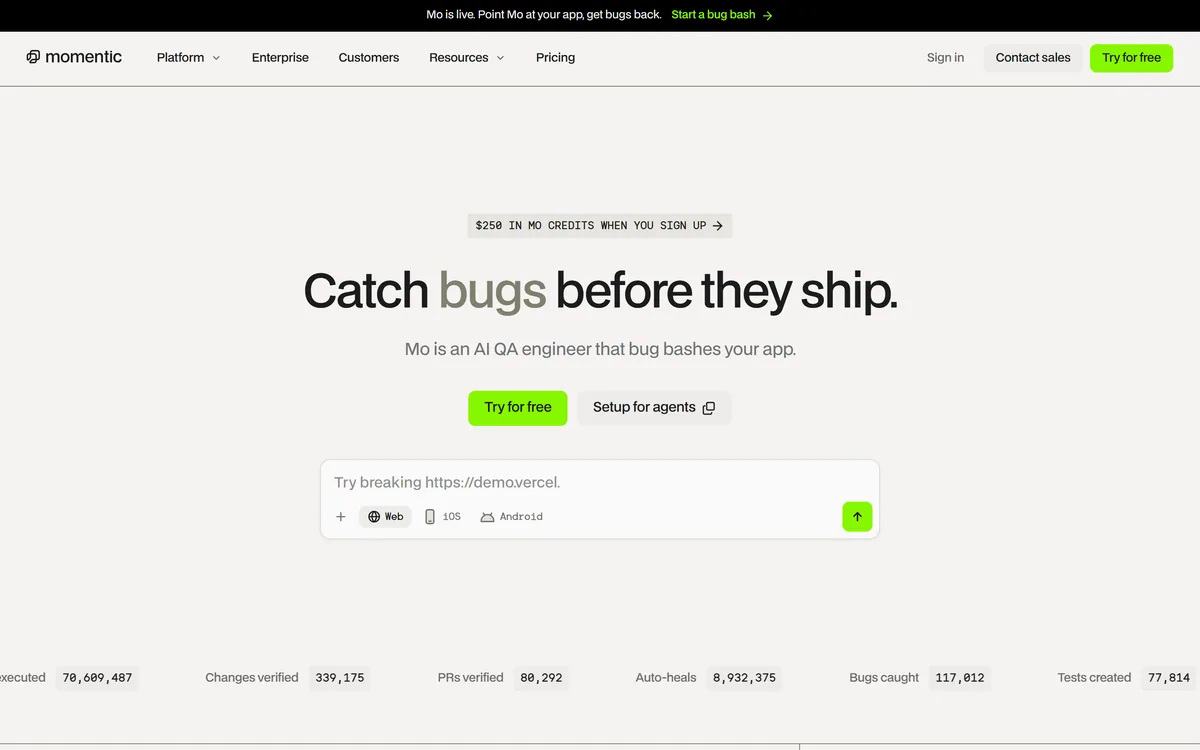
Momentic is an agentic end-to-end testing platform where AI writes tests as plain-English YAML, runs them across web, iOS and Android, and self-heals them when the UI changes, with an autonomous bug-bashing agent, an MCP server and CI integration.
momentic.ai12 viewsAdded November 13, 20255K visitors
End-to-end tests are the first thing teams write and the first thing they abandon, because selector-based scripts break every time the UI shifts. Momentic's whole reason to exist is to make that maintenance someone else's job.
It is an agentic testing platform where AI authors tests as plain-English YAML, runs them across web, iOS and Android, and self-heals them as the product changes, plus an autonomous agent, "Mo", that bug-bashes a URL on its own. It sits among AI-era QA tools like Functionize, competing on how little test upkeep it leaves you.
This review covers how Momentic keeps tests from breaking, where it earns its keep in CI, how it is priced, and who should pass.
Momentic writes tests in plain English and repairs them when the UI shifts.
Momentic, The Fast Version
Momentic is an agentic end-to-end testing platform: AI writes, runs and repairs your tests instead of brittle selector scripts.
Tests are plain-English YAML: readable specs in your codebase, not XPath or CSS selectors that break on every change.
Self-healing is the point: it adapts tests to intended UI changes and flags genuine regressions.
Mo is an autonomous QA agent: point it at a URL and it bug-bashes, returning issues with recordings and repro steps.
Momentic Testing Platform Facts
What it is
An agentic end-to-end testing platform
Tests written as
Plain-English YAML, not selectors
Covers
Web, iOS and Android
Self-healing
Adapts to UI changes, flags regressions
Autonomous agent
Mo bug-bashes a URL on its own
Runs in
Local, CI/CD, or Momentic-hosted infra
Interfaces
CLI, MCP server, API keys
Security
SOC 2 Type 2, SSO, RBAC, audit logs (vendor)
AI Agents That Write And Repair Your Tests
Momentic's core bet is that the expensive part of testing is not writing tests but keeping them alive. Its answer is to let AI agents author, run, repair and maintain tests as the UI evolves, so a cosmetic change does not turn a green suite red overnight.
The headline design choice is that tests are plain-English YAML in your codebase, not XPath or CSS selector scripts. A human can read, review and version them, which is a real improvement over the opaque, brittle scripts that make most teams quietly give up on end-to-end testing.
Momentic reports large usage figures, over a hundred thousand bugs caught and a high signal-to-noise ratio, and names well-known customers. Those are the vendor's own counters and testimonials; we report them as claims, not independent measurements, and they do point to real adoption.
The expensive part of testing is not writing tests but keeping them alive. Momentic's answer is to let AI repair them as the UI evolves, so a cosmetic change doesn't turn a green suite red.
How Does Momentic Keep Tests From Breaking?
Two mechanisms do the work, and understanding both is the key to judging whether it fits your pipeline.
Plain-English Tests And Self-Healing
You describe a test in readable YAML, Momentic runs it, and when the UI changes in an intended way it auto-heals the test rather than failing; when something genuinely regresses, it flags it with root-cause analysis and a session replay.
That heal-versus-flag distinction is the hard problem in test maintenance, and getting it right is what separates a time-saver from a noise machine. A debugging-focused tool like Traversal attacks the same frustration from the failure-analysis side.
Mo, The Autonomous Bug-Bashing Agent
Beyond authored tests, "Mo" is an autonomous agent you point at a URL; it explores and bug-bashes on its own, returning issues with recordings and reproduction steps, and can run cloud QA sessions with your org's MCP servers and secrets attached.
That autonomous exploration is complementary to error monitoring in production; a tool like Sentry Seer catches what breaks after release, while Mo hunts for it before. The two address different ends of the same bug lifecycle.
Where Momentic Earns Its Keep In CI
Momentic pays off most for teams that already feel the pain of flaky end-to-end tests: web and mobile apps with a fast-changing UI, where selector scripts generate more false alarms than caught bugs.
Because the same test command runs locally or in CI (GitHub Actions, GitLab) and failures come with root-cause triage, it slots into an existing pipeline rather than demanding a new one. For a team drowning in test maintenance, that is the whole value.
It earns less for a tiny project with a stable UI and a handful of tests, where the overhead of adopting a platform outweighs the maintenance it saves. The bigger and more volatile the suite, the stronger the case.
How Momentic Prices Its Testing
Momentic is free to start with no credit card and some sign-up credits, then usage- or credit-based, with an "effort" routing control that sets how much credit a run consumes, plus enterprise plans via sales. We do not publish prices, which change; check the site.
A usage model fits testing reasonably, since test volume varies, but it means the cost scales with how much you run, so the honest way to size it is to run your real suite for a period and read the actual consumption.
Against the alternative, engineer-hours spent fixing brittle tests, the maths usually favours automation for a large, active suite, and rarely for a small, stable one.
A Practical Way To Trial Momentic
Because the pitch is less maintenance, trial it on a real, flaky part of your suite rather than a clean demo.
Start free and point Mo at a staging URL to see what it bug-bashes without any setup.
Author a few real tests as plain-English YAML for a flow that changes often.
Make an intended UI change and confirm Momentic self-heals rather than failing.
Introduce a real regression and check it is flagged with useful root-cause detail.
Wire the same command into CI and judge the signal-to-noise on real pull requests.
Pass/fail: Momentic is worth it if it cuts test maintenance without burying you in false alarms.
Track the credit consumption of your real suite before committing to a plan.
Momentic Testing Terms
End-to-end test
A test that drives the whole app like a user would, rather than testing a single unit of code in isolation.
Self-healing
Automatically updating a test to an intended UI change instead of failing, so cosmetic edits don't break the suite.
Flaky test
A test that passes and fails inconsistently without a real code change; the main reason teams abandon end-to-end testing.
MCP server
An interface that lets an AI agent, here Mo, use your org's tools and context during an autonomous QA session.
Key features of Momentic
Plain-English YAML tests
Self-healing on UI changes
Mo autonomous bug-bashing agent
Web, iOS and Android coverage
Root-cause triage and session replays
CLI and CI/CD integration
MCP server and API access
Enterprise controls (SSO, RBAC, audit logs)
Pros & cons
Pros
5
Tackles test maintenance, the real QA pain
Readable, reviewable tests instead of brittle scripts
Self-heal-versus-flag reduces false alarms
Autonomous bug-bashing before release
Fits existing local and CI pipelines
Cons
5
Overkill for tiny, stable test suites
Usage-based cost scales with how much you run
Headline stats are vendor-stated
Needs a CI pipeline to shine
Adoption overhead for very small teams
Best For
Teams with flaky E2E tests
Fast-changing web and mobile apps
Engineers wanting readable tests
Pre-release bug-bashing
CI-integrated QA
Momentic Against Script-Based Test Tools
The useful comparison is with how each tool handles test authoring and maintenance.
Momentic earns 4.3 for attacking the real reason teams abandon end-to-end testing, maintenance, with AI that writes tests as readable plain-English YAML, self-heals them through intended UI changes, and adds an autonomous bug-bashing agent, all fitting local and CI pipelines. Its usage counters are vendor-stated and its cost scales with how much you run, and it is overkill for a tiny stable suite, but for a large, volatile one it is a strong pick. AInexfinder Editor Score: 4.3/5.
Momentic pricing
AInexfinder does not list plan prices or billing details. For current pricing, plans, and trials, visit the official Momentic website.
Vendor pricing, credits, and billing policies change over time. Always confirm on the official site before you buy.
Frequently asked questions
What is Momentic?
Momentic is an agentic end-to-end testing platform. AI agents write tests as plain-English YAML, run them across web, iOS and Android, and self-heal them when the UI changes. An autonomous agent called Mo can also bug-bash a URL on its own and return issues with recordings and repro steps.
How is Momentic different from Playwright or Selenium?
Those are selector-based frameworks where you write and maintain scripts that break when the UI changes. Momentic writes tests as readable YAML and self-heals them through intended changes, aiming to remove the maintenance burden that leads teams to abandon end-to-end tests.
What is self-healing in Momentic?
Self-healing means Momentic automatically updates a test to an intended UI change instead of failing it, while still flagging genuine regressions with root-cause analysis. Getting that heal-versus-flag distinction right is what separates a time-saver from a source of false alarms.
What does the Mo agent do?
Mo is an autonomous QA agent you point at a URL; it explores and bug-bashes on its own, returning issues with recordings and reproduction steps, and can run cloud sessions using your org's MCP servers and secrets. It finds bugs before release rather than after.
Does Momentic work in CI?
Yes. The same test command runs locally or in CI such as GitHub Actions and GitLab, and failures come with root-cause triage and session replays. That lets it slot into an existing pipeline rather than requiring you to build a new testing workflow around it.
How much does Momentic cost?
It is free to start with no credit card and some sign-up credits, then usage- or credit-based, with an effort setting that controls how much credit a run consumes, plus enterprise plans via sales. We do not publish prices; run your real suite to gauge consumption.
Can Momentic test mobile apps?
Yes. It covers web, iOS and Android, using hosted simulators and emulators for mobile, so a team can keep one testing approach across platforms rather than maintaining separate mobile and web test tooling. The same plain-English YAML approach applies across them.
Are Momentic's bug-caught numbers reliable?
They are vendor-stated homepage counters, such as bugs caught and a signal-to-noise ratio, along with named customers, so treat them as claims rather than independent measurements. They indicate real adoption, but judge the tool on its performance against your own suite.
Who should not use Momentic?
Tiny projects with a stable UI and only a handful of tests, teams without a CI pipeline to integrate into, and anyone unwilling to measure credit consumption first. The value of self-healing grows with the size and volatility of your test suite.
Does Momentic replace human QA?
No. It automates the writing and maintenance of end-to-end tests and can bug-bash autonomously, but human QA still defines what matters, judges edge cases and owns release decisions. Momentic removes the brittle-script busywork so testers spend time on higher-value work.
Daniel reviews AI tools the slow way — by actually using them on real projects. His reviews cover what works, what breaks, and who each tool is genuinely a good fit for.
Daniel and the AInexfinder editorial team research Momentic using public product information, listing evidence, and (when available) hands-on checks. Scores reflect listing completeness and transparency — not paid placement.
Listings may include affiliate or sponsored placements, which are labeled when present. Editorial scores and cons are not sold. See our affiliate disclosure and review methodology.
Helicone is open-source LLM observability and an AI gateway. It logs and analyses requests across OpenAI, Anthropic, Gemini, Mistral, Groq, Together and OpenRouter, with sessions, user-level tracking, a query language, prompt management, datasets, a playground, rate limits and alerts.
Langfuse is an open-source LLM engineering platform covering tracing, evaluation, prompt management, experiments and human annotation. Every product feature is MIT licensed, with self-hosting via Docker Compose, Kubernetes or Terraform alongside a managed cloud in US and EU regions.
Functionize is an AI-native test automation platform for enterprise web applications. Its Studio product uses autonomous agents to create and run end-to-end UI tests, with self-healing element resolution built on custom models rather than brittle selectors, across Salesforce, ServiceNow, Workday, SAP and bespoke apps.
Bug0 is managed AI QA: a forward-deployed engineer builds end-to-end tests on Bug0's engine, covering critical flows in seven days. Tests heal themselves when the UI changes, and every failure is verified before it reaches you. It also publishes Passmark and a substantial testing blog.
GitHub Copilot is an AI coding assistant that spans completion, chat, agent mode, automated code review, and a cloud agent that opens pull requests, working across VS Code, Visual Studio, JetBrains, Xcode, Neovim, Eclipse, the CLI, and github.com.
Replit AI turns a written description into a working application — the Agent writes the code, and Replit supplies the database, authentication, hosting, and monitoring, so a prototype goes live without a local setup or a deployment pipeline.