Resolve.ai puts AI agents into software operations: triaging alerts, investigating incidents alongside engineers to find root cause, and running operational workflows on a schedule or trigger. It is sold to large engineering organisations, with Coinbase, DoorDash, Snowflake and Robinhood among its named customers.
Traversal
Verified
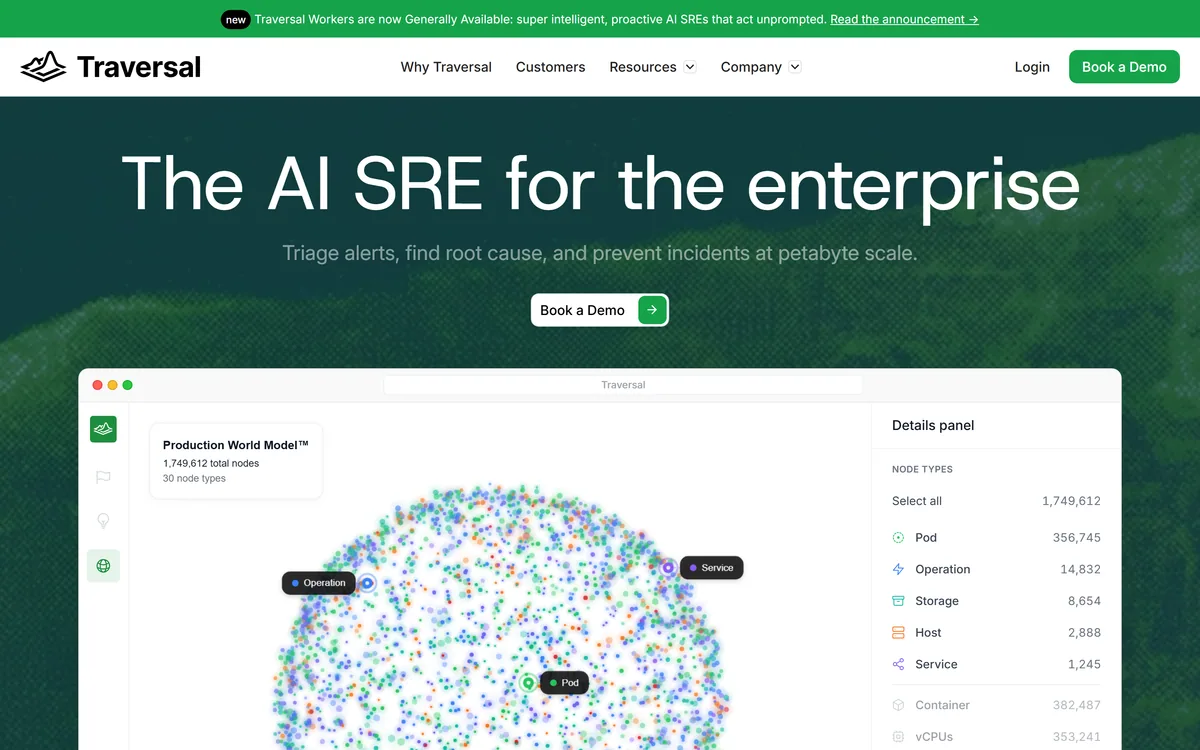
Traversal is an AI site reliability engineering platform. It builds a dependency graph of production — what the vendor calls a Production World Model — and uses a causal search engine to triage alerts, perform evidence-backed root cause analysis across distributed systems, and drive automated remediation.
4.3Editor Score
traversal.com11 viewsAdded February 22, 202610K visitors
AI Incident Response, Condensed
- Traversal is an AI site reliability engineering platform that investigates production incidents and identifies their root cause automatically, rather than only alerting that something is wrong.
- The Production World Model is the foundation — a dependency graph the vendor states spans over 1.7 million nodes across 30+ resource types, so the system knows how your infrastructure actually connects.
- A Causal Search Engine traverses that graph, tracing an incident across services, dependencies and recent changes to isolate the cause and a remediation path.
- Named customers include DigitalOcean, Cloudways and American Express, with DigitalOcean cited as cutting mean time to resolution 38% and finding causes in under a minute rather than an hour.
- It is New York based, contact-sales, and enterprise-shaped — there is no self-serve entry point.
Architecture, Results And Company
| Category | AI site reliability engineering, alert triage and root cause analysis |
|---|---|
| Location | New York, New York |
| Core architecture | Production World Model, a dependency graph the vendor states covers over 1.7 million nodes across 30+ resource types |
| Investigation engine | Causal Search Engine, tracing incidents across services, dependencies and recent changes |
| Named capabilities | Alert Intelligence, Incident RCA, Self-Healing, Code Resilience, Production Support, Traversal Workers |
| Code integration | Production context surfaced into GitHub pull request analysis |
| Collaboration integrations | Slack and Microsoft Teams |
| Latest release | Traversal Workers, AI SRE agents that act proactively rather than on request, stated as generally available |
| Named customers | DigitalOcean, Cloudways, American Express, plus unnamed Fortune 100 financial services, Fortune 50 food and beverage, and a global crypto exchange |
| Customer-reported results | DigitalOcean 38% MTTR reduction; Cloudways 70% MTTR reduction; a Fortune 100 financial services firm 32% MTTR reduction at 82% RCA accuracy; a Fortune 50 food and beverage firm 80% RCA accuracy and 6,000 engineering hours saved annually |
| Research | ORCA-Bench, a published comparison of frontier models on production on-call root cause tasks |
| Charging model | Contact sales, enterprise; no prices published here |
Alerting Was Solved. Diagnosis Was Not.
Observability has been a well-served category for fifteen years, and it solved a specific problem completely: knowing that something is wrong.
Metrics, logs, traces, dashboards, alerting — a modern production estate emits enormous quantities of signal, and detecting anomalies in it is genuinely mature technology.
What none of that answers is the question an on-call engineer actually has at 3am. Not is something broken — the pager already said so — but which of the forty things that changed in the last six hours caused this.
In a distributed system that question is genuinely hard, and it gets harder as architecture gets more granular. A checkout failure might originate in a payment service, or in a database connection pool, or in a config change to a service two hops away that nobody associates with checkout, or in a dependency's dependency degrading in one region.
The human process is manual graph traversal: an engineer holds a mental model of the system, forms a hypothesis, checks a dashboard, revises, repeats. The quality of that mental model is why one engineer resolves in ten minutes what another takes three hours to find.
Catching the defect before release is a different discipline entirely, and where testing platforms like Functionize sit. Building that model explicitly, as a graph the machine can walk, is the entire idea here — and it is the right idea, because the bottleneck was always diagnosis rather than detection.
The pager tells you something is broken. It has never told you which of the forty things that changed today broke it, and that gap is where the whole night goes.
Why The Dependency Graph Is The Hard Part
The Production World Model is the substantial engineering claim here, and it is worth understanding why it is difficult rather than accepting the number.
1.7 million nodes across 30+ resource types describes a large estate — services, containers, databases, queues, load balancers, config objects, cloud resources. Building that map is not the difficult part. Keeping it accurate is.
Production changes constantly. Deployments, autoscaling, configuration updates, infrastructure drift. A dependency graph built on Monday describes a system that no longer exists by Thursday, and a stale graph produces confidently wrong causal conclusions — which is considerably worse than no conclusion during an incident.
This is the specific thing to interrogate in an evaluation. How is the graph maintained, how quickly does it reflect a deployment, and what happens when it encounters something it has not mapped?
The related question is coverage of the parts nobody instruments. Most estates have a legacy component, a third-party dependency, or a service someone built in 2019 that emits almost nothing. Causal reasoning stops at the boundary of what the graph knows, and those unmapped corners are disproportionately where incidents originate.
Pull request review assistance from GitHub Copilot works from the code alone. The Code Resilience feature — bringing production context into pull request analysis — is the interesting inversion of this. Using the same graph to warn that a change touches something fragile is arguably more valuable than diagnosing the outage it would have caused.
Reading The MTTR And Accuracy Figures
The published results are more specific than most vendors offer, which is to their credit, and they still need reading carefully.
The strongest thing about them is that several are attributed to named companies. DigitalOcean at 38% MTTR reduction and Cloudways at 70% are attached to real organisations rather than being anonymous composites, and that is a meaningfully higher standard of evidence than the category norm.
Two things still need holding in mind. MTTR is an average dominated by outliers. A large reduction can come from fixing a handful of long incidents rather than from improving typical ones — which is genuinely valuable and is a different claim from everything getting faster.
RCA accuracy of 80–82% means one investigation in five is wrong. That is a strong number for automated causal reasoning and it is also the number that determines how you use the tool. An engineer who trusts it completely will, one time in five, spend the incident pursuing the wrong system while the real problem continues.
The correct posture follows directly: treat the output as an extremely well-informed first hypothesis with its evidence attached, not as an answer. The evidence-backed framing the vendor uses is the right one, because a conclusion you can check is far more useful than a conclusion you must trust.
The 6,000 engineering hours saved annually at a Fortune 50 firm is the figure that best captures the actual value — the cost of incidents is overwhelmingly people's time.
- Replay incidents you have already resolved and compare the tool's conclusion with your own post-mortems.
- Include the incidents that took longest — those are where MTTR reduction actually comes from.
- Deliberately test a component that is poorly instrumented, to find where the graph's knowledge stops.
- Check how quickly the dependency graph reflects a deployment you make during the trial.
- Run it in advisory mode alongside on-call before letting any self-healing action execute.
Self-Healing Deserves Its Own Governance
Converting a diagnosis into an automated remediation is where this stops being an analysis tool and starts being something that changes production by itself.
The appeal is obvious. If the system knows the cause and the fix is a known action — restart a service, roll back a deployment, scale a pool — executing it immediately resolves incidents faster than any human can.
The risk follows directly from the accuracy figure. Automated remediation acting on a wrong diagnosis does not merely fail to fix the incident; it takes an unnecessary action during an outage, which can compound the problem or introduce a second one.
So the governance questions are the ones to settle before deployment rather than after. Which actions can run unattended and which require approval. What the blast radius of each automated action is. How you stop it mid-execution. Whether every action is logged in a form an auditor or a post-mortem can reconstruct.
Traversal Workers — agents that act proactively and unprompted — raise this further, and the sensible adoption path is the conservative one: advisory first, then automation on a small set of low-risk, well-understood actions, then expansion only where the record justifies it.
Incident coordination platforms such as incident.io approach the same problem from the process end. For regulated environments there is an additional dimension. Automated changes to production systems frequently sit inside change management controls, and an agent acting unprompted needs to be reconciled with those processes rather than routed around them.
- Define which remediations may run unattended and which need approval
- Establish the blast radius of every automated action before enabling it
- Confirm there is a reliable way to halt an action mid-execution
- Ensure every automated change is logged for post-mortem and audit
- Reconcile unprompted agent actions with your change management controls
On-Call Vocabulary Used Here
Five terms from incident response that this listing assumes.
- SRE
- Site reliability engineering — the discipline of running production systems reliably, blending software engineering with operations.
- MTTR
- Mean time to resolution. An average, and therefore heavily influenced by a small number of very long incidents.
- Root cause analysis
- Determining what actually caused an incident, as distinct from what first alerted. The expensive part of on-call.
- Alert fatigue
- The state where so many alerts fire that engineers stop reacting to them, which is how genuine incidents get missed.
- Blast radius
- How much of a system an action or failure can affect. The key question before allowing anything to remediate automatically.
Key features of Traversal
Production World Model dependency graph across infrastructure resources
Causal Search Engine for tracing incidents to root cause
Autonomous alert triage before incidents escalate
Evidence-backed root cause analysis across distributed systems
Self-healing conversion of diagnosis into remediation actions
Traversal Workers acting proactively without being prompted
Code Resilience, surfacing production context in pull request review
Natural-language querying of live production state
Slack and Microsoft Teams integration
Pros & cons
Pros
6- Attacks diagnosis rather than detection, which is where incident time actually goes
- An explicit dependency graph is the right architecture for causal reasoning
- Evidence-backed conclusions can be checked rather than merely trusted
- Named customer results, including DigitalOcean and Cloudways, exceed the category's usual evidence standard
- Code Resilience inverts the idea usefully — warning before a change rather than diagnosing after
- Publishing benchmark research suggests engagement with the problem beyond marketing
Cons
6- Stated RCA accuracy means roughly one in five investigations reaches a wrong conclusion
- The dependency graph must stay current, and a stale graph produces confidently wrong causality
- Reasoning stops at poorly instrumented components, which is often where incidents start
- Self-healing acting on a wrong diagnosis can compound an outage
- Contact-sales enterprise only, with implementation effort forming a real part of the cost
- Funding and founder details are not published on the site
Best For
- Platform and SRE teams running large distributed systems
- Organisations where on-call burden is driving engineer attrition
- Companies whose downtime cost per hour is measurable and large
- Engineering orgs with good observability data and poor causal tooling
- Enterprises with too many services for anyone to hold the dependency map
Traversal Against Neighbouring Approaches
The distinction is between telling you something is wrong, and working out why.
| Tool | What it does | Acts on production | Buyer |
|---|---|---|---|
| Traversal | Dependency-graph causal analysis and remediation | Yes, with self-healing and proactive workers | Enterprise SRE and platform teams |
| incident.io AI SRE | Incident management with AI investigation | Coordination-first | Engineering orgs wanting process plus AI |
| Functionize | Catching defects before release, through testing | No — pre-production | QA and enterprise engineering |
| GitHub Copilot | Assisting an engineer writing the fix | No | Individual developers |
Other Tools Around Reliability
Incident work splits between preventing problems, coordinating the response, and diagnosing the cause.
- incident.io AI SRE — the closest comparison, weighted toward incident management process
- Functionize — catching failures before release rather than diagnosing them after
- GitHub Copilot — where the actual fix gets written once the cause is known
- OpenCode — a terminal-native agent many engineers now keep open during an incident
Does Your Team Need An AI SRE?
Bring In An AI SRE If
- Your architecture is distributed enough that nobody holds the whole dependency map
- Incident cost is dominated by diagnosis time rather than by fixing time
- On-call burden is a retention problem as much as an operational one
- You already have solid observability data for it to reason over
- You can staff the governance that automated remediation requires
Fix The Basics First If
- Your observability coverage is patchy — the graph can only reason over what it sees
- You run a monolith where causal analysis is a much smaller problem
- Your incidents are mostly known-cause and repetitive rather than genuinely puzzling
- You would enable self-healing without defining blast radius and approvals
- You need a self-serve tool, because this is enterprise contact-sales only
What Traversal Publishes
Last checked . Read from traversal.com during this check, with the screenshot above captured at the same time.
- Production World Model described as a dependency graph of over 1.7 million nodes across 30+ resource types
- Causal Search Engine described as tracing incidents across services, dependencies and recent changes
- Named capabilities confirmed: Alert Intelligence, Incident RCA, Self-Healing, Code Resilience and Production Support
- Traversal Workers stated as generally available, described as agents acting proactively and unprompted
- Code Resilience described as bringing production context into GitHub pull request analysis
- Slack and Microsoft Teams integrations stated
- Named customers on site: DigitalOcean, Cloudways and American Express, alongside unnamed Fortune 100 and Fortune 50 references
- Customer-reported results cited: DigitalOcean 38% MTTR reduction with causes found in under a minute; Cloudways 70% MTTR reduction; a Fortune 100 financial services firm at 32% MTTR reduction and 82% RCA accuracy; a Fortune 50 food and beverage firm at 80% RCA accuracy and 6,000 engineering hours saved annually
- ORCA-Bench referenced as published research comparing frontier models on production on-call root cause tasks
- Offices listed in New York, with support and press contact addresses published
- Access is contact-sales with no self-serve signup; no prices published here, in line with this site's pricing policy
- Funding and founder details were not stated on the pages reviewed
MTTR and accuracy figures are reported by the vendor and its customers and were not independently audited. Stated RCA accuracy in the 80–82% range means roughly one investigation in five reaches the wrong conclusion, which is why evidence-backed output matters more than the headline number — and why automated remediation needs defined blast radius and approval gates before it is enabled.
Editor's Verdict
4.3/5Traversal has an AInexfinder Editor Score of 4.3/5.
Traversal pricing
AInexfinder does not list plan prices or billing details. For current pricing, plans, and trials, visit the official Traversal website.
Visit official website for pricingVendor pricing, credits, and billing policies change over time. Always confirm on the official site before you buy.
Frequently asked questions
What is an AI SRE?
Software that performs site reliability engineering work autonomously — triaging alerts, investigating incidents and identifying root cause — rather than only displaying data for a human to interpret. Traversal adds automated remediation on top of that.
How does Traversal find the root cause of an incident?
It maintains a dependency graph of production, which the vendor states covers over 1.7 million nodes, and walks it with a causal search engine across services, dependencies and recent changes. That is essentially an automated version of what an experienced engineer does mentally.
How accurate is automated root cause analysis?
Traversal cites customer-reported accuracy of 80–82%, which is strong for the problem and means roughly one investigation in five is wrong. Treat output as a well-evidenced first hypothesis you can verify, not as an answer — that is exactly why evidence-backed conclusions matter.
Is it safe to let AI fix production automatically?
Only with governance defined first. Automated remediation acting on a wrong diagnosis takes an unnecessary action during an outage, which can compound it. Decide which actions may run unattended, what each one's blast radius is, how to halt it, and how it is logged.
How much does Traversal cost?
Not published — it is contact-sales with no self-serve option. Expect the quote to scale with estate size, and ask early about metering, because per-resource pricing can behave unpleasantly for organisations running many small services.
Who uses Traversal?
The site names DigitalOcean, Cloudways and American Express, plus unnamed Fortune 100 financial services, Fortune 50 food and beverage, and a global crypto exchange. DigitalOcean is cited as reducing mean time to resolution by 38%.
Does Traversal replace our observability stack?
No — it reasons over it. That dependency is worth planning for: causal analysis stops at the boundary of what your telemetry covers, so patchy instrumentation limits the tool exactly where incidents most often originate.
Reviews
Log in to write a review.
User Reviews
No reviews yet. Be the first to share your experience with Traversal.
Reviewed by Daniel Reed
Assigned reviewer
Daniel ReedSenior AI Tools Reviewer
Daniel reviews AI tools the slow way — by actually using them on real projects. His reviews cover what works, what breaks, and who each tool is genuinely a good fit for.
Hands-on reviewsProduct testingAI software
Daniel and the AInexfinder editorial team research Traversal using public product information, listing evidence, and (when available) hands-on checks. Scores reflect listing completeness and transparency — not paid placement.
- Last verified
- Methodology
- How we review AI tools
- Sources used
- traversal.com
- AInexfinder listing fields (features, pros/cons, description)
- Public vendor pages when available
- Editorial policy
- Listings may include affiliate or sponsored placements, which are labeled when present. Editorial scores and cons are not sold. See our affiliate disclosure and review methodology.
Related tools
NeuBird is an agentic reliability platform (AI SRE) that connects your telemetry and LLMs once, remembers every investigation in a central governed memory, and serves engineers, leaders and your own agents the same cited truth, aiming for sub-five-minute root cause without storing your telemetry.
Parity review on AInexfinder — subscription AI tool for Coding & Development. Features, pricing notes, and alternatives.

GitHub Copilot is an AI coding assistant that spans completion, chat, agent mode, automated code review, and a cloud agent that opens pull requests, working across VS Code, Visual Studio, JetBrains, Xcode, Neovim, Eclipse, the CLI, and github.com.
FreemiumCoding & Development

Replit AI turns a written description into a working application — the Agent writes the code, and Replit supplies the database, authentication, hosting, and monitoring, so a prototype goes live without a local setup or a deployment pipeline.
FreemiumCoding & Development
Momentic is an agentic end-to-end testing platform where AI writes tests as plain-English YAML, runs them across web, iOS and Android, and self-heals them when the UI changes, with an autonomous bug-bashing agent, an MCP server and CI integration.
FreemiumCoding & Development
Explore More
Embed this listing on your site
Featured on AInexfinder