
Resolve.ai puts AI agents into software operations: triaging alerts, investigating incidents alongside engineers to find root cause, and running operational workflows on a schedule or trigger. It is sold to large engineering organisations, with Coinbase, DoorDash, Snowflake and Robinhood among its named customers.
NeuBird
Verified
NeuBird is an agentic reliability platform (AI SRE) that connects your telemetry and LLMs once, remembers every investigation in a central governed memory, and serves engineers, leaders and your own agents the same cited truth, aiming for sub-five-minute root cause without storing your telemetry.
4.1Editor Score
neubird.ai8 viewsAdded November 30, 20259K visitors
Production incidents are expensive in two ways: the downtime, and the hours engineers spend re-deriving context that someone already worked out last month. NeuBird attacks the second by remembering investigations.
It is an agentic reliability platform, an AI SRE, that connects your telemetry and LLMs once, holds a central governed memory of every investigation, and serves engineers, leaders and your own agents the same cited truth. It sits in the emerging AI-SRE space alongside tools like Cleric, with institutional memory as its distinctive angle.
This review covers how NeuBird reaches a root cause, where it earns its keep on-call, how it is priced, and who should wait.
NeuBird, The Reliability Brief
- NeuBird is an agentic reliability platform (AI SRE): it speeds root-cause analysis for production incidents.
- Its angle is one governed memory: connect telemetry and LLMs once, and every investigation is remembered and cited.
- It serves three consumers: on-call engineers, leaders and your own AI agents, from the same source of truth.
- It states it stores no telemetry: keeping conclusions and institutional knowledge, not your raw data.
NeuBird Reliability Facts
| What it is | An agentic reliability platform (AI SRE) |
|---|---|
| Angle | One governed memory of every investigation |
| Connects | Your telemetry and your LLMs, once |
| Serves | Engineers, leaders and your own agents |
| Access | MCP server; Slack and IDE surfaces |
| Data | States it stores no raw telemetry |
| Claims | 94% RCA accuracy, <5 min to root cause (vendor) |
| Model | Demo-led |
One Governed Memory For Production Investigations
NeuBird's defining idea is memory. Every incident investigation produces hard-won conclusions, and in most teams those evaporate into a Slack thread. NeuBird captures them as versioned, cited institutional knowledge, so the next person (or agent) starts from what was already learned.
Crucially, it stores conclusions, not telemetry, the finding that 'checkout p99 trails every payments-db failover by ~40s', not your raw metrics. That is a deliberate governance and data-handling choice, and it is central to how it positions itself to security-conscious teams.
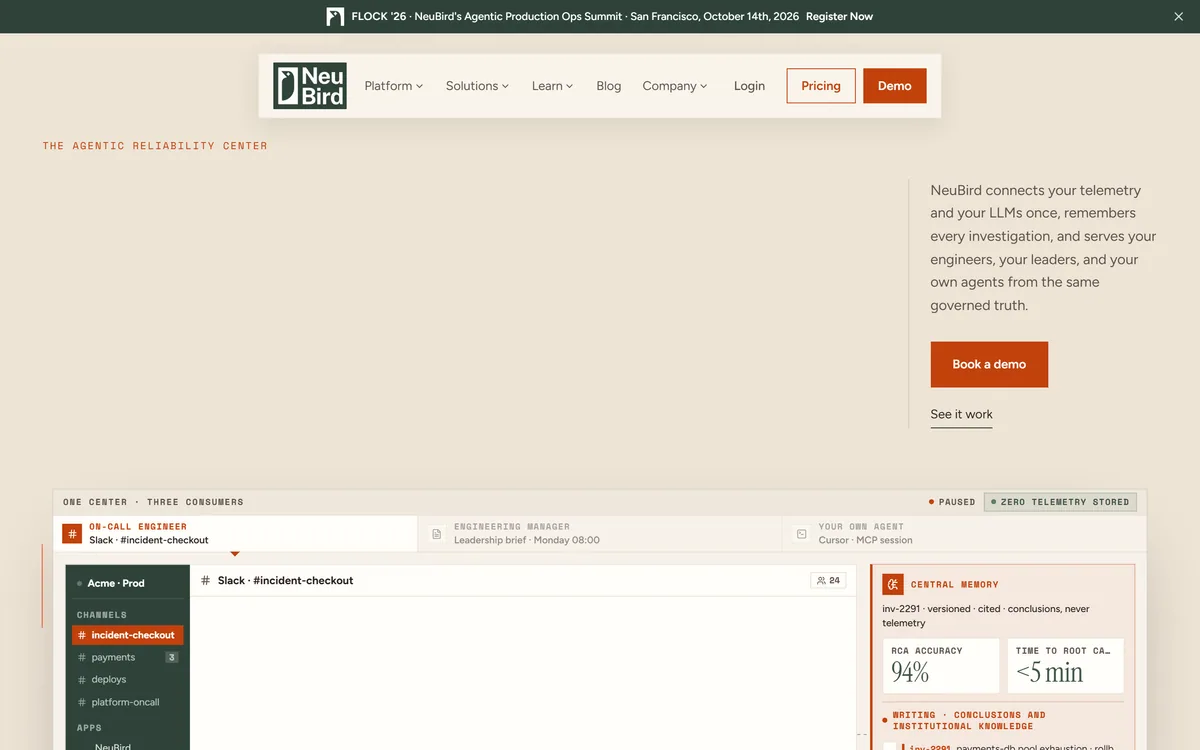
It describes itself as one center serving three consumers, the on-call engineer in Slack, the engineering manager's Monday brief, and your own agents over MCP, all from the same governed truth, which is a thoughtful way to avoid knowledge living in one person's head.
Every incident produces hard-won conclusions that usually evaporate into a Slack thread. NeuBird captures them as versioned, cited knowledge so the next person starts from what was learned.
How Does NeuBird Reach A Root Cause?
Two things make the claim credible: how it connects to your stack, and who it serves from that connection.
Connecting Telemetry And Your LLMs
You connect your telemetry and your own LLMs once, and NeuBird reasons over them to investigate incidents, citing the metrics, deploys and prior investigations it drew on. It reports strong figures, 94% RCA accuracy, under five minutes to root cause, which are vendor-stated and worth testing on your own incidents.
That connect-once model keeps your stack in place rather than replacing it. An error-monitoring tool like Sentry Seer focuses on catching errors; NeuBird focuses on the investigation and the memory of it.
Serving Engineers, Leaders And Agents
The same governed memory serves an on-call engineer asking 'have we hit payments-db pool exhaustion before?' in Slack, a leadership brief, and your own coding or ops agents over an MCP server, so everyone reasons from one cited source.
Feeding agents the same truth is the forward-looking part, as more ops work runs through agents. A change-verification tool like Resolve.ai tackles the reliability problem from another angle; NeuBird's bet is that shared, governed memory is the missing layer.
Where NeuBird Earns Its Keep On-Call
NeuBird earns its keep for teams with real incident volume and the pain of repeated, re-derived investigations: platform and SRE teams at mid-size to large engineering orgs where downtime and on-call toil are costly.
The memory angle pays off most where knowledge currently walks out the door with the engineer who solved it, so a team with turnover, or simply too many services for anyone to hold in their head, gains the most.
It fits less well a small team with rare incidents and a shared understanding, where the overhead of another platform outweighs the memory it builds, and anyone whose data policy forbids connecting telemetry and LLMs to an external service without heavy review.
How NeuBird Approaches Pricing
NeuBird is demo-led, with a book-a-demo and see-it-work motion rather than public self-serve pricing, which fits an enterprise reliability tool. We do not publish prices; there are none listed.
Its own framing, 'keep your stack, lose the overage bill', hints at positioning against the cost of heavy observability tooling, but the real value question is whether faster, remembered root-cause analysis reduces downtime and on-call hours enough to justify the spend.
Because that depends entirely on your incident volume and current toil, a scoped pilot on real incidents is the only honest way to size it.
A Direct Way To Trial NeuBird
Because the pitch is faster, remembered investigations, trial it on your real incidents and judge the memory over time.
- Connect a non-critical slice of telemetry and your LLMs in a scoped trial.
- Run it on a real, recent incident and check whether its root-cause reasoning is accurate and cited.
- Ask it about a past incident to test whether the memory genuinely recalls and reuses conclusions.
- Have an on-call engineer use it in Slack during a real alert and judge the time saved.
- Confirm with your security team that the no-telemetry-stored posture meets your policy.
- Pass/fail: NeuBird is worth it if it cuts time-to-root-cause and stops re-deriving known findings.
- Treat the 94% accuracy and sub-five-minute figures as vendor claims to verify on your incidents.
NeuBird Reliability Terms
- AI SRE
- AI for site-reliability engineering: software that helps investigate, diagnose and fix production reliability issues.
- RCA
- Root-cause analysis: finding the underlying reason an incident happened, not just the symptom.
- Telemetry
- The metrics, logs and traces a system emits; NeuBird reasons over it but states it stores conclusions, not the raw data.
- Governed memory
- A central, versioned, cited store of investigation conclusions that people and agents share.
Key features of NeuBird
Agentic root-cause analysis
Connect-once telemetry and LLMs
Central governed memory
Cited, versioned conclusions
On-call Slack assistant
Leadership briefs
MCP server for your agents
Conclusions-not-telemetry data handling
Pros & cons
Pros
5- Remembers investigations so knowledge is not re-derived
- Serves people and agents one cited truth
- Keeps your existing stack in place
- Thoughtful conclusions-not-telemetry posture
- Agent-ready via MCP
Cons
5- Overkill for small, low-incident teams
- Accuracy figures are vendor-stated
- Demo-led, no public pricing
- Needs real volume to build useful memory
- External connection needs security review
Best For
- SRE and platform teams
- Incident-heavy orgs
- Many-service estates
- Agent-served ops
- Knowledge-retention needs
NeuBird Against Other AI-SRE Tools
The useful comparison is with other reliability and ops approaches.
| Tool | Tool | Angle | Best for |
|---|---|---|---|
| NeuBird | Governed memory + RCA | Remembered, cited investigations | Incident-heavy platform teams |
| Cleric | AI SRE change verification | Catching regressions, on-call | Release reliability |
| Sentry Seer | AI error monitoring | Catching errors | Production errors |
| Resolve.ai | AI reliability agent | Investigation and response | Ops automation |
Is NeuBird Right For Your Ops?
Ops Teams NeuBird Fits
- Platform and SRE teams with real incident volume
- Orgs where investigation knowledge keeps getting re-derived
- Teams with too many services to hold in one head
- Groups that want agents served the same governed truth
- Those who value conclusions-not-telemetry data handling
When NeuBird Is Not Warranted
- Small teams with rare incidents and shared context
- Orgs that cannot connect telemetry/LLMs externally
- Anyone wanting a cheap, self-serve tool
- Teams who take the accuracy figures on faith
- Projects without the volume to build useful memory
How We Investigated NeuBird
Last checked . Read from neubird.ai during this check, with the screenshot above captured at the same time.
- An agentic reliability platform (AI SRE) for production incidents
- A connect-once model for your telemetry and your LLMs
- A central governed memory of versioned, cited investigations
- Service to engineers, leaders and your own agents
- An MCP server and Slack/IDE surfaces
- A stated position that it stores conclusions, not raw telemetry
- Vendor-stated 94% RCA accuracy and under five minutes to root cause
- A demo-led go-to-market
- No plan prices reproduced here, in line with this site's pricing policy
NeuBird's accuracy and time-to-root-cause figures are vendor-stated; verify them on your own incidents. Its no-telemetry-stored posture should be confirmed with your security team against your data policy.
Other Reliability And Ops Tools
An AI-SRE peer, an error monitor and a reliability agent to weigh alongside NeuBird.
- Cleric — AI-SRE change verification and on-call
- Sentry Seer — AI error monitoring
- Resolve.ai — an AI reliability and response agent
Editor's Verdict
4.1/5NeuBird earns 4.1 for a sharp idea in the crowded AI-SRE space: a governed memory that captures every investigation as cited, reusable knowledge and serves engineers, leaders and agents the same truth, while storing conclusions rather than your raw telemetry. Its accuracy and speed figures are vendor claims to verify, and it is overkill for small low-incident teams, but for incident-heavy platform teams the memory angle is genuinely valuable. AInexfinder Editor Score: 4.1/5.
NeuBird pricing
AInexfinder does not list plan prices or billing details. For current pricing, plans, and trials, visit the official NeuBird website.
Visit official website for pricingVendor pricing, credits, and billing policies change over time. Always confirm on the official site before you buy.
Frequently asked questions
What is NeuBird?
NeuBird is an agentic reliability platform, an AI SRE, that connects your telemetry and LLMs once, keeps a central governed memory of every production investigation, and serves engineers, leaders and your own agents the same cited truth. It aims for fast root-cause analysis while storing conclusions rather than raw telemetry.
What makes NeuBird different from other AI-SRE tools?
Its emphasis on memory. Rather than only investigating an incident, it captures the conclusions as versioned, cited institutional knowledge so the next engineer or agent starts from what was already learned, instead of re-deriving context that evaporated into a Slack thread.
Does NeuBird store my telemetry?
The vendor states it stores conclusions and institutional knowledge, not your raw telemetry, so it keeps findings like 'checkout p99 trails payments-db failover by ~40s' rather than your underlying metrics. Confirm this data-handling posture with your security team against your own policy before connecting.
How accurate is NeuBird's root-cause analysis?
It cites figures of 94% RCA accuracy and under five minutes to root cause, but these are vendor-stated. The honest way to judge them is a scoped trial on your own real incidents, checking whether its reasoning is accurate and properly cited, rather than taking the numbers on faith.
Who is NeuBird for?
Platform and SRE teams at mid-size to large engineering orgs with real incident volume, especially where investigation knowledge keeps getting re-derived or where there are too many services for anyone to hold in their head. It is overkill for small teams with rare incidents.
How is NeuBird priced?
It is demo-led, with a book-a-demo and see-it-work motion rather than public self-serve pricing, which fits an enterprise reliability tool. We do not publish prices; evaluate it with a pilot on real incidents and weigh it against your downtime and on-call costs.
Can NeuBird serve my own AI agents?
Yes. It exposes a central governed memory over an MCP server, so your own coding or ops agents can reason from the same cited source of truth as your engineers and leaders. Serving agents the same governed knowledge is one of its more forward-looking design choices.
Does NeuBird replace my observability stack?
No, it connects to it. Its framing is 'keep your stack', connecting your existing telemetry and LLMs once rather than replacing your observability tooling. It adds the investigation-and-memory layer on top rather than asking you to rip out what you have.
What is governed memory in NeuBird?
It is a central, versioned, cited store of investigation conclusions that both people and agents share, with context, guardrails and an audit trail. The 'governed' part means access and provenance are controlled, so the shared knowledge stays trustworthy rather than becoming an unmanaged dump.
Who should not use NeuBird?
Small teams with rare incidents and a shared understanding, where another platform's overhead outweighs the memory it builds; organisations whose data policy forbids connecting telemetry and LLMs externally without heavy review; and anyone wanting a cheap, self-serve tool rather than an enterprise, demo-led one.
Reviews
Log in to write a review.
User Reviews
No reviews yet. Be the first to share your experience with NeuBird.
Reviewed by Daniel Reed
Assigned reviewer
Daniel ReedSenior AI Tools Reviewer
Daniel reviews AI tools the slow way — by actually using them on real projects. His reviews cover what works, what breaks, and who each tool is genuinely a good fit for.
Hands-on reviewsProduct testingAI software
Daniel and the AInexfinder editorial team research NeuBird using public product information, listing evidence, and (when available) hands-on checks. Scores reflect listing completeness and transparency — not paid placement.
- Last verified
- Methodology
- How we review AI tools
- Sources used
- neubird.ai
- AInexfinder listing fields (features, pros/cons, description)
- Public vendor pages when available
- Editorial policy
- Listings may include affiliate or sponsored placements, which are labeled when present. Editorial scores and cons are not sold. See our affiliate disclosure and review methodology.
Related tools
Traversal is an AI site reliability engineering platform. It builds a dependency graph of production — what the vendor calls a Production World Model — and uses a causal search engine to triage alerts, perform evidence-backed root cause analysis across distributed systems, and drive automated remediation.
Parity review on AInexfinder — subscription AI tool for Coding & Development. Features, pricing notes, and alternatives.

GitHub Copilot is an AI coding assistant that spans completion, chat, agent mode, automated code review, and a cloud agent that opens pull requests, working across VS Code, Visual Studio, JetBrains, Xcode, Neovim, Eclipse, the CLI, and github.com.
FreemiumCoding & Development

Replit AI turns a written description into a working application — the Agent writes the code, and Replit supplies the database, authentication, hosting, and monitoring, so a prototype goes live without a local setup or a deployment pipeline.
FreemiumCoding & Development
CodeScene measures code with CodeHealth, a validated metric predicting defects and delivery performance. It states the average enterprise codebase scores 5.15 out of 10 while AI needs 9.5 to work reliably, and offers an MCP server, automated reviews and IDE feedback. Operated by CodeScene AB.
FreemiumCoding & Development
Explore More
Embed this listing on your site
Featured on AInexfinder