CodeScene measures code with CodeHealth, a validated metric predicting defects and delivery performance. It states the average enterprise codebase scores 5.15 out of 10 while AI needs 9.5 to work reliably, and offers an MCP server, automated reviews and IDE feedback. Operated by CodeScene AB.
codescene.com12 viewsAdded August 25, 20251K visitors
Technical debt has always been a hard argument to win. Everyone agrees it exists, nobody can size it, and the request to spend a quarter on refactoring loses every time to a feature with a date attached.
The reason is that debt was never measured in a way a non-engineer could act on. Complaints do not compete with roadmaps.
CodeScene's approach is to produce a number instead — a Code Health score with a published basis — and then to attach that number to something with immediate commercial weight: whether AI agents can work in your codebase at all.
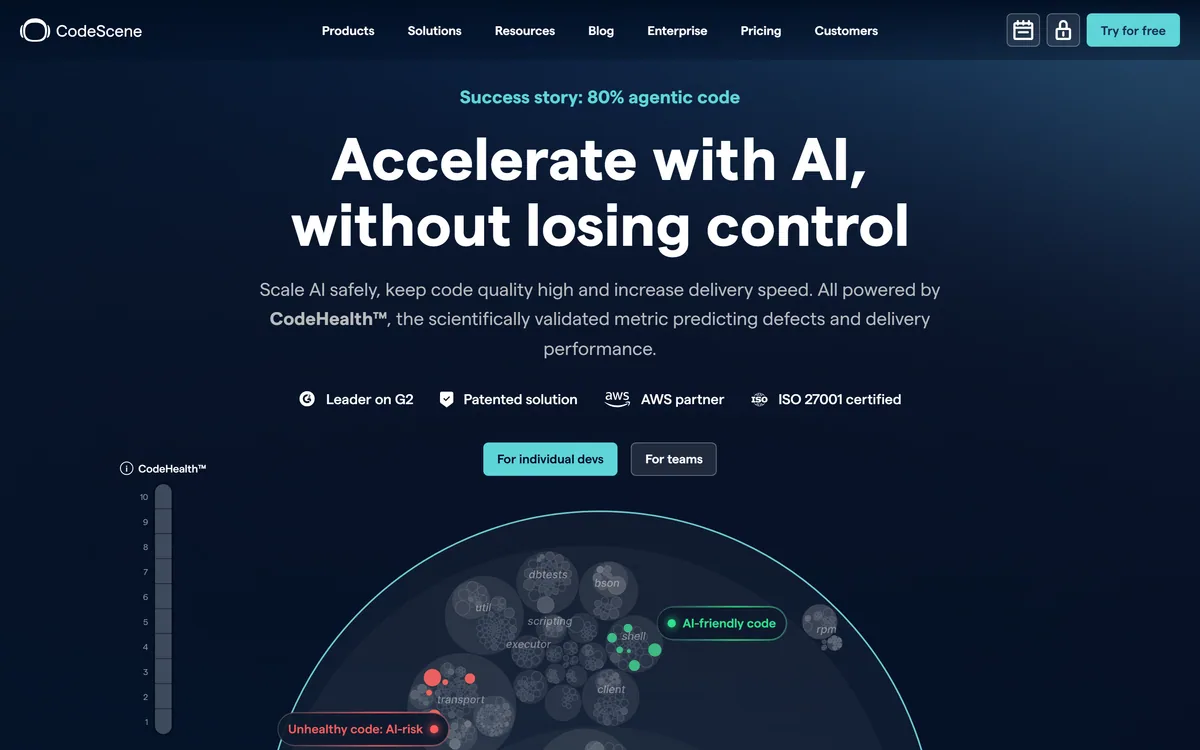
CodeScene's homepage, captured 9 September 2026, showing the CodeHealth scale from optimal to critical.
CodeScene: A Number For Code Health
CodeHealth is a 1–10 score the company describes as scientifically validated for predicting defects and delivery performance.
5.15 versus 9.5 — the stated average enterprise score against what the company says AI needs to work reliably.
Agents in unhealthy code are stated to introduce at least 60% more defects and burn up to 50% more tokens.
An MCP server puts the score inside your AI coding assistant, creating a self-correcting loop.
CodeScene AB, ISO 27001 certified, an AWS partner, with a patented solution per the site.
What Is CodeHealth And Why 9.5?
CodeScene describes CodeHealth as a scientifically validated metric predicting defects and delivery performance, expressed on a 1–10 scale. The site states the average enterprise codebase scores 5.15, and that AI needs 9.5 to work reliably.
The value of a single score is not precision — it is that it can be discussed by people who do not read the code. A team saying this module is a mess loses to a roadmap; a team saying this module scores 3 and the ones above 8 ship twice as fast has an argument.
The gap between 5.15 and 9.5 is doing the heavy lifting in the marketing, and it is worth reading carefully. It says that the typical enterprise codebase is not merely below ideal but far below the threshold at which the company claims AI assistance becomes dependable.
That is a strong claim and it should be treated as the vendor's position rather than settled fact. The direction is well supported by ordinary experience — agents do worse in tangled code — but the specific threshold is a number CodeScene has an interest in.
What makes it useful anyway is that it is falsifiable in your own repository. Score your codebase, look at where your agents already fail, and see whether the two correlate. That is a test you can run in an afternoon.
A team saying this module is a mess loses to a roadmap. A team saying this module scores 3 and the ones above 8 ship twice as fast has an argument.
Why AI Agents Struggle In Unhealthy Code
CodeScene states that AI agents introduce at least 60% more defects and burn up to 50% more tokens in unhealthy code.
The mechanism is not mysterious. An agent works from context, and unhealthy code is code where the context is expensive — long functions, deep nesting, duplicated logic, unclear names, behaviour spread across files with no obvious relationship.
Tokens are consumed reading all of that, which explains the cost figure directly. The defect figure follows from the same cause: an agent that cannot see the whole picture makes a locally reasonable change that breaks something it never read.
Human developers hit exactly the same wall, which is why this is not really an AI story. It is the old argument about maintainability with a new and more expensive consequence attached.
The practical implication is uncomfortable and correct: pointing agents at your worst code is the least effective place to use them, even though it is where the temptation is strongest. Review tooling such as cubic and DeepSource catches what comes out, but the cheaper intervention is improving what goes in.
Technical Debt As A Delivery Problem
CodeScene's framing is that technical debt matters where it impacts delivery, and its stated workflow is to prioritise and quantify debt, enforce standards with automated reviews, then prevent debt at the source with real-time IDE feedback.
Prioritisation is the part that separates this from a linter. Not all bad code costs anything — a badly written module nobody touches is a museum piece, not a liability, and refactoring it is wasted effort.
What costs money is bad code that changes often. Combining health with change frequency identifies the small number of files where debt is actually being paid for, and that list is usually far shorter than the list of files that are simply ugly.
The three-step structure then follows sensibly: find the expensive debt, stop new debt entering through automated review, and shift the feedback into the IDE so problems are caught before they are ever committed.
Real-time IDE feedback is the highest-leverage of the three, for the obvious reason that the cheapest moment to fix a design problem is while the person who created it still has it in their head.
Score your own repository before accepting any threshold as gospel.
Prioritise debt by change frequency, not by ugliness.
Point agents at your healthiest code first, not your worst.
Put the score in the IDE, where fixes are cheapest.
Watch for teams optimising the metric rather than the code.
The MCP Server And Self-Correcting Loops
CodeScene offers a CodeHealth MCP server, described as creating a self-correcting loop inside your AI coding assistant to safeguard AI-generated code and make legacy code AI-ready.
This is the most interesting product decision on the page. Rather than reporting on code after it exists, the metric becomes available to the agent while it is writing.
The loop matters because agents respond well to explicit criteria. An agent told only to make the tests pass will do that and nothing else; an agent that can query a health score has a second objective it can actually measure itself against.
It also changes who the tool is for. A dashboard is for engineering managers; an MCP server is for the developer and the agent, at the moment of writing, which is a much shorter path from measurement to behaviour.
The caution is the general one about optimising to a metric. An agent that can see a score will move the score, and moving a score is not identical to improving code — splitting a long function into four badly named short ones improves several standard measures and helps nobody.
What A Single Score Cannot Tell You
Every metric buys clarity by discarding information, and it is worth being explicit about what Code Health leaves out.
Architecture is the biggest omission. A codebase can be composed entirely of clean, well-named, low-complexity functions and still be a disaster because the boundaries between components are wrong, and no file-level measure sees that.
Test quality is the second. Coverage is measurable and quality is not — a suite that asserts nothing meaningful looks identical to a good one from outside, and it is the difference between change being safe and merely appearing safe.
Domain correctness is the third and largest. Code can be immaculate and compute the wrong thing, and no static measure has an opinion about whether your business logic matches the business.
None of this argues against the metric. It argues for treating it as one input among several — the same way observability data from tools like Langfuse tells you what your system did without telling you whether it should have.
Putting CodeScene In Front Of AI Code
The wrong way to adopt a code quality metric is to score everything, publish a league table, and watch teams start gaming it by Friday.
This sequence establishes the baseline privately and moves to enforcement only once people trust what the number means.
Score the repository once and keep the result within the team initially.
Cross-reference the lowest-scoring files against where your agents already produce bad output.
Rank debt by change frequency to find the files actually costing you money.
Uplift two or three of those before enabling any gate.
Turn on automated reviews for new changes only, so nobody is blocked by history.
Add the MCP server last, once the team agrees the score reflects reality.
Code Health Vocabulary
The terms CodeScene uses, and what each one actually measures.
undefined
undefined
undefined
undefined
undefined
undefined
CodeScene: Metric And Company
Operating company
CodeScene AB
Core metric
CodeHealth, on a 1–10 scale
Stated basis
Scientifically validated for predicting defects and delivery performance
Average enterprise score
5.15 out of 10, per the site
Threshold for AI
9.5, per the site
AI in unhealthy code
At least 60% more defects and up to 50% more tokens, per the site
Developer surface
CodeHealth MCP server inside AI coding assistants
Team surface
An AI Framework covering assessment, safeguarding, uplift and ROI tracking
Workflow
Prioritise debt, enforce automated reviews, prevent debt in the IDE
Credentials
ISO 27001 certified, AWS partner, patented solution, G2 leader, per the site
Last checked . Read from codescene.com in a browser session on the date above, with the screenshot captured alongside.
CodeHealth described as a scientifically validated metric predicting defects and delivery performance
Average enterprise codebase stated as scoring 5.15 out of 10
AI stated as needing 9.5 to work reliably
AI agents stated to introduce at least 60% more defects in unhealthy code
AI agents stated to burn up to 50% more tokens in unhealthy code
A CodeHealth MCP server described as creating a self-correcting loop in AI coding assistants
A three-step workflow described: prioritise debt, enforce CodeHealth reviews, prevent debt in the IDE
Badges displayed for G2 leader, patented solution, AWS partner and ISO 27001 certification
A success story referenced at 80% agentic code
Footer confirms CodeScene AB with Confidentiality, Terms & Conditions and Privacy Policy, and a 2026 copyright
What we could not confirm: the published research behind the validation claim, which the site references but which we did not read at source; how 5.15 and 9.5 were derived and across what sample; the methodology behind the 60% defect and 50% token figures; pricing and plan structure; which languages are supported and how well; and the referenced Gartner report and SonarQube comparison, which we saw named in navigation but did not open. We did not run CodeScene against a codebase, so no figure here is independently tested.
Should You Measure Code Health?
Measure it when
You keep losing the refactoring argument for lack of a number.
AI agents are producing worse results in some parts of your codebase than others.
You need to decide where to spend a limited remediation budget.
New debt is entering faster than you are removing it.
You want quality feedback in the IDE rather than in a report nobody opens.
Skip the metric when
Your codebase is small enough that everyone already knows where the problems are.
Your real issue is architecture or test quality, which a file-level score does not see.
Your organisation will turn any published score into a league table.
You need bugs found rather than health measured.
Nobody has capacity to act on the findings, in which case the score is decoration.
Editor's Verdict
4.2/5
CodeScene has done something most developer tools avoid: it committed to a number. Code Health is a single score, published methodology, validated against defect and delivery outcomes, and it produces uncomfortable answers — the stated average enterprise codebase sits at 5.15 out of 10 while the company argues AI agents need 9.5 to work reliably. That gap reframes technical debt from an engineering complaint into an AI-readiness problem, which is the most useful thing anyone has said about legacy code in two years. The risk with any single metric is that teams optimise the number instead of the code, and no tool can prevent that. AInexfinder Editor Score: 4.2/5.
CodeScene pricing
AInexfinder does not list plan prices or billing details. For current pricing, plans, and trials, visit the official CodeScene website.
Vendor pricing, credits, and billing policies change over time. Always confirm on the official site before you buy.
Frequently asked questions
What is CodeScene?
CodeScene is a code quality platform from CodeScene AB built around CodeHealth, a 1–10 score the company describes as scientifically validated for predicting defects and delivery performance. It offers automated reviews, IDE feedback and an MCP server that exposes the score to AI coding assistants.
What is CodeHealth?
A single 1–10 score for code quality. Its value is not precision but portability: a team saying a module is a mess loses to a roadmap, while a team saying it scores 3 and the modules above 8 ship twice as fast has an argument non-engineers can act on.
What does 5.15 versus 9.5 mean?
The site states the average enterprise codebase scores 5.15 out of 10 while AI needs 9.5 to work reliably. Treat the threshold as the vendor's position rather than settled fact — but it is falsifiable in your own repository by checking whether low-scoring files are where your agents already fail.
Why do AI agents do worse in unhealthy code?
Because context is expensive there. Long functions, deep nesting, duplication and behaviour spread across unrelated files consume tokens to read, which explains the stated 50% cost increase. An agent that cannot see the whole picture makes a locally reasonable change that breaks something it never read.
Should I point agents at my worst code?
It is the least effective place to use them, even though the temptation is strongest there. The cheaper intervention is improving what goes in — uplifting the two or three worst files that also change often — before expecting agents to work reliably in them.
How should I prioritise technical debt?
By change frequency, not ugliness. A badly written module nobody touches is a museum piece, not a liability. What costs money is bad code that changes often, and that list is usually far shorter than the list of files that merely look bad.
What does the MCP server add?
It makes the score available to an AI assistant while it writes, rather than reporting afterwards. Agents respond well to explicit criteria: one told only to make tests pass will do exactly that, while one that can query a health score has a second objective it can measure itself against.
What does a code health score miss?
Architecture, test quality and domain correctness. A codebase of clean, low-complexity functions can still be a disaster if the component boundaries are wrong; a test suite that asserts nothing looks identical to a good one; and immaculate code can compute the wrong thing entirely.
Will teams game the metric?
Some will, and no tool prevents it. Splitting a long function into four badly named short ones improves several standard measures and helps nobody. The mitigation is to keep the score out of performance conversations and inside engineering ones.
How should I roll it out?
Score once and keep the result within the team, cross-reference low scores against where agents already fail, uplift two or three high-churn files, then enable automated reviews for new changes only. Add the MCP server last, once people agree the score reflects reality.
Daniel reviews AI tools the slow way — by actually using them on real projects. His reviews cover what works, what breaks, and who each tool is genuinely a good fit for.
Daniel and the AInexfinder editorial team research CodeScene using public product information, listing evidence, and (when available) hands-on checks. Scores reflect listing completeness and transparency — not paid placement.
Listings may include affiliate or sponsored placements, which are labeled when present. Editorial scores and cons are not sold. See our affiliate disclosure and review methodology.
cubic reviews pull requests in GitHub and your IDE, enforces rules written in plain English, and learns from senior engineers' PR comment history. It runs thousands of agents nightly to scan an entire codebase for bugs, pulls context from Linear, JIRA, Notion and Confluence, and is free for public repositories.
Sourcery is an AI code-review tool that reviews every pull request in minutes, catching bugs, edge cases and security issues with one-click fixes, plus codebase security scanning, with a strong stance on keeping your code private.
Snyk Code is a static application security testing tool built for developers, using DeepCode AI to find vulnerabilities in the IDE in real time and Snyk Agent Fix to propose pre-validated fixes, including coverage for AI-generated code.
Korbit AI is an automated code-review tool that reviews pull requests inside GitHub, GitLab and Bitbucket, flagging bugs, security and design issues with fix explanations, writing PR descriptions and summaries, and generating team insights, without training on your code.
Codacy combines static analysis, SAST, SCA, secret scanning, IaC checks and test coverage in one platform, and has repositioned around AI-assisted engineering — detecting AI policy violations and unapproved model calls, with Codacy Guardrails embedding checks inside agentic workflows.