Korbit AI is an automated code-review tool that reviews pull requests inside GitHub, GitLab and Bitbucket, flagging bugs, security and design issues with fix explanations, writing PR descriptions and summaries, and generating team insights, without training on your code.
korbit.ai8 viewsAdded December 28, 202515K visitors
Code review is where quality is won or lost, and also where senior engineers lose hours and pull requests go stale waiting. Korbit AI takes the first pass so humans arrive at a cleaner PR.
It is an automated reviewer that works inside GitHub, GitLab and Bitbucket, flagging bugs, security and design issues, explaining how to fix each one, and writing the PR description and summary. It sits in the same space as review and quality tools like Sourcery, but is built around the pull-request conversation specifically.
This review covers what Korbit does on every PR, where it pays off for a team, how its pricing tiers work, and when it adds little.
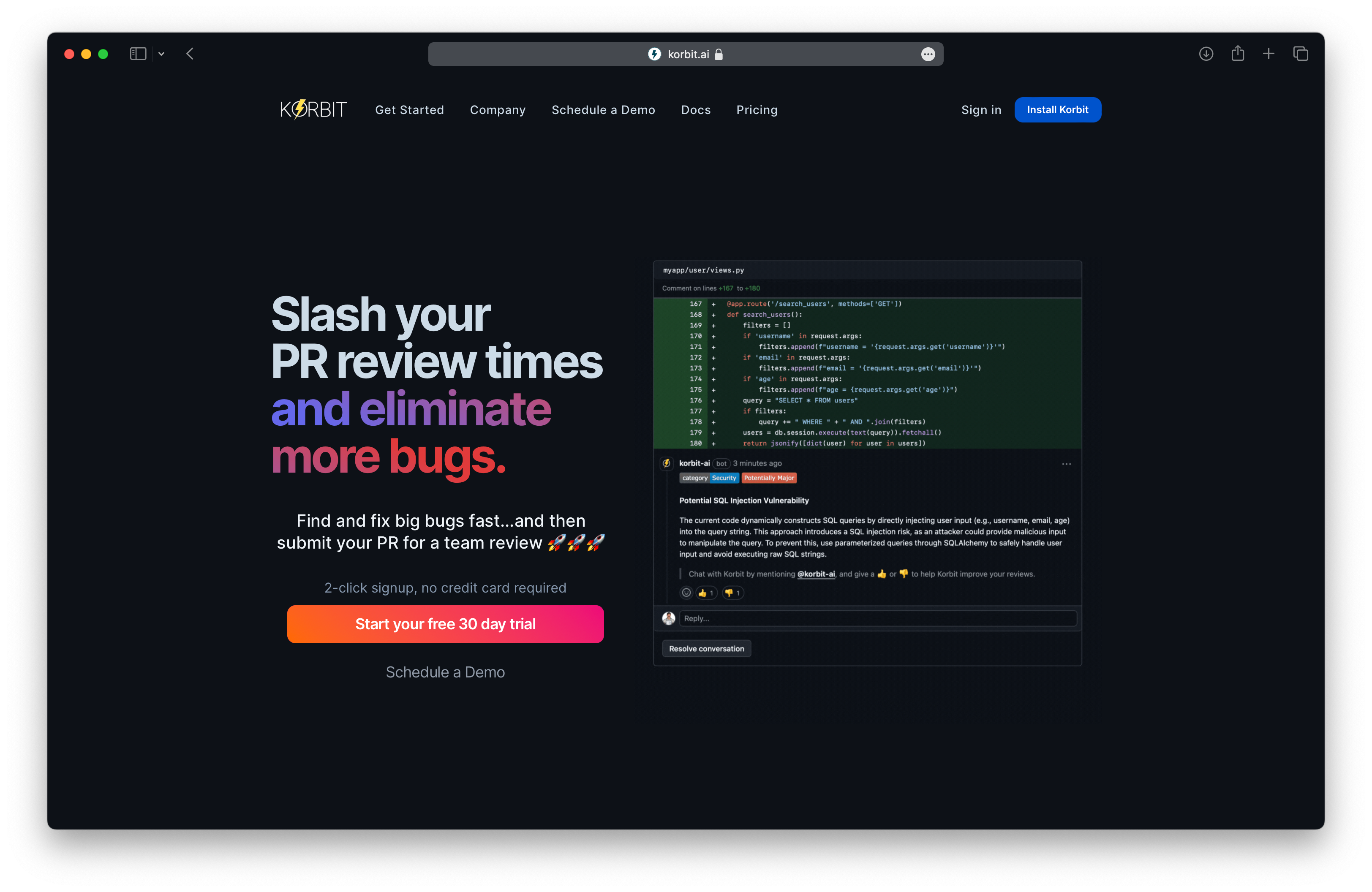
Korbit AI reviews each pull request and explains how to fix what it finds.
Korbit AI Code-Review Facts
What it is
An automated AI code reviewer
Works in
GitHub, GitLab and Bitbucket
Flags
Bugs, security and design issues, with fixes
Writes
PR descriptions and review summaries
Insights
Release notes, sprint recaps, 1:1 summaries
Chat
Ask Korbit questions about your codebase
Privacy
SOC 2 Type 2; no training on your code
Open source
Free for all open-source repositories
Korbit AI, The Short Read
Korbit AI is an automated code reviewer: it reviews every pull request inside GitHub, GitLab and Bitbucket before a person does.
It explains, not just flags: it describes the issue, suggests the fix, and responds to your comments in the PR.
It does the paperwork too: PR descriptions, review summaries and team insights like release notes and sprint recaps.
Your code stays yours: it states it is SOC 2 Type 2 and never trains any model on your code, with free use for open source.
An Automated Reviewer That Lives In Your Pull Requests
Korbit's design choice is to meet code where review already happens: the pull request. Rather than a separate dashboard, it comments inside the PR, so its feedback lands in the same place a human reviewer's would.
That placement is why it fits real workflows. Engineers do not have to go anywhere new; on each PR Korbit posts issues with explanations before a teammate even opens it, which means the human reviewer spends their time on judgement, not catching the obvious.
The company leans on a credible proof point: it shows live sample findings from real open-source repositories, so you can see the kind of issue it catches rather than take the claim on trust. That is a more honest demo than a polished reel.
Korbit meets code where review already happens, the pull request, so the human reviewer spends their time on judgement, not on catching the obvious.
What Does Korbit AI Do On Every PR?
The value is in combining the review itself with the surrounding paperwork that usually gets skipped.
Finding Issues And Explaining The Fix
Korbit flags high-impact issues across bugs, security and design, and crucially explains how to fix each one rather than just naming it. It also responds to developer comments inside the PR, so it behaves more like a reviewer than a linter.
The explain-the-fix behaviour is what makes it a training aid as well as a gate, especially for junior developers. A dedicated security scanner like Snyk Code goes deeper on vulnerabilities specifically; Korbit's breadth across issue types is its own strength.
Summaries, Insights And Asking The Codebase
Beyond the review, Korbit writes PR descriptions and summaries for faster handoffs, and generates team insights, release notes, sprint recaps, 1:1 summaries, with no extra work. An 'Ask Korbit' feature lets you chat with your codebase.
That reporting layer is where it starts to resemble engineering-intelligence tools like CodeScene, though Korbit's insights are a by-product of the review rather than the main event. For a lead, the automatic summaries are a quiet but real time-saver.
Where Korbit AI Pays Off For A Team
Korbit earns its place for teams where review is a bottleneck: fast-moving startups, teams with more PRs than senior reviewers, or anywhere pull requests sit waiting. It gives every PR an immediate first pass.
It is also a genuine training tool. Junior developers get instant, explained feedback and learn from it, which several of Korbit's own customers single out as the real benefit, not just bugs caught but skills built.
It matters less for a solo developer or a tiny team where a human reviews everything quickly anyway, though even there the auto-generated PR descriptions and the no-training-on-your-code pledge may appeal.
How Korbit AI Tiers Its Pricing
Korbit uses per-user subscription tiers, with Pro and a higher Max tier that adds things like custom policies, plus an Enterprise plan with on-prem options, billed monthly or annually, and a free trial of the top tier. Open-source repositories are free. We do not publish prices; check the site.
The value question for a team is whether the reviewer time it frees, plus the bugs caught before production, justifies a per-seat cost. Korbit's own figures, like the share of its suggestions that get implemented, are vendor-stated and best validated on your repos.
Because it is free for open source and offers a trial, the low-risk path is to run it on real code and measure the signal-to-noise before committing a team.
A Practical Way To Trial Korbit AI
A review bot lives or dies on signal versus noise, so judge it on real pull requests, not a demo repo.
Connect Korbit to a real repository on GitHub, GitLab or Bitbucket.
Let it review several genuine PRs and read whether the issues are real and high-impact.
Check the false-positive rate, the thing that makes teams ignore a review bot.
Read a Korbit-written PR description and summary to judge the handoff quality.
Have a junior developer act on the explained fixes and see if they learn from them.
Pass/fail: Korbit is worth it if it catches real issues without burying them in noise.
Confirm the SOC 2 and no-training commitments satisfy your security team before rollout.
Korbit AI Code-Review Terms
Pull request (PR)
A proposed set of code changes submitted for review before being merged; the unit Korbit reviews.
False positive
A flagged issue that is not actually a problem; a high rate is what makes teams stop trusting a review bot.
Custom policy
A team-defined coding rule Korbit can enforce on reviews, available on its higher tier.
No-training pledge
Korbit's stated commitment that none of your code is used to train any model, ever.
Key features of Korbit AI
AI review on every pull request
Issue flagging with fix explanations
Replies to comments inside the PR
Auto-written PR descriptions and summaries
Team insights and reports
Ask Korbit codebase chat
Custom policy enforcement on higher tiers
GitHub, GitLab and Bitbucket support
Pros & cons
Pros
5
Reviews inside the PR where work already happens
Explains fixes, doubling as a training aid
Automates PR descriptions and summaries
Clear no-training-on-your-code commitment
Free for open-source repositories
Cons
5
Initial false positives need tuning out
Does not replace human review
Limited value for solo developers
Deep security analysis is better served elsewhere
Headline stats are vendor-stated
Best For
Teams with a review bottleneck
Groups upskilling junior developers
High-PR, low-reviewer teams
Security-conscious engineering orgs
Open-source maintainers
Korbit AI Against Other Review Bots
The useful comparison is with other code-quality and engineering-intelligence tools.
Groups with more pull requests than senior reviewers
Teams that want to upskill junior developers
Anyone wanting PR descriptions written automatically
Security-conscious teams who need a no-training pledge
When Korbit AI Adds Little
Solo developers who review everything quickly anyway
Teams unwilling to tune out an initial false-positive rate
Shops not using GitHub, GitLab or Bitbucket
Groups wanting deep security analysis as the main goal
Anyone expecting it to replace human review entirely
How We Vetted Korbit AI
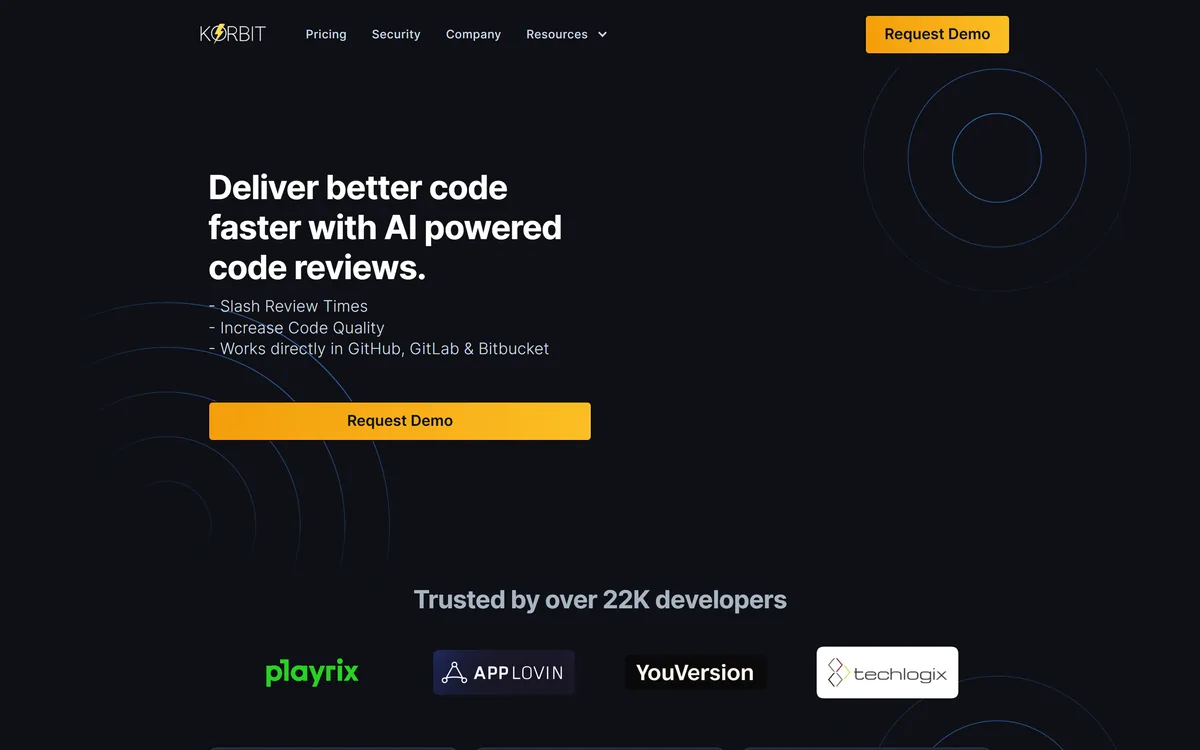
Last checked . Read from korbit.ai during this check, with the screenshot above captured at the same time.
An automated AI code reviewer working inside pull requests
Integration with GitHub, GitLab and Bitbucket
Issue flagging across bugs, security and design, with fix explanations
Replies to developer comments inside the PR
Auto-generated PR descriptions and review summaries
Team insights such as release notes and sprint recaps
A stated SOC 2 Type 2 posture and no training on your code
Free use for open-source repositories plus paid per-user tiers
No plan prices reproduced here, in line with this site's pricing policy
Korbit's figures, such as the share of suggestions implemented, are vendor-stated; validate signal-to-noise on your own repositories before a team rollout.
Other Coding And Review Tools
A review-and-refactor tool, a security scanner and an engineering-intelligence platform to weigh alongside Korbit.
Sourcery — code review and refactoring suggestions
CodeScene — code-health and technical-debt intelligence
Editor's Verdict
4.1/5
Korbit AI earns 4.1 for reviewing every pull request where review actually happens, flagging real issues with explained fixes, writing the PR paperwork, and doubling as a training aid for junior developers, all with a clear no-training-on-your-code pledge and free access for open source. It does not replace human review and needs its false-positive rate tuned, but for teams where review is a bottleneck it is a strong first pass. AInexfinder Editor Score: 4.1/5.
Korbit AI pricing
AInexfinder does not list plan prices or billing details. For current pricing, plans, and trials, visit the official Korbit AI website.
Vendor pricing, credits, and billing policies change over time. Always confirm on the official site before you buy.
Frequently asked questions
What is Korbit AI?
Korbit AI is an automated code-review tool that reviews pull requests inside GitHub, GitLab and Bitbucket. It flags bugs, security and design issues, explains how to fix each one, writes PR descriptions and summaries, and generates team insights, all before a human reviewer opens the PR.
Which platforms does Korbit AI work with?
It integrates with GitHub, GitLab and Bitbucket, posting its review as comments inside the pull request. Higher tiers add options like Slack-delivered insights and on-prem installation for enterprise, but the core review happens in your existing version-control workflow.
Does Korbit AI train on my code?
The site states that none of your code is used to train any model, ever, and that Korbit is SOC 2 Type 2 compliant. For any sensitive codebase you should still confirm the current terms with your security team, but the stated posture is clear.
Does Korbit AI replace human code review?
No, and it is better thought of as a first pass. It catches obvious and high-impact issues before a teammate reviews, so humans spend their time on judgement. The best results come from pairing Korbit with, not substituting it for, human review.
Is Korbit AI good for junior developers?
Yes, that is one of its clearer strengths. Because it explains how to fix each issue rather than just flagging it, and replies to comments, juniors get instant, teaching feedback inside the PR, which several of Korbit's customers highlight as a real benefit.
How much does Korbit AI cost?
It uses per-user subscription tiers, including Pro and a higher Max tier with custom policies, plus an Enterprise plan with on-prem options, and a free trial of the top tier. Open-source repositories are free. We do not publish prices; check the site.
Will Korbit AI flood my PRs with false positives?
Any review bot produces some noise initially, and a high false-positive rate is what makes teams ignore one. Korbit positions itself around fewer false positives and high-impact findings, but you should measure the signal-to-noise on your own repositories before a wide rollout.
Is Korbit AI free for open source?
Yes. Korbit states it is free for all open-source repositories, which lets maintainers add automated review at no cost and gives everyone else a low-risk way to see the quality of its findings on real, public code before paying for private repos.
What are Korbit Insights?
Insights are reports Korbit generates as a by-product of reviewing, including release notes, sprint recaps, 1:1 summaries and team reports. They keep leads and stakeholders informed without extra work, turning review activity into readable summaries automatically.
Who should not use Korbit AI?
Solo developers or tiny teams who review everything quickly already, shops not on GitHub, GitLab or Bitbucket, and teams whose main need is deep security analysis, which a dedicated scanner handles better. Korbit shines most where review volume outstrips reviewers.
Daniel reviews AI tools the slow way — by actually using them on real projects. His reviews cover what works, what breaks, and who each tool is genuinely a good fit for.
Daniel and the AInexfinder editorial team research Korbit AI using public product information, listing evidence, and (when available) hands-on checks. Scores reflect listing completeness and transparency — not paid placement.
Listings may include affiliate or sponsored placements, which are labeled when present. Editorial scores and cons are not sold. See our affiliate disclosure and review methodology.
CodeScene measures code with CodeHealth, a validated metric predicting defects and delivery performance. It states the average enterprise codebase scores 5.15 out of 10 while AI needs 9.5 to work reliably, and offers an MCP server, automated reviews and IDE feedback. Operated by CodeScene AB.
cubic reviews pull requests in GitHub and your IDE, enforces rules written in plain English, and learns from senior engineers' PR comment history. It runs thousands of agents nightly to scan an entire codebase for bugs, pulls context from Linear, JIRA, Notion and Confluence, and is free for public repositories.
Sourcery is an AI code-review tool that reviews every pull request in minutes, catching bugs, edge cases and security issues with one-click fixes, plus codebase security scanning, with a strong stance on keeping your code private.
Snyk Code is a static application security testing tool built for developers, using DeepCode AI to find vulnerabilities in the IDE in real time and Snyk Agent Fix to propose pre-validated fixes, including coverage for AI-generated code.
Codacy combines static analysis, SAST, SCA, secret scanning, IaC checks and test coverage in one platform, and has repositioned around AI-assisted engineering — detecting AI policy violations and unapproved model calls, with Codacy Guardrails embedding checks inside agentic workflows.