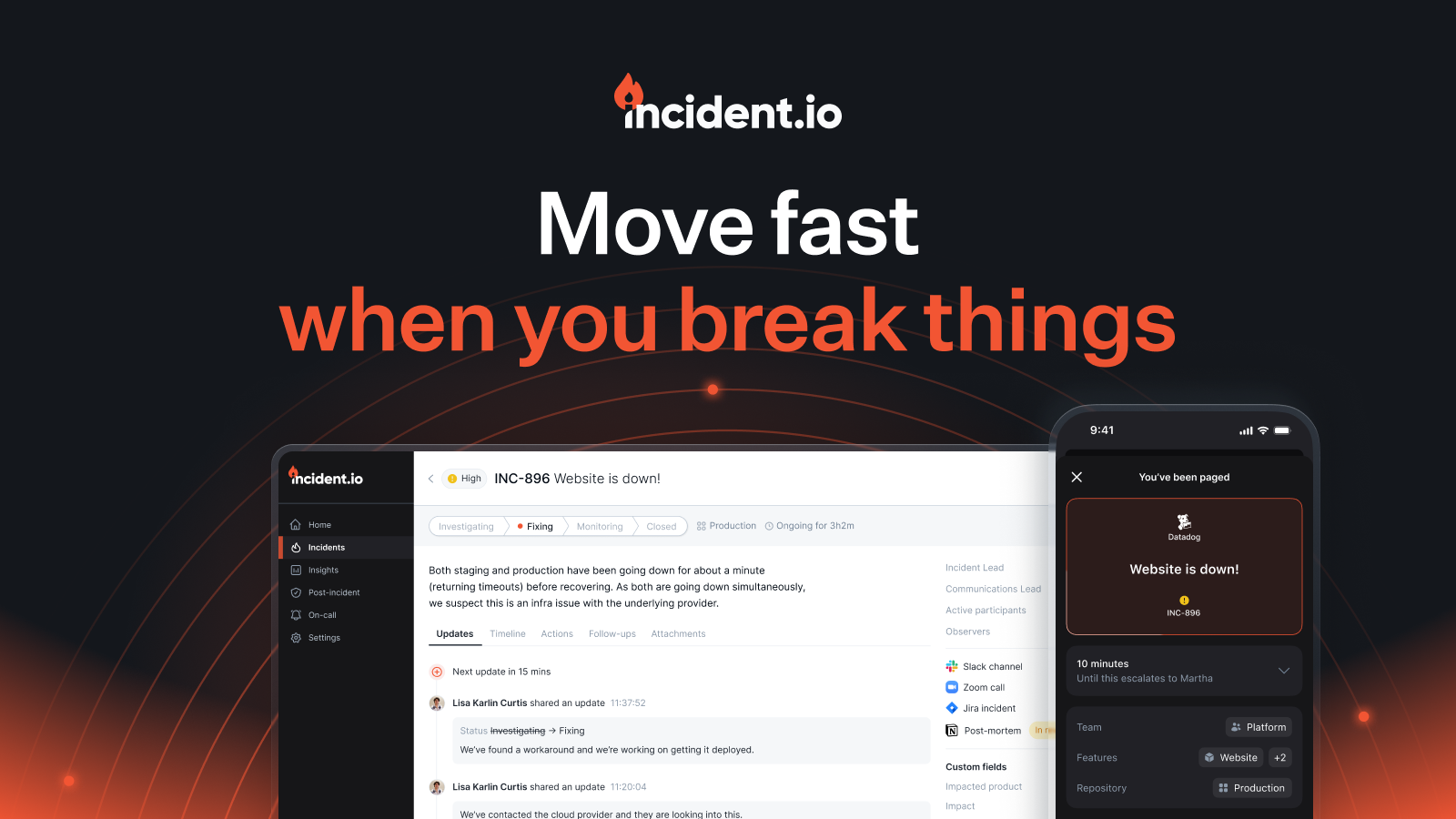
Resolve.ai puts AI agents into software operations: triaging alerts, investigating incidents alongside engineers to find root cause, and running operational workflows on a schedule or trigger. It is sold to large engineering organisations, with Coinbase, DoorDash, Snowflake and Robinhood among its named customers.
incident.io AI SRE
Verified
AI that resolves incidents like your best engineer Category: Coding & Development.
4.5Editor Score
incident.io2 viewsAdded May 28, 202611K visitors
incident.io AI SRE is a subscription product listed on AInexfinder for people who need AI that resolves incidents like your best engineer. If you are searching for a incident.io AI SRE review, what incident.io AI SRE is, or how incident.io AI SRE works in real projects, this page explains the product in plain language using the details on its listing — without restating the feature cards and pros/cons blocks that already appear on this page.
AI that resolves incidents like your best engineer Category: Coding & Development. In short, incident.io AI SRE is aimed at getting you from a clear task to a usable result with less manual busywork.
Searchers comparing incident.io AI SRE alternatives usually want three answers: what the tool is for, whether the workflow matches theirs, and what trade-offs show up after the first week. This incident.io AI SRE review is written for that decision — not as a sales page, and not as a copy of the bullet lists further down the page.
How incident.io AI SRE works
At a high level, incident.io AI SRE is built around a simple loop: you bring a clear input (a brief, a file, a prompt, or a task), you guide the process with the controls the product exposes, and you take away a draft or result you can refine. The exact input depends on the job — for example multi-agent autonomous investigation of alerts and incidents — but the evaluation method stays the same: run one real task end-to-end and see if the output is usable.
In practice, people often start with multi-agent autonomous investigation of alerts and incidents, then shape the output until it matches the job. Another part of the loop is root-cause analysis correlating code, logs, metrics, and traces, which keeps the work moving without rebuilding the process from scratch each time.
incident.io AI SRE also surfaces drafts code fixes and opens pull requests from Slack, so teams can keep quality consistent across runs. When the task is more complex, natural-language Q&A about systems and incidents becomes the control that separates a rough draft from something you can actually ship.
Because incident.io AI SRE is a subscription product, your first session should also test whether free limits (if any) or plan boundaries affect the task you care about. The listing describes the commercial model; this review focuses on how the work feels once you are inside the product.
Where incident.io AI SRE fits in a workflow
incident.io AI SRE is most useful when it plugs into a step you already do repeatedly: drafting, generating, editing, analyzing, automating, or preparing assets for a team. If your process is one-off and highly custom, a general-purpose assistant might be enough. If you keep returning to the same job, a focused product like incident.io AI SRE can reduce setup time and keep results more consistent.
On this listing, the intended audiences include themes such as users who need multi-agent autonomous investigation of alerts and incidents, users focused on root-cause analysis correlating code, logs, metrics, and traces, users focused on drafts code fixes and opens pull requests from Slack, and teams that need natural-language Q&A about systems and incidents. Treat those as starting hypotheses: the right test is whether incident.io AI SRE shortens your real cycle time on a task you will repeat next week.
A practical pattern: pick one “golden path” task, write down the input you will use, define what “good enough” looks like, and run incident.io AI SRE against that bar. That single experiment beats scanning feature names. If incident.io AI SRE clears the bar with less rework than your current stack, it earns a longer trial.
What incident.io AI SRE handles well
The strengths below are framed as outcomes, not a second feature list. The Key features and Pros cards on this page already inventory the listing facts; here the goal is to explain what those facts mean when you are mid-project.
For many teams, the value shows up because deep integration with Slack, Teams, and existing incident workflows. Day to day, it helps that investigates across many data sources for faster root cause.
Reviewers often notice that part of a unified platform covering on-call, response, and status pages. A practical upside is that multi-agent autonomous investigation of alerts and incidents.
On the capability side, multi-agent autonomous investigation of alerts and incidents is one of the reasons people shortlist incident.io AI SRE instead of a generic alternative. On the capability side, root-cause analysis correlating code, logs, metrics, and traces is one of the reasons people shortlist incident.io AI SRE instead of a generic alternative.
On the capability side, drafts code fixes and opens pull requests from Slack is one of the reasons people shortlist incident.io AI SRE instead of a generic alternative.
For SEO-minded readers evaluating “is incident.io AI SRE any good,” quality usually means consistency under your constraints: speed, control, export format, and how much cleanup you still do. Run the same task twice. If incident.io AI SRE stays stable and the edits you make are small, that is a stronger signal than a polished marketing page.
Limits and trade-offs with incident.io AI SRE
No serious incident.io AI SRE review should skip limits. The Cons card on this page captures listing trade-offs; the notes here explain how those trade-offs show up while you work, without dramatic language.
A realistic trade-off is that per-user pricing can grow with larger teams and add-ons. Before you commit, remember that AI-suggested fixes still require human validation before applying.
Like most focused tools, incident.io AI SRE is not perfect: worth comparing plans before long-term commit. It is fair to note that cost can add up if you only need a few features.
Also plan for the usual AI-tool realities: edge cases need judgment, templates can feel generic until you add your own examples, and team rollout goes smoother when one person owns the first playbook. incident.io AI SRE is strongest when you treat it as leverage on a defined job, not as a replacement for domain expertise.
Getting started with incident.io AI SRE
A clean first hour with incident.io AI SRE looks like this: open the product with one real task, ignore optional settings until you have a first draft, then tighten controls only where quality slips. Save a before/after note so you can compare against your previous process. That note becomes your internal “should we keep incident.io AI SRE?” evidence.
On day one, focus on multi-agent autonomous investigation of alerts and incidents and root-cause analysis correlating code, logs, metrics, and traces. Those are enough to see whether the workflow matches your muscle memory. On day two, explore secondary controls only if the first path already saves time.
If incident.io AI SRE is a subscription product, map your expected monthly volume in the first week. Limits, credits, or plan gates matter more after the novelty fades. Keep the evaluation tied to throughput you actually need.
Is incident.io AI SRE a good fit for your team?
incident.io AI SRE is a better fit when you have a recurring job aligned with AI that resolves incidents like your best engineer, when you can define quality in concrete terms, and when someone will own the rollout for a few weeks. It is a weaker fit when your needs change every day, when you need deep custom development the listing does not describe, or when you expected an all-in-one suite rather than a focused tool.
A balanced way to decide: if the upside around “Deep integration with Slack, Teams, and existing incident workflows” outweighs the friction around “Per-user pricing can grow with larger teams and add-ons” on your actual task, keep testing. If the friction shows up every run, shortlist an alternative and compare side by side on the same input.
For buyers searching “incident.io AI SRE vs alternatives,” insist on identical prompts or source files. Directory pages like this one help you shortlist; a controlled bake-off tells you what to buy.
Notes for evaluating incident.io AI SRE
When you document a incident.io AI SRE trial for stakeholders, capture: the task, the input, the settings you used, the time spent, the edits required, and whether a teammate could repeat the result without you. Those notes turn a vague “it felt good” demo into a decision other people can trust.
Also separate product quality from category hype. incident.io AI SRE should be judged on the job listed for this page — AI that resolves incidents like your best engineer — not on whether it claims to do everything. Focused tools often win on reliability precisely because they refuse to be a Swiss army knife.
Finally, re-check this AInexfinder listing after your trial: features, pros, cons, and editor notes can help you brief a teammate, while your own test results should drive the final call. If incident.io AI SRE earns a place in your stack, write a one-page internal playbook so usage stays consistent as more people join.
Bottom line: incident.io AI SRE is worth a structured trial if your workload matches AI that resolves incidents like your best engineer and you can measure success on a real task within a week. Use this incident.io AI SRE review as context, use the cards below for scannable facts, and let a hands-on test decide whether it stays in your toolkit.
Key features of incident.io AI SRE
Multi-agent autonomous investigation of alerts and incidents
Root-cause analysis correlating code, logs, metrics, and traces
Drafts code fixes and opens pull requests from Slack
Natural-language Q&A about systems and incidents
Automated postmortem drafting with timelines and follow-ups
Native Slack and Microsoft Teams integration within a full incident platform
Pros & cons
Pros
4- Deep integration with Slack, Teams, and existing incident workflows
- Investigates across many data sources for faster root cause
- Part of a unified platform covering on-call, response, and status pages
- Multi-agent autonomous investigation of alerts and incidents
Cons
4- Per-user pricing can grow with larger teams and add-ons
- AI-suggested fixes still require human validation before applying
- Worth comparing plans before long-term commit
- Cost can add up if you only need a few features
Best For
- Users who need multi-agent autonomous investigation of alerts and incidents
- Users focused on root-cause analysis correlating code, logs, metrics, and traces
- Users focused on drafts code fixes and opens pull requests from Slack
- Teams that need natural-language Q&A about systems and incidents
- Users who need automated postmortem drafting with timelines and follow-ups
- Users who need native Slack and Microsoft Teams integration within a full incident
Editor's Verdict
4.5/5incident.io AI SRE has an AInexfinder Editor Score of 4.5/5.
incident.io AI SRE pricing
AInexfinder does not list plan prices or billing details. For current pricing, plans, and trials, visit the official incident.io AI SRE website.
Visit official website for pricingVendor pricing, credits, and billing policies change over time. Always confirm on the official site before you buy.
Frequently asked questions
What is incident.io AI SRE?
AI that resolves incidents like your best engineer Category: Coding & Development.
How much does incident.io AI SRE cost?
AInexfinder does not publish plan prices because vendor pricing changes frequently. Visit the official incident.io AI SRE website (incident.io/ai-sre) for current pricing, trials, and plans.
What are the main features of incident.io AI SRE?
Listed features include: Multi-agent autonomous investigation of alerts and incidents; Root-cause analysis correlating code, logs, metrics, and traces; Drafts code fixes and opens pull requests from Slack; Natural-language Q&A about systems and incidents; Automated postmortem drafting with timelines and follow-ups; Native Slack and Microsoft Teams integration within a full incident platform.
Are there alternatives to incident.io AI SRE?
Similar tools on AInexfinder include Resolve.ai, Traversal, NeuBird. See the alternatives and compare links on this page.
Reviews
Log in to write a review.
User Reviews
No reviews yet. Be the first to share your experience with incident.io AI SRE.
Reviewed by Daniel Reed
Assigned reviewer
Daniel ReedSenior AI Tools Reviewer
Daniel reviews AI tools the slow way — by actually using them on real projects. His reviews cover what works, what breaks, and who each tool is genuinely a good fit for.
Hands-on reviewsProduct testingAI software
Daniel and the AInexfinder editorial team research incident.io AI SRE using public product information, listing evidence, and (when available) hands-on checks. Scores reflect listing completeness and transparency — not paid placement.
- Last verified
- Methodology
- How we review AI tools
- Sources used
- incident.io/ai-sre
- AInexfinder listing fields (features, pros/cons, description)
- Public vendor pages when available
- Editorial policy
- Listings may include affiliate or sponsored placements, which are labeled when present. Editorial scores and cons are not sold. See our affiliate disclosure and review methodology.
Related tools
Traversal is an AI site reliability engineering platform. It builds a dependency graph of production — what the vendor calls a Production World Model — and uses a causal search engine to triage alerts, perform evidence-backed root cause analysis across distributed systems, and drive automated remediation.
NeuBird is an agentic reliability platform (AI SRE) that connects your telemetry and LLMs once, remembers every investigation in a central governed memory, and serves engineers, leaders and your own agents the same cited truth, aiming for sub-five-minute root cause without storing your telemetry.
Parity review on AInexfinder — subscription AI tool for Coding & Development. Features, pricing notes, and alternatives.

GitHub Copilot is an AI coding assistant that spans completion, chat, agent mode, automated code review, and a cloud agent that opens pull requests, working across VS Code, Visual Studio, JetBrains, Xcode, Neovim, Eclipse, the CLI, and github.com.
FreemiumCoding & Development

Replit AI turns a written description into a working application — the Agent writes the code, and Replit supplies the database, authentication, hosting, and monitoring, so a prototype goes live without a local setup or a deployment pipeline.
FreemiumCoding & Development
Compare:incident.io AI SRE vs Resolve.aiincident.io AI SRE vs Traversalincident.io AI SRE vs NeuBirdincident.io AI SRE vs Parity
incident.io AI SRE alternatives Explore More
Embed this listing on your site
Featured on AInexfinder