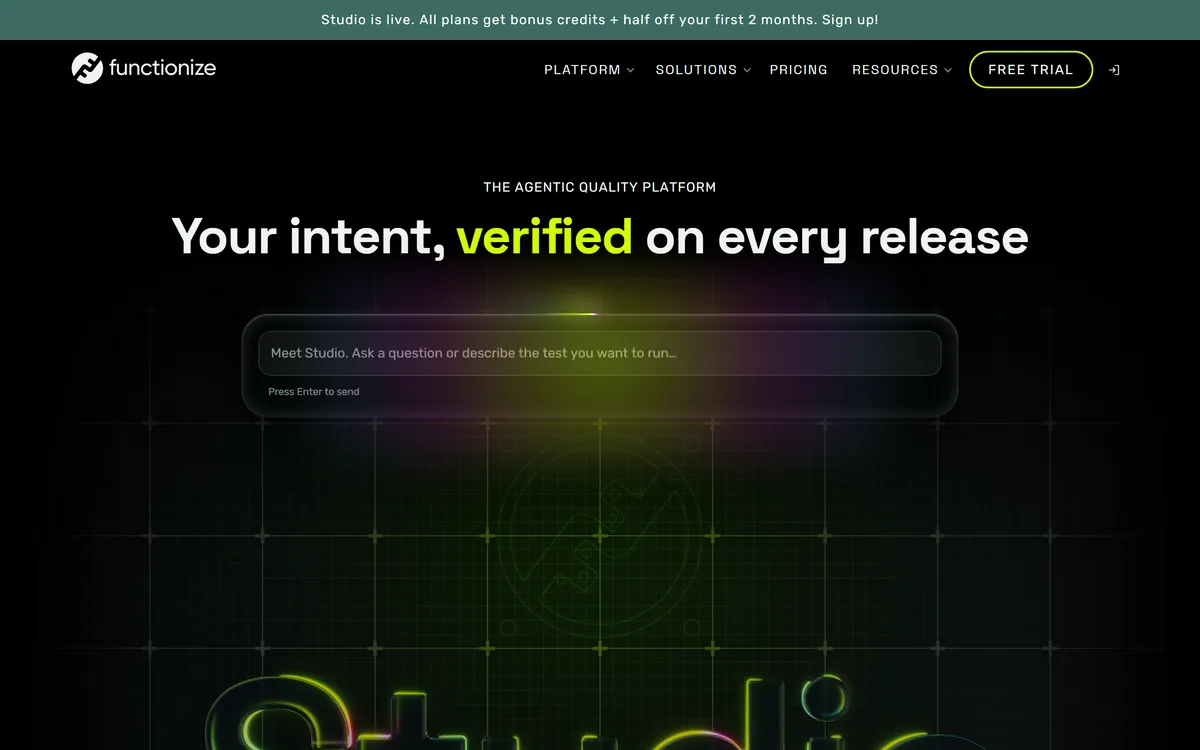
Functionize is an AI-native test automation platform for enterprise web applications. Its Studio product uses autonomous agents to create and run end-to-end UI tests, with self-healing element resolution built on custom models rather than brittle selectors, across Salesforce, ServiceNow, Workday, SAP and bespoke apps.
functionize.com9 viewsAdded April 9, 202623K visitors
Test automation has one universal failure mode and everyone who has maintained a suite knows it. The tests break, constantly, and almost never because the application is broken.
A developer renames a CSS class. A framework upgrade restructures the DOM. A dynamically generated ID changes between builds. Two hundred tests go red, an engineer spends a day discovering that nothing is actually wrong, and the team's trust in the suite drops another notch.
That maintenance burden is the reason automation efforts stall, and it is the problem Functionize has been working on since 2014. This review covers how the model-based approach differs from a selector, why the AI-written-code positioning is more than repositioning, what the enterprise application focus tells you about who this is for, and what to test before you believe the maintenance claims.
The pitch has shifted with the market: agents write the code, so something has to prove it works.
Company, Product And Coverage
Company
Functionize, founded 2014, headquartered in San Francisco
Category
AI-native end-to-end test automation and autonomous QA
Current product
Functionize Studio
Positioning
The quality layer for AI-written code, described by the vendor as generative intent with a deterministic core
Element resolution
Vendor states more than 200 data points per element
Model approach
Custom-built models rather than wrapped general-purpose ones, per the vendor
Self-healing
Tests adapt to application changes rather than failing on a changed selector
Learning behaviour
Vendor states the system trains on your application with each run
Enterprise applications supported
Salesforce, ServiceNow, Workday, SAP and bespoke applications
$41 million Series B, total funding reported above $67 million
Series B investors
Led by Mumford Investments and LHH Investments, with participation from Wipro Ventures
Plan tiers
Individual, Team and Enterprise
Autonomous QA, Condensed
Functionize is an AI-native test automation platform that creates, runs and maintains end-to-end tests for web applications without hand-written selectors, sold to enterprises rather than to individual developers.
Studio is the current product, positioned explicitly as the quality layer for code written by AI agents — the vendor's own line is that agents write the code and Studio proves it works.
Element resolution uses more than 200 data points per element, which is the mechanism behind self-healing: a test survives a changed ID because the ID was never the only thing identifying the element.
It targets the hardest enterprise applications — Salesforce, ServiceNow, Workday, SAP — where dynamic DOM structures defeat conventional automation.
Founded in 2014 and San Francisco-based, with a $41 million Series B taking total funding past $67 million, and customers including McAfee, ServiceNow, Conduent and Norstella.
Why Selectors Break And What Replaces Them
Conventional browser automation, including anything you would write with help from GitHub Copilot, identifies elements by a selector — a CSS path, an XPath expression, an ID. The test says click the element matching this string, and the string is the entire basis of the identification.
This works perfectly until the string changes, and in a modern application the string changes constantly. Component libraries generate class names at build time. React and Angular restructure the DOM as state changes. Enterprise platforms produce IDs that are different on every page load by design.
The result is a test suite where failures carry almost no information. Red means something changed somewhere, and an engineer has to investigate every one to find the rare failure that represents a real defect.
Functionize identifies elements by many attributes at once instead, with the vendor stating over 200 data points per element. testRigor reaches a similar place by a different route, describing the element in plain English rather than in a selector. Position, size, colour, text content, surrounding elements, accessibility attributes, the shape of the containing structure.
When one of those changes, the element is still identifiable from the other 199. That is what self-healing means in practice: not that the system guesses, but that the identification was never dependent on a single fragile string in the first place.
The trade-off is worth naming. A test that adapts to change can adapt to a change that was actually a bug. If a button moves to a different part of the page and the test finds it anyway and passes, the suite has just hidden a regression.
A selector is one string. Two hundred data points is a description. The difference is whether a renamed CSS class costs you a day.
The AI-Written-Code Positioning Is Not Just Marketing
Functionize now frames itself as the quality layer for AI-written code, with the line that agents write the code and Studio proves it works. It would be easy to read that as riding a wave. It is more substantial than that.
The argument runs like this. When a human writes code, verification is distributed through the process — they understood the requirement, they reasoned about the edge cases, they ran it locally, a colleague reviewed it. Testing catches what slipped through a chain of human judgement.
When an agent writes the code, most of that chain is gone. The code arrives faster, in larger volumes, and often without anyone having read it line by line. Whatever confidence exists has to come from somewhere else.
That makes independent verification more valuable, not less — and specifically verification against intent rather than against implementation. A unit test written by the same agent that wrote the code — or drafted with a general model like Claude from that same code — tests whether the code does what the code does. It cannot catch the case where the agent misunderstood the requirement.
End-to-end tests driven from stated intent, exercising the application the way a user would, are the natural check on that failure. The vendor's phrase for the architecture — generative intent with a deterministic core — is the right shape: agents interpret what you meant, but the verification itself has to be repeatable or it verifies nothing.
It also explains the emphasis on Studio being independent. A testing agent that shares the code-writing agent's assumptions is not a second opinion.
Salesforce, SAP And The Applications Nobody Wants To Test
The named enterprise platforms tell you a lot about where this product is aimed and why it can charge enterprise prices.
Salesforce, ServiceNow, Workday and SAP are among the most difficult applications in existence to test automatically, and for structural reasons rather than incidental ones.
They generate their DOM dynamically with unstable identifiers. They are heavily customised per organisation, so no two deployments look alike and no shared test library exists. They update on the vendor's schedule rather than yours, meaning your tests break on a timetable you do not control. And they are frequently the systems running payroll, revenue or case management, where a regression is a business incident rather than a bug.
Most teams respond by testing these manually, which means a room of people clicking through workflows before every release — expensive, slow, and the reason release cadence on these systems is measured in months.
A tool that genuinely automates this is solving an expensive problem for a customer with budget. The named customers fit that shape exactly: McAfee, ServiceNow itself, Conduent, Norstella, Banjo Health and Uponor are enterprise organisations with substantial regulated software estates.
ServiceNow appearing as a customer is a particularly useful signal, since testing ServiceNow is one of the harder cases the product claims to handle.
Dynamically generated DOM structures with unstable element identifiers
Deep per-organisation customisation, so no shared test assets exist
Vendor-controlled update schedules that break tests on someone else's calendar
Business-critical workflows where a regression is an incident rather than a bug
Long manual regression cycles that gate the release cadence
Reading The Published Outcome Claims
Four figures appear prominently and all four are vendor claims. They are worth reading for what they imply about the product rather than as forecasts.
Ten times productivity and 75% faster time to market are the kind of headline numbers that only make sense against a stated baseline, which is not published. A team moving from fully manual regression testing could plausibly see something like this; a team with a working automated suite will not.
80% less maintenance burden is the most interesting one, because maintenance is the actual problem this category exists to solve. It is also the most testable — you can measure it directly by counting how many test failures in a month were real defects versus broken selectors.
Test execution from hours to minutes is largely a claim about parallel cloud execution rather than about AI, and it is the least differentiated of the four. Most modern platforms do this.
The right way to use these numbers is as a specification for your own pilot. Pick the one that matters to you, measure your current baseline before you start, and hold the pilot to it.
Measure your current state first: test count, monthly failure count, and how many of those failures were real defects.
Pick your five most brittle existing tests — the ones that break most often for no reason.
Rebuild exactly those in Studio and run them against your normal release cadence for a full month.
Count how many times each broke and, critically, how many breaks were genuine regressions.
Deliberately introduce a real defect and confirm the suite catches it, because a self-healing test that heals past a bug is worse than a brittle one.
The Cautions Before A Pilot
Four, and the first is the one people underestimate.
Self-healing can hide regressions. This is the inherent tension in the approach. A test that adapts to a changed application will sometimes adapt to a change that was a defect. Ask specifically how the system distinguishes an acceptable adaptation from a failure, and what it surfaces for review when it heals.
Custom models mean less portability. Tests built on a proprietary platform do not migrate to Playwright or Selenium. That is a real lock-in consideration, and the counter-argument — that hand-written suites are also difficult to migrate — is true but weaker.
This is priced and shaped for enterprises. There are Individual and Team tiers, but the product, the customer list and the funding all point at large organisations with complex application estates. A small team testing a straightforward React app is likely better served elsewhere.
The vendor claims and the demos are not your application. Every test automation tool demos beautifully on a clean example. The only meaningful evaluation is on the specific screens in your own system that currently break most often.
Testing Terms Used Loosely In This Market
Four phrases recur across every vendor in this category and mean subtly different things depending on who is saying them.
Self-healing
A test that continues to work when the application changes, by identifying elements from many attributes rather than one selector. It is a maintenance feature, and it carries the risk of healing past a genuine regression.
Flaky test
A test that passes and fails intermittently without any change to the code. Flakiness is what destroys a team's trust in a suite, usually faster than outright failures do.
End-to-end test
A test that drives the real application through a complete user workflow, rather than testing a function in isolation. The slowest and most valuable kind.
Deterministic core
Functionize's term for the verification layer being repeatable even though the test authoring is generative. A non-deterministic test is not a test.
Key features of Functionize
Autonomous agents that author end-to-end UI tests
Self-healing element resolution across more than 200 data points per element
Custom-built models rather than wrapped general-purpose models
Testing across Salesforce, ServiceNow, Workday, SAP and bespoke applications
Continuous learning on your application with each test run
Parallel cloud test execution
Intent-based verification independent of the code under test
User-directed quality standards rather than fixed thresholds
Coverage that expands with use
Pros & cons
Pros
6
Attacks the real problem in test automation, which is maintenance rather than authoring
Multi-attribute element resolution is a structurally sound answer to brittle selectors
Coverage of Salesforce, ServiceNow, Workday and SAP targets genuinely hard cases
ServiceNow appearing as a customer is a meaningful signal given the platform's difficulty
The AI-written-code positioning reflects a real gap rather than repositioning for a trend
Eleven years of focus and $67 million raised suggests staying power in a churning category
Cons
5
Self-healing can adapt past a genuine regression, which is the inherent risk in the approach
Tests built on a proprietary platform do not migrate to Playwright or Selenium
All published outcome claims lack a stated baseline
Shaped and priced for enterprise buyers despite Individual and Team tiers existing
Tests live in the platform rather than in your repository beside the code
Best For
Enterprise QA teams testing Salesforce, ServiceNow, Workday or SAP
Organisations where manual regression cycles gate the release schedule
Teams whose engineers spend significant time repairing broken tests
Regulated industries needing repeatable evidence that workflows still function
Engineering organisations shipping a growing share of AI-generated code
Functionize Against Other Automation Approaches
The meaningful axis is not features but who maintains the tests when the application changes.
Tool
Approach
Who fixes a broken test
Target buyer
Functionize
AI agents with custom models over 200+ element data points
You test Salesforce, ServiceNow, Workday, SAP or similarly dynamic enterprise applications
Test maintenance consumes engineering time that should go to features
Manual regression cycles are what gate your release cadence
AI agents are producing a growing share of your code and verification has not kept up
You have the budget and procurement patience for an enterprise platform
Overkill If
Your application is simple enough that Playwright or Cypress is genuinely working
You are a small team where the whole suite is a few dozen tests
Platform lock-in on your test assets is unacceptable to you
You need tests that live in your repository alongside the code
Nobody is available to review what the self-healing decided to adapt to
Other Tools In The Testing Stack
These sit at different points between writing tests by hand and having them written for you.
testRigor — plain-English test authoring aimed at reducing the same maintenance burden
mabl — low-code test automation with ML-assisted maintenance
GitHub Copilot — the assisted-writing approach, where an engineer still owns the suite
Claude — a general model many teams use to draft and reason about test cases
Evidence Behind This Assessment
Last checked . Read from functionize.com during this check, with the screenshot above captured at the same time and company details corroborated against independent coverage.
Product named as Functionize Studio, described as an independent testing agent for full web UI workflows
Positioning statements confirmed on site: the quality layer for AI-written code, and generative intent with a deterministic core
Element resolution stated by the vendor as using more than 200 data points
Custom-built models described by the vendor as distinct from wrapped general-purpose models
Enterprise application support stated for Salesforce, ServiceNow, Workday, SAP and bespoke applications
Named customers on site: McAfee, ServiceNow, Conduent, Uponor, Banjo Health, Norstella
Vendor outcome claims of 10x productivity, 75% faster time to market, 80% less maintenance and execution from hours to minutes
Plan tiers listed as Individual, Team and Enterprise
Founding in 2014 and San Francisco headquarters corroborated by independent coverage
$41 million Series B led by Mumford Investments and LHH Investments with Wipro Ventures participating, taking total funding above $67 million, reported in independent press
Company, careers, blog, documentation and legal pages present in the site footer
No plan prices published here, in line with this site's pricing policy
The productivity, time-to-market, maintenance and execution figures are all vendor claims without a published baseline and were not independently verified. Self-healing tests carry an inherent risk of adapting to a change that was actually a defect — establish how the platform surfaces its healing decisions for review before relying on the suite as a release gate.
Editor's Verdict
4.3/5
Functionize has an AInexfinder Editor Score of 4.3/5.
Functionize pricing
AInexfinder does not list plan prices or billing details. For current pricing, plans, and trials, visit the official Functionize website.
Vendor pricing, credits, and billing policies change over time. Always confirm on the official site before you buy.
Frequently asked questions
What does self-healing mean in test automation?
It means a test keeps working when the application changes, because elements are identified by many attributes at once rather than by a single selector. Functionize states it uses more than 200 data points per element, so a renamed CSS class does not break the test.
Can self-healing tests miss real bugs?
Yes, and it is the honest risk in the approach. A test that adapts to a moved button will pass even if the move was a defect. Ask any vendor in this category how healing decisions are surfaced for human review, and deliberately introduce a regression during your pilot to see whether it is caught.
Does Functionize work with Salesforce and SAP?
Yes — Salesforce, ServiceNow, Workday, SAP and bespoke applications are all named. These are the hardest applications to automate because they generate unstable identifiers and update on the vendor's schedule, which is precisely why a platform can charge for solving it.
Is Functionize suitable for a small development team?
There are Individual and Team tiers, but the product, customer list and funding all point at large enterprises with complex application estates. A small team testing a straightforward web app will usually get further with Playwright or Cypress.
How does Functionize differ from Selenium or Playwright?
Those are open-source frameworks where you write and maintain the tests yourself, using selectors that break when the DOM changes. Functionize is a commercial platform where agents author tests and the platform maintains them — you trade portability and control for a much lower maintenance burden.
Who owns Functionize and how well funded is it?
It is an independent San Francisco company founded in 2014. It raised a $41 million Series B led by Mumford Investments and LHH Investments with Wipro Ventures participating, bringing total reported funding above $67 million.
Why does AI-generated code need different testing?
Because the human verification chain thins out. When an agent writes code that nobody reads line by line, a unit test written by that same agent only confirms the code does what the code does — it cannot catch a misunderstood requirement. Independent end-to-end verification against stated intent is the check that still works.
Daniel reviews AI tools the slow way — by actually using them on real projects. His reviews cover what works, what breaks, and who each tool is genuinely a good fit for.
Daniel and the AInexfinder editorial team research Functionize using public product information, listing evidence, and (when available) hands-on checks. Scores reflect listing completeness and transparency — not paid placement.
Listings may include affiliate or sponsored placements, which are labeled when present. Editorial scores and cons are not sold. See our affiliate disclosure and review methodology.
Momentic is an agentic end-to-end testing platform where AI writes tests as plain-English YAML, runs them across web, iOS and Android, and self-heals them when the UI changes, with an autonomous bug-bashing agent, an MCP server and CI integration.
Helicone is open-source LLM observability and an AI gateway. It logs and analyses requests across OpenAI, Anthropic, Gemini, Mistral, Groq, Together and OpenRouter, with sessions, user-level tracking, a query language, prompt management, datasets, a playground, rate limits and alerts.
Langfuse is an open-source LLM engineering platform covering tracing, evaluation, prompt management, experiments and human annotation. Every product feature is MIT licensed, with self-hosting via Docker Compose, Kubernetes or Terraform alongside a managed cloud in US and EU regions.
Bug0 is managed AI QA: a forward-deployed engineer builds end-to-end tests on Bug0's engine, covering critical flows in seven days. Tests heal themselves when the UI changes, and every failure is verified before it reaches you. It also publishes Passmark and a substantial testing blog.
GitHub Copilot is an AI coding assistant that spans completion, chat, agent mode, automated code review, and a cloud agent that opens pull requests, working across VS Code, Visual Studio, JetBrains, Xcode, Neovim, Eclipse, the CLI, and github.com.
Replit AI turns a written description into a working application — the Agent writes the code, and Replit supplies the database, authentication, hosting, and monitoring, so a prototype goes live without a local setup or a deployment pipeline.