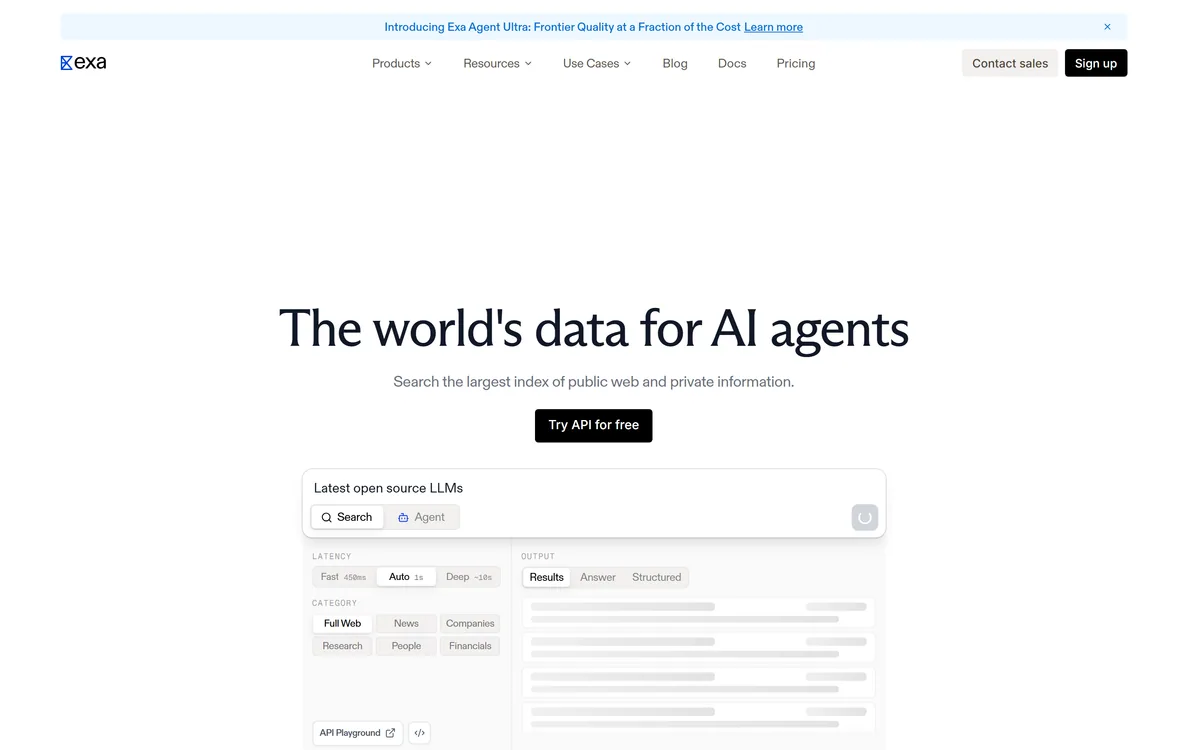
Exa is a search API that gives AI agents real-time access to the web, built on its own large index, embedding and retrieval models, with selectable latency, search verticals, token-efficient highlights, structured enrichments and an MCP server.
AI agents are only as good as the information they can reach, and a consumer search engine was never designed to feed one. Exa is search rebuilt for that job: an API an agent calls, not a page a person reads.
It gives agents real-time web access through its own index, embedding and retrieval models and a vector database, with selectable latency, search verticals and token-efficient highlights. It sits between consumer AI search like Perplexity AI and the developer infrastructure layer, serving the retrieval that agents and apps are built on.
This review covers how Exa feeds an agent the right data, where it earns its place in a build, how its API is priced, and when it is the wrong call.
Exa is search designed to be consumed by an AI agent, not read by a person.
Exa, The Short Picture
Exa is a search API for AI agents: real-time web data designed to be consumed by software, not read by a person.
It runs its own stack: a large index, embedding and retrieval models, and a vector database, not a resold engine.
It is built for agent context: selectable latency, search verticals and token-efficient highlights.
Its scale claims are the vendor's: 'world's largest independent index' and benchmark leads are stated, worth verifying.
A Search Engine Built For AI Agents, Not People
Exa's premise is that searching for a machine is a different problem from searching for a human. A person wants ten blue links; an agent wants the most relevant content, in the fewest tokens, fast, in a structure it can act on. Exa optimises for the second.
The clearest expression of that is 'highlights': rather than returning whole pages, a specialised model extracts the most relevant excerpts, which the vendor says cuts the tokens an agent consumes dramatically. For anyone paying per token, that is a direct cost lever, not just a nicety.
It also builds its own index and retrieval models rather than reselling another engine, which is a meaningful difference: the behaviour is Exa's to tune for agent use, not a wrapper around someone else's search.
A person wants ten blue links; an agent wants the most relevant content, in the fewest tokens, fast, in a structure it can act on. Exa optimises for the second.
How Does Exa Feed An Agent The Right Data?
The API is shaped around the choices an agent build actually needs to make.
Latency Modes, Verticals And Highlights
You can trade latency for depth, from near-instant results to a deep mode that takes longer, choose output as results, a direct answer or structured data, and search verticals like news, companies, research, people and code rather than the whole web indiscriminately.
That control is what makes it usable inside a real agent loop. A consumer AI search like Felo answers a person's question; Exa gives a developer the knobs, latency, vertical, format, to wire search into an agent's reasoning step.
Its Own Index And Retrieval Models
Underneath sits Exa's own large index, a vector database built for high query volume, and embedding and retrieval models it trains itself, plus structured enrichments across millions of companies with grounded citations.
Owning the stack is why it can promise things a reseller cannot, like zero data retention and tuned agent behaviour. It pairs naturally with model infrastructure such as Replicate: one runs the models, the other feeds them fresh, grounded context.
Where Exa Earns Its Place In A Build
Exa earns its place anywhere an agent or app needs current, grounded information: research assistants, coding agents that must read the live web, lead-enrichment pipelines, and anything that would otherwise hallucinate without retrieval.
Its benchmark positioning, which the vendor states shows it leading rivals on several retrieval benchmarks, and named customers using it at scale, are real signals, though the benchmark figures are Exa's own and worth verifying against your use case.
One honest note: Exa indexes public web content including information about people, and offers people-search as a vertical. That is a legitimate capability, but it carries privacy responsibilities for whoever builds on it, which sit with the developer, not the API.
How Exa Prices Its API
Exa is usage-based: you can try the API free, with pricing scaling by use, and enterprise agreements adding data-security terms like a DPA or BAA and custom arrangements. We do not publish rates, which change; check the site.
The token-efficient highlights matter to the economics here: because they cut how much content your model has to process, Exa can reduce downstream model cost, not just its own charge, which is a subtler value than a headline rate suggests.
The sensible way to size it is to run your real agent's query pattern against the free tier and measure both Exa's cost and the token savings on your model side.
A Fast Way To Prove Out Exa
Because the value is retrieval quality inside an agent, test it on your real queries, not demo ones.
Call the API with genuine queries from your agent's actual workload.
Try the latency modes and pick the one that fits your loop's speed budget.
Use the right vertical, news, research, code, rather than whole-web search, and compare relevance.
Turn on highlights and measure the token reduction on your model side.
If you build with agents, wire it in through the MCP server and test end to end.
Pass/fail: Exa is worth it if retrieval quality and token savings beat your current approach.
If your build touches people-search, confirm your privacy obligations before shipping.
Exa Search API Facts
What it is
A search API for AI agents and apps
Built on
Its own index, embeddings and retrieval models
Latency
Selectable modes from instant to deep
Verticals
Web, news, companies, research, people, code
Highlights
Token-efficient excerpts for agent context
Structured
Enrichments with grounded citations
Access
REST API, MCP server, playground
Security
SOC 2 Type II, GDPR, zero data retention stated
Exa Search-API Terms
Highlights
Exa's token-efficient excerpts: the most relevant parts of a page, extracted so an agent processes fewer tokens.
Latency mode
A setting trading speed for depth, from near-instant results to a slower deep search.
Vertical
A focused search domain such as news, companies, research, people or code, rather than the whole web.
Vector database
A store of embeddings that enables fast semantic retrieval at high query volume, which Exa runs itself.
Developers building agents that need live, grounded web data
Coding agents that must read the current web
Lead-enrichment and research pipelines
Teams paying per token who want retrieval that cuts context
Builders who want verticals and latency control
When Exa Is Not The Right Call
End users who just want a search engine to read
Apps that need no real-time external data
Teams unwilling to handle people-search privacy duties
Projects wanting model inference, not retrieval
Anyone who will not test retrieval on their own queries
How We Benchmarked Exa For This Review
Last checked . Read from exa.ai during this check, with the screenshot above captured at the same time.
A search API aimed at AI agents and applications
Its own large index, embedding and retrieval models
Selectable latency modes from instant to deep
Search verticals including news, companies, research, people and code
Token-efficient 'highlights' extraction
Structured outputs and enrichments with citations
A REST API, an MCP server and a playground
Stated SOC 2 Type II, GDPR and zero-data-retention posture
No rates reproduced here, in line with this site's pricing policy
Exa's benchmark leads and 'world's largest independent index' claims are vendor-stated; verify against your use case. Its people-search vertical carries privacy responsibilities that sit with the developer building on it.
Other Search And Agent Tools
Consumer AI search, an AI search engine and a model-hosting API to weigh alongside Exa.
Perplexity AI — consumer AI search for people, not agents
Exa earns 4.3 for rebuilding search for the thing that now consumes it, AI agents, with its own index and retrieval models, latency and vertical control, and token-efficient highlights that cut not just its own cost but the model cost downstream. Its benchmark and scale claims are vendor-stated and worth verifying, and its people-search vertical carries privacy duties for the builder, but as retrieval infrastructure it is a strong, purpose-built choice. AInexfinder Editor Score: 4.3/5.
Exa pricing
AInexfinder does not list plan prices or billing details. For current pricing, plans, and trials, visit the official Exa website.
Vendor pricing, credits, and billing policies change over time. Always confirm on the official site before you buy.
Frequently asked questions
What is Exa?
Exa is a search API built for AI agents and applications rather than people. It gives software real-time access to the web through its own large index, embedding and retrieval models and a vector database, with selectable latency, search verticals, token-efficient highlights and an MCP server.
How is Exa different from a consumer search engine?
A consumer engine returns links for a person to read; Exa returns the most relevant content in the fewest tokens, in a structure an agent can act on. It is optimised for being consumed by software, with controls like latency modes and verticals that a human-facing search does not expose.
What are Exa's highlights?
Highlights are token-efficient excerpts: instead of returning whole pages, a specialised model extracts the most relevant parts, which the vendor says sharply reduces the tokens an agent consumes. For anyone paying per token, that cuts downstream model cost, not just Exa's own charge.
Does Exa run its own index?
Yes. Exa builds its own large index, trains its own embedding and retrieval models, and runs a vector database for high query volume, rather than reselling another engine. Owning the stack lets it tune behaviour for agent use and promise things like zero data retention.
How is Exa priced?
It is usage-based: you can try the API free, with pricing scaling by use, and enterprise agreements adding data-security terms such as a DPA or BAA. We do not publish rates, which change; check the site, and factor in the token savings highlights can create on your model side.
Who should use Exa?
Developers building agents and apps that need current, grounded web data: research assistants, coding agents that read the live web, and lead-enrichment pipelines. It is not for end users who just want a search engine to read, nor for apps that need no real-time external data.
Does Exa search for information about people?
Yes, it indexes public web content and offers a people-search vertical. That is a legitimate capability, but it carries privacy responsibilities for whoever builds on it. Those obligations sit with the developer, not the API, so confirm your duties before shipping a build that uses it.
Are Exa's benchmark claims reliable?
Exa states it leads rivals on several retrieval benchmarks, and names customers using it at scale. These are genuine signals, but the benchmark figures are the vendor's own, so verify retrieval quality against your actual use case rather than taking the leaderboard at face value.
Can an AI agent use Exa directly?
Yes. Alongside the REST API, Exa provides an MCP server, so an AI agent such as a coding assistant can call its search as a capability within its reasoning loop. That makes wiring live, grounded retrieval into an agent build straightforward rather than a custom integration.
What search verticals does Exa offer?
It offers focused verticals including the full web, news, companies, research, people and code, so you can search the relevant domain rather than the whole web indiscriminately. Choosing the right vertical improves relevance and is part of what makes Exa usable inside a real agent loop.
Daniel reviews AI tools the slow way — by actually using them on real projects. His reviews cover what works, what breaks, and who each tool is genuinely a good fit for.
Daniel and the AInexfinder editorial team research Exa using public product information, listing evidence, and (when available) hands-on checks. Scores reflect listing completeness and transparency — not paid placement.
Listings may include affiliate or sponsored placements, which are labeled when present. Editorial scores and cons are not sold. See our affiliate disclosure and review methodology.
Felo is a multilingual AI search and creation platform from Felo Inc. It pairs an answer engine with Felo Slides, an agent mode, an LLM playground, LiveDoc and an API, with the multilingual layer as its distinguishing feature rather than an afterthought.
Liner splits into three purpose-built agents: everyday search returning cited answers with one-click verification and mind maps, Liner Scholar for finding, comparing and citing papers and building literature reviews, and a writing agent that drafts, verifies and edits in the same window.
Komo is an AI search engine that answers with sources across three modes — Web, People and Deep research. Its Firsthand feature finds the right people to answer what AI cannot, and it offers a Komo Fast model, saved history and an Earn programme.
R Discovery is a research reading and literature search app from Cactus Communications, covering 150M+ journal articles, 78M+ open access papers and 10M+ conference documents. It offers AI summaries with citations, chat with a PDF, generated literature reviews, audio papers and translation into 30+ languages.
Zendy is an AI-powered research library combining open-access and premium academic literature with ZAIA, an assistant that summarises papers, highlights key phrases and gives reference-backed answers, aimed at independent researchers and institutions.