R Discovery is a research reading and literature search app from Cactus Communications, covering 150M+ journal articles, 78M+ open access papers and 10M+ conference documents. It offers AI summaries with citations, chat with a PDF, generated literature reviews, audio papers and translation into 30+ languages.
discovery.researcher.life7 viewsAdded April 3, 202638K visitors
Literature search has a scale problem that predates AI and is getting worse. Something like five thousand papers are published every day, and a researcher entering a new area has to work out which of several thousand results actually matter.
Keyword search does not solve it, because the same idea is described differently across fields, decades and journals — and the paper you most need to find is often the one using unfamiliar vocabulary.
R Discovery's answer is a large indexed corpus with AI on top of it, and the corpus is the part that makes the AI worth anything.
R Discovery: Literature Search With Citations
300M+ verified research sources, including 150M+ journal articles, 78M+ open access papers and 10M+ conference documents.
Answers backed by citations, which is the property that makes an academic search tool usable at all.
Chat with a PDF you upload or one already in the corpus.
Audio papers and translation into 30+ languages, which address access rather than convenience.
Cactus Communications, an established academic services company, with 5,000+ papers added daily.
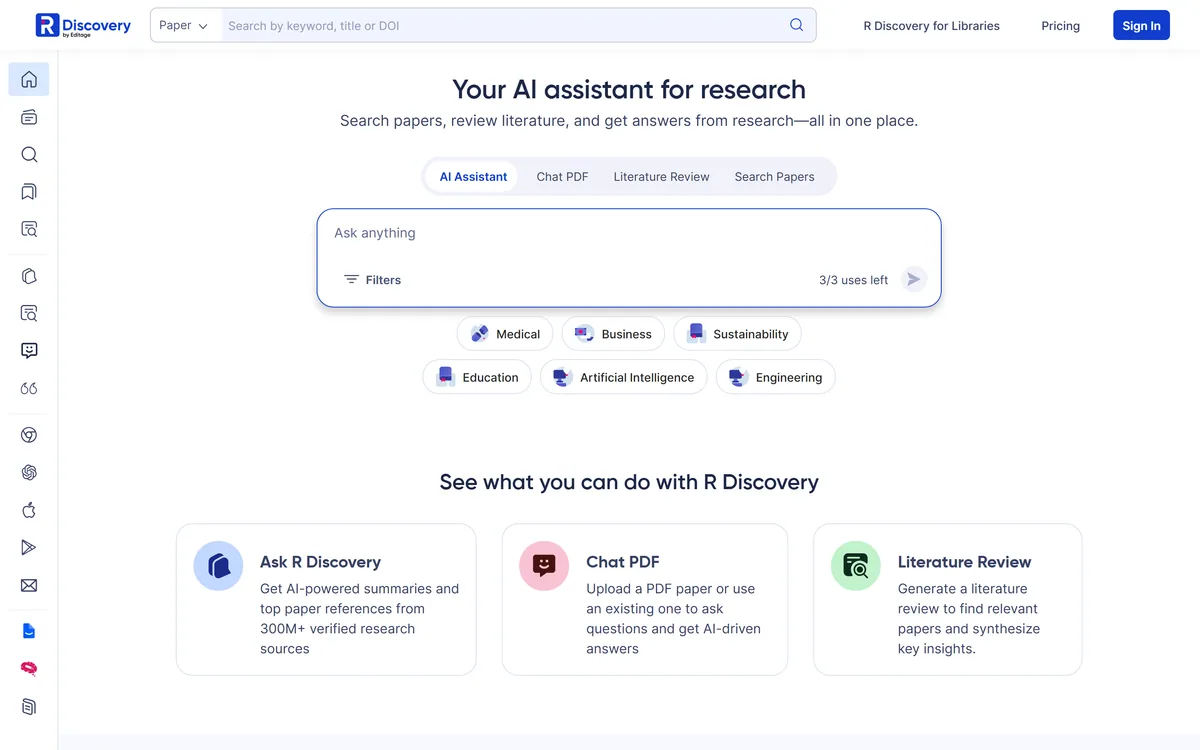
R Discovery's homepage, captured 9 September 2026, showing the literature search and reading tools.
How Do You Search Three Hundred Million Papers?
R Discovery states that its AI assistant gives summaries and top paper references from 300M+ verified research sources, with answers backed by citations.
The word verified is doing important work there, and it is the difference between this and asking a general assistant about literature.
A general model answering a research question generates plausible references, some of which do not exist. In academic work that is not a minor flaw — a citation is a claim that a specific finding appears in a specific place, and one that fails checking undermines everything around it.
Searching an indexed corpus and citing what was retrieved changes the failure mode entirely. The system can still surface something irrelevant or misread a paper; it cannot invent one, and a wrong-but-real reference is an error a researcher is trained to catch.
The corpus composition matters as much as its size. 78 million open access papers is the figure with the most practical consequence, because a citation you cannot read is only marginally more useful than one you cannot find — the same access problem that makes verifiable citations central to tools like Khoj.
A general model can invent a citation. A system searching an indexed corpus can only surface the wrong real one — and researchers are trained to catch that.
Chat PDF And Generated Literature Reviews
Two features sit on very different points of the risk spectrum and it is worth separating them.
Chat with a PDF is straightforwardly useful and low risk. You have the paper, the answers come from it, and you can check any claim against the text in front of you. For working through a dense methods section or finding whether a paper addresses your specific question, it is a genuine time saving.
The generated literature review is the feature to handle carefully, because a literature review is not a summary of papers.
It is an argument: this is what the field believes, this is where it disagrees, this is what remains unresolved, and this is why my question follows. Producing that requires judgement about which disagreements matter and which findings are contested.
What generation can do well is the mapping — here are the relevant papers, here are the clusters, here is roughly what each says. That is genuinely valuable as a starting point and it is the first day of the work rather than the output of it.
Audio Papers And Thirty Language Translations
R Discovery offers audio papers in human-like voices, paper translations across 30+ languages, and full texts, summaries and top-cited papers in your native language.
These are the features that look like conveniences and are actually access.
Academic publishing is overwhelmingly in English, which places a substantial and rarely acknowledged burden on researchers who do not read it as a first language. Reading a technical paper in a second language is several times slower and comprehension is lower.
Translation does not remove that gap entirely, and technical terminology has established conventions in each language that machine translation handles unevenly. It does make the initial triage possible — deciding whether a paper is worth the effort of reading properly.
Audio serves a different constraint. It makes literature consumable while commuting or walking, which converts otherwise dead time into reading time — and for researchers with visual impairments or reading differences it is accessibility rather than convenience.
Use generated reviews as a map of the field, never as the review itself.
Verify every citation by opening it, since retrieval can still surface the wrong paper.
Prefer open access results when you need to actually read the source.
Treat translated technical terms with suspicion; conventions differ by language.
Use chat-with-PDF for triage — deciding whether to read properly.
Cactus Communications And What That Signals
The footer identifies R Discovery as a product of Cactus Communications, and that attribution is more informative than most.
Cactus is an established academic services company rather than a startup entering research tooling, and it has spent years working with publishers, journals and researchers.
That matters for a specific reason: corpus access in academic publishing is a relationships problem as much as a technical one. Indexing 300 million papers requires arrangements with publishers, and a company already embedded in that ecosystem is better placed than one starting fresh.
The site's reference to 25+ partners in publishing and technology points at the same thing, and it is the kind of infrastructure that is difficult to replicate quickly.
The corresponding consideration is one of position. A company serving publishers and researchers simultaneously has two constituencies whose interests sometimes diverge — on access, pricing and what gets surfaced — which is not a criticism, but it is worth being aware of.
Where AI Literature Tools Mislead
The risks here are subtle rather than obvious, which makes them worth naming explicitly.
Retrieval bias is the first. What a search surfaces is shaped by what is indexed, what is open access and how relevance is scored — so a systematic gap in the corpus produces a systematic gap in your review, invisibly.
Recency skew is the second. Search tends to favour recent and highly cited work, which is often correct and sometimes badly wrong, since foundational papers and negative results are systematically underrepresented in citation-weighted results.
Summarisation flattening is the third and most consequential. A paper's caveats, sample limitations and the authors' own hedging are exactly what a summary drops, and those caveats are frequently the most important part.
The fourth is the false sense of completeness. Having searched 300 million papers feels exhaustive and is not — you searched what was indexed, ranked by an algorithm, and stopped at page one, which is the same limitation every search has always had.
The line to hold is between finding literature and producing coursework from it. Tools aimed at generating submitted work, such as LabReportAI, sit in a different category with different rules — and conflating a search tool with a writing tool is how students end up in trouble they did not intend.
For taught material rather than published literature, the tooling differs again. Note systems like Coconote capture what a lecturer said, which is a separate corpus from what a field has published and often the one a student actually needs first.
Doing A Literature Review That Holds Up
Generated literature tools change how quickly you can orient in a field, and they change nothing about what a defensible review requires.
This sequence uses the speed where it helps and keeps the judgement where it belongs.
Use AI search to map the field and identify clusters, not to write the review.
Open every paper you intend to cite — a summary is not a reading.
Search deliberately for contradicting findings, which relevance ranking buries.
Follow citations backwards to foundational work that recency skew hides.
Read the limitations section of anything central, since summaries drop it.
Write the argument yourself, because the argument is what a review actually is.
Research Search Terms
Terms that decide whether a literature tool is useful for academic work.
undefined
undefined
undefined
undefined
undefined
undefined
Key features of R Discovery
AI search across 300M+ research sources with citations
Chat with an uploaded or indexed PDF
Generated literature reviews
A personalised paper feed
Audio papers in human-like voices
Paper translation across 30+ languages
Patents, pre-prints and conference documents indexed
An institutional offering for libraries
Pros & cons
Pros
7
Retrieval from an indexed corpus removes the invented-citation failure entirely
78M+ open access papers means citations you can actually read
Chat with a PDF is genuinely useful and carries almost no risk
Audio and translation address access rather than merely convenience
Published by an established academic services company with publisher relationships
Corpus composition published in detail rather than as one headline number
Pre-prints and conference documents included alongside journal articles
Cons
7
A generated literature review is a map of a field, not an argument about it
Retrieval bias produces invisible gaps where the corpus is incomplete
Relevance ranking systematically buries foundational work and negative results
Summarisation drops caveats and limitations, which are often the important part
Searching 300 million papers feels exhaustive and is not
Which publishers the corpus draws from is unstated, so field coverage is unknown
Not suitable for a systematic review needing a reproducible search strategy
Best For
Researchers orienting in an unfamiliar field
Postgraduates beginning a literature review
Academics reading in a second language
Anyone without broad institutional subscription access
Researchers who want to consume literature as audio
R Discovery Against Other Literature Tools
Research tools differ by what they search and whether the citations can be checked.
9.5M+ topics, 64K+ journals, 120K+ universities and institutions
Also indexed
7.5M+ patents and 8M+ summaries and highlights
Update rate
More than 5,000 papers added every day
Core features
Ask R Discovery, Chat PDF, Literature Review, personalised feed
Accessibility
Audio papers in human-like voices, paper translations across 30+ languages
Partners
25+ partners in publishing and technology, per the site
Institutional
An R Discovery for Libraries offering
Copyright
Copyright 2026 Cactus Communications
R Discovery: Confirmed From Cactus Communications
Last checked . Read from discovery.researcher.life in a browser session on the date above, with the screenshot captured alongside.
Positioned as your AI assistant for research — search papers, review literature and get answers
300M+ verified research sources stated
Corpus composition displayed as 150M+ journal articles, 78M+ open access papers, 10M+ conference documents and 5M+ pre-prints
9.5M+ topics, 64K+ journals and 120K+ universities and institutions displayed
7.5M+ patents and 8M+ summaries and highlights displayed
More than 5,000 papers added every day stated
Ask R Discovery described as giving AI summaries and top paper references backed by citations
Chat PDF described for uploaded or existing papers
Literature Review described as finding relevant papers and synthesising key insights
Audio papers described in human-like voices, with full texts and summaries in your native language
Paper translations across 30+ languages stated
25+ partners in publishing and technology referenced
An R Discovery for Libraries offering listed
Footer confirms Copyright 2026 Cactus Communications with Privacy Policy, Cookies Policy and Terms of Use
What we could not confirm: pricing and what the free tier includes, beyond a usage counter shown on the page; which publishers and databases the corpus draws from, which determines coverage in your specific field; how relevance is ranked; which models generate summaries and literature reviews; whether uploaded PDFs are retained; and how translation handles established technical terminology. We did not run a search.
Is R Discovery Right For Your Research?
Search here when
You are orienting in an unfamiliar field and need a map of it.
Keyword search keeps missing papers that use different vocabulary.
You read in a second language and translation would speed up triage.
You want to consume literature as audio during otherwise dead time.
Open access coverage matters because you lack broad subscriptions.
Use a database when
You need a reproducible, documented search strategy for a systematic review.
Your field's key sources sit outside the indexed corpus.
You would submit a generated literature review as your own analysis.
You need database-specific controlled vocabulary and precise filters.
Your institution's subscriptions already give you better access.
Editor's Verdict
4.1/5
The corpus is the reason to take this seriously. 150 million journal articles, 78 million open access papers and 10 million conference documents, from a publisher-services company that has been in academic infrastructure for years, is a genuinely different foundation from a general assistant guessing at literature. The audio papers and 30-language translation features address real access problems rather than adding convenience. The one feature to use carefully is the generated literature review, because a review is an argument about a field rather than a summary of it — and that distinction decides whether the output is a starting point or a liability. AInexfinder Editor Score: 4.1/5.
R Discovery pricing
AInexfinder does not list plan prices or billing details. For current pricing, plans, and trials, visit the official R Discovery website.
Vendor pricing, credits, and billing policies change over time. Always confirm on the official site before you buy.
Frequently asked questions
What is R Discovery?
R Discovery is an AI research reading and literature search app from Cactus Communications, covering 300M+ verified sources including 150M+ journal articles and 78M+ open access papers. It offers cited summaries, chat with a PDF, generated literature reviews, audio papers and 30+ language translation.
Why does searching an indexed corpus matter?
Because it changes the failure mode. A general model answering a research question generates plausible references, some of which do not exist. A retrieval system can surface the wrong paper but cannot invent one — and a wrong-but-real reference is an error researchers are trained to catch.
Which corpus figure matters most?
The 78 million open access papers, because a citation you cannot read is only marginally more useful than one you cannot find. Total corpus size establishes scale; open access coverage determines whether you can actually check what you cite.
Is chat-with-PDF safe to rely on?
It is the lowest-risk feature here. You have the paper, the answers come from it, and you can check any claim against the text in front of you. For working through a dense methods section or triaging relevance, it is a genuine time saving.
Can AI write my literature review?
It can map the field — relevant papers, clusters, roughly what each says — which is genuinely valuable as a first day of work. It cannot write the review, because a review is an argument about what a field believes, disputes and leaves unresolved.
What is retrieval bias?
A gap in what is indexed producing a matching gap in your review, invisibly, because absence leaves no trace in results. It is the most serious risk in AI literature search and the hardest to detect from inside the tool.
What does relevance ranking hide?
Foundational papers and negative results. Ranking favours recent and highly cited work, which is often correct and sometimes badly wrong — so following citations backwards deliberately is the counterweight, and it is manual work.
Why are audio and translation more than convenience?
Because academic publishing is overwhelmingly in English, which places a substantial burden on researchers who read it as a second language. Translation makes initial triage possible, and audio converts commuting time into reading time — and is accessibility for some readers rather than convenience.
Should I trust translated technical terms?
Treat them with suspicion. Technical terminology has established conventions in each language that machine translation handles unevenly, so a translated term may be comprehensible and not the one the field actually uses.
When should I use a traditional database instead?
For a systematic review, where you need a documented, reproducible search strategy with controlled vocabulary and precise filters. AI search is excellent for orienting and poor for the kind of completeness a systematic review has to demonstrate.
Daniel reviews AI tools the slow way — by actually using them on real projects. His reviews cover what works, what breaks, and who each tool is genuinely a good fit for.
Daniel and the AInexfinder editorial team research R Discovery using public product information, listing evidence, and (when available) hands-on checks. Scores reflect listing completeness and transparency — not paid placement.
Listings may include affiliate or sponsored placements, which are labeled when present. Editorial scores and cons are not sold. See our affiliate disclosure and review methodology.
Zendy is an AI-powered research library combining open-access and premium academic literature with ZAIA, an assistant that summarises papers, highlights key phrases and gives reference-backed answers, aimed at independent researchers and institutions.
Scinapse analyses research landscapes rather than merely searching them, ranking papers and researchers by citation impact within a filtered set of a field instead of by global totals, generating review papers on request, and mapping how work and authors connect.
Clarivate's Web of Science Research Assistant is a generative and agentic AI layer over the Web of Science Core Collection, turning a research question into guided literature-review, author and trend workflows with visible grounding in trusted data.
Exa is a search API that gives AI agents real-time access to the web, built on its own large index, embedding and retrieval models, with selectable latency, search verticals, token-efficient highlights, structured enrichments and an MCP server.
Felo is a multilingual AI search and creation platform from Felo Inc. It pairs an answer engine with Felo Slides, an agent mode, an LLM playground, LiveDoc and an API, with the multilingual layer as its distinguishing feature rather than an afterthought.