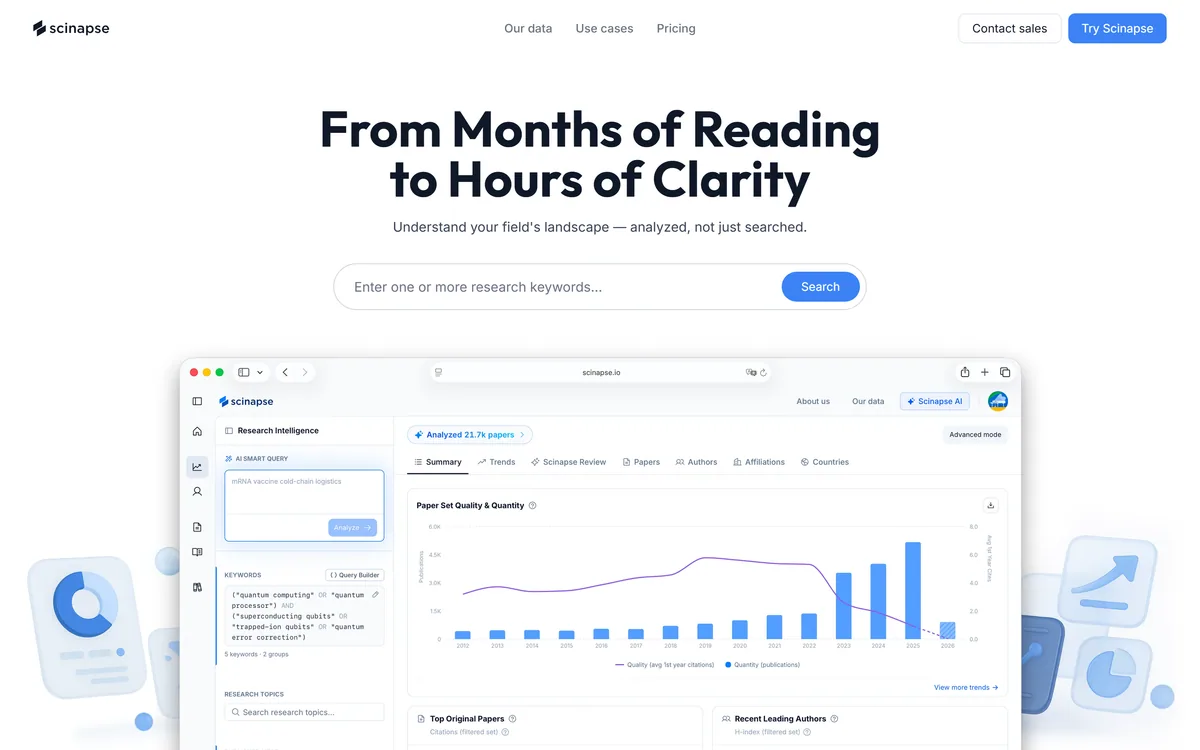
Scinapse analyses research landscapes rather than merely searching them, ranking papers and researchers by citation impact within a filtered set of a field instead of by global totals, generating review papers on request, and mapping how work and authors connect.
Scinapse's homepage, captured 9 September 2026, showing its field-level analysis positioning.
Scinapse: What The Index Covers
Impact measured within your field, not against global citation totals.
Generated review papers on topics where the review you wanted was never written.
Experts ranked by field influence rather than overall reputation.
A network map showing how papers and researchers connect.
Grounded in real citations — insights tied to how papers actually cite each other.
Scinapse: Data And Method
Category
Research landscape analysis and expert discovery
Core method
Analysis within a filtered set of papers rather than across all literature
Impact measure
Citation influence assessed inside a field, not by global totals
Grounding
Stated as based on how papers actually cite each other rather than inference
Reviews
Generated review papers on topics where none exists
Expert ranking
Researchers ranked by influence within a field rather than overall fame
Query building
Describe your research in words and a search query is constructed
Visualisation
A network map of paper and researcher connections
Analytics
Journal influence analysis, researcher profiles and a full article view
Classification
Papers structured by topic, year, type, journal and citation impact
Coverage
Stated as field-specific analysis across every discipline
Company
Pluto Labs, per the 2026 footer copyright, with institutional access offered
Scinapse: Impact Measured Inside Your Field
The positioning is a single distinction repeated in several forms: understand your field's landscape, analysed rather than just searched, with impact measured where it counts.
The FAQ states the difference plainly — most tools rank papers by total citations across all fields, while Scinapse analyses within your field's trends, influential papers and experts.
That is not a marketing refinement. It is a correction to a well-documented flaw in how research is commonly evaluated.
Citation practices differ enormously between disciplines. Biomedical papers carry long reference lists and cite recent work heavily; mathematics papers cite sparsely and reach back decades. A paper with 300 citations is unremarkable in one field and field-defining in another.
Ranking everything on a single scale therefore does not measure importance — it measures which discipline you are in, plus some importance. Anyone who has searched a general index and found the top results dominated by adjacent biomedical work has experienced the problem directly.
A paper with 300 citations is unremarkable in one field and field-defining in another. A single ranking scale measures your discipline first and your importance second.
Reading A Field-Weighted Score
If impact is measured within a set, then everything depends on how the set is drawn — which is why the FAQ gives the filtered set its own question.
This deserves attention rather than acceptance, because the boundary is a methodological choice and the results follow from it.
Draw the set narrowly and a paper looks foundational because it dominates a small pond. Draw it broadly and genuinely important specialist work disappears into the noise of a larger field. Neither is wrong; they answer different questions, and only the person asking knows which one they meant.
The practical implication is that a field-weighted score should be read as a comparison you specified rather than as a property of the paper.
Two other cautions apply to any citation measure. Citation lag means recent work is systematically undervalued, which is a problem precisely for anyone working in an emerging area. And citations record attention rather than merit — papers are cited for being wrong, for being convenient to cite, and for being written by someone whose name lends weight. Bibliometrics measures conversation, not truth. Evidence-focused tools like Elicit work on what papers found rather than on who cited them.
Why Are Total Citations A Noisy Signal?
The site states it directly: a paper's total citations are noisy, so impact is measured where it counts.
Noise is the right word, and it is worth unpacking the sources because they affect how you read any number.
Field is the largest, as above. Age is the second — a paper from 2010 has had fifteen years to accumulate citations and one from last year has had months, so any ranking by total citations is substantially a ranking by publication date.
Document type is the third and least appreciated. Review papers and methods papers attract citations far out of proportion to their originality, because everyone working in an area cites the review and everyone using a technique cites the method. A widely used statistical method can out-cite the discoveries it enabled by an order of magnitude.
The fourth is self-reinforcement: highly cited papers get read more and therefore cited more, independent of merit. Analysing within a filtered set addresses the first source directly and helps with the others by making comparison local. It does not eliminate any of them, and no tool can, because they are properties of how science communicates rather than defects in the data.
Choose the filtered set deliberately — it determines every result.
Discount recent work less than a citation measure will.
Check document type before treating a high count as importance.
Use generated reviews as a map, then read the primary sources.
Verify a suggested collaborator's recent work, not just their score.
Generated Reviews And What To Do With Them
The boldest feature is stated without hedging: the perfect review for your topic rarely exists, so we build it for you.
The observation behind that is entirely correct and familiar to every researcher. Review articles exist for topics somebody chose to review, at the moment they chose to write it — so a review of your exact intersection either does not exist or is six years old, which in a fast-moving area is the same thing.
What the feature is genuinely good for is orientation. Entering an unfamiliar field means learning what the questions are, who the camps are and which papers everyone assumes you have read, and a synthesis gets you there in an afternoon rather than a fortnight.
What it cannot be is a substitute for the reading. A review paper is an argument: it selects, weights, dismisses and connects, and those judgements are the substance. Reading a generated synthesis leaves you knowing what the literature says without having formed a view about which parts are convincing — a difference that becomes obvious the moment a supervisor or reviewer asks why you believe something.
The grounding claim matters here, and the FAQ addresses accuracy directly. Insights tied to how papers actually cite each other is a meaningfully stronger position than generating from a model's memory, which is where fabricated references come from. Verify anything you will cite by opening the paper — always, from any tool. R Discovery takes the reading-list approach to the same problem.
Finding Collaborators By Influence
Expert discovery is framed the same way as paper ranking: find collaborators by real influence, not reputation, with researchers ranked by impact inside your field rather than overall fame.
This is the most practically valuable feature and the one hardest to replicate by hand.
The person you actually want for a collaboration, a review, a citation or a conference invitation is rarely the most famous name in the adjacent field. It is the person doing the most influential work on your specific question, who may be mid-career, at a less visible institution, or publishing in a specialist venue nobody outside the area reads.
Finding them manually means reading enough of the literature to notice the same name recurring, which takes months and is exactly the knowledge a newcomer does not have.
Supporting tools follow the same logic: a query builder that turns a description of your research into a search, a network map showing how papers and researchers connect, journal analytics, researcher profiles and a single article view. The network map is the one worth spending time in — citation structure reveals things keyword search cannot, including where a field split into camps and which paper bridges them. Institutional access is offered with setup handled by the vendor, which is how research tools are usually bought. For a question outside your own discipline entirely, a general cited-answer tool such as Perplexity AI is usually the faster first step.
Mapping A Field Before You Read It
The claimed transformation is months of reading into hours of clarity, and the honest version is narrower: hours to orient, then read properly.
This sequence uses it that way.
Define your filtered set deliberately, and note where you drew the boundary.
Generate a review to learn the questions and the camps, not the answers.
Read the network map for structure — clusters, bridges and splits.
Open every paper you intend to cite; never cite from a summary.
Adjust for citation lag before dismissing recent work.
Check a suggested expert's last two years before contacting them.
Key features of Scinapse
Field-relative citation impact analysis
Generated review papers on demand
Expert ranking by influence within a field
Natural language query builder
Network map of papers and researchers
Journal influence analytics
Researcher profiles and full article views
Classification by topic, year, type, journal and impact
Pros & cons
Pros
7
Corrects a well-documented flaw in cross-field citation comparison
Ranking experts by field influence surfaces people reputation hides
Generated reviews fill a real gap where no current review exists
Grounding in actual citation relationships reduces the fabricated-reference risk
The network map reveals structure keyword search cannot show
The filtered set concept is documented rather than hidden
Institutional deployment is handled by the vendor
Cons
7
Results depend entirely on how the filtered set is drawn
Citation lag means recent work is systematically undervalued
Citations record attention, not correctness, whatever the normalisation
Review and methods papers still distort counts within a field
Reading a generated review is not the same as forming a view of a literature
Data sources and coverage completeness are not stated publicly
Discovery does not solve full-text access, which is often the real constraint
Best For
Researchers entering an unfamiliar field
Postgraduates orienting before a literature review
Anyone seeking collaborators or reviewers by genuine influence
R&D teams tracking where a research area is moving
Institutions providing analysis tools across many disciplines
Scinapse Beside Other Literature Tools
Research tools differ by what they do with the literature.
Last checked . Read from scinapse.io in a browser session on the date above, with the screenshot captured at the same time.
Positioned as moving from months of reading to hours of clarity, analysed rather than just searched
Impact stated as measured within your field rather than by total citations
Total citations described explicitly as a noisy signal
Generated review papers offered for topics where the review you wanted does not exist
Experts ranked by impact inside a field rather than by overall fame
Analysis stated as grounded in how papers actually cite each other, not guesswork
A filtered set given its own FAQ entry, indicating the analysis boundary matters
A query builder described as constructing a search from a description of your research
A network map showing how papers and researchers connect
Journal analytics, researcher profiles and a full article view offered
Papers described as classified by topic, year, type, journal and citation impact
Institutional access offered with setup handled by the vendor; footer showing Pluto Labs with a 2026 copyright, terms and privacy policy
What we could not confirm: which databases the citation data comes from or how complete the coverage is; how a filtered set is constructed and what defaults apply; how field-normalised impact is calculated; what accuracy checking is applied to generated reviews beyond the stated citation grounding; and pricing. We did not run a search or generate a review.
Editor's Verdict
4.1/5
Scinapse is built on a correction that bibliometricians have argued for since the 1980s and that most literature tools still ignore: citation counts are not comparable across fields. A molecular biology paper and a pure mathematics paper of identical importance will differ by an order of magnitude in citations, because the fields cite at different rates. Measuring impact inside a defined set rather than against all of science is the right fix, and the generated review papers are the feature to treat most carefully — a review is an argument, and reading one you did not construct is not the same as knowing a field. AInexfinder Editor Score: 4.1/5.
Scinapse pricing
AInexfinder does not list plan prices or billing details. For current pricing, plans, and trials, visit the official Scinapse website.
Vendor pricing, credits, and billing policies change over time. Always confirm on the official site before you buy.
Frequently asked questions
What does Scinapse do differently?
It analyses within your field rather than across all literature. Most tools rank by total citations, which mixes importance with discipline — Scinapse measures influence inside a defined set of papers instead.
Why are total citations misleading?
Because fields cite at wildly different rates. Biomedical papers carry long reference lists; mathematics papers cite sparsely. A paper with 300 citations is unremarkable in one field and field-defining in another.
What else makes citation counts noisy?
Age, since a 2010 paper has had fifteen years to accumulate them. Document type, since reviews and methods papers attract citations far out of proportion to originality. And self-reinforcement, since cited papers get read and cited more.
What is a filtered set?
The collection of papers an analysis runs within. It determines everything downstream — draw it narrowly and a paper dominates a small pond; draw it broadly and specialist work vanishes into noise.
Should I use a generated review paper?
For orientation, yes — learning the questions, the camps and the assumed reading in an afternoon is genuinely valuable. As a substitute for reading, no: a review is an argument, and its judgements are the substance.
How do I know the reviews are accurate?
The site states analysis is grounded in how papers actually cite each other rather than in model inference, which is a stronger position than generating from memory. Open every paper you intend to cite regardless.
How does expert ranking help?
The person you want is rarely the most famous name nearby. It is whoever does the most influential work on your specific question — often mid-career, at a less visible institution, publishing in a specialist venue.
Does it work for emerging fields?
It has a dedicated FAQ entry, though citation lag applies to any such tool. Recent work has not had time to accumulate citations, so discount the measure rather than the paper when the area is new.
Does a high impact score mean a paper is correct?
No. Citations record attention, not merit. Papers are cited for being wrong, for being convenient, and for their author's standing. Bibliometrics measures the conversation about science, not science.
Who does not need it?
Researchers who already know their field and the people in it, anyone whose real constraint is full-text access rather than discovery, and anyone who needs what studies found rather than how they were received.
Daniel reviews AI tools the slow way — by actually using them on real projects. His reviews cover what works, what breaks, and who each tool is genuinely a good fit for.
Daniel and the AInexfinder editorial team research Scinapse using public product information, listing evidence, and (when available) hands-on checks. Scores reflect listing completeness and transparency — not paid placement.
Listings may include affiliate or sponsored placements, which are labeled when present. Editorial scores and cons are not sold. See our affiliate disclosure and review methodology.
R Discovery is a research reading and literature search app from Cactus Communications, covering 150M+ journal articles, 78M+ open access papers and 10M+ conference documents. It offers AI summaries with citations, chat with a PDF, generated literature reviews, audio papers and translation into 30+ languages.
Zendy is an AI-powered research library combining open-access and premium academic literature with ZAIA, an assistant that summarises papers, highlights key phrases and gives reference-backed answers, aimed at independent researchers and institutions.
Clarivate's Web of Science Research Assistant is a generative and agentic AI layer over the Web of Science Core Collection, turning a research question into guided literature-review, author and trend workflows with visible grounding in trusted data.
Felo is a multilingual AI search and creation platform from Felo Inc. It pairs an answer engine with Felo Slides, an agent mode, an LLM playground, LiveDoc and an API, with the multilingual layer as its distinguishing feature rather than an afterthought.