Clarivate's Web of Science Research Assistant is a generative and agentic AI layer over the Web of Science Core Collection, turning a research question into guided literature-review, author and trend workflows with visible grounding in trusted data.
clarivate.com7 viewsAdded December 25, 2025401K visitors
Most research chatbots have the same weakness: they are fluent about the literature without being anchored to it, so a confident answer can rest on a paper that does not exist. Clarivate's answer to that is to build the assistant on top of a database it already curates rather than on the open web.
The Web of Science Research Assistant runs alongside a researcher inside the Web of Science, turning a question about a topic, author or journal into a connected set of agentic workflows — exploring a field, building a literature review, weighing an author's influence, reading trends — while keeping its reasoning tied to the Core Collection and showing how each output was produced.
This review covers what the grounding actually buys you, how the guided literature-review and visualization features work, what Clarivate means by responsible academic AI, how access reaches researchers, and who will get real value versus who can wait.
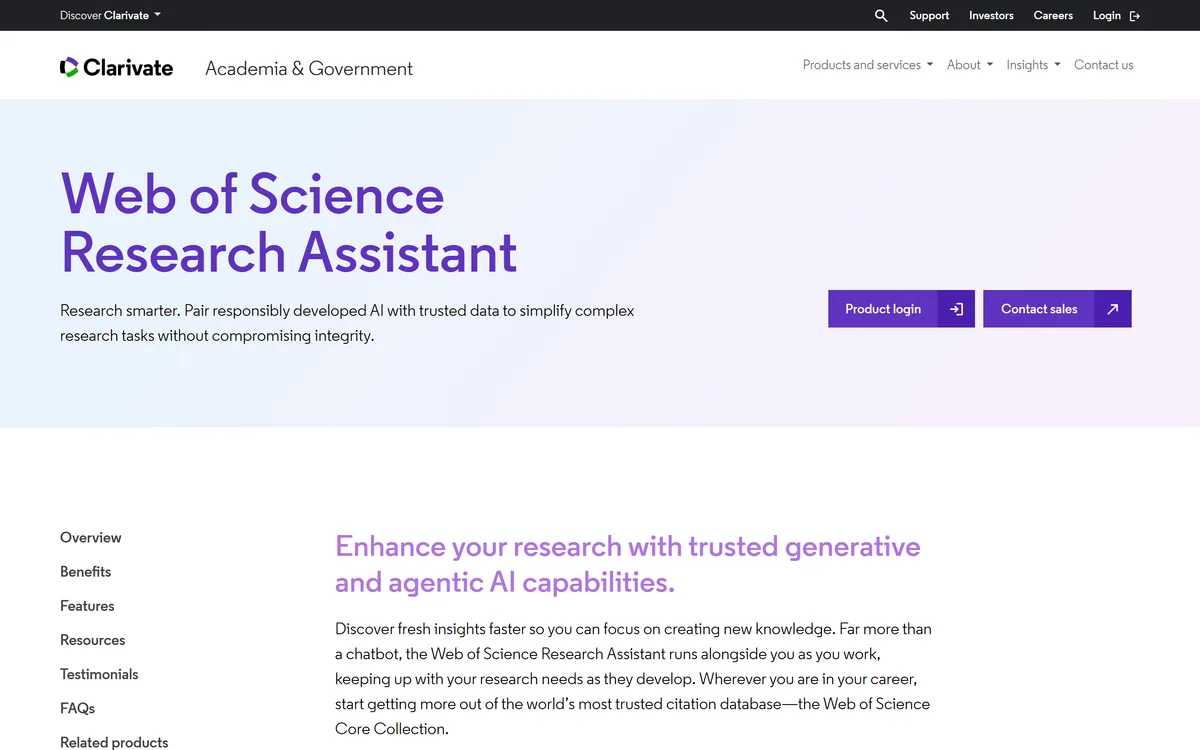
Clarivate's pitch: pair responsibly developed AI with the Web of Science Core Collection.
How We Reviewed The Web of Science Research Assistant
Last checked . Read from Clarivate's Web of Science Research Assistant page during this check, captured in a browser because the page returns a block to simple requests.
Generative and agentic AI assistant built on the Web of Science Core Collection
Workflows for topic exploration, literature review, author influence and trend interpretation
Visualizations including co-citation networks, topic maps and trend graphs
Extended assistant adding funding-opportunity and emerging-topic exploration for Research Intelligence institutions
Responsible-AI framing: developed with researchers and librarians, with transparency about how outputs are generated
Access described as institutional, through a Web of Science subscription
Legal, trust centre, privacy and cookie pages present in the Clarivate footer
No prices published, consistent with institutional licensing
Access and the extended feature set depend on which Web of Science products an institution licenses; confirm your own entitlement through your library.
Four Lines On The Web of Science Research Assistant
It is an AI assistant built on the Web of Science Core Collection, Clarivate's editorially curated citation database, not a general chatbot.
It is agentic, turning one question about a topic, author or journal into guided, multi-step workflows for literature review and trend analysis.
Grounding and transparency are the point: answers stay tied to curated sources and show how outputs were generated.
Access is institutional. It comes through a Web of Science subscription, so availability depends on your library rather than a personal sign-up.
Key Facts On The Web of Science Research Assistant
Vendor
Clarivate
Built on
Web of Science Core Collection, an editorially selected citation database
Type
Generative and agentic AI research assistant
Core workflows
Topic exploration, literature review, author influence, trend interpretation
Search
Natural-language queries in several languages, spanning 120+ years of research
Visualizations
Co-citation networks, topic maps and trend graphs
Extended version
Adds funding-opportunity and emerging-topic exploration for Research Intelligence institutions
Access
Institutional, through a Web of Science subscription
Transparency
Designed to show how content is generated and let users interrogate responses
An Assistant Grounded In The Web of Science Core Collection
The defining choice here is the data the assistant stands on. Rather than reasoning over the open web, it draws on the Web of Science Core Collection — content from editorially selected, publisher-independent sources that Clarivate curates.
That grounding is the whole value proposition. A general assistant can summarise a field quickly and occasionally invent a citation while doing it; an assistant tied to a curated index is answering from a bounded, vetted set of records, which is exactly what you want when the output feeds a literature review or a grant application. It also lets you interrogate where an answer came from, instead of taking fluency on trust.
The trade-off is coverage: a curated database is, by design, not everything ever published. The Core Collection is deliberately selective, so the assistant is strongest for the peer-reviewed, indexed literature and is not a replacement for a broad discovery search — or an open-access library like Zendy — when you need the long tail.
An assistant grounded in a curated index is answering from vetted records, not improvising from the open web — which is the difference that matters in academic work.
How Does The Research Assistant Handle A Literature Review?
The assistant's agentic design shows most clearly in literature review, where a single question becomes a structured, multi-step workflow rather than a one-shot answer.
Task-Based Guidance Through Each Research Step
Instead of a blank prompt box, the assistant offers task-based guidance and contextual prompts that light up the next sensible step — narrowing a topic, building the review, identifying experts to collaborate with. It brings the right tool and context to the right moment while staying grounded in the data.
This guided shape is what separates it from an open-ended chat tool. Where a tool like Elicit leans on extracting structured findings from papers, the Web of Science Research Assistant leans on walking you through the research journey step by step, which suits people who want a path as much as an answer.
Visualizations For Citation And Topic Links
Alongside the text, the assistant produces visualizations — co-citation networks, topic maps and trend graphs — and light analytics you can run quickly. Beta testers singled these out as the part that makes connections between topics, organisations and researchers easy to see.
These visual tools are where the underlying citation database earns its keep. Seeing how a field clusters, or how a line of research connects to an author or institution, is hard to get from a prose summary alone and is a genuine advantage over tools that only return text.
What Clarivate Means By Responsible, Academic AI
Clarivate leans heavily on the phrase 'responsible AI', and in this case it is backed by specifics rather than left as a slogan. The assistant was developed in partnership with researchers and librarians through a development-partner programme, and is designed to help users understand how content is generated and to interrogate its responses.
That transparency posture is the serious part. The assistant is aligned with evolving licensing and usage rights, and the FAQ addresses how the underlying models get their training data and how customer data is protected — the questions a cautious institution actually asks. For academic work, where provenance and integrity are non-negotiable, this is the right set of commitments to make.
It is worth reading those commitments directly rather than taking them on faith, as you would with any AI tool handling scholarly work and institutional data. The claims are specific enough to check, which is itself a good sign. Broader research chatbots like Consensus make their own grounding claims, so compare how each one shows its working.
How Web of Science Research Assistant Reaches Institutions
This is not a consumer product you sign up for with a card. The Research Assistant comes through a Web of Science subscription, which means access is mediated by your institution's library rather than bought individually.
There is also a tiered reality to it: researchers at institutions with Web of Science Research Intelligence can reach an extended assistant that adds guided exploration of funding opportunities and emerging topics. So what you can do depends partly on which Web of Science products your institution licenses.
AInexfinder does not publish plan prices, and institutional licensing is quoted rather than listed in any case. The practical step is to check whether your university or organisation already provides Web of Science access, and whether the Research Assistant and its extended version are included — many researchers have the entitlement without realising it.
A Careful Way To Evaluate The Assistant On Your Own Field
Because the assistant's strength is grounding, the only honest test is to point it at a corner of the literature you already know well and check whether it holds up.
Confirm your institution's access through the library, and whether you have the standard or extended assistant.
Ask it to summarise a topic you know deeply, and verify that the sources it cites are real and relevant.
Run a literature-review workflow on a question in your field and follow whether the guided steps add structure you would otherwise build by hand.
Open a co-citation or topic visualization and check whether it reveals a connection you had not already mapped.
Interrogate one answer: ask how it was generated and confirm you can trace it back to Core Collection records.
Pass/fail: the assistant has earned its place only if, in your own field, at least one answer is both correct and faster than your usual search.
Finally, note the gaps — where the curated coverage misses literature you know exists — so you know when to fall back to a broader search.
Key features of Web of Science Research Assistant
Generative and agentic AI grounded in the Web of Science Core Collection
A single conversational entry point for topic, author or journal questions
Guided literature-review workflows with contextual prompts
Co-citation networks, topic maps and trend-graph visualizations
Natural-language search in several languages across 120+ years of research
Transparency into how each output was generated
An extended assistant adding funding and emerging-topic exploration
Author-influence and expert-identification tools for collaboration
Pros & cons
Pros
5
Grounded in a curated, publisher-independent citation database rather than the open web
Agentic, guided workflows add real structure to literature review
Visualizations surface connections a prose summary cannot
Clear responsible-AI commitments developed with researchers and librarians
Shows its working, so answers can be traced and interrogated
Cons
5
Access is institutional, so you cannot simply sign up as an individual
Curated coverage omits the long tail, preprints and unindexed work by design
The extended feature set depends on which Web of Science products you license
Not a substitute for broad discovery search when you need everything
Value is tied to already working within the Web of Science ecosystem
Best For
Academics who already use the Web of Science
Researchers building grounded literature reviews
People who value citation and topic visualizations
Institutions that prioritise provenance and responsible AI
Research Intelligence users who can reach the extended assistant
The Research Assistant Against Other Academic AI Tools
Academic AI tools differ most in what they are grounded on and how you reach them.
Tool
Grounding
Access
Strength
Web of Science Research Assistant
Web of Science Core Collection
Institutional subscription
Guided, agentic workflows with citation visualizations
Academics who already rely on the Web of Science Core Collection
Researchers building literature reviews who want a guided, grounded workflow
People who value citation and topic visualizations, not just text answers
Institutions that prioritise provenance, transparency and responsible AI
Teams at organisations with Research Intelligence who can use the extended assistant
Researchers Who May Not Need It Yet
Anyone without institutional Web of Science access, since it is not a personal sign-up
Researchers who mainly need the long tail of unindexed or preprint literature
People who want a free, individual tool they can start today
Those who need broad web search rather than a curated citation index
Users who will not verify and interrogate AI output as they go
Other Academic AI Tools Worth Knowing
Different groundings and access models for the same research job.
Elicit — structured extraction of findings across many papers
Consensus — evidence-weighted answers to a research question
Zendy — a readable library with its own assistant, available to individuals
Editor's Verdict
4.3/5
The Web of Science Research Assistant earns 4.3 for grounding its agentic workflows in a curated citation database and being unusually transparent about how answers are produced; it is held back for most readers by institutional-only access and curated coverage that deliberately excludes the long tail. AInexfinder Editor Score: 4.3/5.
Web of Science Research Assistant pricing
AInexfinder does not list plan prices or billing details. For current pricing, plans, and trials, visit the official Web of Science Research Assistant website.
Vendor pricing, credits, and billing policies change over time. Always confirm on the official site before you buy.
Frequently asked questions
What is the Web of Science Research Assistant?
It is Clarivate's generative and agentic AI assistant built on the Web of Science Core Collection. It turns a research question into guided, multi-step workflows for literature review, author influence and trend analysis, while keeping its answers grounded in curated, vetted sources.
Who can use the Web of Science Research Assistant?
Researchers, faculty and students at institutions that subscribe to the Web of Science. Access is institutional rather than a personal sign-up, so it depends on whether your library provides Web of Science and the Research Assistant.
How does it help with a literature review?
It offers task-based guidance and contextual prompts that walk you through each step — narrowing a topic, building the review, identifying experts — and adds visualizations like co-citation networks, all grounded in the Core Collection rather than the open web.
Is the Web of Science Research Assistant accurate?
It is grounded in a curated citation database and designed to show how outputs are generated, which reduces the invented-citation problem common to open chatbots. It is not infallible, so verify cited sources and interrogate answers, especially outside the indexed literature.
How is it different from a general AI chatbot?
A general chatbot reasons over the open web and can fabricate references. This assistant answers from the editorially selected Web of Science Core Collection, stays grounded, and lets you trace how each output was produced — provenance that academic work depends on.
How does it compare with Elicit or Consensus?
Elicit focuses on extracting structured findings across many papers, and Consensus on evidence-weighted answers to a question. The Web of Science Research Assistant emphasises guided, agentic workflows and citation visualizations over its curated database. The best choice depends on your grounding and access needs.
What does the extended assistant add?
At institutions with Web of Science Research Intelligence, an extended assistant adds guided exploration of funding opportunities and emerging topics. What you can access therefore depends on which Web of Science products your institution licenses.
How is my data handled?
Clarivate addresses data protection and how the underlying models are trained in its FAQ, and frames the tool around responsible, transparent AI developed with researchers and librarians. Read the current trust-centre and privacy pages to confirm the specifics for your institution.
Is it free?
There is no individual free plan. The Research Assistant is included with institutional Web of Science access, and institutional licensing is quoted rather than listed. Check with your library whether you already have the entitlement.
Does it cover everything ever published?
No. The Web of Science Core Collection is deliberately selective, drawn from editorially chosen sources. That curation is its strength for quality, but it means you should fall back to a broader search when you need preprints or the unindexed long tail.
Daniel reviews AI tools the slow way — by actually using them on real projects. His reviews cover what works, what breaks, and who each tool is genuinely a good fit for.
Daniel and the AInexfinder editorial team research Web of Science Research Assistant using public product information, listing evidence, and (when available) hands-on checks. Scores reflect listing completeness and transparency — not paid placement.
Listings may include affiliate or sponsored placements, which are labeled when present. Editorial scores and cons are not sold. See our affiliate disclosure and review methodology.
R Discovery is a research reading and literature search app from Cactus Communications, covering 150M+ journal articles, 78M+ open access papers and 10M+ conference documents. It offers AI summaries with citations, chat with a PDF, generated literature reviews, audio papers and translation into 30+ languages.
Zendy is an AI-powered research library combining open-access and premium academic literature with ZAIA, an assistant that summarises papers, highlights key phrases and gives reference-backed answers, aimed at independent researchers and institutions.
Scinapse analyses research landscapes rather than merely searching them, ranking papers and researchers by citation impact within a filtered set of a field instead of by global totals, generating review papers on request, and mapping how work and authors connect.
Exa is a search API that gives AI agents real-time access to the web, built on its own large index, embedding and retrieval models, with selectable latency, search verticals, token-efficient highlights, structured enrichments and an MCP server.
Felo is a multilingual AI search and creation platform from Felo Inc. It pairs an answer engine with Felo Slides, an agent mode, an LLM playground, LiveDoc and an API, with the multilingual layer as its distinguishing feature rather than an afterthought.