Felo is a multilingual AI search and creation platform from Felo Inc. It pairs an answer engine with Felo Slides, an agent mode, an LLM playground, LiveDoc and an API, with the multilingual layer as its distinguishing feature rather than an afterthought.
Most AI search tools are built by English-speaking teams for English-speaking users, and the consequence is invisible until it matters.
Ask about a Japanese regulatory change or a Chinese manufacturing standard and you will often get an answer assembled entirely from English-language coverage of the thing, rather than from the thing itself.
Felo comes at search from the other direction. It is a multilingual platform first, and the rest of what it does — slides, agents, documents, an API — is built around the assumption that the research and the deliverable may not be in the same language.
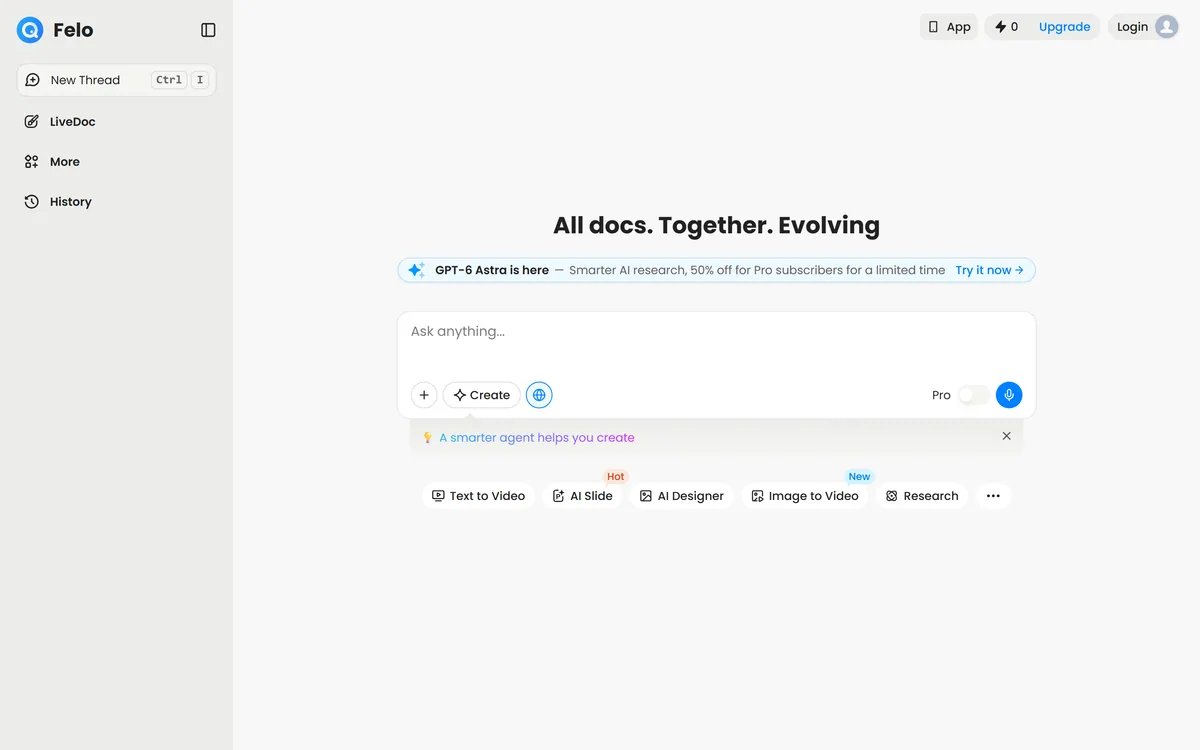
Felo's homepage, captured 9 September 2026, showing the search entry point and the wider product set around it.
Felo In Five Points
Multilingual is the product, not a setting — Felo describes itself as a free multilingual AI search and creation platform, and the language reach is what most distinguishes it.
Search plus Slides in one flow: Felo Slides turns a research answer into a presentation without an export-and-rebuild step.
An agent mode and an LLM playground sit alongside search, for multi-step tasks and for comparing model behaviour.
LiveDoc and an API extend it past the chat box into documents and into your own applications.
There is a free tier, which lowers the cost of finding out whether the multilingual difference matters for your sources.
What Multilingual Search Actually Changes
Felo describes itself as a free multilingual AI search and creation platform, and that word does more work than it appears to.
There are two different things a tool can mean by multilingual. The weak version is a translated interface: the buttons are in your language, and the search still runs across predominantly English sources. The strong version is retrieval across languages — the tool finds Japanese sources for a Japanese question, or finds them for an English question and answers you in English.
The second is genuinely useful and much harder to build, because it requires the retrieval layer to work across scripts and search conventions that differ substantially from English.
The practical test is easy to run yourself, and worth running before committing. Ask about something where the authoritative sources are not in English — a regulation, a local market, a company that files in another language — and look at what it cites. If the citations are in the source language, the retrieval is real. If they are all English-language secondary coverage, you have the weak version.
For anyone working across Asian markets specifically, this is not a nice-to-have. The gap between what an English-first tool surfaces about Japan and what actually exists in Japanese sources is large enough to change conclusions.
The comparison to run is against whatever answer engine you already use. Perplexity is the sensible baseline, precisely because it is strong enough on general questions that anything replacing it has to win somewhere specific.
There are two things a tool can mean by multilingual: a translated interface, or retrieval that actually crosses languages. Only one of them changes your answers.
Felo Slides And The Research-To-Deliverable Gap
Felo Slides generates presentations, and its position inside a search product is the interesting part rather than the slide generation itself.
Think about what research for work actually ends in. Very rarely a satisfied curiosity; far more often a deck, a memo or a document that someone else reads. The search tool answers the question and then hands you a wall of text you must restructure by hand.
That restructuring is where most of the time goes, and it is also where most of the sourcing gets lost. Facts move from an answer with citations into slides without them, and the deck arrives looking more certain than the research was.
Generating slides directly from the answer closes that gap mechanically. Whether it closes it well depends on something you should check: does the deck keep the citations, or does it strip them? A sourced deck is far more defensible than a confident one.
Expect to edit heavily regardless. Generated slides are a reasonable first structure — the argument in order, the sections identified — rather than a finished deliverable, and treating them as finished is how errors reach an audience.
If the deck rather than the research is the hard part, a dedicated generator such as Gamma produces a better-looking result — at the cost of the research and the slides living in different places.
Agent Mode, LiveDoc And Where Each Fits
Felo's product set runs wider than search — an agent mode, an LLM playground, LiveDoc and an API — and knowing which to reach for saves time.
Search answers a question. Agent mode is for tasks with several steps that depend on each other, where the second search depends on what the first returned, and it is worth the extra latency only when the task genuinely has that shape.
The LLM playground is for comparison rather than production. It is where you find out whether a given model handles your kind of question well before building anything on it, and that is a more useful habit than most people practise.
LiveDoc extends the platform into documents, which matters if your output is prose rather than slides. The API is what makes any of it repeatable — the difference between a person doing research and a process that runs on a schedule.
Most users will live in search and Slides. The rest is worth knowing about at the point where the manual version starts repeating itself.
How To Evaluate Felo Against What You Already Use
The free tier makes evaluation cheap, and the way to use it is to test the thing that differentiates rather than the thing everyone has.
Every AI search tool answers general questions acceptably. Comparing them on that produces a tie and tells you nothing.
Run the multilingual test first, because it is the only question where the answer could be decisive.
Take three real questions where the authoritative sources are not in English, and run each through Felo and through whatever you use now.
Compare the citations rather than the prose — count how many are in the source language versus English secondary coverage.
Take one answer through to Felo Slides and check whether the citations survive into the deck.
Time the search-to-deck path against your current process, including the manual restructuring you normally do.
Test one multi-step research task in agent mode to see whether the extra latency buys a better answer.
Decide on the differentiator, not the baseline — if the multilingual retrieval and the slide path are not better for your work, the general answer quality will not carry it.
What Does Felo's Site Leave Unanswered?
Two things are worth knowing before you build a workflow on this, and neither is stated on the marketing pages.
The first is which models sit behind which features. Felo offers an LLM playground, which implies multiple models are available, but the site does not say what powers ordinary search or Slides. That matters for anyone with a policy about where data goes, and for anyone whose answer quality expectations are model-specific.
The second is how the free tier is bounded. Free tiers on AI search products almost always carry limits on searches, model access or output volume, and the shape of those limits determines whether free is a trial or a usable state. The site presents a free entry point without our being able to establish where it stops.
There is a corporate footer with Enterprise, Blog, Tools, Privacy and Terms sections, which is more transparency than many AI startups offer and the right place to start if data handling is a constraint for you.
None of this is disqualifying. It is the ordinary due diligence for a tool that will hold your research questions, which are frequently more sensitive than the answers.
For academic work the gap is wider still. A literature tool like Elicit retrieves from indexed papers rather than the open web, which is a different and considerably more reliable corpus for that job.
Confirm which model backs search and Slides before routing anything confidential through them.
Find where the free tier stops before designing a workflow that assumes it does not.
Read the privacy terms if your research questions are themselves commercially sensitive.
Check whether Slides preserves citations, since an unsourced deck is a liability.
Test the multilingual retrieval on your own sources rather than trusting the description.
Key features of Felo
Multilingual AI search presented as the platform's core proposition
Felo Slides for generating presentations from research output
Agent mode for multi-step research and task execution
LLM Playground for comparing model behaviour
LiveDoc for document-oriented work alongside search
API access for programmatic use
Auspia SEO automation offered alongside the core platform
A free tier for evaluation without commitment
Pros & cons
Pros
6
Treats multilingual retrieval as the product rather than as a translated interface
Closes the research-to-deliverable gap by generating slides from the answer directly
Agent mode and playground extend it past single-question search
An API makes repeatable research processes possible rather than manual ones
A free tier makes evaluation genuinely cheap
A corporate footer with named Privacy and Terms sections, which many AI startups lack
Cons
6
The models behind search, Slides and agent mode are not disclosed
Free-tier limits are not stated, so the boundary between trial and usable is unknown
Paid pricing structure could not be established
The answer-engine field is crowded and Felo is not obviously strongest on general questions
No independent benchmark of retrieval or answer quality is published
Whether generated slides retain source citations is not stated
Best For
Research across Japanese, Chinese, Korean and other non-English sources
Analysts whose work ends in a deck rather than a document
Teams working across Asian markets where English coverage is secondhand
Anyone comparing answer engines without wanting to pay to find out
Developers wanting search inside their own applications via API
Felo Against Other Answer Engines
AI search tools differ most in what they retrieve and what they hand you at the end — not in how the chat box looks.
SEO automation product listed alongside the core platform
API
Available for programmatic access
Pricing
A free tier is offered; paid structure not established
Footer sections
Enterprise, Blog, Tools, Privacy, Terms
Other Search And Deliverable Tools
Felo sits between the answer engines and the deck generators, and both neighbours are worth knowing.
Perplexity — the reference point for citation-led AI search
Genspark — a different take on what an answer should look like
Gamma — if the presentation rather than the research is the hard part
Elicit — for academic literature, where general web search retrieves badly
You.com — another answer engine with a broad product surface around it
Is Felo Worth Your Time?
Worth testing when
Your authoritative sources are frequently in Japanese, Chinese, Korean or another non-English language.
Your research routinely ends in a deck, and the restructuring step is where your time goes.
You work across markets where English-language coverage is thin or secondhand.
You want to compare model behaviour before committing, which the playground supports.
You want to test an alternative answer engine without paying to find out.
Probably not when
Your sources are overwhelmingly English, where the multilingual advantage does not apply.
You need to know exactly which model handles your data, which the site does not state.
Your work is academic literature review, where a specialist tool retrieves better.
You need a hard commitment on free-tier limits before adopting anything.
You already have an answer engine embedded in a workflow and no specific reason to move.
Verifying The Felo Claims
Last checked . Read from felo.ai and its footer navigation, with the screenshot above captured in the same session.
Publisher identified in the site footer as Felo Inc.
Product described on the site as a free multilingual AI search and creation platform
AI search confirmed as the core product surface
Felo Slides confirmed as a listed product for presentation generation
Agent mode confirmed in the product navigation
LLM Playground confirmed in the product navigation
LiveDoc confirmed in the product listing
Auspia listed alongside the platform as an SEO automation product
API access confirmed as available
A free tier confirmed as offered
Footer sections confirmed for Enterprise, Blog, Tools, Privacy and Terms
What we could not confirm: which underlying models power search, Slides or the agent; the limits that bound the free tier; the paid pricing structure; whether Slides output preserves citations from the source answer; how many languages are supported and whether retrieval genuinely crosses languages or the interface is merely localised; company size, funding or headquarters; and any independent benchmark of answer quality. We did not run comparative searches, so nothing here reflects tested retrieval performance.
Editor's Verdict
3.9/5
Felo is worth attention for two reasons that have little to do with the answer engine itself. It treats multilingual search as the product rather than a translated interface, which matters enormously if your sources are in Japanese, Chinese or Korean and Western tools quietly ignore them. And it closes the loop from research to deliverable — an answer becomes a deck in one step, which is what most search-for-work actually ends in. It loses ground because the answer-engine layer is a crowded field where it is not obviously the strongest, and because the model behind any given feature is not disclosed. AInexfinder Editor Score: 3.9/5.
Felo pricing
AInexfinder does not list plan prices or billing details. For current pricing, plans, and trials, visit the official Felo website.
Vendor pricing, credits, and billing policies change over time. Always confirm on the official site before you buy.
Frequently asked questions
What is Felo?
Felo is a multilingual AI search and creation platform from Felo Inc. It pairs an answer engine with Felo Slides for presentation generation, an agent mode for multi-step tasks, an LLM playground, LiveDoc and an API. The multilingual layer is presented as the core proposition rather than as a localisation feature.
What does multilingual actually mean here?
There are two versions, and the difference matters. The weak one is a translated interface over predominantly English retrieval. The strong one finds sources in other languages and answers in yours. Test it directly: ask about something whose authoritative sources are not in English and look at whether the citations are in the source language or are English secondary coverage.
Is Felo free?
A free tier is offered. What we could not establish is where it stops — free tiers on AI search products usually carry limits on searches, model access or output volume, and the shape of those limits determines whether free is a trial or a usable state. Find the boundary before designing a workflow that assumes there is not one.
What is Felo Slides?
Presentation generation built into the search product, so a research answer becomes a deck without an export-and-rebuild step. That matters because research for work usually ends in a deliverable, and the manual restructuring is where the time goes and where sourcing gets lost. Check whether the generated deck preserves citations — a sourced deck is far more defensible.
Which AI models does Felo use?
Not stated on the site. Felo offers an LLM Playground, which implies multiple models are available to users, but which model powers ordinary search or Slides is not disclosed. That matters if you have a policy about where data goes, or if your quality expectations are model-specific — confirm before routing anything confidential through it.
How does Felo compare to Perplexity?
Perplexity is the reference point for citation-led general AI search and is stronger as a general-purpose default. Felo differentiates on multilingual retrieval and on the built-in path from answer to deck. If your sources are overwhelmingly English and your output is prose, the case for switching is weak; if either is untrue, it is worth a real test.
When should I use agent mode rather than search?
When the task genuinely has several dependent steps — where the second search depends on what the first returned. Agent modes cost latency, and they earn it only on that shape of problem. A single question with a single answer is faster and usually better through ordinary search.
Does Felo have an API?
Yes, API access is listed. That is what turns research from something a person does into something a process does on a schedule, which is the point at which any search tool becomes infrastructure rather than a destination. Pricing and rate limits for API use were not established.
What is Auspia?
An SEO automation product listed alongside the core Felo platform. It sits outside the search-and-create workflow described here, and we did not evaluate it. Its presence suggests Felo Inc. is building more than a single product, which is context worth having when assessing how much attention any one of them receives.
How should I evaluate Felo against what I already use?
Test the differentiator, not the baseline. Every AI search tool handles general questions acceptably, so comparing on those produces a tie. Run three questions whose authoritative sources are not in English, compare the citations rather than the prose, then take one answer through to Slides and time the whole path against your current process.
Daniel reviews AI tools the slow way — by actually using them on real projects. His reviews cover what works, what breaks, and who each tool is genuinely a good fit for.
Daniel and the AInexfinder editorial team research Felo using public product information, listing evidence, and (when available) hands-on checks. Scores reflect listing completeness and transparency — not paid placement.
Listings may include affiliate or sponsored placements, which are labeled when present. Editorial scores and cons are not sold. See our affiliate disclosure and review methodology.
Exa is a search API that gives AI agents real-time access to the web, built on its own large index, embedding and retrieval models, with selectable latency, search verticals, token-efficient highlights, structured enrichments and an MCP server.
Liner splits into three purpose-built agents: everyday search returning cited answers with one-click verification and mind maps, Liner Scholar for finding, comparing and citing papers and building literature reviews, and a writing agent that drafts, verifies and edits in the same window.
Komo is an AI search engine that answers with sources across three modes — Web, People and Deep research. Its Firsthand feature finds the right people to answer what AI cannot, and it offers a Komo Fast model, saved history and an Earn programme.
Zendy is an AI-powered research library combining open-access and premium academic literature with ZAIA, an assistant that summarises papers, highlights key phrases and gives reference-backed answers, aimed at independent researchers and institutions.
R Discovery is a research reading and literature search app from Cactus Communications, covering 150M+ journal articles, 78M+ open access papers and 10M+ conference documents. It offers AI summaries with citations, chat with a PDF, generated literature reviews, audio papers and translation into 30+ languages.