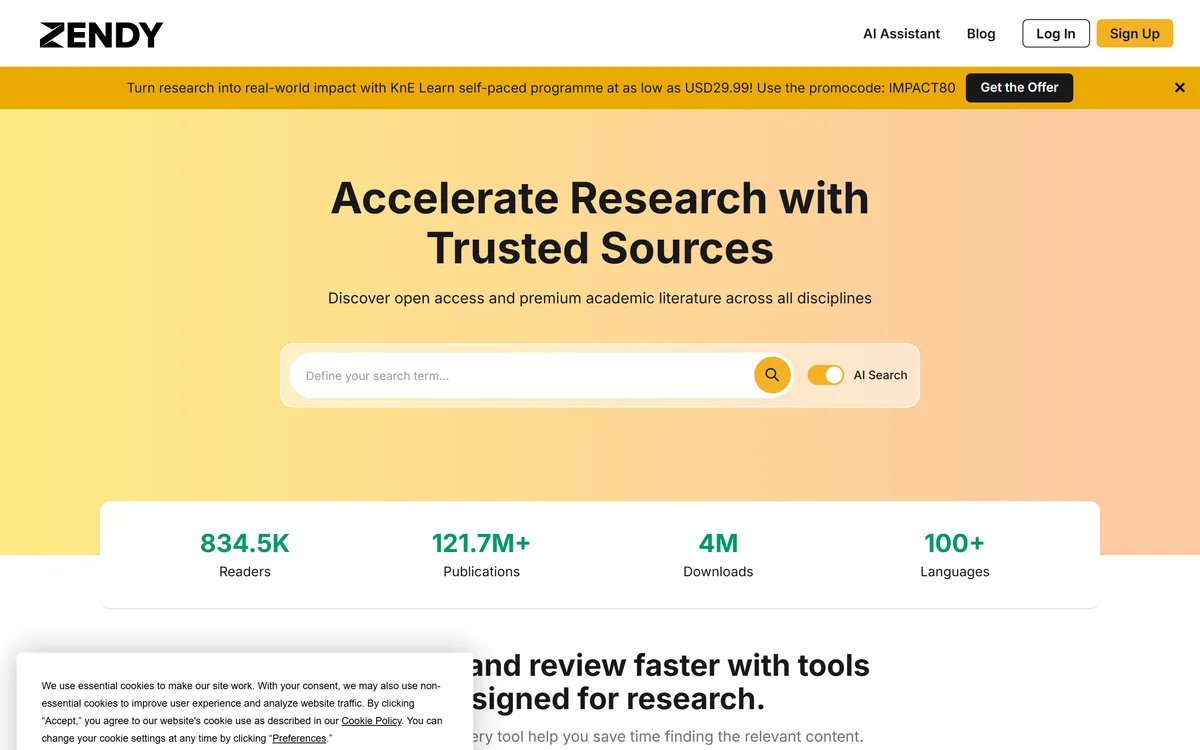
Zendy is an AI-powered research library combining open-access and premium academic literature with ZAIA, an assistant that summarises papers, highlights key phrases and gives reference-backed answers, aimed at independent researchers and institutions.
Academic literature has a two-tier access problem: universities pay for sweeping database subscriptions, and everyone else — independent researchers, clinicians in private practice, professionals outside academia — hits paywalls constantly. Zendy is built squarely for that second group.
It combines open-access and premium literature across disciplines into one library, and layers an AI assistant, ZAIA, on top to summarise papers, highlight key concepts and answer questions with references attached. The company behind it, Knowledge E, operates out of the Oxford Science Park and also sells institutional plans to libraries.
This review covers what the combined library actually contains, what ZAIA adds to plain search, how Zendy serves independent researchers and institutions differently, how access is priced, and who it genuinely helps versus who already has what it offers.
Zendy pairs a searchable library with ZAIA, its research assistant.
Zendy Explained In Four Points
Zendy is an AI-powered research library that brings open-access and premium academic literature together in one searchable place.
ZAIA is its assistant, giving summaries, key-phrase highlighting and reference-backed answers to research questions.
Its sweet spot is access, especially for independent researchers and professionals without a big university subscription.
It works across web and a mobile app, syncing finds across devices, and offers institutional plans for libraries.
Open Access And Premium Literature In One Library
Zendy's foundation is the library itself: a single place to search both open-access material and licensed premium journals across disciplines, rather than bouncing between repositories and publisher paywalls.
For someone without institutional access, that consolidation is the real value. The premium tier, Zendy Plus, is pitched at exactly the researcher a university does not cover — the independent practitioner, the clinician, the professional — and the pitch that recurs in its reviews is affordability relative to buying journal access piecemeal.
It is not trying to be the largest index in existence. A grounded, curated tool like the Web of Science Research Assistant sits on a different, institutionally-licensed database; Zendy's angle is breadth of access at an individual's budget, which is a different and underserved niche.
Universities pay for sweeping access and everyone else hits paywalls. Zendy is built for the everyone else.
What Can ZAIA, Zendy's Assistant, Do For A Reader?
ZAIA is the AI layer that turns Zendy from a library into a research assistant, and it is aimed at the reading-and-reviewing stage rather than only discovery.
Summaries And Key-Phrase Highlighting
ZAIA can generate a summary of a lengthy paper on demand and highlight the key research concepts within an article, which speeds up the triage stage — deciding whether a paper is worth a full read before you commit the time.
This is the same job tools like Scholarcy focus on, and it is genuinely useful when you are working through a reading list. The sensible caution is the universal one for AI summaries: use them to decide what to read, not as a substitute for reading the papers you then rely on.
Reference-Backed Answers On Mobile
Chatting with ZAIA returns answers backed by references rather than free-floating claims, and the mobile app keeps your questions and saved finds in sync with the desktop so you can start on one device and continue on another.
Reference-backed answering is where a research assistant earns trust, because it lets you check the source rather than take the answer on faith — the same grounding principle that a tool like Elicit is built around. Verify the citations before quoting them, as you would with any AI tool.
How Zendy Serves Independent Researchers And Libraries
Zendy runs two audiences in parallel. For individuals, it is a personal library and assistant, with the premium Zendy Plus tier unlocking the licensed content. For organisations, it offers institutional plans that bring its smart search, instant insights and reference-backed answers to a library's whole user base.
The reviews it publishes lean heavily on the independent-researcher story — a plastic surgeon in private practice, students, professionals without a university affiliation — which is consistent with the gap it is filling. That focus is a strength: it knows who it is for.
The institutional offer also means a library can trial it for its users, which is how several of its cited partners came on board. If you are inside a well-resourced university, much of what Zendy offers you may already have; its value climbs the further you sit from that kind of access.
How Zendy Prices Open And Premium Access
Zendy's open-access search is free to use, with the premium literature and fuller features behind Zendy Plus, and separate quoted plans for institutions. There is also a learning arm, KnE Learn, promoted alongside the library.
AInexfinder does not publish plan prices, which change and are best read on the site. The affordability framing is central to Zendy's appeal, so the thing to weigh is the premium tier against how often you actually hit a paywall — if you are blocked weekly, the maths is easy; if rarely, open access alone may suffice.
For institutions, pricing is quoted against your user base, so the route is a trial or quote rather than a listed figure.
Testing Zendy Against A Real Reading List
Because Zendy is about access and triage, test it on literature you actually need rather than on a demo search.
Search for three papers you know you need and check whether Zendy can get you to the full text, open-access or premium.
Ask ZAIA to summarise one long paper and compare its summary against your own reading of it.
Use key-phrase highlighting on an article and judge whether it surfaces the concepts that actually matter.
Ask ZAIA a real research question and verify that the references it returns are real and relevant.
Export a citation in your required style and confirm it is correctly formatted.
Pass/fail: Zendy earns a premium subscription only if it reliably unlocks content you would otherwise be paywalled out of.
Finally, test the mobile app's sync if you research across devices, since that continuity is part of the pitch.
Zendy Research Library Facts
What it is
AI-powered academic research library and assistant
Library
Open-access plus premium literature across disciplines
Elicit — structured extraction of findings across many papers
Scholarcy — fast summary cards for triaging individual papers you upload
Editor's Verdict
4.0/5
Zendy earns 4.0 for solving a genuine access problem — open-access plus affordable premium literature with a useful assistant in ZAIA — and loses ground only because its index is not the largest and much of its value disappears for researchers who already sit inside a well-funded university. AInexfinder Editor Score: 4.0/5.
Zendy pricing
AInexfinder does not list plan prices or billing details. For current pricing, plans, and trials, visit the official Zendy website.
Vendor pricing, credits, and billing policies change over time. Always confirm on the official site before you buy.
Frequently asked questions
What is Zendy?
Zendy is an AI-powered research library that brings open-access and premium academic literature into one searchable place, with an assistant called ZAIA that summarises papers, highlights key phrases and gives reference-backed answers. It is aimed at researchers without big institutional subscriptions.
What does ZAIA do?
ZAIA is Zendy's AI assistant. It generates on-demand summaries of long papers, highlights the key concepts within an article, and answers research questions with references attached so you can verify the source rather than take the answer on trust.
Is Zendy free?
Open-access search is free to use. Licensed premium literature and fuller features sit behind the Zendy Plus subscription, and institutions are quoted separately. Weigh the premium tier against how often you actually hit paywalls you would otherwise be blocked by.
Who is Zendy best for?
Independent researchers, clinicians in private practice, students and professionals without a well-funded university subscription — the people who hit journal paywalls most. If you already have broad institutional access, much of Zendy's value is redundant for you.
How does Zendy compare with the Web of Science Research Assistant?
The Web of Science Research Assistant sits on an institutionally-licensed database with guided, agentic workflows. Zendy's angle is affordable access to open and premium literature for individuals. Choose the former if your institution provides it, Zendy if you are outside that kind of access.
How does Zendy compare with Scholarcy or Elicit?
Scholarcy focuses on summarising papers you upload, and Elicit on extracting structured findings across many papers. Zendy combines a literature library with an assistant, so its distinctive value is access to the papers in the first place, not only what the AI does with them.
Can I use Zendy on my phone?
Yes. Zendy has a mobile app that lets you chat with ZAIA, skim full-text articles and save finds, keeping everything in sync with the desktop so you can start research on one device and continue on another.
How accurate are ZAIA's summaries and answers?
ZAIA returns reference-backed answers and paper summaries, which are useful for triage, but like any AI tool it can misread nuance. Use summaries to decide what to read and verify the references before quoting them, rather than relying on them as a substitute for the source.
Can I export citations from Zendy?
Yes. Zendy lets you cite research content in several referencing styles, including Harvard, Vancouver, APA and MLA, and copy the formatted citation. Confirm the exact style and edition you need matches your requirements before relying on it.
Who is behind Zendy?
Zendy is operated by Knowledge E, based at the Oxford Science Park in the UK, which also runs a learning arm called KnE Learn. The company offers individual, premium and institutional plans, and publishes terms, privacy and FAQ pages in its footer.
Daniel reviews AI tools the slow way — by actually using them on real projects. His reviews cover what works, what breaks, and who each tool is genuinely a good fit for.
Daniel and the AInexfinder editorial team research Zendy using public product information, listing evidence, and (when available) hands-on checks. Scores reflect listing completeness and transparency — not paid placement.
Listings may include affiliate or sponsored placements, which are labeled when present. Editorial scores and cons are not sold. See our affiliate disclosure and review methodology.
R Discovery is a research reading and literature search app from Cactus Communications, covering 150M+ journal articles, 78M+ open access papers and 10M+ conference documents. It offers AI summaries with citations, chat with a PDF, generated literature reviews, audio papers and translation into 30+ languages.
Scinapse analyses research landscapes rather than merely searching them, ranking papers and researchers by citation impact within a filtered set of a field instead of by global totals, generating review papers on request, and mapping how work and authors connect.
Clarivate's Web of Science Research Assistant is a generative and agentic AI layer over the Web of Science Core Collection, turning a research question into guided literature-review, author and trend workflows with visible grounding in trusted data.
Felo is a multilingual AI search and creation platform from Felo Inc. It pairs an answer engine with Felo Slides, an agent mode, an LLM playground, LiveDoc and an API, with the multilingual layer as its distinguishing feature rather than an afterthought.