Coconote records or accepts uploads — lectures, PDFs, videos, links, documents — and produces organised notes and transcripts, then generates quizzes, flashcards, study games and AI podcasts. It supports 100+ languages and syncs across iPhone, iPad, Android, web and desktop.
Sitting in a lecture, you have to choose between listening and writing. Nobody does both well, and the notes taken while trying to follow an argument are reliably worse than the argument was.
That is the problem this whole category exists to solve, and solving it is genuinely valuable — transcription is not learning, and the attention it consumes was the attention you needed.
What separates the tools is what happens next. Coconote's answer includes quizzes, flashcards and study games, which is the half that actually builds retention rather than the half that saves time.
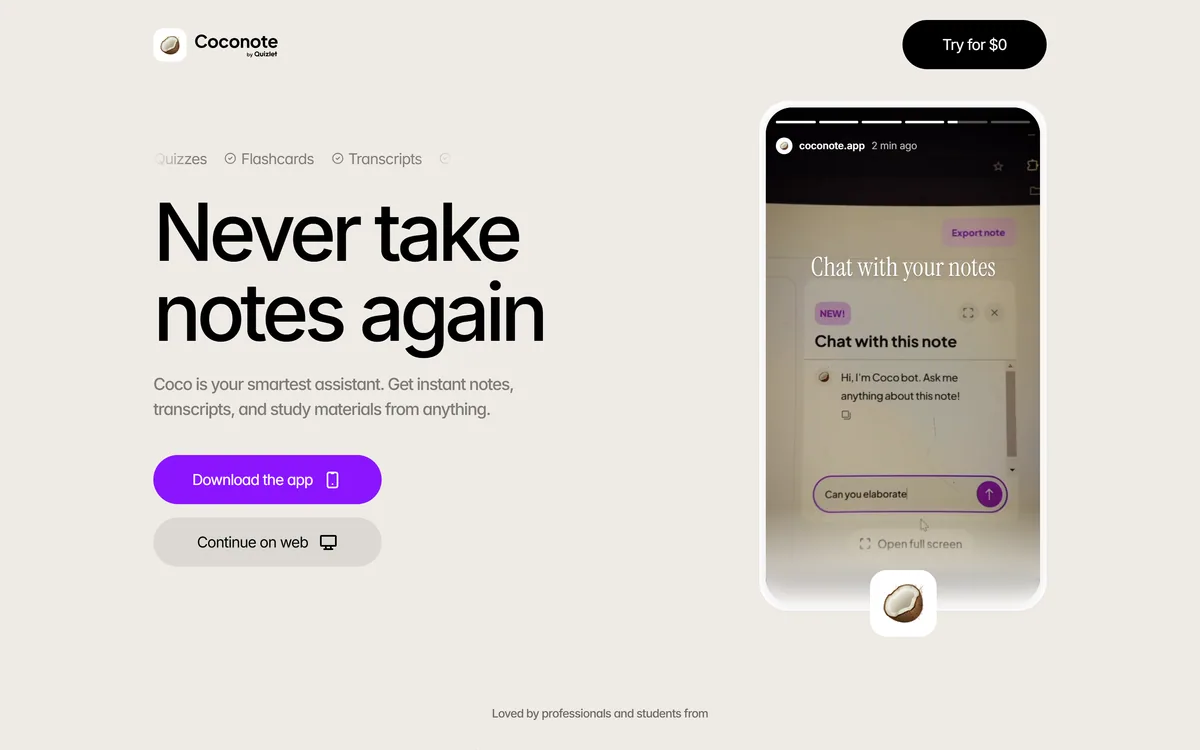
Coconote's homepage, captured 9 September 2026, showing the notetaking and study material generation flow.
Does A Notetaker Break Your Honour Code?
Coconote addresses this directly in its own FAQ, stating that it only helps you learn and capture key details rather than cheating for you, and that recording is fine as long as your professor or teacher is comfortable with it.
Both halves of that are worth taking seriously. Raising the question at all is more than most study tools do, and the two conditions it names are the two that actually matter.
The academic integrity line is generally about who did the thinking. A tool that records a lecture and organises what was said is capturing material you were present for; a tool that writes your essay is producing work you did not do. Coconote sits clearly on the first side of that.
The recording permission is the more commonly overlooked condition, and it is not merely courteous. Many institutions require a lecturer's consent to record, some restrict it entirely, and rules vary between departments within one university.
The practical position is that this is a question to resolve before the first lecture rather than after. It takes one email, the answer is almost always yes, and the alternative is discovering the policy in a conversation you did not want to have.
It is worth noticing that most tools in this category do not raise the question at all. NoteGPT ships an essay writer and an AI humaniser beside its study tools, which is a different position entirely.
The integrity question is about who did the thinking. Recording a lecture you attended is capturing material you were present for; writing your essay is not.
Quizzes, Flashcards And Study Games
Coconote generates quizzes, flashcards, practice exams and study games from your material, and this group is the part that actually produces learning.
The distinction that runs through every tool in this category is simple. Summarising reduces effort — useful for triage, catching up and deciding what deserves attention. Testing increases effort deliberately, and increased effort is the mechanism by which anything is retained.
Retrieval practice reliably outperforms re-reading and highlighting in the study literature, and it is also the least popular technique because it feels like failing. That feeling is the reason students choose the method that works worse.
Study games are therefore a more thoughtful inclusion than they first appear. Making retrieval feel less like being tested addresses the actual barrier, which is motivational rather than informational — nobody needs convincing that quizzes work.
The usual caveat applies to what is generated: questions favour recall of definitions over application, because definitions are easier to generate. Add three of your own harder questions per topic, aimed at using the idea rather than restating it.
A Hundred Languages And Who Benefits
Coconote states 100+ languages for capturing audio and translating, and the beneficiary is more specific than a language count suggests.
International students are the group this serves most, and their problem is not translation in the ordinary sense. It is that following a fast lecture in a second language while simultaneously taking notes is close to impossible, even at high fluency.
That produces a specific and unfair disadvantage: the student understands the material and cannot capture it in real time, so their notes are worse than their comprehension. Removing the note-taking removes the disadvantage entirely.
Translation on top of that means the notes can exist in whichever language the student thinks in, which is not always the language of instruction — and reviewing in your stronger language is meaningfully faster.
The quality caveat is the same as everywhere: transcription accuracy varies by language, and technical vocabulary is where it fails first. A physics lecture in a less-resourced language will mangle exactly the terms the lecture was about, and that is worth checking on the first recording rather than the fifth.
That is the same split Turbo AI is built around, and the reason both products live or die on whether anyone answers the quiz rather than on how good the notes look.
Ask your lecturer before recording — one email, almost always yes.
Listen actively and note only what confused you; the transcript handles the rest.
Do the quizzes, since summaries are triage and testing is the learning.
Add your own application questions to generated definition cards.
Check transcription of technical terms on the first recording, not the fifth.
AI Podcasts And Found Study Time
Coconote turns a note into a podcast narrated by Coco, and the case for it is about when you can use it rather than how well it works.
Passive listening is weak review. Hearing material again is closer to re-reading than to retrieval, and it produces the comfortable feeling of familiarity rather than the ability to recall anything.
But it uses time that was not otherwise available for studying. A twenty-minute commute, a walk, a gym session — none of those were study time, so weak review in found time is strictly better than nothing.
The mistake is substituting it for the effortful work. A student who listens to podcasts of their lectures and skips the quizzes has spent more time and learned less than one who did twenty minutes of retrieval practice.
Used correctly it is a supplement that costs no additional hours, which is a rare thing in studying. Used as the main method it is the most comfortable way to not learn something that has yet been invented.
For standardised exams none of this replaces calibrated material, which is the argument a platform such as MentoMind makes by refusing to generate questions at all.
Recording A Lecture And Actually Learning It
The tool changes what is possible during a lecture. It does not change what learning requires afterwards, and the sequence matters.
The failure is reviewing generated notes and feeling prepared.
Confirm your lecturer is comfortable with recording before the first session.
Listen actively during the lecture, writing only the points that confused you.
Review the generated notes the same day, while you still remember the shape of the argument.
Generate flashcards and a quiz immediately rather than saving them for revision week.
Add three harder questions per topic yourself, aimed at applying rather than recalling.
Test whether you can explain a topic without the notes open after a fortnight — the only measure that counts.
You cannot listen properly and take notes at the same time.
You study in a language that is not your first.
Your material arrives as a mix of lectures, PDFs, videos and links.
You know retrieval practice works and never make the flashcards.
You have commuting time that podcast review could use.
Study another way when
Your lecturer has not agreed to recording, which is the first thing to resolve.
You would read summaries instead of engaging with the material.
Your exam rewards application, where generated recall questions are not enough alone.
You need calibrated standardised-test practice, where question quality decides everything.
Your material is not spoken at all, which removes the strongest feature.
Coconote: Checking The Feature Claims
Last checked . Read from coconote.app in a browser session, with the screenshot above captured alongside.
Positioned as an AI notetaker producing instant notes, transcripts and study materials from anything
Three-step flow confirmed: record or upload, get notes, review and study
Inputs confirmed including lectures, PDFs, documents, videos, links, audio and websites
Organised notes and transcripts confirmed as the primary output
Quizzes, practice exams, flashcards, study games and videos confirmed as generated study materials
AI Chat confirmed for asking questions of your notes
AI Podcasts confirmed, narrated by Coco
100+ languages confirmed for capturing audio and translating
Platform sync confirmed across iPhone, iPad, Android, web and desktop, with Apple Watch referenced
Academic position stated in the site's FAQ: it helps you learn and capture key details rather than cheating, and recording is acceptable as long as your professor or teacher agrees
Testimonials attributed to students at named universities, dated
What we could not confirm: the operating company's legal name or location; pricing and plan structure; which underlying models generate notes, questions and audio; transcription accuracy in any language, particularly for technical vocabulary; how uploaded lecture recordings are stored, retained or deleted; and whether the study game formats are substantively different from the quizzes. We did not use the product, so nothing here reflects tested output quality.
Other Student Study Tools
Capturing lectures, generating practice and providing calibrated exam material are three different products.
Turbo AI — the closest direct alternative, with a live lecture notetaker
NoteGPT — a wider toolbox covering more than study
Quizlet — spaced repetition with an established system behind it
MentoMind — for standardised exams, with expert-written questions
Wave — the same idea aimed at professional meetings
Editor's Verdict
3.9/5
Coconote does the same thing several study apps do and answers the awkward question more directly than its competitors: it states explicitly that it helps you learn rather than cheat, and that recording depends on your teacher being comfortable with it. That is the right framing for a category where the boundary matters. The product itself splits like all of them — summarising saves time and teaches nothing, quizzes and flashcards are the half with evidence behind it. Study games are a genuinely good idea, because the barrier to retrieval practice has always been that it feels like failing. AInexfinder Editor Score: 3.9/5.
Coconote pricing
AInexfinder does not list plan prices or billing details. For current pricing, plans, and trials, visit the official Coconote website.
Vendor pricing, credits, and billing policies change over time. Always confirm on the official site before you buy.
Frequently asked questions
What is Coconote?
Coconote is an AI notetaker that records or accepts uploads — lectures, PDFs, documents, videos, links and audio — and produces organised notes and transcripts, then generates quizzes, flashcards, practice exams, study games and AI podcasts. It supports 100+ languages and syncs across mobile, web and desktop.
Does using Coconote break my university's honour code?
The site addresses this directly, stating it helps you learn and capture key details rather than cheating for you. The integrity line is generally about who did the thinking — recording a lecture you attended captures material you were present for, which is a different thing from producing work you did not do.
Do I need permission to record lectures?
Frequently yes, and the site says so: recording is fine as long as your professor or teacher is comfortable with it. Many institutions require consent, some restrict it entirely, and rules vary between departments. It takes one email, the answer is almost always yes, and finding out afterwards is worse.
Which features actually help me learn?
The quizzes, flashcards and study games. Summarising reduces effort, which helps triage and catching up and teaches nothing. Testing increases effort deliberately, and increased effort is the mechanism by which anything is retained — which is also why retrieval practice is the least popular technique that works best.
Why include study games?
Because the barrier to retrieval practice is motivational rather than informational. Nobody needs convincing that quizzes work; they avoid them because being tested feels like failing. Making retrieval less unpleasant addresses the actual obstacle, which is a more thoughtful design choice than it first appears.
Are AI podcasts a good way to revise?
As a supplement, yes. Passive listening is weak review — closer to re-reading than retrieval, producing familiarity rather than recall. But it uses commuting or walking time that was not study time anyway, so weak review in found time beats nothing. Substituting it for the quizzes is the mistake.
How does the 100+ language support help?
Most for international students, whose problem is not translation but that following a fast lecture in a second language while taking notes is close to impossible even at high fluency. Removing the note-taking removes an unfair disadvantage, and translation lets the notes exist in the language you actually think in.
How accurate is the transcription?
Not published, and it varies by language — technical vocabulary is where it fails first. A lecture in a less-resourced language will mangle exactly the terms the lecture was about, which is worth checking on your first recording rather than discovering when you revise from it.
How does it compare to Turbo AI?
They are close alternatives, both recording live lectures and generating notes, flashcards, quizzes and podcasts from them. Coconote's distinguishing detail is addressing the honour code and recording permission questions explicitly in its own FAQ, which most tools in this category simply do not raise.
What should I actually do with the notes?
Review them the same day, while you still remember the argument's shape, then generate flashcards and a quiz immediately rather than in revision week. Add three of your own harder questions per topic. After a fortnight, check whether you can explain the topic without the notes open.
Daniel reviews AI tools the slow way — by actually using them on real projects. His reviews cover what works, what breaks, and who each tool is genuinely a good fit for.
Daniel and the AInexfinder editorial team research Coconote using public product information, listing evidence, and (when available) hands-on checks. Scores reflect listing completeness and transparency — not paid placement.
Listings may include affiliate or sponsored placements, which are labeled when present. Editorial scores and cons are not sold. See our affiliate disclosure and review methodology.
NoteGPT is an AI learning assistant covering YouTube summarising, transcription, note taking, flashcards, quizzes and slide generation, alongside image, audio and writing tools. Chrome and Edge extensions extend it into the browser.
Recall is an AI knowledge base that saves videos, articles, podcasts, PDFs and books, summarises them, auto-tags and links related ideas, and schedules spaced-repetition quizzes. It runs on web, iOS and Android with Chrome, Safari, Edge and Firefox extensions.
LUCA is a K-12 reading intervention platform that analyses student reading at the phoneme level rather than the word level, identifying skill gaps in real time. It reports a 17.4 words-per-minute average fluency gain and 763,000+ grapheme-phoneme mappings, delivered through SoundScout, StoryGen and Assessment Intelligence.
Question AI is a homework-helper app that scans a question and returns step-by-step answers across school subjects, plus AI writing, search, translation and summarizing. Its study uses are legitimate; using it to hand in answers or graded work crosses academic-integrity lines, which we weigh honestly.
RemNote combines outlining, handwriting, PDF annotation and spaced-repetition flashcards in one document, generating cards, quizzes and summaries from PDFs, slides, lecture transcripts and video, with an exam scheduler that works backwards from a date you set.
Gizmo is a mobile-first study app that turns your notes, PDFs, slides and YouTube videos into AI-generated quizzes and flashcards, built around active recall so revision becomes a habit rather than a chore.