NoteGPT is an AI learning assistant covering YouTube summarising, transcription, note taking, flashcards, quizzes and slide generation, alongside image, audio and writing tools. Chrome and Edge extensions extend it into the browser.
notegpt.io8 viewsAdded January 3, 20262.8M+ visitors
There is a version of studying with AI that works and a version that quietly does not, and they look almost identical from the outside.
The version that works uses the tool to remove effort that teaches you nothing — typing out flashcards, finding the timestamp, transcribing a lecture. The version that does not uses it to remove the effort that is the learning.
NoteGPT contains both, generously. Which half you end up using is a decision you make rather than one the product makes for you, and it is worth making deliberately.
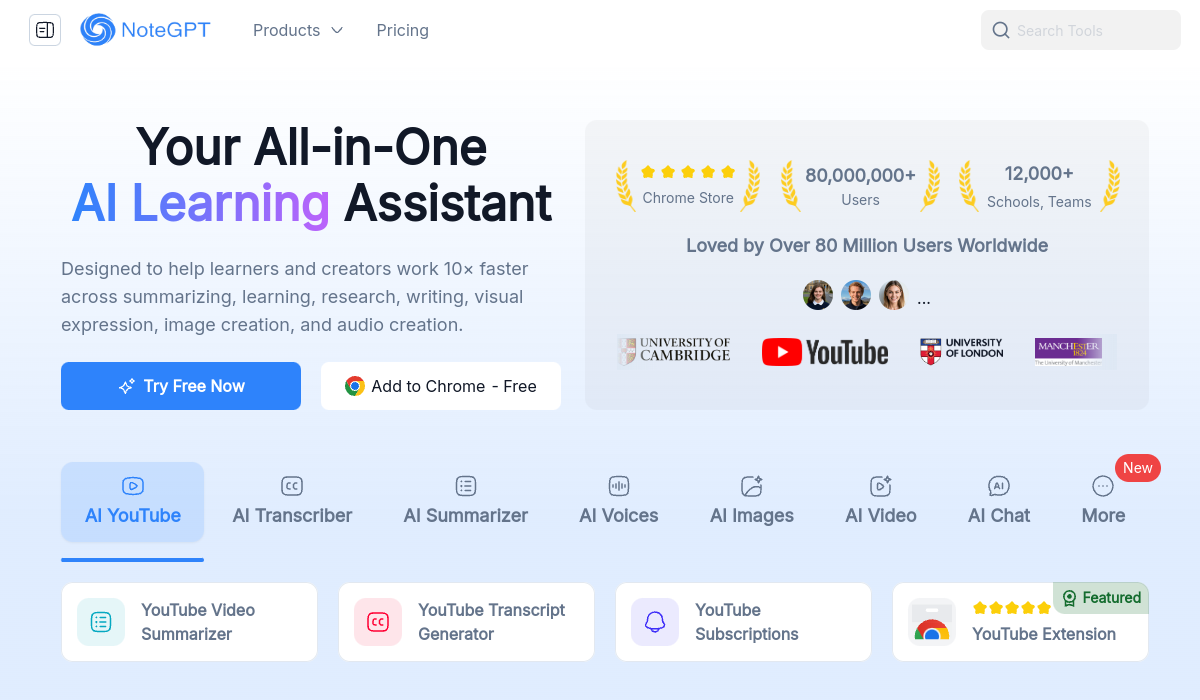
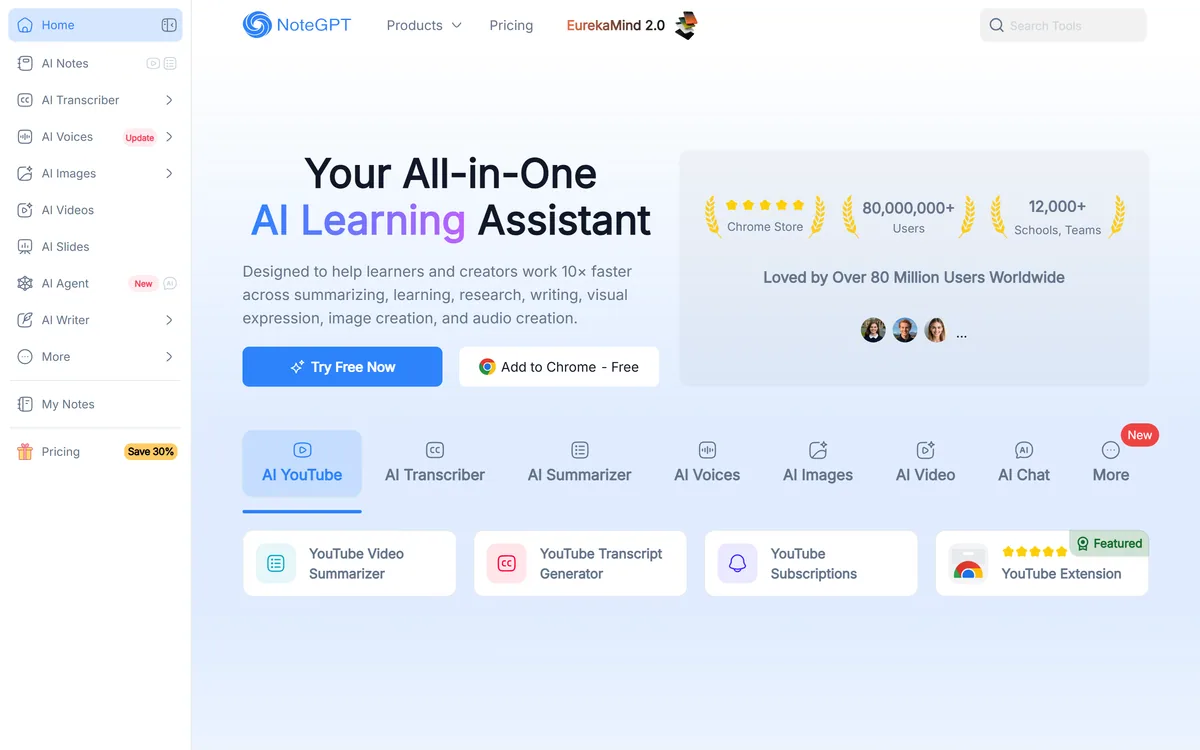
NoteGPT's homepage, captured 9 September 2026, showing the breadth of learning and creation tools it offers.
Does Summarising A Lecture Help You Learn It?
NoteGPT's most visible tools summarise: YouTube videos, PDFs, PowerPoints, audio, lectures and meetings, each condensed into something you can read in a fraction of the time.
For triage, this is unambiguously good. Deciding whether a two-hour lecture is worth watching, or which of forty papers to read properly, is a real problem and a summary answers it in seconds. Skipping material that turned out to be irrelevant is not a loss of learning.
For learning the material, it is more complicated, and the research on this is fairly consistent. Understanding is built by effortful processing — struggling with an argument, reconstructing it, noticing what you did not follow. A summary hands you the conclusions with the struggle removed, which produces the feeling of understanding without much of the substance.
The specific danger is that the feeling is convincing. Reading a good summary produces high confidence and low retention, and the gap between those two only becomes visible in an exam or a conversation where you have to use the idea.
The defensible pattern is summary first as a map, then the material itself. Knowing the structure of an argument before encountering it makes the effortful version easier and faster — which is a genuine gain, and quite different from reading the summary instead.
If you need to interrogate the source rather than replace it, a grounded notebook such as Gemini Notebook cites back into your own material instead of condensing it away.
A summary hands you the conclusions with the struggle removed. That produces the feeling of understanding without much of the substance.
Flashcards And Quizzes Are The Useful Half
The AI Flashcard Maker and Quiz Generator are the strongest things in this product, and it is worth being explicit about why.
Retrieval practice — testing yourself rather than re-reading — is among the best-evidenced techniques in the study literature. It reliably outperforms highlighting, re-reading and note-copying, and it is also the least popular, because it feels harder and produces the sensation of failing.
The barrier to doing it has always been the setup. Making good flashcards from a lecture is slow, boring, and happens after the studying you already did not want to do, so most students never make them.
Generating cards from your own material removes precisely the right effort. The tedious transcription work goes; the difficult retrieval work stays, because you still have to answer the cards.
The quality caveat is real: generated cards tend toward definition-recall rather than the application questions that actually test understanding. Use them as a base, and add your own harder cards for the concepts you know you find slippery.
The Tool Count Problem
NoteGPT lists a very large number of tools: YouTube summariser, transcript generator, note taker, transcriber, text-to-speech, podcast generator, voice cloning, voice designer, image generator, image editor, headshot generator, background remover, object remover, video generator, slide generator, PDF and PPT summarisers, essay writer, essay grader, AI detector, humaniser, flashcard maker, quiz generator, maths solver, homework helper and PDF translator.
Breadth of this kind is a business decision rather than a product one. Each tool is a landing page and a search term, and a site with forty of them captures forty kinds of visitor — which is a rational way to grow and tells you nothing about depth.
The consequence for a user is that quality is uneven and you cannot tell which tools got the attention. A headshot generator and a flashcard maker are entirely unrelated problems, and no team is excellent at both.
The practical approach is to identify the two tools you would use weekly and judge only those. If YouTube summarising and flashcards are your workflow, their quality is the whole decision, and the object remover is irrelevant however well it works.
It is also worth noticing what the breadth signals about the audience. Voice cloning and headshot generation are not study tools, and their presence suggests the product is chasing general AI-tool traffic as much as serving students.
Compare that with a tool that picked one job. Quizlet has done spaced repetition for years and is judged on it; Quizgecko does assessment generation and nothing else.
Use summaries to decide what to study, not as a substitute for studying it.
Generate flashcards, then add your own harder application questions.
Pick the two tools you would use weekly and judge the product on those alone.
Check your institution's policy before using anything that writes on your behalf.
Treat AI detector output as unreliable, in both directions.
AI Detectors And Humanisers Deserve A Word
NoteGPT lists an AI Detector and an AI Humanizer alongside its study tools, and both are worth understanding rather than ignoring.
AI detectors do not work reliably, and this is not a controversial position. They produce false positives on writing by non-native English speakers, on formal or formulaic prose, and on perfectly human text that happens to be well structured. A detector output is a probability estimate from a system with a known error rate, and treating it as evidence about a specific student is unsound.
That cuts in both directions. If you are a student, a detector telling you your own writing reads as AI-generated is not a useful signal and not worth rewriting for. If you are an educator, a detector score is not a basis for an academic-integrity finding.
A humaniser is a tool for rewriting generated text to evade those detectors, which is a fairly direct statement of intent. It has legitimate uses — editing generated drafts to sound like you — and its position next to an essay writer and a homework helper is not accidental.
The honest framing is that submitting generated work as your own is an academic-integrity violation at essentially every institution, the tools to do it exist here, and the consequences fall on the student rather than the vendor. Know your institution's policy before you touch any of it.
For standardised exams none of this substitutes for calibrated material — that is the argument a platform like MentoMind makes when it refuses to generate questions at all.
Studying With It Without Undermining Yourself
The difference between the two versions of AI-assisted study is a sequence, not a set of tools.
Run it in this order and the summarising helps rather than substitutes.
Summarise first to triage — decide what deserves your actual attention and what does not.
Read or watch the material you kept, properly, without the summary open.
Generate flashcards and a quiz from that material immediately afterwards.
Add three of your own harder cards per topic, aimed at application rather than definition.
Test yourself before re-reading anything, since the discomfort of retrieval is the mechanism.
Check your institution's policy before using the essay or homework tools at all.
NoteGPT At Speed
YouTube summarising and transcripts are the entry point, extended into the browser by Chrome and Edge extensions.
Flashcards and quizzes are the genuinely useful half — retrieval practice with the tedium removed.
It reads a lot: YouTube, PDFs, PowerPoint, video, audio, lectures, meetings and articles.
A very wide toolset spanning image generation, voice cloning, slide generation, essay writing and maths solving.
An AI detector and humaniser sit in the same product as the study tools, which is worth knowing about.
Key features of NoteGPT
YouTube summarising with transcript generation
Summarisers for PDF, PowerPoint, video and audio
AI Flashcard Maker and Quiz Generator from your own material
AI Note Taker and transcription for lectures and meetings
Slide generation and PDF translation
Essay writing and grading tools
Image, voice and video generation alongside the study tools
Chrome and Edge extensions for use inside the browser
Pros & cons
Pros
6
Flashcard and quiz generation removes the setup barrier to retrieval practice
Summarising is genuinely valuable for triage across more material than you can read
Very wide input support — YouTube, PDFs, slides, audio, video and articles
Browser extensions put summarising where the lectures actually are
One subscription covers study, media and writing tools
Interface available in Japanese and Simplified Chinese as well as English
Cons
6
Summaries produce the feeling of understanding with much less of the substance
Generated flashcards skew toward definition recall rather than application
The tool count means uneven depth, and you cannot tell which tools got attention
An AI detector and humaniser sit beside the study tools, which changes what the product is for
AI detectors are unreliable in both directions and should not be treated as evidence
No operating company, location, pricing or model disclosure on the pages we read
Best For
Students triaging more lectures and papers than they can watch
Anyone who knows flashcards work and never makes them
Turning recorded lectures into searchable transcripts
Study material spread across YouTube, PDFs and slide decks
Multilingual learners using the Japanese or Chinese interface
NoteGPT Beside Other Learning Tools
Study tools differ on whether they remove the effort that teaches you or the effort that does not.
Tool
Core mechanism
Effort it removes
Best for
NoteGPT
Summarising plus generated flashcards and quizzes
Both transcription and, if you let it, comprehension
Fast triage and card generation from your own material
AI Video Generator and AI Slide Generator confirmed
PDF, PPT, video and audio summarisers confirmed
AI Essay Writer and Essay Grader confirmed
AI Detector and AI Humanizer confirmed as listed tools
AI Flashcard Maker and Quiz Generator confirmed
AI Math Solver, Homework Helper and PDF Translator confirmed
Source types confirmed including YouTube videos, PDFs, PowerPoints, images, video, audio, lectures, meetings, recordings, articles and books
Chrome and Edge browser extensions confirmed
Interface languages confirmed as English, Japanese and Simplified Chinese
Footer sections confirmed for AI Learning, AI Creation, More Tools, AI Agent, Top Models, About and Resources
What we could not confirm: the operating company's legal name or location, with the site identified only by its domain; pricing and plan structure; which underlying models power the summarising, generation or detection tools; usage limits per tool; how uploaded material and transcripts are retained; the accuracy of the AI detector, which is not published; and any independent evaluation of summary or flashcard quality. We did not use the product, so nothing here reflects tested output.
Should You Study With NoteGPT?
A real help when
You need to triage more lectures, papers or videos than you can possibly watch.
You know retrieval practice works and never make the flashcards.
Your material is spread across YouTube, PDFs and slide decks.
You want transcripts of lectures you attended but could not fully note.
You will use the summary as a map rather than as a replacement.
Study differently when
You would read summaries instead of the material, which produces confidence without retention.
Your exam rewards application, where generated definition cards are not enough on their own.
Your institution restricts AI tools and you have not checked the policy.
You need calibrated exam practice, where question quality decides the outcome.
You would be tempted by the essay writer and humaniser, which is a different risk entirely.
Editor's Verdict
3.5/5
NoteGPT splits cleanly into two halves, and only one of them helps you learn. The summarising tools save time and, used carelessly, replace the effortful reading that produces understanding. The flashcard and quiz generators are the opposite: retrieval practice is one of the best-evidenced study techniques there is, and generating cards from your own material removes the tedious part while keeping the part that works. The tool count is the problem — an AI detector, a humaniser, an essay writer and a homework helper sit alongside genuine study aids, and their presence changes what the product is for. AInexfinder Editor Score: 3.5/5.
NoteGPT pricing
AInexfinder does not list plan prices or billing details. For current pricing, plans, and trials, visit the official NoteGPT website.
Vendor pricing, credits, and billing policies change over time. Always confirm on the official site before you buy.
Frequently asked questions
What is NoteGPT?
NoteGPT is an AI learning assistant covering YouTube and document summarising, transcription, note taking, flashcards, quizzes, slide generation and PDF translation, alongside image, voice and video tools. It accepts YouTube videos, PDFs, PowerPoints, audio, lectures and articles, with Chrome and Edge extensions.
Does summarising a lecture help me learn it?
For deciding what to study, yes — triage is a real problem and a summary answers it in seconds. For learning the material, less so. Understanding is built by effortful processing, and a summary hands you the conclusions with the struggle removed, producing high confidence and low retention. Use it as a map, then read the thing.
Are the flashcards actually useful?
They are the best part of the product. Retrieval practice reliably outperforms re-reading and highlighting, and it is also the least popular technique because it feels like failing. The barrier has always been making the cards, which is slow and boring — generating them removes exactly the right effort and keeps the part that works.
What is wrong with generated flashcards?
They skew toward definition recall, and definitions are not what most exams test. Application questions — use this concept in a new situation — are harder to generate and are what actually reveal understanding. Use generated cards as a base and add three of your own harder ones per topic.
Why does NoteGPT have so many tools?
Because each tool is a landing page and a search term, which is a rational growth strategy and tells you nothing about depth. A headshot generator and a flashcard maker are unrelated problems, and no team is excellent at both. Pick the two tools you would use weekly and judge the product on those alone.
Is the AI detector reliable?
No, and this is not a controversial position. Detectors produce false positives on writing by non-native English speakers, on formal prose, and on well-structured human text. A detector score is a probability estimate from a system with a known error rate — not evidence about a specific piece of writing, in either direction.
What is an AI humaniser for?
Rewriting generated text so it does not read as generated, which is a fairly direct statement of purpose. There are legitimate uses, such as editing a generated draft into your own voice. Its position beside an essay writer and a homework helper is not accidental, and submitting generated work as your own violates academic-integrity policy essentially everywhere.
How should I actually study with it?
In this order: summarise to triage, read or watch what you kept without the summary open, generate flashcards and a quiz from that material immediately, add your own harder cards, then test yourself before re-reading anything. The discomfort of retrieval is the mechanism, not a sign you are doing it wrong.
How does NoteGPT compare to Quizlet?
Quizlet is built around spaced repetition on card decks, with an established system and a large shared library. NoteGPT's advantage is generating cards from your own specific material — your lecture, your PDF — rather than relying on someone else's deck for the same subject. Different strengths for different material.
Which models does NoteGPT use?
Not disclosed on the pages we read, and neither is pricing, usage limits or how uploaded material is retained. For a tool you would upload lecture recordings and course PDFs to, retention is worth resolving before you start — particularly for anything covered by your institution's own data policies.
Daniel reviews AI tools the slow way — by actually using them on real projects. His reviews cover what works, what breaks, and who each tool is genuinely a good fit for.
Daniel and the AInexfinder editorial team research NoteGPT using public product information, listing evidence, and (when available) hands-on checks. Scores reflect listing completeness and transparency — not paid placement.
Listings may include affiliate or sponsored placements, which are labeled when present. Editorial scores and cons are not sold. See our affiliate disclosure and review methodology.
Coconote records or accepts uploads — lectures, PDFs, videos, links, documents — and produces organised notes and transcripts, then generates quizzes, flashcards, study games and AI podcasts. It supports 100+ languages and syncs across iPhone, iPad, Android, web and desktop.
Recall is an AI knowledge base that saves videos, articles, podcasts, PDFs and books, summarises them, auto-tags and links related ideas, and schedules spaced-repetition quizzes. It runs on web, iOS and Android with Chrome, Safari, Edge and Firefox extensions.
LUCA is a K-12 reading intervention platform that analyses student reading at the phoneme level rather than the word level, identifying skill gaps in real time. It reports a 17.4 words-per-minute average fluency gain and 763,000+ grapheme-phoneme mappings, delivered through SoundScout, StoryGen and Assessment Intelligence.
Question AI is a homework-helper app that scans a question and returns step-by-step answers across school subjects, plus AI writing, search, translation and summarizing. Its study uses are legitimate; using it to hand in answers or graded work crosses academic-integrity lines, which we weigh honestly.
Gizmo is a mobile-first study app that turns your notes, PDFs, slides and YouTube videos into AI-generated quizzes and flashcards, built around active recall so revision becomes a habit rather than a chore.
RemNote combines outlining, handwriting, PDF annotation and spaced-repetition flashcards in one document, generating cards, quizzes and summaries from PDFs, slides, lecture transcripts and video, with an exam scheduler that works backwards from a date you set.