BrandMentions is an AI social-listening and brand-monitoring tool that tracks mentions of a brand, product or keyword across the web and social media, for reputation management, competitor tracking, media monitoring and automated reporting, with agency and white-label options.
Cometly
Verified
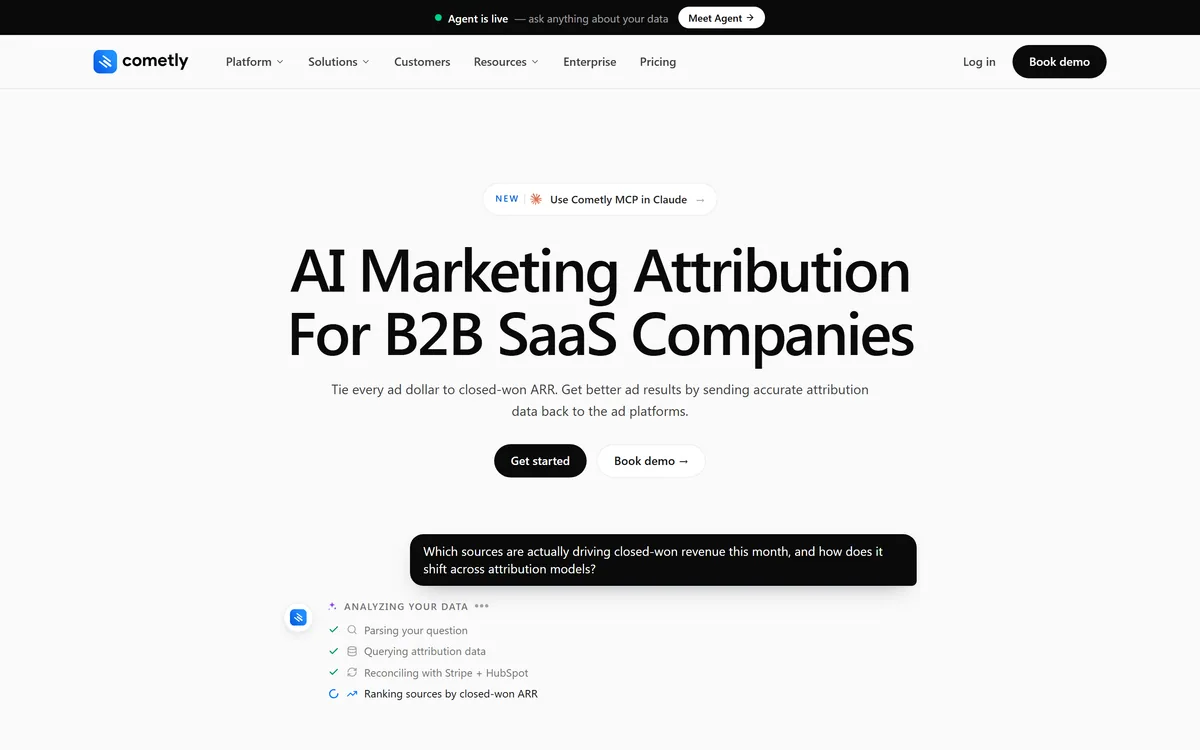
Cometly is a marketing attribution platform for B2B SaaS that connects ad spend to pipeline and closed-won revenue. It links Stripe, HubSpot and Salesforce with ad platforms, sends conversion data back to the networks, and exposes its data through an MCP server. Operated by Comet LLC.
4.0Editor Score
cometly.com8 viewsAdded April 26, 202512K visitors
Every B2B marketing team has the same unanswerable question at the end of a quarter: which of this spend produced the revenue? The ad platforms each claim the same deals, the CRM disagrees with all of them, and the spreadsheet reconciling it is somebody's least favourite afternoon.
The reason it is hard is structural. A B2B purchase takes months, involves several people, and touches a dozen surfaces before anyone signs — while the ad platforms only see the last thing that happened inside their own walls.
Cometly's pitch is to close that loop: connect the payment system and the CRM to the ad accounts, and follow a deal from first touch to closed-won ARR.
Why Is B2B Attribution So Hard?
Cometly's positioning is tying every ad dollar to closed-won ARR, and mapping spend to MQL, SQL, opportunity and closed-won inside HubSpot or Salesforce without spreadsheets.
The difficulty is not measurement, it is time and identity. A B2B deal takes months, so the click that started it happened two quarters before the revenue, and by then the cookie has expired and the person has changed devices twice.
Identity is worse. The person who clicked the ad is often not the person who books the demo, who is not the person who signs. Consumer attribution assumes one buyer; B2B has a committee, and only one of them ever touches your tracking.
The result is that every ad platform reports a version of events flattering to itself, because each one only sees interactions inside its own network. Sum them and you have credited more revenue than you earned.
Connecting the payment system and the CRM is the only structural fix, because those hold the one fact everybody agrees on — money arrived, on this date, from this account. Everything upstream is inference, and the honest version of attribution admits that.
It is worth being clear about which number is the anchor. Revenue recognised in the ledger — the figure accounting platforms such as Puzzle exist to produce — is the only one finance will defend, and an attribution model that cannot reconcile against it will lose every argument it enters.
Every ad platform reports a version of events flattering to itself. Sum them and you have credited more revenue than you actually earned.
Sending Data Back To The Ad Platforms
Cometly states that it gets better ad results by sending accurate attribution data back to the ad platforms, and lists a Conversion API and server-side tracking among its features.
This is the part that distinguishes attribution as reporting from attribution as infrastructure, and it is the more valuable half.
The platforms optimise bidding against whatever conversion signal you feed them. If that signal is a form fill, they will get very good at finding people who fill in forms, including everyone who will never buy.
Feeding closed-won revenue back changes the objective. The platform starts optimising towards people who resemble your actual customers rather than your actual leads, and in B2B those populations differ enormously.
The lag is the practical problem nobody mentions in the sales call. If your sales cycle is four months, the signal arrives four months late, and the bidding algorithm is learning from a market that has moved. It still beats optimising for form fills, but it is not a real-time loop.
First Touch, Last Touch, Different Answers
The site's own example makes the point better than any critique could: it shows Google Ads leading under last touch, while Google Organic and LinkedIn Ads climb under first touch.
That is not a flaw in the product. It is the honest fact about attribution, and putting it on the homepage is more candid than most vendors manage.
First touch credits the channel that started the relationship, which favours awareness and content. Last touch credits the channel that closed it, which favours branded search and retargeting. Both are answers to different questions.
The failure is picking one model, forgetting you picked it, and then reallocating budget as though the number were a measurement rather than a modelling choice. Cutting the channel that always starts relationships because it never finishes them is how pipelines quietly die two quarters later.
The disciplined approach is to look at several models, treat large disagreements between them as information, and change budget slowly. Attribution is directional evidence — better than instinct, worse than an experiment, and no substitute for occasionally turning a channel off to see what happens.
- Read every attribution number as a modelling choice, not a measurement.
- Compare first touch and last touch, and treat disagreement as information.
- Feed closed-won revenue back to the ad platforms, not form fills.
- Expect signal lag equal to your sales cycle before bidding improves.
- Test big reallocations by turning a channel off, not by trusting a model.
An MCP Server For Your Attribution Data
Cometly lists an MCP server among its features and promotes using it inside Claude, which is an unusually current thing for an attribution vendor to ship.
The reasoning is sound. Attribution data is exactly the kind of thing people want to ask questions of in natural language, and exactly the kind of thing that gets locked inside a dashboard with the wrong filters.
Questions like which sources drove closed-won ARR this month, and how that shifts across models, are tedious in a reporting interface and trivial in a conversation. Making the data reachable from an assistant removes the analyst bottleneck for routine questions.
It also changes who can ask. A founder or a finance lead who would never learn a reporting tool will ask a question in a chat window, and the answer being grounded in your own connected systems is what makes it trustworthy.
The risk is the same one that applies to any conversational data access: a confidently phrased answer to a subtly wrong question. The data being real does not make the interpretation right, which is why attribution literacy matters more, not less, once the interface gets easy.
The Questions Attribution Cannot Answer
Attribution answers where revenue came from. It does not answer several adjacent questions that people expect it to.
It does not tell you whether the content was any good. A blog post that ranks and converts and a blog post that ranks and does not are both just sources in a table, and improving the second is an editorial problem addressed by tools like MarketMuse rather than a measurement one.
It does not tell you whether you are visible where buyers now look. An increasing share of B2B research happens inside AI assistants that leave no referrer at all, which is the gap platforms such as Conductor exist to measure.
It does not fix the CRM. Attribution inherits whatever hygiene your pipeline has, so if opportunity stages are applied inconsistently, the model will faithfully report nonsense with excellent formatting.
And it does not make the decision. A model showing LinkedIn underperforming is one input; whether that means cut the spend or fix the creative is a judgement no attribution platform can make for you.
Setting Up Attribution That Survives Scrutiny
The most common attribution failure is not a bad tool — it is a beautiful dashboard nobody trusts, because the numbers never matched what finance said.
This order connects the source of truth first and leaves reallocation until the data has earned some credibility.
- Connect the payment system first, since revenue is the one fact nobody disputes.
- Fix CRM stage hygiene before connecting it, or the model will report your inconsistencies.
- Reconcile a completed month against finance's numbers before believing anything.
- Compare first touch and last touch on the same period to see the spread.
- Turn on conversion feedback to the ad platforms and wait one sales cycle before judging it.
- Change budget slowly, and validate any large reallocation with a hold-out test.
Cometly: Ad Spend Tied To Closed Won
- Built specifically for B2B SaaS, mapping spend to MQL, SQL, opportunity and closed-won rather than stopping at a lead.
- Sends data back to the ad platforms through conversion APIs, which improves bidding rather than just reporting.
- Stripe, HubSpot and Salesforce plus six or more ad platforms, per the site.
- An MCP server so the attribution data can be queried from an AI assistant directly.
- Comet LLC, trading as Cometly, with server-side tracking, a pixel and multi-touch attribution.
Cometly: Integrations And Company
| Operating company | Comet LLC, doing business as Cometly |
|---|---|
| Product type | Marketing attribution for B2B SaaS |
| Positioning | Tie every ad dollar to closed-won ARR |
| Revenue sources | Stripe, HubSpot, Salesforce |
| Ad platforms | Six or more, including Google Ads, Meta Ads and LinkedIn Ads |
| Tracking | Pixel plus server-side tracking |
| Feedback loop | Conversion API sending attribution data back to ad platforms |
| Models | Multi-touch attribution across first touch, last touch and others |
| AI access | An MCP server, promoted for use inside Claude |
| Segments | Product-led trial-to-paid, sales-led lifecycle, and founder or CMO reporting |
| Setup claim | Hours, not weeks |
| Copyright | © 2026 Comet LLC |
Key features of Cometly
Attribution from ad spend through to closed-won ARR
Stripe, HubSpot and Salesforce connections
Multi-touch attribution across several models
Pixel and server-side tracking
Conversion API feeding data back to ad platforms
An MCP server for AI assistant access
Account journeys and customisable dashboards
Audience syncing and an AI ads manager
Pros & cons
Pros
7- Draws the line to closed-won revenue rather than stopping at a lead
- Sending conversions back to ad platforms improves bidding, not just reporting
- Publishes an example showing models disagreeing, which is unusually candid
- Connecting Stripe grounds attribution in the one fact nobody disputes
- The MCP server removes the analyst bottleneck for routine questions
- Segmented for product-led and sales-led motions, which have different funnels
- A named operating entity and published security and legal pages
Cons
7- Attribution remains a modelling choice, and different models will rank channels differently
- Signal lag equals your sales cycle, so bidding improvements are slow to arrive
- Identity resolution across a buying committee is the hard part and is undescribed
- Inherits your CRM hygiene, reporting inconsistencies as though they were findings
- No pricing or jurisdiction stated on the pages we read
- Conversational access makes confidently wrong interpretations easier, not harder
- Cannot see research that happens inside AI assistants with no referrer
Best For
- B2B SaaS teams with multi-month sales cycles
- Marketers whose ad platforms all claim the same deals
- Companies running Stripe alongside HubSpot or Salesforce
- Growth teams spending enough that misallocation is expensive
- Founders who want to ask revenue questions without learning a dashboard
Cometly Against Other Marketing Tools
Marketing tools differ by whether they measure demand, create it, or make you findable.
| Tool | What it answers | Data source | Best for |
|---|---|---|---|
| Cometly | Which spend produced closed-won revenue | Stripe, CRM and ad platforms | B2B SaaS teams with long sales cycles |
| Conductor | Whether you appear in AI and search answers | Search and LLM visibility tracking | Enterprise visibility measurement |
| MarketMuse | What content to write and improve | Content and topic analysis | Editorial planning rather than measurement |
| SEO.AI | How to write for search | Keyword and content data | Smaller teams producing search content |
| Vista Social | Social publishing and reporting | Social platforms | Managing channels rather than attributing them |
Is Cometly Built For Your Funnel?
Worth connecting when
- You sell B2B SaaS with a sales cycle measured in months.
- Your ad platforms each claim credit for the same deals.
- Revenue lives in Stripe and pipeline lives in HubSpot or Salesforce.
- You are spending enough that a wrong allocation costs real money.
- You want conversion feedback improving bidding, not just a report.
Too much machinery when
- Your CRM hygiene is poor, which the model will faithfully reproduce.
- Your sales cycle is short enough that platform reporting is roughly right.
- You sell to consumers, where the identity problem is different.
- Ad spend is small enough that reallocation would not change much.
- You need to fix content quality or visibility rather than measure spend.
Cometly: Checked On The Site
Last checked . Read from cometly.com in a browser session on the date above, with the screenshot captured alongside.
- Positioned as AI marketing attribution for B2B SaaS companies
- Stated as tying every ad dollar to closed-won ARR
- Stated as sending accurate attribution data back to the ad platforms
- Stripe, HubSpot and Salesforce named as connected systems
- Six or more ad platforms stated, with Google Ads, Meta Ads and LinkedIn Ads shown
- An example showing Google Ads leading under last touch while other sources climb under first touch
- Pixel, server-side tracking, multi-touch attribution and a Conversion API listed as features
- An MCP server listed, with a banner promoting its use in Claude
- Product-led, sales-led and founder or CMO segments described
- Setup stated as hours, not weeks
- Footer confirms © 2026 Comet LLC d/b/a Cometly, with Legal, Terms, Privacy, Cookies and Security pages
What we could not confirm: pricing and plan structure; the company's location or jurisdiction, which the footer does not state beyond the entity name; which six or more ad platforms are supported in full; how identity resolution works across devices and buying committees, which is the hardest part of the problem; what the Agent feature does with your data; and how the reported figures reconcile against finance in practice. Every dashboard number shown on the site is illustrative, and we did not connect an account.
More Marketing And Growth Tools
Adjacent products covering the parts of demand generation attribution does not.
- Conductor — visibility in AI answers, which leaves no referrer
- MarketMuse — deciding what content to produce and improve
- SEO.AI — search content production for smaller teams
- Describely — the ecommerce equivalent of content at catalogue scale
- Vista Social — managing the social channels attribution measures
Editor's Verdict
4.0/5Attribution software is easy to buy and hard to trust, because the answer it gives depends on a modelling choice most buyers never examine. Cometly does two things that make it more credible than most: it draws the line all the way to closed-won ARR rather than stopping at a form fill, and it sends conversion data back to the ad platforms, which is where attribution stops being a report and starts being an input to bidding. The MCP server is a genuinely forward-looking touch. The permanent caveat applies — models disagree, first touch and last touch will rank your channels differently, and neither is the truth. AInexfinder Editor Score: 4.0/5.
Cometly pricing
AInexfinder does not list plan prices or billing details. For current pricing, plans, and trials, visit the official Cometly website.
Visit official website for pricingVendor pricing, credits, and billing policies change over time. Always confirm on the official site before you buy.
Frequently asked questions
What is Cometly?
Cometly is a marketing attribution platform for B2B SaaS, operated by Comet LLC. It connects Stripe, HubSpot and Salesforce with six or more ad platforms to tie ad spend to closed-won ARR, feeds conversion data back to the networks, and exposes its data through an MCP server.
Why is B2B attribution harder than consumer?
Time and identity. A deal takes months, so the click that started it happened two quarters before the revenue. And the person who clicked is often not the person who books the demo or signs — consumer attribution assumes one buyer, B2B has a committee.
Why do ad platforms disagree with each other?
Because each only sees interactions inside its own network and credits itself accordingly. Sum their reported conversions and you have credited more revenue than you earned. Connecting the payment system is the structural fix, because money arriving is the one fact nobody disputes.
What does sending data back to ad platforms do?
It changes what the bidding algorithm optimises for. Fed a form-fill signal, platforms get very good at finding people who fill in forms, including those who never buy. Fed closed-won revenue, they optimise towards people who resemble your actual customers.
How fast does that feedback work?
About as slow as your sales cycle. If deals take four months, the closed-won signal arrives four months late and the algorithm is learning from a market that has moved. It still beats optimising for form fills, but it is not a real-time loop.
Which attribution model should I use?
Look at several. First touch credits what started the relationship and favours awareness; last touch credits what closed it and favours branded search. The site's own example shows the ranking flipping between them. Treat large disagreements as information rather than picking one and forgetting you did.
Can I reallocate budget straight from the dashboard?
Slowly, and with a test. Cutting the channel that always starts relationships because it never finishes them is how pipelines quietly die two quarters later. Attribution is directional evidence — better than instinct, worse than turning a channel off to see what happens.
What does the MCP server give me?
Natural-language access to your attribution data from an AI assistant. Questions about which sources drove closed-won ARR and how that shifts by model are tedious in a reporting interface and trivial in a conversation, which removes the analyst bottleneck for routine asks.
Will it fix bad CRM data?
No — it will report it faithfully and attractively. Attribution inherits whatever pipeline hygiene you have, so inconsistently applied opportunity stages produce a model that is precisely wrong. Fix stage discipline before connecting the CRM, not after.
Does attribution cover AI search?
Not really, and this is a growing blind spot. An increasing share of B2B research happens inside AI assistants that leave no referrer, so that influence never appears in any attribution model. Measuring it requires a different kind of tool entirely.
Reviews
Log in to write a review.
User Reviews
No reviews yet. Be the first to share your experience with Cometly.
Reviewed by Daniel Reed
Assigned reviewer
Daniel ReedSenior AI Tools Reviewer
Daniel reviews AI tools the slow way — by actually using them on real projects. His reviews cover what works, what breaks, and who each tool is genuinely a good fit for.
Hands-on reviewsProduct testingAI software
Daniel and the AInexfinder editorial team research Cometly using public product information, listing evidence, and (when available) hands-on checks. Scores reflect listing completeness and transparency — not paid placement.
- Last verified
- Methodology
- How we review AI tools
- Sources used
- cometly.com
- AInexfinder listing fields (features, pros/cons, description)
- Public vendor pages when available
- Editorial policy
- Listings may include affiliate or sponsored placements, which are labeled when present. Editorial scores and cons are not sold. See our affiliate disclosure and review methodology.
Related tools

Listomize is an Etsy SEO platform that generates titles, tags, and descriptions within Etsy's own limits, scores listings, optimises 100+ listings from a CSV, tracks competitors and trends, and auto-generates Pinterest pins.
FreemiumBusiness & Marketing

Lahjty (لهجتي) is an Arabic-first marketing platform for MENA campaigns. From one brief it produces dialect-aware ad copy, headlines, campaign images with Arabic text rendered in, dialect-aware voice, and SEO articles grounded in your own brand sources — with a Partner API and an MCP server for teams that want it inside their own workflow.
FreemiumBusiness & Marketing

MaxAEO is an answer engine optimisation platform from HIII PTE. LTD. It tracks how ChatGPT, Gemini, Claude, Perplexity, Copilot, Grok and Google's AI surfaces mention a brand, with sentiment, competitor benchmarking and citation tracing.
Mailjet is a Sinch-owned email platform handling both marketing campaigns and transactional sending from one account. It offers a collaborative drag-and-drop editor, an email API with SMTP relay, AI generation and segmentation, and EU-based data centres.
FreemiumBusiness & Marketing
Outranking is an AI SEO content platform that writes briefs and first drafts and optimises them with real-time scoring, grounding content in live SERP data through its Concepts feature, with keyword clustering, internal linking and content workflows.
FreemiumBusiness & Marketing
Explore More
Embed this listing on your site
Featured on AInexfinder