
MaxAEO is an answer engine optimisation platform from HIII PTE. LTD. It tracks how ChatGPT, Gemini, Claude, Perplexity, Copilot, Grok and Google's AI surfaces mention a brand, with sentiment, competitor benchmarking and citation tracing.
Conductor is an enterprise AEO and SEO platform with four products: Intelligence for AI and search visibility, Creator for content generation, Monitoring for site health and AI bot crawling, and AgentStack for LLM apps and turnkey agents.
Search used to end with a click. Somebody typed a question, saw ten links, chose one, and arrived on your site where your analytics recorded them.
Increasingly it ends with an answer. The assistant reads several sources, synthesises a reply, and the person never visits anything — which means the moment your brand was or was not mentioned is invisible to every tool you own.
Conductor's argument is that this layer needs its own measurement, and that measurement is what its platform is now organised around.
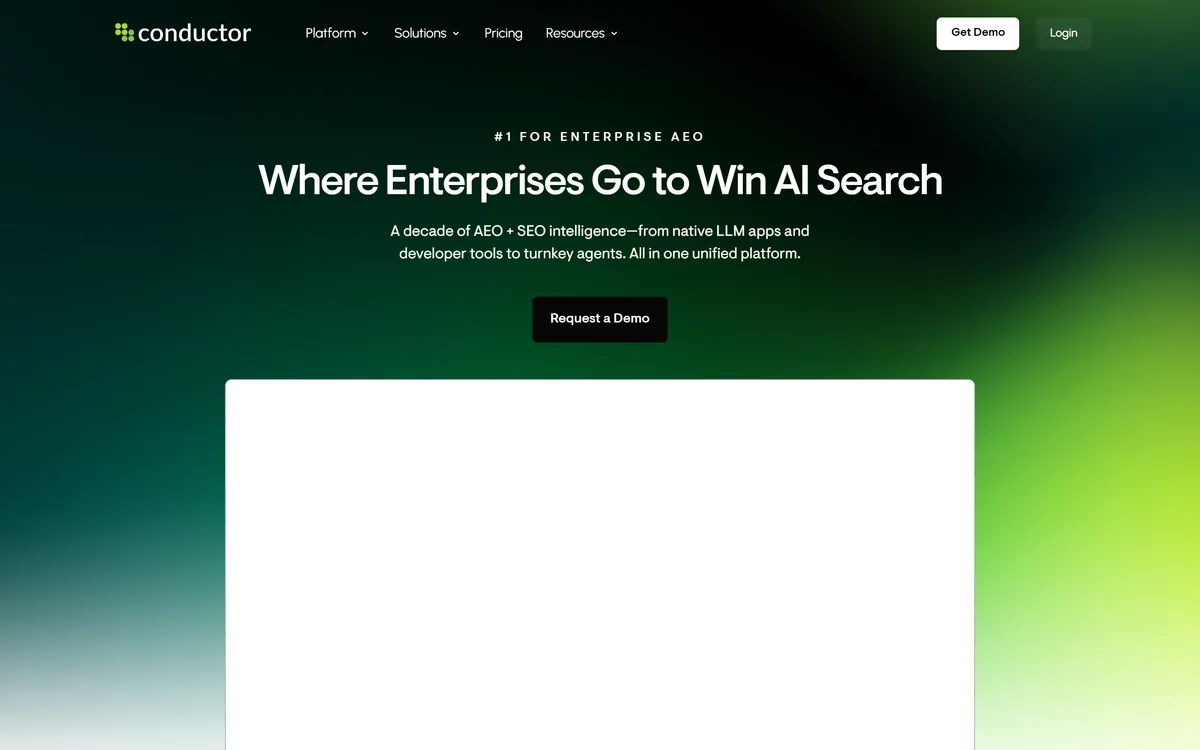
Conductor positions itself as the enterprise AEO platform, covering the full lifecycle from AI visibility tracking through content creation to real-time site health.
Answer engine optimisation is the practice of being cited and recommended inside AI-generated answers rather than ranking in a list of links. The distinction sounds academic and is not.
Ranking is a position you can observe. Being included in an answer is probabilistic — ask the same question twice and you may get different sources, because the assistant is generating rather than retrieving a fixed list.
That changes what measurement means. AEO metrics are frequency distributions, not positions: how often you appear across many runs of many phrasings, which is a fundamentally noisier signal than rank tracking ever was.
It also changes what you optimise. Keyword targeting matters less than being the source that states a fact clearly and citably, because the assistant is looking for something to draw on rather than something to link to. Content tooling such as MarketMuse approaches the same shift from the editorial side.
Ranking is a position you can observe. Being included in an answer is probabilistic — ask twice, get different sources.
The mechanics of measuring AEO are worth understanding before you evaluate anyone's numbers, including Conductor's.
There is no ranking API for an assistant. Measurement is done by asking questions repeatedly and recording what comes back, which means every vendor's numbers depend on which questions they ask, how many times, in which phrasings and from which regions.
Two platforms measuring the same brand can therefore report materially different visibility, and neither is lying. They asked different things.
This makes methodology the most important thing to interrogate, and the least likely to be published in detail. The questions you actually care about are the ones your buyers ask, and a generic prompt set will not contain them.
The practical guidance is to treat absolute visibility percentages sceptically and trends within one platform seriously. A number that moves consistently on a fixed method tells you something even when the number itself is not comparable to anyone else's.
Conductor splits into Intelligence, Creator, Monitoring and AgentStack, and the split is more meaningful than most enterprise product taxonomies.
Intelligence is measurement — visibility across ChatGPT, Gemini, Copilot, Claude and traditional search, connected to traffic, conversions and revenue.
Creator is generation, producing and optimising content for both search and LLMs. This is the most crowded of the four and the least differentiated, since generating content is something a great many products do.
Monitoring is technical site health with an AI-specific twist: 24/7 tracking of how AI bots crawl your site, with alerts and prioritised fixes. That is genuinely new territory rather than repackaged crawling.
AgentStack is the newest and vaguest — LLM apps, developer tools and turnkey agents for running AEO workflows. Worth understanding concretely before buying, since agent suites are the easiest thing in enterprise software to describe and the hardest to evaluate.
The unifying claim is a single data engine behind all four, which is the standard argument for buying a suite rather than four tools. It is a real advantage when it holds — visibility, content and crawl health genuinely inform each other — and a familiar disappointment when the products turn out to be separately acquired things sharing a login.
The practical way to test it is to ask how a finding in one product produces an action in another. If Monitoring detects that an AI crawler is blocked, does Creator know not to bother optimising those pages? A suite that answers that concretely is a suite; one that answers it in principle is a bundle.
Conductor Monitoring is described as always-on tracking of how AI bots crawl your site, with real-time alerts and prioritised fixes so visibility issues never become revenue problems.
This is the most concrete and least fashionable part of the platform, and probably the most immediately useful.
AI crawlers are not search crawlers. They arrive from different agents, respect robots directives differently, and are frequently blocked by the same infrastructure that protects you from scrapers — often by a security team that made a sensible decision without knowing the consequence.
The result is a specific and common failure: excellent content that assistants cannot read, producing zero visibility for reasons that have nothing to do with the content at all.
Checking crawler access is therefore the first thing to do, before any AEO strategy work. It is a technical question with a yes or no answer, and getting it wrong makes every other investment pointless — the same logic that makes documentation platforms like GitBook worry about machine readability at all.
There are structural limits to AEO that no platform can solve, and knowing them prevents unrealistic expectations of any vendor.
You cannot verify a model's reasoning. Why an assistant cited one source and not another is not observable, and vendors offering explanations are inferring, not reporting.
Model behaviour changes without notice. A model update can reshape which sources are favoured overnight, and unlike a search algorithm update there is no announcement, no documentation and no community consensus about what changed.
Attribution is close to impossible. Someone who read about you in an answer and typed your name into a browser three days later arrives as direct traffic, and no attribution platform — including specialists such as Cometly — can see the assistant that started it.
None of this makes measurement worthless. It makes it directional, which is the same status search rank data had for years before people started treating it as gospel.
There is also a self-defeating dynamic worth naming. If everyone optimises specifically to be cited, the assistants will adjust for exactly that, and the tactics that work now are the ones most likely to stop working — which is the entire history of search optimisation repeating at higher speed.
What survives that cycle is the same thing that survived the last one: being genuinely the best source on a specific question. That is slower than tactics and it is the only durable position, whichever surface is doing the summarising. Content planning tools such as SEO.AI and editorial judgement matter more here than any measurement platform.
The mistake with a new measurement discipline is buying the platform before establishing what you would do differently with the answer.
This sequence resolves the cheap technical questions first and reaches procurement only once there is something to act on.
The vocabulary of answer engine optimisation, without the marketing.
AI visibility tracking across ChatGPT, Gemini, Copilot and Claude
Traditional search visibility alongside AI visibility
Content generation and optimisation for both surfaces
24/7 monitoring of AI bot crawling with prioritised fixes
LLM apps, developer tools and turnkey AEO agents
A unified data engine across the four products
A free AI visibility report
Enterprise security and governance
Search and content tools differ by whether they measure visibility, plan content, or produce it.
| Tool | What it does | Scale | Best for |
|---|---|---|---|
| Conductor | AI and search visibility, content, site health, agents | Enterprise | Large brands measuring visibility in AI answers |
| MarketMuse | Content planning and topic authority | Mid-market | Deciding what to write and improve |
| SEO.AI | Search content writing | Small teams | Producing optimised content directly |
| GetGenie | Content generation inside WordPress | Small teams | Publishing where the site already lives |
| Cometly | Revenue attribution across channels | Mid-market to enterprise | What the visibility eventually produced |
| Product type | Enterprise AEO and SEO platform |
|---|---|
| Positioning | Where enterprises go to win AI search |
| Intelligence | Visibility across ChatGPT, Gemini, Copilot, Claude and traditional search |
| Creator | AI content generation and optimisation for search and LLMs |
| Monitoring | 24/7 tracking of how AI bots crawl your site, with prioritised fixes |
| AgentStack | LLM apps, developer tools and turnkey agents for AEO workflows |
| Entry point | A free AI visibility report across ChatGPT, Perplexity and Google AI Overviews |
| Named comparisons | Profound, BrightEdge, Semrush and Adobe |
| Verticals | Retail and eCommerce, technology and SaaS, healthcare, financial services, travel and hospitality |
| Languages | English and German site versions |
| Copyright | © Conductor 2026 |
Last checked . Read from conductor.com in a browser session on the date above, with the screenshot captured alongside.
What we could not confirm: pricing, which routes through Contact Sales; the methodology behind visibility measurement — how many prompts, which phrasings, which regions, how often — which is the single most important variable and is not published on the pages we read; whether the #1 for enterprise AEO claim rests on a cited source; how AgentStack agents work in practice; and the operating company's registered entity, which the Imprint would name and we did not open. We did not use the platform.
The uncomfortable fact for anyone with a content strategy is that a growing share of research now ends inside an AI assistant, and that traffic never appears in your analytics because it never arrives. Conductor's central product is measurement of that invisible layer — whether your brand shows up in ChatGPT, Gemini, Copilot and Claude answers — plus monitoring of how AI crawlers actually treat your site. That is a real and currently underserved problem. What tempers the score is that AEO is a young discipline where the measurement methodology matters enormously and nobody's is independently audited, and this is priced and built for enterprises. AInexfinder Editor Score: 4.0/5.
AInexfinder does not list plan prices or billing details. For current pricing, plans, and trials, visit the official Conductor website.
Visit official website for pricingVendor pricing, credits, and billing policies change over time. Always confirm on the official site before you buy.
Log in to write a review.
No reviews yet. Be the first to share your experience with Conductor.
Assigned reviewer
Daniel ReedSenior AI Tools Reviewer
Daniel reviews AI tools the slow way — by actually using them on real projects. His reviews cover what works, what breaks, and who each tool is genuinely a good fit for.
Daniel and the AInexfinder editorial team research Conductor using public product information, listing evidence, and (when available) hands-on checks. Scores reflect listing completeness and transparency — not paid placement.
MaxAEO is an answer engine optimisation platform from HIII PTE. LTD. It tracks how ChatGPT, Gemini, Claude, Perplexity, Copilot, Grok and Google's AI surfaces mention a brand, with sentiment, competitor benchmarking and citation tracing.
Outranking is an AI SEO content platform that writes briefs and first drafts and optimises them with real-time scoring, grounding content in live SERP data through its Concepts feature, with keyword clustering, internal linking and content workflows.

Listomize is an Etsy SEO platform that generates titles, tags, and descriptions within Etsy's own limits, scores listings, optimises 100+ listings from a CSV, tracks competitors and trends, and auto-generates Pinterest pins.

Lahjty (لهجتي) is an Arabic-first marketing platform for MENA campaigns. From one brief it produces dialect-aware ad copy, headlines, campaign images with Arabic text rendered in, dialect-aware voice, and SEO articles grounded in your own brand sources — with a Partner API and an MCP server for teams that want it inside their own workflow.
Mailjet is a Sinch-owned email platform handling both marketing campaigns and transactional sending from one account. It offers a collaborative drag-and-drop editor, an email API with SMTP relay, AI generation and segmentation, and EU-based data centres.
PitchBud is a press outreach tool that drafts a release with Claude Sonnet, publishes it to a newsroom URL with NewsArticle schema and RSS, matches relevant journalists by their recent work, and drafts personal pitches you review and send yourself.