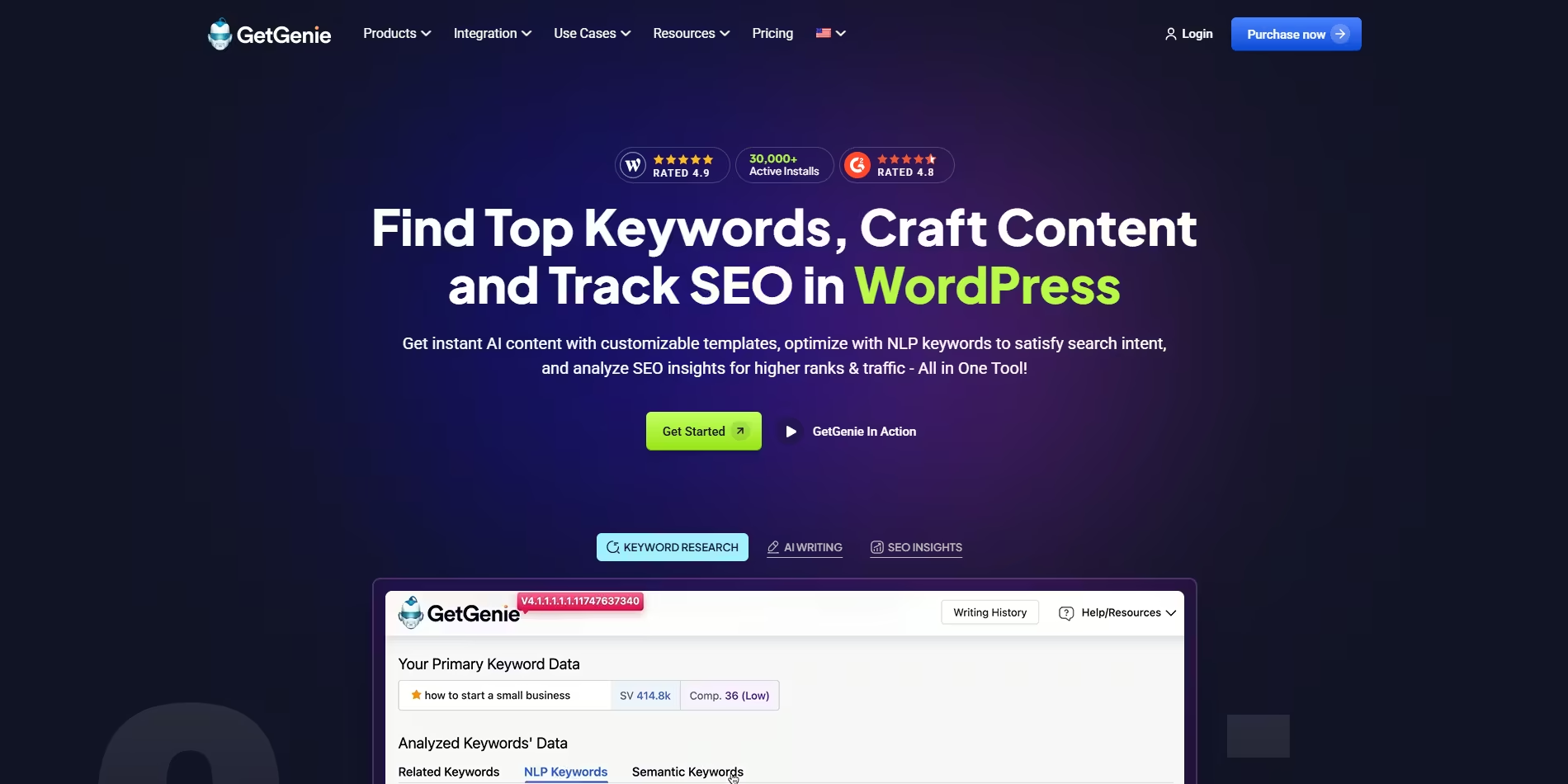
GetGenie is a WordPress plugin combining keyword research, competitor analysis, one-click blog generation and SEO scoring inside the editor. It reports over 80,000 active installations and a 4.9 rating on WordPress.org, with 33+ language support and a WooCommerce copy wizard.
Content work is fragmented in a way nobody designed and everyone tolerates. Keyword research happens in one tool, competitor analysis in another, the draft in a third, and the SEO check in a plugin after the fact.
Each handoff loses something. The most common casualty is intent: by the time the draft exists, the reason that keyword was chosen has evaporated, and the article answers a slightly different question than the one people were searching for.
GetGenie's answer is to put all of it in the WordPress editor. That is a workflow argument rather than a technical one, and workflow arguments are frequently the ones that change what actually gets published.
Why GetGenie Is Worth A Look
It lives inside WordPress, so keyword research, competitor analysis and drafting happen in the editor rather than across four tabs.
Over 80,000 active installations and a 4.9 rating on WordPress.org — unusually strong evidence of retention rather than downloads.
Positioned for AI citation, not just ranking, which reflects where discovery is genuinely moving.
33+ languages and a WooCommerce wizard, covering product copy as well as blog content.
Genie Chat with 22+ AI personalities and Genie Image for visuals, alongside the SEO tooling.
GetGenie's homepage, captured 9 September 2026, showing its positioning around ranking and AI citation.
The Case For Doing This Inside The Editor
GetGenie combines keyword research, competitor analysis, one-click blog generation and SEO insights inside WordPress, and the integration is the point rather than any individual feature.
Consider what the fragmented version costs. You research a keyword, note it, open a competitor's article, skim it, switch to a document, write, then paste into WordPress and run an SEO check that tells you the article does not target the keyword well. That final step is where the loop closes badly, because restructuring a finished draft is far more work than structuring it correctly at the start.
Having the competitor analysis visible while you write changes what you write. You can see which questions the ranking pages answer and which they miss, and the gap is where a new article has any chance of competing.
The SEO insight in the same place shifts the check from post-hoc verification to live guidance. That is a materially different activity, and it is the difference between an article that targets its keyword and one that was adjusted to look like it does.
The caveat that accompanies every in-editor SEO score deserves stating: the score measures adherence to on-page conventions, not usefulness. An article can hit every green light and still lose to a page that answers the question better, and optimising for the score rather than the reader is the classic way to publish a great deal of content that never ranks.
The alternative arrangement is a deeper analysis tool alongside the editor. Surfer SEO goes considerably further into SERP data, at the cost of being one more place to be.
An SEO score measures adherence to conventions, not usefulness. Every green light and a worse answer still loses to one green light and a better one.
Writing To Be Cited, Not Only Ranked
GetGenie positions itself around ranking and being cited by AI, and that distinction reflects a real change in how content gets found.
Ranking means appearing in a list of links a person then clicks. Citation means an answer engine reads your page, uses what it says, and attributes it. The second increasingly happens without a click at all, which is uncomfortable and not optional to plan for.
What gets cited is not identical to what ranks. Answer engines favour content that states things plainly and specifically — a clear claim, a number, a definition, a direct answer near the question — because that is what can be lifted and attributed. Long atmospheric introductions before the substance are penalised in a way traditional search never quite penalised them.
That points at concrete structural choices: answer the question in the first paragraph under each heading, use headings that are the questions people actually ask, keep specific facts specific rather than hedged into vagueness, and make claims that can stand on their own outside the surrounding paragraph.
None of this conflicts with writing well for people. It mostly rewards directness, which was always the better choice and is now also the one that gets you quoted.
What Do 80,000 Installs And A 4.9 Rating Tell You?
GetGenie reports over 80,000 active installations and a 4.9 rating on WordPress.org, and this is more informative than most vendor numbers because of how WordPress counts.
Active installations are not downloads. The figure reflects sites where the plugin is currently installed and running, which means it drops when people uninstall — so it is a retention measure rather than a marketing one, and that makes it hard to inflate.
A 4.9 rating on the WordPress.org repository is also independently hosted. The vendor does not control the review page, cannot remove unfavourable reviews, and every rating is attached to a WordPress.org account.
Both should still be read with appropriate scepticism. Plugin ratings skew positive because unhappy users tend to uninstall silently rather than review, and satisfied users are more likely to be prompted at a good moment. A 4.9 means very few people were angry enough to complain publicly, which is genuinely useful and not the same as excellence.
The practical read is that this is an established plugin with real usage rather than a launch-week product. For anything installed on a site you depend on, that matters more than a feature list — a plugin with 80,000 active installs is one where the compatibility bugs have been found by someone other than you.
Compare that with a standalone platform, where no equivalent independent signal exists at all. Jasper AI and ContentMonk publish their own figures, and nobody else counts them.
Active installs measure retention, not downloads, so the number falls when people leave.
WordPress.org hosts the reviews, so the vendor cannot curate them.
Plugin ratings skew positive because unhappy users uninstall rather than review.
Established install bases mean compatibility problems surface before they reach you.
Check the support forum for recent unresolved threads before installing anything.
Genie Chat, Genie Image And The WooCommerce Wizard
Beyond the SEO core, GetGenie includes Genie Chat with more than 22 AI personalities, Genie Image for visuals, and a WooCommerce wizard for product copy.
The WooCommerce wizard is the most practically valuable of the three, and it addresses a specific, miserable problem. A store with several hundred products needs several hundred descriptions, and the alternative to generating them is either writing them all or shipping the manufacturer's copy — which every competing store also ships, and which search engines correctly treat as duplicate content.
Generated product copy is a genuine improvement over duplicated copy, provided the specifications are checked. The failure mode is specific: a model may produce plausible dimensions or materials that are simply wrong, and wrong specifications on a product page cause returns and complaints rather than merely poor writing.
Genie Image handles the visuals, which spares a second subscription for a task most content workflows need occasionally. Expect it to be adequate rather than a replacement for a dedicated generation tool.
The 22+ personalities framing is presentation more than substance. Underneath it is prompt configuration for different writing tasks, which is useful; the personality metaphor mostly helps people who would not otherwise think to change how they ask.
For SEO content generation outside WordPress entirely, a toolkit such as AIKTP covers similar ground at a different price point.
Using It Without Producing Content Nobody Reads
One-click blog generation makes it easy to publish a great deal quickly, and that capability is a trap as often as it is a benefit.
Search engines have spent two years getting better at discounting exactly this — high-volume, low-differentiation content that answers a query without adding anything. Publishing more of it does not fail neutrally; it costs you site-level quality signals.
Start from the competitor analysis and identify what the ranking pages do not answer, since that gap is the only reason to publish.
Generate a draft as a structure, not as a finished article, and expect the first version to be the outline rather than the output.
Add what only you can add — your data, your customers, your tested experience — because that is what the generation cannot produce.
Answer the question directly under each heading, which serves both readers and answer engines.
Verify every specific claim, particularly product specifications and any number the model produced.
Publish less than the tool makes possible, and measure whether what you published earned traffic before publishing more.
Key features of GetGenie
Keyword research inside the WordPress editor
Competitor analysis visible while drafting rather than beforehand
One-click blog generation from a keyword and brief
In-editor SEO scoring and guidance as you write
Genie Image for generating visuals without a second subscription
Genie Chat with more than 22 configured AI personalities
WooCommerce wizard for generating product descriptions at scale
Support for more than 33 languages
Pros & cons
Pros
6
Runs where the writing happens, removing the context switches that lose keyword intent
Competitor analysis while drafting changes what gets written rather than what gets checked
Over 80,000 active installs is a retention figure, which is hard to inflate
The WordPress.org rating is independently hosted and cannot be curated by the vendor
The WooCommerce wizard addresses duplicate manufacturer copy, a real ranking problem
A complete footer including Refund, Roadmap and Help Center pages
Cons
6
One-click generation makes volume publishing easy, which search engines now discount
In-editor SEO scores measure convention adherence, not whether the answer is useful
The underlying models are not disclosed
The source of keyword and competitor data is not stated, which determines research quality
Install and rating figures are vendor-reported on the site rather than read from the repository
No pricing tiers were established from the pages we read
Best For
WordPress publishers running a fragmented content workflow
WooCommerce stores needing hundreds of unique product descriptions
Writers who want competitor gaps visible while drafting
Multilingual publishing from a single editor
Small teams without a separate SEO subscription
GetGenie Against Other Content And SEO Tools
The real difference between these tools is where they run — inside the editor, alongside it, or somewhere else entirely.
Tool
Where it runs
Scope
Best for
GetGenie
Inside the WordPress editor
Keywords, competitors, drafting, SEO scoring, product copy
An alternative for the same job at a different price point
GetGenie: Plugin And Coverage
Product type
WordPress plugin for AI writing and SEO
Active installations
Over 80,000 reported
WordPress.org rating
4.9
Positioning
Ranking and being cited by AI
Keyword research
Included in the plugin
Competitor analysis
Included, visible while writing
Content generation
One-click blog generation
SEO insights
In-editor scoring and guidance
Genie Image
Image generation
Genie Chat
Chat with 22+ AI personalities
WooCommerce
Product copy wizard
Languages
33+ supported
Footer sections
Privacy, Terms, Refund, Help Center, Blog, Roadmap, Affiliate
The GetGenie Facts, Checked
Last checked . Read from getgenie.ai and its footer navigation, with the screenshot above captured in the same session.
Product confirmed as a WordPress plugin for AI writing and SEO
Positioning stated on the site around ranking and being cited by AI
Over 80,000 active installations reported on the site
A 4.9 rating on WordPress.org reported on the site
Keyword research confirmed as an included capability
Competitor analysis confirmed as an included capability
One-click blog generation confirmed
SEO insights confirmed as an in-editor capability
Genie Image confirmed for image generation
Genie Chat confirmed with more than 22 AI personalities
A WooCommerce wizard confirmed for product copy
Support for 33+ languages confirmed
Footer confirmed with Privacy, Terms, Refund, Help Center, Blog, Roadmap and Affiliate sections
What we could not confirm: which underlying models power generation, and whether they can be selected; the pricing tiers and what each includes; the source of the keyword and competitor data, which determines how good the research actually is; whether the install and rating figures are current, since both are vendor-reported here; the operating company and its location; and any published data behind the AI-citation positioning. We did not install the plugin, so nothing here reflects tested output quality.
Is GetGenie Right For Your Site?
Good fit when
You publish on WordPress and your content workflow is spread across four tabs.
You run a WooCommerce store facing hundreds of product descriptions.
You want competitor analysis visible while writing rather than beforehand.
You publish in multiple languages and want that handled in one place.
You value an established plugin whose compatibility bugs are already found.
Not worth installing when
You do not publish on WordPress, since the plugin's whole advantage is positional.
You need deep SERP analysis, where a specialist tool goes considerably further.
You want to publish at volume, which is the failure mode rather than the use case.
Your content requires strict brand-voice control across a large team.
You need to know which model generates your copy, which the site does not state.
Other Content And SEO Tools
GetGenie's competitors split between deeper SEO analysis and stronger standalone generation.
Surfer SEO — when on-page analysis depth matters more than staying in one tab
Jasper AI — for brand-voice control across a marketing team
ContentMonk — long-form production outside the WordPress editor
AIKTP — a comparable SEO content toolkit at a different price point
GitBook — if the content is documentation rather than marketing
Editor's Verdict
4.0/5
GetGenie's advantage is positional rather than technical: it runs where the writing actually happens. Keyword research in one tab, a competitor analysis in another and a draft in a third is how most content work is done, and each context switch loses something — usually the keyword intent by the time the draft is written. Collapsing that into the editor is a real workflow gain, and 80,000 active installations with a 4.9 rating is meaningful evidence people keep it. It scores where it does because plugin-based AI writing tempts volume publishing, and volume is precisely what search engines have spent two years learning to discount. AInexfinder Editor Score: 4.0/5.
GetGenie pricing
AInexfinder does not list plan prices or billing details. For current pricing, plans, and trials, visit the official GetGenie website.
Vendor pricing, credits, and billing policies change over time. Always confirm on the official site before you buy.
Frequently asked questions
What is GetGenie?
GetGenie is a WordPress plugin that puts keyword research, competitor analysis, one-click blog generation and SEO scoring inside the editor. It also includes Genie Image for visuals, Genie Chat with 22+ AI personalities, a WooCommerce product copy wizard and support for more than 33 languages.
Why does running inside WordPress matter?
Because each context switch in a fragmented workflow loses something, and the usual casualty is intent — by the time the draft exists, the reason the keyword was chosen has evaporated. Having competitor analysis visible while you write changes what you write, rather than telling you afterwards that the finished draft needs restructuring.
Are the 80,000 installs and 4.9 rating trustworthy?
More than most vendor numbers, with caveats. WordPress counts active installations rather than downloads, so the figure falls when people uninstall — a retention measure that is hard to inflate. Ratings are hosted on WordPress.org and cannot be curated by the vendor. But plugin ratings skew positive, because unhappy users uninstall silently rather than review.
What does being cited by AI mean, and how is it different from ranking?
Ranking means appearing in a list of links someone clicks. Citation means an answer engine reads your page, uses what it says and attributes it — often with no click at all. What gets cited favours plain, specific statements near the question that can be lifted and attributed, which rewards directness more than traditional search did.
Can I use GetGenie to publish a lot of content quickly?
You can, and it is the main way people waste money with tools like this. Search engines have spent two years getting better at discounting high-volume, low-differentiation content, and publishing it does not fail neutrally — it costs site-level quality signals. Publish less than the tool makes possible and measure what earned traffic first.
Is the WooCommerce wizard actually useful?
It is the most practically valuable piece for a store. A shop with several hundred products otherwise ships the manufacturer's copy, which every competitor also ships and search engines treat as duplicate. Generated descriptions are a genuine improvement — provided you verify specifications, since wrong dimensions or materials cause returns, not just poor writing.
Should I trust the in-editor SEO score?
As guidance, not as a target. The score measures adherence to on-page conventions, not whether the article is useful. A page can hit every green light and lose to one that answers the question better, and optimising for the score rather than the reader is the classic route to publishing content that never ranks.
Which AI models does GetGenie use?
Not stated on the pages we read, and neither is whether you can choose. That matters if you have expectations tied to a specific model's quality, or a policy about where your content data is processed. The same gap applies to the source of the keyword and competitor data, which determines how good the research underneath actually is.
How much does GetGenie cost?
Pricing tiers were not established from the pages we read. The site does have a Refund page in its footer alongside Privacy, Terms, Help Center, Blog, Roadmap and Affiliate sections, which is a more complete set than many plugin vendors publish and the right place to check terms before purchasing.
How does GetGenie compare to a dedicated SEO tool?
It trades depth for position. A specialist tool goes considerably further on SERP analysis; GetGenie's advantage is being in the editor where the writing happens. If your bottleneck is analytical depth, the specialist wins. If it is the four-tab workflow and the intent lost between them, the integrated one does.
Daniel reviews AI tools the slow way — by actually using them on real projects. His reviews cover what works, what breaks, and who each tool is genuinely a good fit for.
Daniel and the AInexfinder editorial team research GetGenie using public product information, listing evidence, and (when available) hands-on checks. Scores reflect listing completeness and transparency — not paid placement.
Listings may include affiliate or sponsored placements, which are labeled when present. Editorial scores and cons are not sold. See our affiliate disclosure and review methodology.
AIKTP generates SEO-optimised articles of 2,000 to 2,500 words in around thirty seconds using ChatGPT, Gemini and Claude, across eighteen languages. It bundles keyword research, clustering, entity extraction, image tools, auto-publishing to WordPress and Shopify, and bulk Google and Bing indexing.
SEOWriting AI analyses SERP competitors and generates articles optimised for search and AI engines, with one-click and bulk generation across 48 languages, AI images, affiliate content models, Amazon product tools and WordPress auto-posting.
Frase runs SEO and AI search end to end: auditing a site page by page, researching and briefing, drafting in a defined brand voice, optimising for both rankings and AI citation, publishing to WordPress, Webflow, Sanity and Wix or its own CMS, then monitoring for ranking decay and AI mentions.
SEO.AI, based in Kongens Lyngby, Denmark, is an SEO agent that creates content, publishes it directly to your CMS, and builds backlinks through an automatic link exchange network. It supports 50+ languages and integrates with WordPress, Webflow, Wix, Squarespace, Shopify and Magento.
Byword is an AI article writer aimed at SEO content produced at scale. It runs a four-stage loop — research keywords, build the article, edit it, optimise it — writes in your brand voice, and publishes to your CMS, with a programmatic mode for generating large sets of pages from structured data.
RivalFlow, built by SpyFu, analyses a page you already have against competitors ranking for the same terms, then returns around 23 specific content gaps with ready-to-paste copy and placement guidance. It connects to Google Search Console to track whether rankings move afterwards.