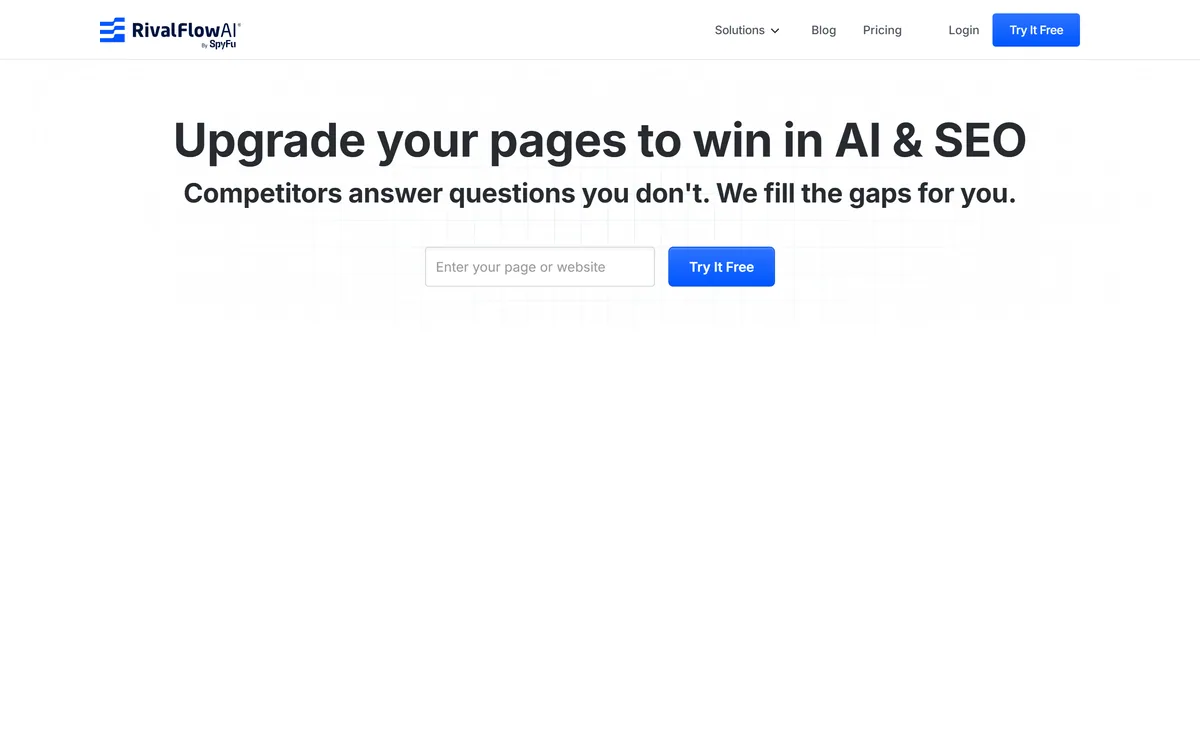
RivalFlow, built by SpyFu, analyses a page you already have against competitors ranking for the same terms, then returns around 23 specific content gaps with ready-to-paste copy and placement guidance. It connects to Google Search Console to track whether rankings move afterwards.
rivalflow.com10 viewsAdded September 30, 20251K visitors
Everyone writes new pages. Almost nobody goes back and fixes the ones already ranking eleventh.
Why Fixing Beats Writing, And Why Nobody Does It
The premise here is the most defensible thing about the product, and it runs against how almost every content team actually operates.
A page ranking eleventh has already earned something. It has been crawled, indexed, judged relevant enough to appear on page two, and has accumulated whatever internal links and age it has. Moving it to fourth is a smaller job than getting a brand new page to fourth from nothing.
New pages start with none of that. They need to be discovered, evaluated, and to earn position against incumbents that already have history. The work is larger and the odds are worse.
Despite that arithmetic, content teams overwhelmingly write new things — which is what tools like Byword and SEOwind are built to serve. The reason is psychological rather than analytical: publishing feels like progress and editing feels like admin. A new post is a deliverable; an improved post is invisible on a content calendar.
So a tool whose entire function is to make improvement concrete and quick is attacking a real behavioural gap rather than a capability one. Returning specific text with placement guidance turns a vague instruction — improve this page — into a task someone will actually complete before lunch.
This is the same insight MarketMuse built a strategy product around, delivered at a much smaller unit of work. RivalFlow is not planning your content programme; it is fixing one page.
A page ranking eleventh has already earned its position. Moving it to fourth is a smaller job than getting a new page there from nothing — and almost nobody does it.
Content Gaps Are The Right Signal To Use
The specific analysis — questions competitors answer that your page does not — is a well-chosen proxy, and it is worth understanding why it works.
Search engines increasingly evaluate whether a page comprehensively addresses a topic rather than whether it repeats a keyword. A page that covers a subject and leaves three obvious follow-up questions unanswered loses to one that anticipates them, even when the first page is better written.
Those follow-up questions are visible in what competitors cover. If four pages ranking above you all address warranty terms and yours does not, that is not a coincidence — it is either what searchers ask or what the engine has learned they want.
Deriving gaps from ranking competitors rather than from a general model is the important distinction. A model asked what else should this page cover invents plausible additions; a comparison against pages that actually rank identifies real ones.
Fully automated publishers such as BlogBuster skip this step entirely. SpyFu's involvement matters here for the same reason. The competitor identification and keyword data come from a company that has been collecting it for years, which is harder to replicate than the generation layer on top.
The limit worth naming is that this optimises toward the consensus of what already ranks. Follow it faithfully across enough pages and you converge on the same content as everyone else — comprehensive, well covered, and indistinguishable. Gap-filling improves a page; it does not differentiate it.
The Guarantee Claim Needs Addressing Directly
The site carries a headline promising SEO rank improvement in ten days, described as guaranteed, with testimonials citing movement within four days.
That needs saying plainly: no tool can guarantee a ranking outcome, and nobody in SEO should imply otherwise. Rankings depend on competitor behaviour, algorithm updates, crawl scheduling, site authority and query intent — none of which any vendor controls.
There is a narrower version of the claim that is defensible. If a page is currently missing content that four ranking competitors all include, adding it will plausibly help, and Google can re-crawl and re-evaluate an updated page within days. Fast movement is genuinely possible.
But possible is not guaranteed, and a page can also be updated thoroughly and not move at all — because the real constraint was domain authority, or backlinks, or that the intent behind the query is not what the page serves.
The practical reading is that the guarantee is almost certainly a refund policy rather than an outcome commitment. Read what it actually promises before treating it as either.
None of this makes the tool bad. It makes the marketing more confident than the discipline allows, which is worth noticing in a category where that is common.
Pick pages ranking between five and fifteen — high enough to have earned something, low enough to have room.
Connect Google Search Console before making any changes, so you have a baseline.
Apply the suggestions to one page and leave the rest untouched as a control.
Wait a full crawl cycle rather than judging in four days.
Check whether the added content reads as useful to a person, not just as coverage.
Paying Per Page Improved
This site does not publish plan prices. RivalFlow's structure is a free trial followed by subscription, and the metering is what shapes how you use it.
In this category the meter is normally pages analysed or reports generated per month, sometimes combined with connected sites for agencies. That is a materially different unit from the per-article metering of content generators, and it changes the economics in your favour.
The reason is that a page improvement is repeatable value on an asset you already own, whereas a generated article is a new asset that may never rank. Paying to improve twenty existing pages is a more predictable investment than paying to generate twenty new ones.
The question to establish before subscribing is whether re-analysing the same page after changes consumes the allowance again. You will want to check whether your edits worked, and if each check costs a credit the iteration loop gets expensive quickly.
For agencies, the white-label capability is the feature that determines whether this is a tool or a deliverable. Confirm it sits at the tier you are considering, since white-labelling almost always gates upward.
The free trial is the right way to answer the only question that matters: whether the 23 suggestions on your own page are things you would actually add, or filler you would reject.
What Twenty-Three Suggestions Actually Means
The fixed number in the marketing is worth thinking about, because a specific count implies a precision the analysis cannot really have.
Pages differ enormously. A thin 400-word page competing against 3,000-word guides has dozens of genuine gaps. A comprehensive page already covering its topic well may have two or three, and padding that to 23 means the last twenty are noise.
So the realistic expectation is that the suggestions are ranked, the first handful are genuinely valuable, and the tail diminishes. Treating the list as a checklist to complete rather than a ranked set to triage is how these tools get misused.
There is a related quality risk. Adding every suggested section to a page produces a longer page, not necessarily a better one — and a bloated page that answers everything at low quality can perform worse than a focused one that answers the main question well.
The ready-to-paste copy needs the same treatment. It is a draft in a generic voice, and pasting it unedited across twenty pages produces a site where the added sections all sound like each other and nothing like you.
Used properly — take the top five, write them yourself in your own voice, publish, measure — this is a genuinely useful loop. Used as a checklist with paste, it inflates pages and flattens your writing.
Expect the suggestions to be ranked, with the first few carrying most of the value
A comprehensive page may only have two or three real gaps, whatever the count says
Longer is not better — a bloated page can underperform a focused one
Rewrite the supplied copy in your own voice rather than pasting it
Measure one page at a time so you learn what actually moved the ranking
Improving What You Already Have
RivalFlow analyses a page you have already published against competitors ranking for the same terms, and returns specific content gaps with copy you can paste in — it improves pages rather than generating new ones.
The workflow is deliberately short: enter a URL or keyword, get around 23 suggested improvements, copy the text, see where to put it, publish.
It connects to Google Search Console, so ranking movement after a change is measured rather than assumed.
Built by SpyFu, a long-established competitive SEO data company, which is where the competitor analysis comes from.
White-label output is available for agencies, and there is a free trial before subscription.
Workflow, Data And Output
Category
SEO content gap analysis and page optimisation
Built by
SpyFu
Core function
Analyses an existing page against ranking competitors and identifies content gaps
Output
Around 23 improvement suggestions with ready-to-paste copy and placement guidance
Workflow
Enter a URL or target keyword, receive suggestions, copy the text, see where it goes, publish, monitor
Measurement
Google Search Console integration for before-and-after ranking tracking
Agency features
White-label capability
Positioning
Vendor frames it around winning in both AI answers and traditional SEO
Headline claim
Vendor states rank improvement in 10 days, described as guaranteed, with testimonials citing movement within 4 days
Not published
CMS integrations, supported languages, or company detail beyond SpyFu attribution
Charging model
Free trial, then subscription; no prices published here
Key features of RivalFlow
Content gap analysis against ranking competitors
Around 23 ranked improvement suggestions per page
Ready-to-paste copy for each suggestion
Placement guidance showing where each addition belongs
Google Search Console integration for before-and-after tracking
Analysis from a URL or a target keyword
White-label output for agencies
Competitive data drawn from SpyFu
Pros & cons
Pros
6
Improving existing pages is genuinely higher-return than writing new ones, and almost nobody does it
Deriving gaps from actual ranking competitors beats asking a model what to add
Search Console integration means the tool is judged on movement rather than output
SpyFu's competitive data is harder to replicate than the generation layer above it
The workflow is short enough that people will actually finish the task
Page-based metering is more predictable value than paying per generated article
Cons
6
A guaranteed ranking claim is not something any SEO tool can honestly make
A fixed suggestion count implies uniformity that real pages do not have
Gap-filling converges your content on the same coverage as everyone else
Paste-ready copy in a generic voice flattens your writing if used unedited
No CMS integrations or language support specified on the site
Re-analysis after edits may consume allowance, which matters for iteration
Best For
Content teams with an archive of page-two rankings nobody revisits
SEO agencies wanting a white-label improvement deliverable
Marketers who need to show measurable ranking movement
Sites with strong authority whose individual pages are thin
Anyone who publishes constantly and never edits
RivalFlow Beside The Content Tools
The dividing line is whether the tool improves pages you have or produces pages you do not.
You have an archive of pages ranking on page two that nobody has revisited
Your content team writes new posts and never goes back to old ones
You want ranking movement measured rather than assumed
You are an agency wanting a white-label deliverable for clients
You will rewrite the suggested copy rather than pasting it
Rewrite It Yourself If
You have almost no published content for it to work on
Your pages already rank well and the remaining constraint is authority or links
You would treat 23 suggestions as a checklist to complete
Your differentiation is a viewpoint that gap-filling would flatten
You need new content produced rather than existing content improved
Other Tools For Content Performance
Most content programmes need one tool that plans, one that produces and one that improves — these cover the three.
MarketMuse — the strategic version of the same gap analysis, across a whole site
Byword — producing new articles with keyword research at the front
SEOwind — new article production with human editorial QA
BlogBuster — the fully automated end of new content production
Originality.ai — checking what gets published before it goes live
RivalFlow's Claims, Examined
Last checked . Read from rivalflow.com during this check, with the screenshot above captured at the same time.
Headline claims on site: upgrade your pages to win in AI and SEO, and competitors answer questions you do not, we fill the gaps for you
Core function stated as analysing competitor content to identify gaps in your pages
Output stated as 23 or more optimisation suggestions with ready-to-paste copy and placement guidance
Workflow stated as entering a URL or keyword, receiving suggestions, copying text, viewing placement, publishing and monitoring
Google Search Console integration stated for tracking ranking changes after updates
White-label capability stated for agencies
Built by SpyFu, stated in the site footer
Vendor states rank improvement in 10 days as guaranteed, with testimonials citing increases within 4 days
CMS integrations, supported languages and further company detail were not specified on the pages reviewed
A free trial and subscription model are referenced; no plan prices published here, in line with this site's pricing policy
No tool can guarantee a search ranking outcome — rankings depend on competitor behaviour, algorithm changes, crawl scheduling and site authority, none of which any vendor controls. Read what the stated guarantee actually promises, since it is far more likely to be a refund policy than an outcome commitment. Gap analysis optimises toward the consensus of what already ranks, which improves a page without differentiating it.
Editor's Verdict
3.8/5
The premise is the strongest thing here — improving an existing page that already has authority is genuinely higher-return than writing another new one, and closing the loop through Google Search Console means the tool is measured on outcomes rather than output. It is marked down for a guaranteed-ranking claim that nothing in SEO can honestly support, and for a fixed suggestion count that implies uniformity where pages differ. AInexfinder Editor Score: 3.8/5.
RivalFlow pricing
AInexfinder does not list plan prices or billing details. For current pricing, plans, and trials, visit the official RivalFlow website.
Vendor pricing, credits, and billing policies change over time. Always confirm on the official site before you buy.
Frequently asked questions
What does RivalFlow do?
It takes a page you have already published, compares it against competitors ranking for the same terms, and returns around 23 specific content gaps with copy you can paste in and guidance on where it belongs.
Is improving old pages better than writing new ones?
Usually, yes. A page ranking eleventh has already been crawled, indexed and judged relevant, so moving it up is a smaller job than getting a new page there from nothing. Teams write new posts anyway because publishing feels like progress and editing feels like admin.
Can RivalFlow guarantee better rankings?
No tool can. Rankings depend on competitor behaviour, algorithm updates, crawl scheduling and site authority, none of which a vendor controls. The stated guarantee is far more likely to be a refund policy — read what it actually promises.
Who makes RivalFlow?
SpyFu, a long-established competitive SEO data company. That matters practically: the competitor identification and keyword data underneath are harder to replicate than the AI layer that turns them into suggestions.
Should I apply all 23 suggestions?
No. Treat them as ranked rather than as a checklist — the first handful usually carry most of the value, and a comprehensive page may only have two or three real gaps. Adding everything produces a longer page, not necessarily a better one.
Can I paste the suggested copy straight in?
You can, and you should not across many pages. The copy is a draft in a generic voice, and pasting it unedited leaves a site where every added section sounds the same and none of it sounds like you. Take the idea and write it yourself.
How quickly will rankings move after an update?
Google can re-crawl and re-evaluate an updated page within days, so fast movement is genuinely possible. It is also possible for a thoroughly improved page not to move at all, because the real constraint was authority, links or query intent rather than content.
Daniel reviews AI tools the slow way — by actually using them on real projects. His reviews cover what works, what breaks, and who each tool is genuinely a good fit for.
Daniel and the AInexfinder editorial team research RivalFlow using public product information, listing evidence, and (when available) hands-on checks. Scores reflect listing completeness and transparency — not paid placement.
Listings may include affiliate or sponsored placements, which are labeled when present. Editorial scores and cons are not sold. See our affiliate disclosure and review methodology.
AIKTP generates SEO-optimised articles of 2,000 to 2,500 words in around thirty seconds using ChatGPT, Gemini and Claude, across eighteen languages. It bundles keyword research, clustering, entity extraction, image tools, auto-publishing to WordPress and Shopify, and bulk Google and Bing indexing.
SEOWriting AI analyses SERP competitors and generates articles optimised for search and AI engines, with one-click and bulk generation across 48 languages, AI images, affiliate content models, Amazon product tools and WordPress auto-posting.
Frase runs SEO and AI search end to end: auditing a site page by page, researching and briefing, drafting in a defined brand voice, optimising for both rankings and AI citation, publishing to WordPress, Webflow, Sanity and Wix or its own CMS, then monitoring for ranking decay and AI mentions.
SEO.AI, based in Kongens Lyngby, Denmark, is an SEO agent that creates content, publishes it directly to your CMS, and builds backlinks through an automatic link exchange network. It supports 50+ languages and integrates with WordPress, Webflow, Wix, Squarespace, Shopify and Magento.
Byword is an AI article writer aimed at SEO content produced at scale. It runs a four-stage loop — research keywords, build the article, edit it, optimise it — writes in your brand voice, and publishes to your CMS, with a programmatic mode for generating large sets of pages from structured data.
RankYak automates the full SEO publishing loop: scoring keywords against your site's authority, building a topical map, writing researched articles in 40-plus languages, publishing on a calendar you control, and running daily checks on existing pages using your Search Console data.