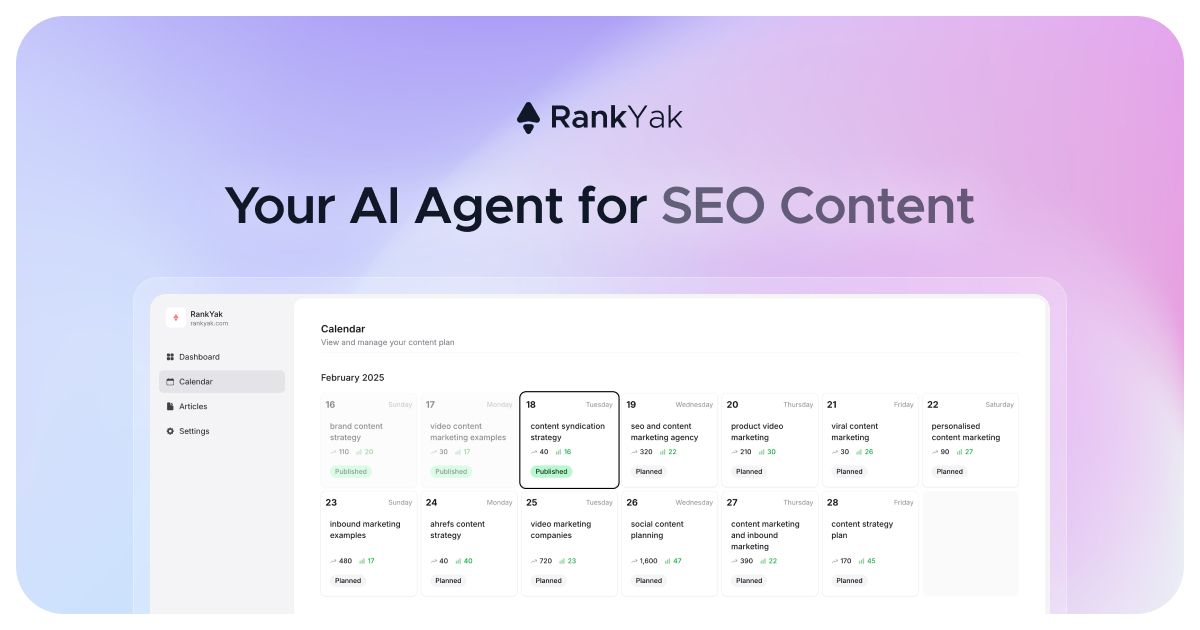
RankYak automates the full SEO publishing loop: scoring keywords against your site's authority, building a topical map, writing researched articles in 40-plus languages, publishing on a calendar you control, and running daily checks on existing pages using your Search Console data.
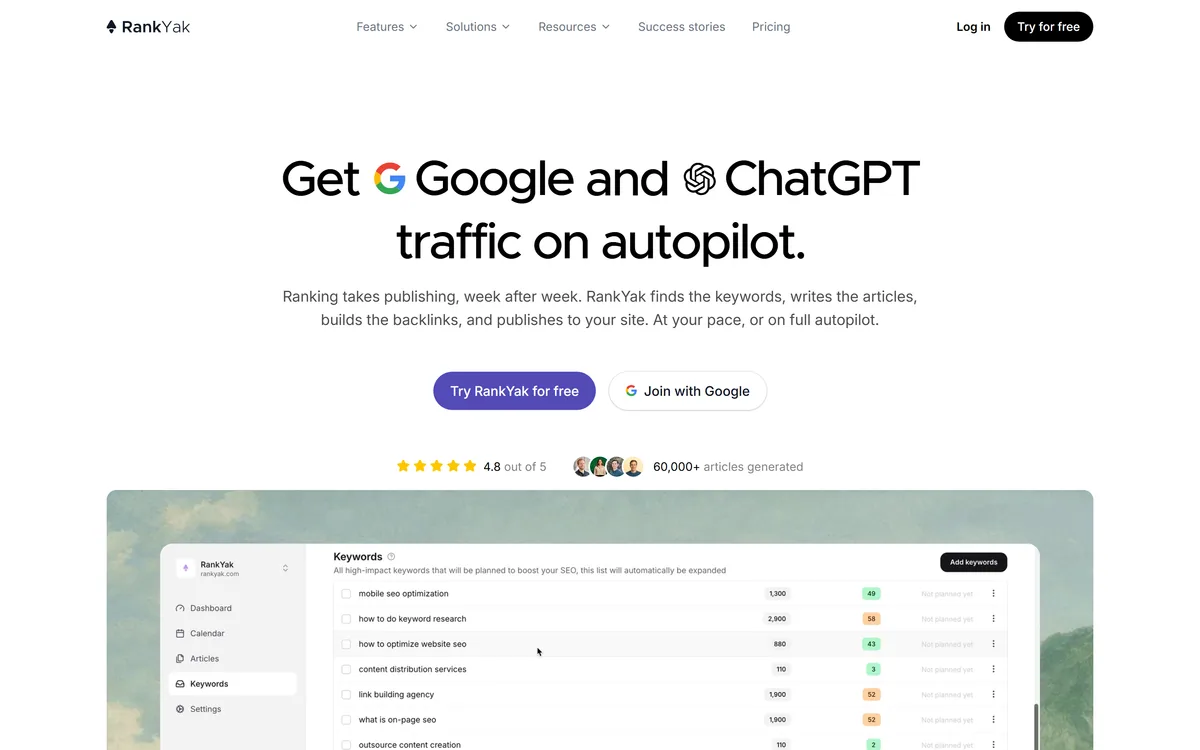
RankYak's homepage, captured 9 September 2026, showing its autopilot SEO positioning.
RankYak: What Runs Without You
Keywords scored against your authority, refreshed monthly as that authority changes.
One article a day maximum — around 21 a month on weekdays, 30 if you publish daily.
Site Guard: daily checks on existing pages for weak titles, descriptions and lost clicks.
Research before writing — top-ranking pages read, intent and length set, then the draft.
A backlink exchange network — optional, and the feature we would think hardest about.
RankYak: Publishing On Autopilot
The premise is stated in one line and it is the correct diagnosis: ranking takes publishing, week after week, and the sites that keep publishing are the sites that take the traffic.
Anyone who has run a content programme knows that is true and knows why it fails.
Consistency is not hard because writing is hard. It is hard because the fourth month arrives, the person who owned it is busy, and the calendar quietly empties. Search rewards the sites that did not stop, which means the constraint is operational rather than creative.
RankYak's answer is to remove every step that requires a human decision unless you want one: keyword research runs and waits for approval or auto-approves, articles write themselves and publish on a date you set, and existing pages get checked daily.
The honest framing of the trade-off is on the same page — anyone can generate a blog post with AI, but that does not mean it will rank. What separates this from a bulk generator is the research step, and that is where the assessment should focus.
Consistency does not fail because writing is hard. It fails because month four arrives, the owner gets busy, and the calendar quietly empties.
The Strategy Built In Minute One
The topical map is where a content programme is won or lost, and RankYak's description of it is more thoughtful than the automation framing suggests.
Core topics anchor the map, every keyword cluster hangs off one of them, and variations group under a single primary keyword so one article covers the whole cluster.
That structure matters because of how search engines assess a site rather than a page. Ten articles scattered across unrelated topics establish nothing. Ten articles covering one subject thoroughly establish that the site is about that subject, which is what topical authority means in practice.
Grouping variations into one article rather than writing one per keyword is the other half, and it is the discipline most automated content programmes abandon first — because publishing thirty near-identical pages is easier than writing ten good ones.
The site's own phrasing is that coverage is deliberate instead of random, which is exactly the right ambition. Whether the clustering holds up on your niche is testable in the first research run, before you commit. Research-led writing platforms such as Byword make the same structural argument from a different starting point.
What Does Full Autopilot SEO Actually Do?
The pipeline is described end to end: RankYak scans your site and niche, finds what your audience searches for in Google and in AI chats, scores every keyword, schedules articles on a calendar, reads the top-ranking pages before writing, and publishes to your CMS.
The research-first sequencing is the part worth examining, because it is what the output quality rests on.
The stated order is competitor analysis, search intent and target length settled before an outline exists — then writing. That is how a competent human SEO writer works, and reversing it is how you get an article that reads well and answers a different question than the one people typed.
Search intent is the specific thing generators miss. A query can want a definition, a comparison, a purchase or a how-to, and producing the wrong type is a total failure however well written the result is.
The volume cap is a design decision that deserves credit. One article a day, on days you choose, with some days spent optimising an existing page instead. A platform that could publish a hundred a week and deliberately does not is telling you it understands that mass-produced thin content is the failure mode of this category, not the goal. Pure generators like SEOWriting.ai will produce far more per day, which is precisely the distinction being drawn.
Check the first research run for cluster quality before committing.
Read the first five articles in full — that is your quality sample.
Connect Search Console early; the refresh logic depends on it.
Leave the backlink exchange switched off unless you accept the risk.
Keep approval on until you trust the output, then decide.
Keyword Scoring Against Your Own Authority
One line in the keyword section is the most important sentence on the page: volume, difficulty and your site's authority decide what is within reach, and the scores refresh as your authority grows.
Scoring against your own site rather than in the abstract is what separates a usable keyword list from a wish list.
Every keyword tool reports difficulty, and difficulty is a property of the competition — not of your chances. A term rated moderately difficult is unwinnable for a new site and trivial for an established one, and a list that ignores that produces months of work on pages that will never rank.
Refreshing monthly is the other half. A site's realistic target set changes as it accumulates authority, so terms out of reach in January become reasonable by September, and a static plan never notices.
The emerging keywords feature — rising queries with confirmed demand, picked up before volume tools register them — is the highest-value item in this section if it works, because the entire advantage in content SEO is arriving before the competition does. It is also the hardest claim to verify from outside, since it depends on data sources the page does not describe. Established suites like Surfer SEO approach the same problem with a heavier human workflow.
Backlinks, And Why That Word Needs Care
The backlink exchange is described plainly: RankYak exchanges backlinks between your site and relevant sites in the network, on full autopilot, with no cold emails and no outreach — matched by niche, links going live automatically, accumulating steadily.
This section is not an accusation about the company, and none is intended. It is a description of a well-documented tension every buyer should understand before enabling the feature.
Google publishes spam policies naming link schemes, and excessive reciprocal linking — the you-link-to-me-and-I-link-to-you pattern — appears in them by name. A network that automatically arranges reciprocal links between member sites matches that description as written.
The same homepage states that every article follows Google's helpful content standards and E-E-A-T guidance, and both things being on one page is the tension worth noticing rather than resolving on the vendor's behalf.
In practice the risk is borne entirely by the site owner. Search engines act on sites, not on the tools their owners used, and a manual action or algorithmic devaluation lands on your domain. The rest of the platform works without it: the feature is presented as something you activate, so leaving it off costs you nothing and removes the question. The zero-outreach appeal is real, because outreach is genuinely miserable work — that is why the shortcut exists and why it warrants a decision rather than a default.
Publishing At A Pace You Can Live With
The failure mode with automated content is not bad articles. It is a hundred adequate ones nobody reads, on a site that now looks mass-produced.
This sequence keeps the automation useful.
Connect Search Console first so decisions run on your real data.
Review the first research run and reject clusters that miss your niche.
Keep manual approval on for the first month, and read every article.
Leave the backlink exchange off until you have decided about it deliberately.
Use some publishing days to refresh existing pages rather than add new ones.
Check after ninety days whether traffic is arriving on the terms you targeted.
Key features of RankYak
Keyword scoring against your own site authority
Topical map with clusters rather than isolated keywords
Editorial calendar with drag-and-drop scheduling
Research-first article generation with cited sources
Writing in 40-plus languages in your brand voice
Daily Site Guard checks on existing pages
Cannibalisation detection with redirect suggestions
Article refresh on the same URL, preserving history
Pros & cons
Pros
7
Scoring keywords against your own authority is the correct model, and rare
Clustering variations into one article avoids self-competition
Capping output at one article a day works against thin mass production
Site Guard maintains existing pages, which content generators ignore entirely
Cannibalisation resolution with a redirect list is genuinely useful work
Research before writing is the sequence a competent human writer uses
Search Console integration means decisions run on your real performance
Cons
7
The backlink exchange matches the reciprocal linking described in Google's spam policies
That feature sits on the same page as a commitment to following Google's guidelines
Enforcement risk falls on your domain, not on the tool
The headline percentages carry no stated source or methodology
First-hand experience — a named part of E-E-A-T — cannot be automated
Emerging keyword detection depends on data sources the page does not describe
Our capture did not reach the footer, so company details went unread
Best For
Small businesses with no SEO staff and no agency budget
Founders who have abandoned a content calendar before
Sites with existing pages nobody has maintained in a year
Multilingual publishers needing the same content in many languages
Agencies managing search content for several small clients
RankYak Beside Other SEO Platforms
SEO tools differ by how much of the loop they run without you.
Last checked . Read from rankyak.com in a browser session on the date above, with the screenshot captured at the same time.
Positioned as getting Google and AI chat traffic on autopilot, with 60,000-plus articles generated and a 4.8 rating displayed
Keywords scored on volume, difficulty and your own site authority, with scores refreshed monthly
A topical map described with core topics anchoring clusters, one article covering each cluster
Research runs stated to wait for approval, with auto-approve available
A calendar allowing steady publishing, batched launch weeks or quiet periods, with drag and reschedule
Articles described as researched first: top-ranking pages read, intent and target length set before writing
Article output stated as verified facts with cited sources, generated images, video and internal links
Writing offered in 40-plus languages, listed by name in the FAQ
Output capped at one article per chosen publishing day, with some days used to optimise existing pages
Site Guard described as daily checks of titles, descriptions and click-through using Search Console data, with cannibalisation resolved via a redirect list
A backlink exchange described as pairing sites within a niche and publishing links automatically, with no outreach
Integrations listed for WordPress, Wix, Shopify, Webflow, Zapier and Make, plus RSS, REST API and webhooks
What we could not confirm: our capture did not reach the site footer, so we make no claim in either direction about what is published there, including the operating company. We also could not confirm the basis for the tenfold speed, 90 percent time saving and threefold ranking claims, none of which carry a source; how emerging keywords are detected; how the backlink network selects partners; or pricing. We did not connect a site or generate an article.
Editor's Verdict
3.7/5
Two thirds of RankYak is better designed than its category usually manages. Scoring keywords against your own site's authority rather than raw difficulty is the correct model, and Site Guard — daily checks on pages you already have, with cannibalisation resolution and click-through comparison against Search Console — addresses the half of SEO that content generators ignore entirely. The backlink exchange is the part that requires a clear head: reciprocal link exchanges appear by name in Google's own published spam policies, which sits awkwardly beside the same page's commitment to following Google's guidelines. That feature is optional, and we would leave it off. AInexfinder Editor Score: 3.7/5.
RankYak pricing
AInexfinder does not list plan prices or billing details. For current pricing, plans, and trials, visit the official RankYak website.
Vendor pricing, credits, and billing policies change over time. Always confirm on the official site before you buy.
Frequently asked questions
What does RankYak do?
It runs the whole SEO publishing loop: finding and scoring keywords, planning them on a calendar, researching and writing articles, publishing them to your CMS, and checking existing pages daily for problems.
How many articles does it produce?
One per publishing day at most — around 21 a month on weekdays, 30 if you publish daily. Some days are used to refresh an existing page instead, chosen from Search Console data.
Why does scoring against my site's authority matter?
Because difficulty describes the competition, not your chances. A term rated moderately difficult is unwinnable for a new site and trivial for an established one, and a list ignoring that wastes months.
Is the backlink exchange safe to use?
It is the feature to think hardest about. Google's published spam policies name excessive reciprocal linking as a link scheme, and a network that arranges reciprocal links automatically matches that description as written.
Who carries the risk if there is a problem?
You do. Search engines act on sites rather than on the tools their owners used, so any devaluation or manual action lands on your domain. The rest of the platform works with the exchange switched off.
What is Site Guard?
A daily check on pages you already have, comparing titles, descriptions and click-through rate against what your search positions should earn, using your own Search Console data, with fixes you approve.
What is cannibalisation and why does it matter?
Two of your own pages competing for the same query, so neither ranks well. It is the most common self-inflicted SEO problem, and resolving it means picking one winner and redirecting the other.
Will the articles actually rank?
The site is candid that anyone can generate a post and that does not mean it ranks. The research-first sequence — reading top-ranking pages and fixing intent and length before writing — is what separates this from bulk generation.
Can it satisfy Google's E-E-A-T guidance?
Partly. Structure, citations and topical coverage are automatable. The first E — experience, meaning first-hand knowledge — is not, and it is the part that distinguishes content nobody else could have written.
Should I review articles before publishing?
Yes, at least for the first month. Read the first five in full: that is your quality sample, it becomes your brand voice, and you cannot judge the system from a marketing page.
Daniel reviews AI tools the slow way — by actually using them on real projects. His reviews cover what works, what breaks, and who each tool is genuinely a good fit for.
Daniel and the AInexfinder editorial team research RankYak using public product information, listing evidence, and (when available) hands-on checks. Scores reflect listing completeness and transparency — not paid placement.
Listings may include affiliate or sponsored placements, which are labeled when present. Editorial scores and cons are not sold. See our affiliate disclosure and review methodology.
AIKTP generates SEO-optimised articles of 2,000 to 2,500 words in around thirty seconds using ChatGPT, Gemini and Claude, across eighteen languages. It bundles keyword research, clustering, entity extraction, image tools, auto-publishing to WordPress and Shopify, and bulk Google and Bing indexing.
SEOWriting AI analyses SERP competitors and generates articles optimised for search and AI engines, with one-click and bulk generation across 48 languages, AI images, affiliate content models, Amazon product tools and WordPress auto-posting.
Frase runs SEO and AI search end to end: auditing a site page by page, researching and briefing, drafting in a defined brand voice, optimising for both rankings and AI citation, publishing to WordPress, Webflow, Sanity and Wix or its own CMS, then monitoring for ranking decay and AI mentions.
SEO.AI, based in Kongens Lyngby, Denmark, is an SEO agent that creates content, publishes it directly to your CMS, and builds backlinks through an automatic link exchange network. It supports 50+ languages and integrates with WordPress, Webflow, Wix, Squarespace, Shopify and Magento.
Byword is an AI article writer aimed at SEO content produced at scale. It runs a four-stage loop — research keywords, build the article, edit it, optimise it — writes in your brand voice, and publishes to your CMS, with a programmatic mode for generating large sets of pages from structured data.
RivalFlow, built by SpyFu, analyses a page you already have against competitors ranking for the same terms, then returns around 23 specific content gaps with ready-to-paste copy and placement guidance. It connects to Google Search Console to track whether rankings move afterwards.