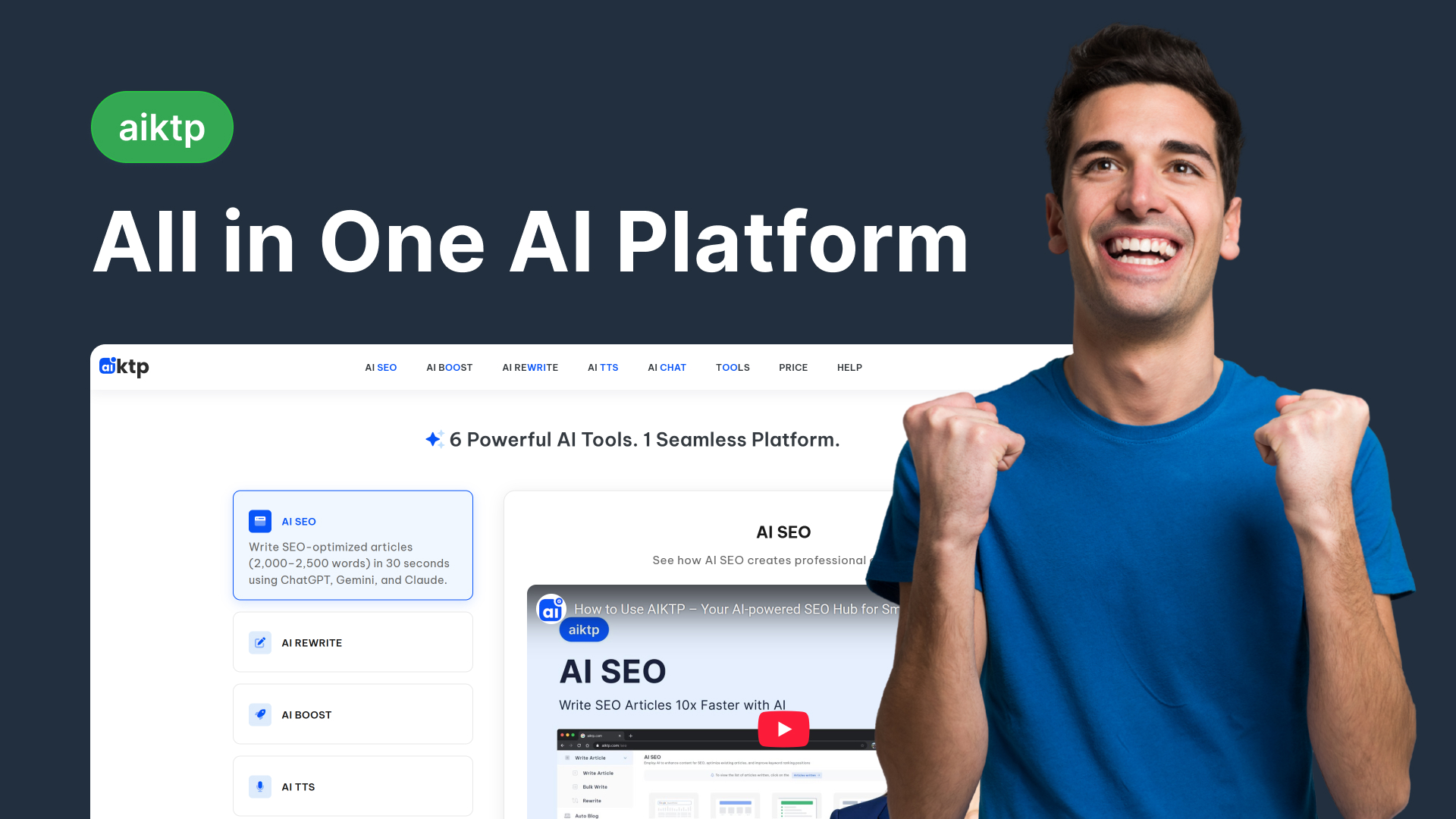
AIKTP generates SEO-optimised articles of 2,000 to 2,500 words in around thirty seconds using ChatGPT, Gemini and Claude, across eighteen languages. It bundles keyword research, clustering, entity extraction, image tools, auto-publishing to WordPress and Shopify, and bulk Google and Bing indexing.
AIKTP does what it says. Give it a keyword and it returns a long, structured, SEO-conscious article in about the time it takes to read this paragraph, then publishes it to your site and asks Google to index it.
Whether that is useful depends entirely on a question the product does not raise: what happens to a website that publishes thirty such articles a month.
That question has an answer, and it has had one for several years. This review covers what the toolkit genuinely does well — and it does several things well, particularly for non-English markets — alongside the risk that the pipeline's whole design encourages you to take.
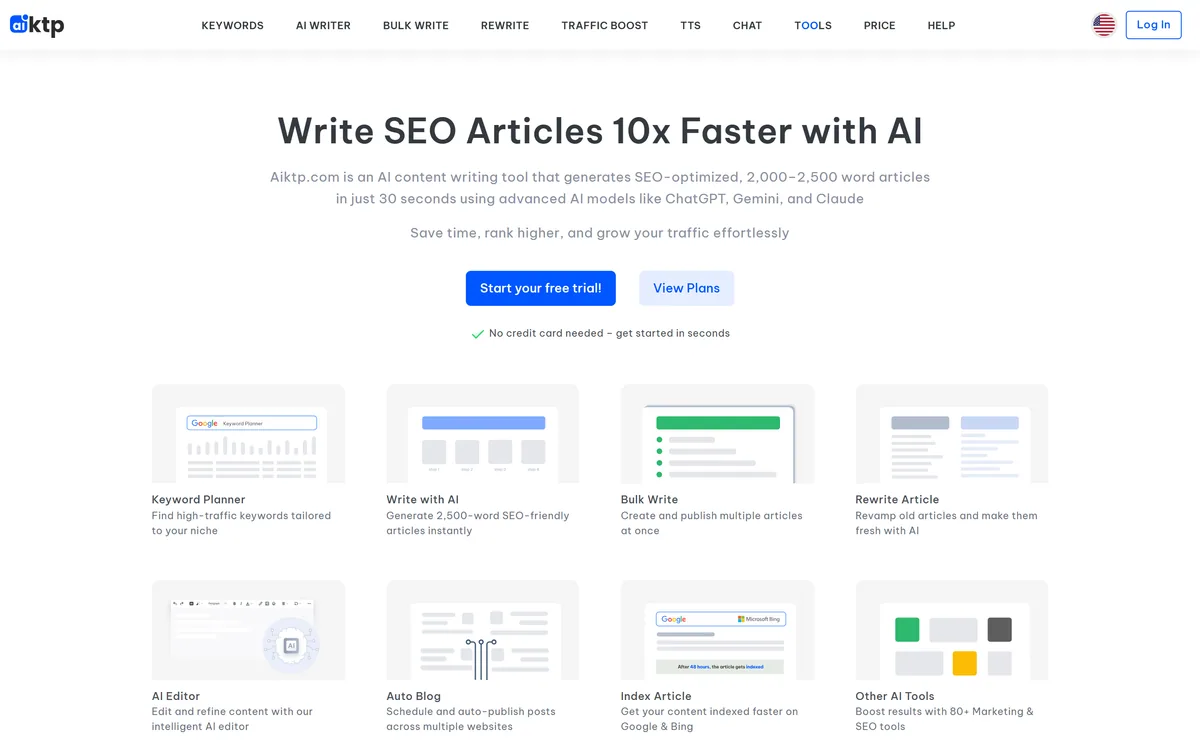
AIKTP's homepage, captured 9 September 2026. The pitch leads on speed and word count, which describes the product's priorities accurately.
The Volume Strategy Search Engines Learned To Detect
AIKTP is built around publishing at scale: thirty-second generation, bulk writing, auto-publishing to six platforms and bulk index submission to Google and Bing. Every one of those features exists to increase throughput.
That strategy worked once, before optimisation tools such as Clearscope became the sounder bet. Publishing large volumes of keyword-targeted content reliably captured search traffic, and an entire industry was built on it.
It works considerably less well now, and the reason is not a moral judgement about AI writing. Google's published position is that content produced primarily to manipulate rankings — rather than to help someone — is the problem, whoever or whatever wrote it. Successive updates have specifically targeted sites publishing large volumes of unhelpful content, and the penalties have been site-wide rather than page-level.
That last detail is what makes volume genuinely dangerous. A page that fails to rank costs you the effort of writing it. A site-wide quality assessment costs you the rankings of pages that were fine, including ones you wrote by hand years ago.
The bulk indexing feature is the sharpest expression of this. It exists to get many pages assessed quickly — which is exactly what you want if the pages are good and exactly what you do not want if they are not.
A page that fails to rank costs you an afternoon. A site-wide quality assessment costs you the rankings of everything you wrote by hand.
What Thirty Seconds Buys And What It Cannot
Two thousand words in thirty seconds is a real capability, and it is worth being precise about what is actually produced.
What you get is a competent, structured, on-topic article covering the obvious ground. It will be readable, correctly organised and factually plausible.
What you do not get is anything the model could not infer from having read the internet: original data, a specific experience, a considered opinion, or knowledge of what happened in your industry last month. Those are precisely what makes a page worth linking to.
The consequence follows directly. A thirty-second article competes against every other thirty-second article on the same keyword, including everything produced through Byword and its peers, and there are a great many of them, because the same tools are available to everyone.
Used as a first draft that a knowledgeable person then rewrites, adds to and corrects, the speed is genuine leverage. Published as generated, it is one more indistinguishable page competing on a crowded term.
Why Are Eighteen Languages The Best Thing Here?
AIKTP's language list — English, Vietnamese, Japanese, Indonesian, Hindi, Thai, Spanish, Korean, Arabic, Bengali, Turkish, German, Dutch, Portuguese, Russian, French, Italian and Simplified Chinese — is the most interesting thing about it.
Most SEO content tools are built for English-language markets and treat other languages as translation. AIKTP's list, and its evident Vietnamese origin, points at Southeast and South Asian markets specifically.
That matters commercially because those markets are less saturated. The competitive difficulty of ranking for a term in English is enormous; the same term in Vietnamese, Thai or Bengali frequently is not, simply because far fewer people have built tools and published content for it.
It is also where the quality concern is most acute, and worth naming. Content quality assessment is generally more advanced in English than in smaller-market languages, which means volume strategies survive longer there. That is a temporary advantage rather than a durable one, and building a business on it means building on something that will close.
The genuinely good use of this capability is different: taking content you already have in one language and reaching an audience that could not read it. That is a real service to real readers, and it is not what a volume pipeline is optimised for.
Non-English markets are less saturated, which is a real and current advantage.
Quality assessment is less developed in smaller-market languages — treat that as temporary.
Translating genuinely good content into an underserved language serves real readers.
Generating volume in a language nobody on your team reads means nobody can catch errors.
Have a native speaker review before publishing, or you cannot know what you published.
The Research Tools Are Worth More Than The Writing
Beneath the generation sits a substantial research toolkit: keyword planner, suggestions, volume data, clustering, entity extraction, semantic keyword generation, and a stated 15-plus SEO criteria for optimisation.
These are the parts worth paying for, and they are the parts least likely to get you into trouble.
Keyword clustering in particular is genuinely valuable and tedious to do manually, and it is where research-led tools such as SEOwind also concentrate. Grouping hundreds of keywords into topics that should be one page rather than many is how you avoid the common self-inflicted problem of five thin pages competing against each other for the same intent.
Entity extraction and semantic keywords reflect how search engines actually work now — understanding a page's topic through the concepts it covers rather than through keyword repetition. Using those to make one page genuinely comprehensive is sound practice.
The unfortunate part is that the same research feeding a bulk generation pipeline produces the opposite: a page per keyword rather than a page per topic. The tools support good practice and the workflow encourages bad practice, and which you get depends entirely on how you use it.
Getting Value Without The Damage
There is a way to get real value here, and it involves deliberately not using several of the features as designed.
The bar is step four. If nobody with subject knowledge reads a page before it publishes, you are running the strategy that gets sites demoted.
Use the research tools first and the generator second. Cluster your keywords into topics and decide how many pages should genuinely exist — usually far fewer than the keyword count suggests.
Turn auto-publishing off. Generate into drafts, always, whatever the workflow suggests.
Rewrite substantially rather than editing lightly. Add your own data, examples and opinions — the things a model could not know.
Have someone with genuine subject knowledge read every page before it goes live, in the language it is written in.
Publish far less than the tool makes possible. Ten good pages will outperform a hundred generated ones, and will not put the rest of your site at risk.
Leave bulk indexing alone until you are confident the pages are genuinely useful, since it accelerates whatever assessment is coming.
AIKTP’s Freemium Structure
The model is freemium with paid subscription tiers; amounts are not disclosed on the pages we read. Indexing services for Google and Bing are offered alongside.
For a tool sold on volume, the pricing question is really a strategy question. If you intend to publish at the rate the product enables, cost per article is what matters and the tool is priced to make that attractive.
If you intend to use it the way described above — research heavily, generate selectively, rewrite substantially — you will use a fraction of any tier's capacity, and the research tools alone need to justify the subscription.
That is worth deciding before subscribing rather than after, because it determines which tier you need and whether the product suits you at all.
We do not publish amounts, since they change. The footer carries About Us, Usage Policy, Privacy Policy, Terms of Service, docs and an API — read the usage policy in particular, since it will describe what the platform expects of you.
What Is AIKTP Built To Do?
Generate SEO articles fast — the site states 2,000 to 2,500 words in around thirty seconds, using ChatGPT, Gemini and Claude.
It covers the whole SEO pipeline: keyword planning, clustering, entity extraction, semantic keywords, generation, images and publishing.
Eighteen languages including Vietnamese, Hindi, Thai, Indonesian, Bengali, Korean and Arabic — markets most Western tools underserve.
Publishing is automated to WordPress, Shopify, Blogger, Medium, Ghost and ecommerce platforms, with bulk Google and Bing indexing.
The risk is structural: everything about the pipeline is designed to increase how much you publish, which is the behaviour search engines penalise.
AIKTP: The Tool Inventory
Product type
AI SEO content generation with research, publishing and indexing
Stated output
2,000 to 2,500 word SEO-optimised articles in around 30 seconds
WordPress, Shopify, Blogger, Medium, Ghost and ecommerce platforms
Indexing
Bulk Google and Bing index submission
Pricing model
Freemium with paid subscription tiers
Published links
About Us, Usage Policy, Privacy Policy, Terms of Service, Blog, Docs, API
Key features of AIKTP
SEO article generation of 2,000 to 2,500 words in around thirty seconds
Keyword planning, suggestions, volume data and clustering
Entity extraction and semantic keyword generation
Bulk writing and outline-based generation modes
Eighteen languages including several underserved by Western tools
AI image generation, editing, upscaling and watermark removal
Auto-publishing to WordPress, Shopify, Blogger, Medium and Ghost
Bulk Google and Bing index submission
Pros & cons
Pros
6
Keyword clustering and entity extraction are genuinely valuable and tedious to do by hand
Eighteen languages including Vietnamese, Thai, Bengali and Indonesian serves markets most tools ignore
Multi-platform publishing removes real friction for anyone running several sites
Routes across ChatGPT, Gemini and Claude rather than depending on one provider
A comprehensive toolkit — research, writing, images, video scripts and publishing in one place
Freemium access allows evaluation of the research tools before committing
Cons
6
The entire pipeline is optimised for publishing volume, which is the behaviour search engines have learned to demote
Bulk indexing accelerates assessment of pages that may not survive it
Quality penalties are frequently site-wide, so generated pages put your existing rankings at risk
Thirty-second articles contain nothing a model could not infer, which is what makes a page linkable
No performance or ranking outcome data is published for generated content
No company legal name, registration or headquarters appears on the pages we read
Best For
Teams that want the keyword research and clustering rather than the generation
Publishers working in Vietnamese, Thai, Indonesian, Bengali or Hindi
Producing first drafts that subject-matter experts will substantially rewrite
Translating genuinely good content into underserved languages
Anyone with an editorial process strong enough to catch what a model cannot know
AIKTP Against Other Content Tools
The dividing line in this category is whether a tool optimises for volume or for making one page genuinely better. That choice determines what happens to your site.
You want the research tools — clustering, entity extraction, semantic keywords — and treat generation as secondary.
You publish in Vietnamese, Thai, Indonesian, Bengali or Hindi, where language coverage is genuinely better than Western tools offer.
You have subject-matter experts who will substantially rewrite every draft before it publishes.
You are translating content that is already good into languages your audience actually reads.
You need first drafts quickly and have an editorial process that catches what a model cannot know.
It will hurt when
You would use auto-publishing as designed, which is the single fastest way to damage a site that currently ranks.
Your site already performs well, since site-wide quality assessments put those existing rankings at risk.
Nobody on your team reads the language you are generating in, so nobody can catch what is wrong.
You are building an affiliate or programmatic site on volume, which is the strategy search engines specifically target.
You want bulk indexing to accelerate results, since it accelerates whatever assessment is coming either way.
What We Read On AIKTP
Last checked . Read from aiktp.com, including the footer, with the screenshot above captured in the same session.
Product described as an AI content writing tool generating SEO-optimised articles of 2,000 to 2,500 words in around 30 seconds
Models named on the site as ChatGPT, Gemini and Claude
Writing modes confirmed as keyword-based, outline-based and bulk writing, plus news writing and rewriting, product reviews and affiliate content
Research tools confirmed as keyword planner, suggestion and volume tools, keyword clustering, entity extraction and semantic keyword generation
SEO optimisation stated as covering more than 15 criteria
Eighteen languages listed on the site, including Vietnamese, Hindi, Thai, Indonesian, Bengali, Korean, Arabic and Simplified Chinese
Media tools confirmed including AI image generation and editing, upscaling, watermark removal, background changes, video script generation and text-to-video
YouTube tools confirmed as a summariser, description generator and subtitle downloader
Publishing platforms confirmed as WordPress, Shopify, Blogger, Medium, Ghost and multiple ecommerce platforms
Bulk Google and Bing indexing services confirmed on the site
Footer read directly and confirmed to carry About Us, Usage Policy, Privacy Policy, Terms of Service, Blog, Docs, API and social links
What we could not confirm: no pricing amounts or tier structure are disclosed on the pages we read; no company legal name, registration or headquarters is published; no data is published on how generated content performs in search, which is the only outcome that matters for an SEO tool; the 15-plus SEO criteria are not enumerated; and we did not generate or publish content, so nothing here reflects tested output quality or ranking outcomes.
Other SEO And Content Tools
Compare on whether a tool helps you publish more or helps you make one page better — that single choice decides the risk.
Clearscope — optimises one page toward comprehensiveness rather than generating many
Surfer SEO — established optimisation with AI visibility tracking added
SEOwind — research-led long-form briefs, closer to how good content actually gets made
Byword — the closest comparison on scaled article production
ContentMonk — if visibility in AI answers rather than search results is the goal
Editor's Verdict
3.2/5
AIKTP scores low-to-middling despite doing what it claims competently, and the reason is what it is built to encourage rather than what it can do. The toolkit is genuinely comprehensive — keyword research through clustering, generation, images, multi-platform publishing and bulk indexing — and eighteen languages including Vietnamese, Hindi, Thai, Bengali and Indonesian serves markets most Western tools ignore, which is a real advantage. It loses substantial ground because the entire pipeline is optimised for publishing volume, bulk indexing exists to accelerate exactly that, and content produced primarily to rank is what search engines have spent years learning to identify and demote. AInexfinder Editor Score: 3.2/5.
AIKTP pricing
AInexfinder does not list plan prices or billing details. For current pricing, plans, and trials, visit the official AIKTP website.
Vendor pricing, credits, and billing policies change over time. Always confirm on the official site before you buy.
Frequently asked questions
What is AIKTP?
AIKTP is an AI content platform that generates SEO-optimised articles of 2,000 to 2,500 words in around thirty seconds using ChatGPT, Gemini and Claude. It bundles keyword research and clustering, entity extraction, image tools, auto-publishing to WordPress, Shopify, Medium and Ghost, and bulk Google and Bing indexing, across eighteen languages.
Is publishing AI-generated articles bad for SEO?
It depends entirely on what happens between generation and publication. Google's stated position targets content produced primarily to manipulate rankings, regardless of who wrote it. A generated draft that a knowledgeable person substantially rewrote is fine; thirty published unread each month is the pattern successive updates have specifically targeted — and those penalties are frequently site-wide.
What is the risk of using AIKTP's bulk publishing?
Site-wide quality assessment. A single page that fails to rank costs you the effort of writing it. A site-wide demotion costs you the rankings of pages that were fine, including ones you wrote by hand years ago. Bulk indexing makes this worse by accelerating how quickly many pages get assessed.
Which languages does AIKTP support?
Eighteen: English, Vietnamese, Japanese, Indonesian, Hindi, Thai, Spanish, Korean, Arabic, Bengali, Turkish, German, Dutch, Portuguese, Russian, French, Italian and Simplified Chinese. That Southeast and South Asian coverage is the genuinely distinctive part — most Western SEO tools treat those languages as translation rather than as first-class markets.
Is AIKTP free?
It is freemium with paid subscription tiers; amounts are not disclosed on the pages we read. The pricing question is really a strategy question: if you publish at the rate the tool enables, cost per article matters. If you use it for research and selective generation, the research tools alone need to justify the subscription.
What is AIKTP actually good at?
The research tools, more than the writing. Keyword clustering is genuinely valuable and tedious by hand — grouping hundreds of keywords into topics that should be one page rather than five prevents the common self-inflicted problem of thin pages competing with each other. Entity extraction and semantic keywords reflect how search engines actually assess topics now.
Can I use AIKTP safely?
Yes, by deliberately not using several features as designed. Use the research first and the generator second. Turn auto-publishing off and generate into drafts. Rewrite substantially rather than editing lightly. Have a subject expert read every page in the language it is written in. And publish far less than the tool makes possible.
How good is a 2,000-word article generated in thirty seconds?
Competent, structured, on-topic and readable — and containing nothing a model could not infer from having read the internet. What it lacks is original data, specific experience, a considered opinion, and knowledge of what happened in your industry last month. Those are exactly what makes a page worth linking to, and what determines whether it ranks.
Does AIKTP publish directly to my website?
Yes — WordPress, Shopify, Blogger, Medium, Ghost and various ecommerce platforms, with bulk indexing on top. Our strong recommendation is to configure it to create drafts rather than published posts. The convenience is real, and so is the damage from unreviewed articles landing on a site that currently performs.
How does AIKTP compare with Clearscope or Surfer SEO?
They optimise in opposite directions. Clearscope and Surfer help you make one page genuinely comprehensive against what already ranks. AIKTP helps you publish many pages quickly. Given how search engines now assess sites, the first approach is both lower risk and — for competitive English-language terms — considerably more likely to work.
Daniel reviews AI tools the slow way — by actually using them on real projects. His reviews cover what works, what breaks, and who each tool is genuinely a good fit for.
Daniel and the AInexfinder editorial team research AIKTP using public product information, listing evidence, and (when available) hands-on checks. Scores reflect listing completeness and transparency — not paid placement.
Listings may include affiliate or sponsored placements, which are labeled when present. Editorial scores and cons are not sold. See our affiliate disclosure and review methodology.
SEOWriting AI analyses SERP competitors and generates articles optimised for search and AI engines, with one-click and bulk generation across 48 languages, AI images, affiliate content models, Amazon product tools and WordPress auto-posting.
Frase runs SEO and AI search end to end: auditing a site page by page, researching and briefing, drafting in a defined brand voice, optimising for both rankings and AI citation, publishing to WordPress, Webflow, Sanity and Wix or its own CMS, then monitoring for ranking decay and AI mentions.
SEO.AI, based in Kongens Lyngby, Denmark, is an SEO agent that creates content, publishes it directly to your CMS, and builds backlinks through an automatic link exchange network. It supports 50+ languages and integrates with WordPress, Webflow, Wix, Squarespace, Shopify and Magento.
Byword is an AI article writer aimed at SEO content produced at scale. It runs a four-stage loop — research keywords, build the article, edit it, optimise it — writes in your brand voice, and publishes to your CMS, with a programmatic mode for generating large sets of pages from structured data.
RivalFlow, built by SpyFu, analyses a page you already have against competitors ranking for the same terms, then returns around 23 specific content gaps with ready-to-paste copy and placement guidance. It connects to Google Search Console to track whether rankings move afterwards.
SEOwind produces SEO content through a multi-agent system covering briefs, research, drafting and quality scoring, with human editorial checkpoints before delivery. It uses retrieval-grounded research to reduce fabrication, scores content against EEAT criteria, and delivers white-label exports ready for a CMS.