SE Ranking is an SEO platform built around cross-channel visibility, adding trackers for AI Overviews, AI Mode and assistant answers alongside conventional rank tracking, backed by 188 country databases and exposed through an API and an MCP server for use inside AI assistants.
Clearscope
Verified
Clearscope is a content optimisation platform from Mushi Labs, combining search intent analysis and query discovery with Prompt Tracking that monitors brand visibility across ChatGPT, Gemini, and Claude.
4.4Editor Score
clearscope.io13 viewsAdded May 23, 20265K visitors
Clearscope has a particular reputation in content optimisation: the one editors respect. Where competitors push term counts and automation, Clearscope has generally erred toward fewer, better-justified recommendations.
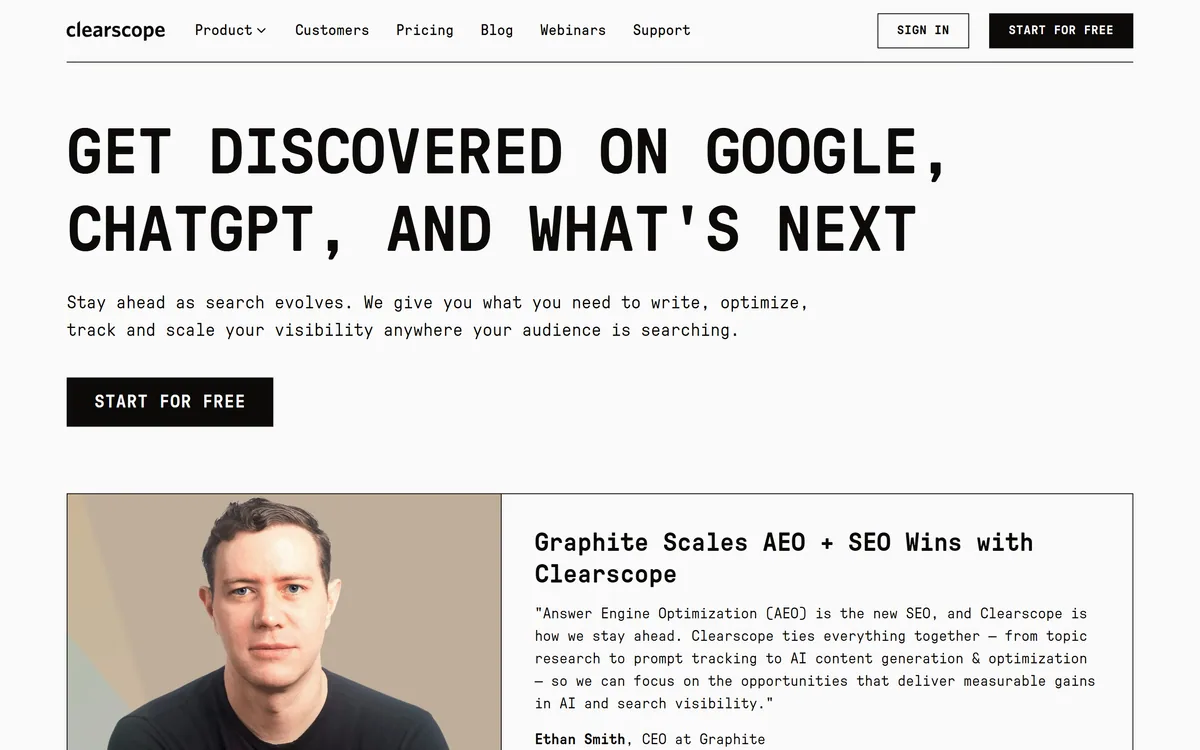
Its positioning has now widened. The homepage headline reads "Get Discovered on Google, ChatGPT, and What's Next", and Prompt Tracking monitors whether your brand appears in answers from ChatGPT, Gemini, and Claude.
This review covers what the optimisation side actually measures, what Prompt Tracking adds, why the customer list matters, and the honest case against paying for it.
Clearscope Boiled Down
- What it does: content optimisation and search intent analysis, now extended to tracking whether AI assistants mention your brand.
- Prompt Tracking monitors visibility across ChatGPT, Gemini, and Claude — the measurement rank tracking cannot provide.
- Query Discovery finds what people actually ask, rather than starting from a keyword list.
- The customer list is the signal: Adobe, Shopify, IBM, Deloitte, Condé Nast, Intuit, YouTube, Webflow.
- Reputation: the editorially serious option in this category — less automation, more signal per recommendation.
Key features of Clearscope
Content reports grading a draft against what currently ranks
Prompt Tracking across ChatGPT, Gemini, and Claude
Query Discovery based on what people actually ask
Search intent analysis to shape the brief before writing
AI drafting and editing workflow inside the platform
Content analytics and ongoing monitoring
Custom content views for teams managing large libraries
Pros & cons
Pros
5- Restrained, well-reasoned recommendations that do not wreck the prose
- Prompt Tracking answers a question rank tracking structurally cannot
- Query Discovery fits how people phrase things to AI assistants
- Search intent analysis prevents the most expensive briefing mistake
- Customer profile suggests it holds up under real editorial standards
Cons
5- Expensive relative to the category, and hard to justify at low volume
- Deliberately does less automation than competitors
- Prompt Tracking measures the problem without fixing it
- No published methodology behind the AI visibility numbers
- Does nothing for technical SEO, performance, or authority
Best For
- In-house content teams with editors and quality standards
- Publishers whose reputation depends on how the writing reads
- Brands whose organic traffic is falling despite stable rankings
- Teams shifting from keyword lists to real question coverage
- Anyone needing evidence of AI visibility for a leadership conversation
Clearscope Next To Its Direct Rivals
These tools overlap heavily, and the difference is temperament as much as feature set.
| Tool | Character | AI visibility tracking | Best fit |
|---|---|---|---|
| Clearscope | Editorial, restrained recommendations | Prompt Tracking across ChatGPT, Gemini, Claude | Teams with editors who want sharper judgement |
| Surfer SEO | Prescriptive, term-driven guidance | AI Tracker | High-volume content teams needing consistency |
| Writesonic | Automated execution alongside measurement | Visibility tracker plus Action Center | Agencies wanting the work done, not just measured |
| Frase | Research and brief-building focus | Limited | Writers building briefs from SERP research |
| Perplexity AI | Not a tool — the surface itself | Manual checking | Seeing first-hand how AI answers cite your category |
Optimisation Without The Term-Stuffing
Clearscope's content reports analyse what already ranks for a query and grade your draft against it. That much is standard in the category.
The difference is temperament. Clearscope has consistently pushed fewer recommendations with more reasoning behind each, which produces copy that reads like it was written rather than assembled to satisfy a checker.
Search intent analysis sits underneath that. Knowing whether a query wants a definition, a comparison, or a purchase decision changes the whole shape of a piece — and getting it wrong makes every other optimisation irrelevant.
A content score measures how much your page resembles the pages already ranking. Useful as a floor. Ruinous as a target.
Prompt Tracking And The New Question
Prompt Tracking is the addition that matters most, because it answers a question no rank tracker can: when someone asks ChatGPT, Gemini, or Claude about your category, do you get mentioned?
That is now a commercially significant question. A brand can hold its rankings while the traffic quietly reroutes into AI answers that cite someone else.
The measurement is inherently noisy — AI answers vary between sessions, users, and regions — so treat movements over weeks as signal and any single reading as anecdote.
Query Discovery Versus Keyword Lists
Query Discovery starts from what people ask rather than from a keyword export. That distinction has grown more important as AI answers have taken over informational queries.
People type keywords into search engines and ask full questions of assistants. Content built around a keyword list is optimised for the surface that is losing traffic.
Practically, this means writing pieces that answer a real question completely, in language a person would use — which is also, conveniently, what makes content worth citing.
Fitting It Into An Editorial Process
Clearscope works best as a check on work rather than as a generator of it, and the sequence below reflects how content teams actually use it.
- Start with Query Discovery to establish what the piece should genuinely answer.
- Check search intent before outlining — a comparison brief and a definition brief produce different articles.
- Draft in your own voice first, without the report open. Writing to a grade from the start produces flat copy.
- Run the content report as a review pass, and act on the recommendations you agree with.
- Stop short of a perfect grade. The last stretch is bought with phrasing nobody would choose.
- Add the piece to Prompt Tracking and monitor whether it starts appearing in AI answers.
What The Customer List Tells You
Clearscope names Intuit, Condé Nast, Adobe, Shopify, Deloitte, YouTube, IBM, Webflow, and Optimizely among its customers.
That group skews toward organisations with real editorial standards — publishers and large in-house content teams rather than volume affiliate operations.
It is a vendor-stated list, but the composition is consistent with the product's character. Tools that optimise aggressively tend to attract a different customer profile entirely.
The Case Against Buying It
Price is the recurring objection. Clearscope has always sat at the expensive end of this category, and if you publish occasionally the subscription will not pay for itself.
It also does less than some competitors, deliberately. There is no sprawling suite of automation, which is a virtue if you have editors and a limitation if you were hoping the tool would do the work.
Prompt Tracking is measurement, not remediation. It will tell you that AI assistants do not mention you; it will not fix that for you.
And like every tool in this category, it optimises content only. Technical SEO, site performance, and authority are outside its scope and are frequently the actual constraint.
Who Actually Needs This
The honest answer is teams that already publish well and want to publish better, plus anyone whose organic traffic is falling for reasons rank tracking cannot explain.
If you have editors, Clearscope sharpens their judgement. If you do not, a cheaper tool with more automation will get you closer to the same place, and a much cheaper one will get you most of the way.
The AI visibility layer changes that calculation somewhat, because that measurement is genuinely hard to get elsewhere and increasingly hard to ignore.
Clearscope Coverage And Customers
| Company | Mushi Labs |
|---|---|
| Category | Content optimisation and AI visibility platform |
| Current positioning | Getting discovered on Google, ChatGPT, and what comes next |
| AI visibility | Prompt Tracking across ChatGPT, Gemini, and Claude |
| Research tools | Query Discovery and search intent analysis |
| Writing workflow | AI drafting and editing inside the platform |
| Reporting | Content analytics, monitoring, and custom content views |
| Named customers | Intuit, Condé Nast, Adobe, Shopify, Deloitte, YouTube, IBM, Webflow, Optimizely |
| Audience range | Solo creators through global content teams |
| Free trial | Yes |
Is Clearscope Worth It For You?
Buy It When
- You have editors and want the tool to sharpen judgement, not replace it
- Content quality matters more than publishing volume
- Organic traffic is falling and rank tracking cannot explain why
- You need to know whether ChatGPT, Gemini, or Claude mention your brand
- You are building content around real questions rather than keyword exports
Skip It When
- You publish only occasionally — the subscription will not pay back
- You want the tool to write and optimise automatically
- Your bottleneck is technical SEO, site speed, or authority
- You need a cheap option and can accept blunter recommendations
- Nobody on the team can exercise editorial judgement over the suggestions
Other Content Optimisation Options
Worth comparing before committing to any of them.
- Surfer SEO — more prescriptive guidance and its own AI visibility tracker
- Writesonic — executes optimisation work rather than only measuring it
- Frase — stronger on research and brief-building for writers
- Perplexity AI — check by hand how AI answers actually cite your category
Checks Behind This Review
Last checked . Taken from Clearscope's own site during this check, with the screenshot above captured at the same time.
- The "Get Discovered on Google, ChatGPT, and What's Next" positioning read directly from clearscope.io
- Feature names — Prompt Tracking, Query Discovery, search intent analysis, content analytics — as Clearscope lists them
- Named customers recorded as Clearscope presents them, not independently confirmed
- Company attributed to Mushi Labs per the site's own footer
- No plan prices published here, in line with this site's pricing policy
No methodology is published for Prompt Tracking, so its coverage and sampling are described as unverified.
Editor's Verdict
4.4/5Clearscope has an AInexfinder Editor Score of 4.4/5.
Clearscope pricing
AInexfinder does not list plan prices or billing details. For current pricing, plans, and trials, visit the official Clearscope website.
Visit official website for pricingVendor pricing, credits, and billing policies change over time. Always confirm on the official site before you buy.
Frequently asked questions
What is Clearscope Prompt Tracking?
It monitors whether your brand appears in answers from ChatGPT, Gemini, and Claude. That is a different measurement from search rankings — your position can stay healthy while traffic reroutes into AI answers citing someone else.
How is Clearscope different from Surfer SEO?
Temperament more than features. Clearscope gives fewer, better-justified recommendations and suits teams with editors. Surfer is more prescriptive and term-driven, which fits high-volume teams needing consistency across many writers.
Is Clearscope worth the price?
It depends entirely on volume and standards. If you publish regularly and have editors, it sharpens their work. If you publish occasionally or want the tool to do the writing, cheaper options will serve you better.
What is Query Discovery for?
Finding what people actually ask rather than starting from a keyword export. That matters increasingly, because people type keywords into search engines but ask full questions of AI assistants.
Can I trust Clearscope's AI visibility numbers?
Treat them as trends. No methodology is published, and AI answers vary between sessions, users, and regions. Movements over weeks are meaningful; a single reading is not.
Who uses Clearscope?
It names Intuit, Condé Nast, Adobe, Shopify, Deloitte, YouTube, IBM, Webflow, and Optimizely — a profile weighted toward publishers and large in-house content teams rather than volume operations.
Does Clearscope help with technical SEO?
No. It optimises content. Technical SEO, site performance, and domain authority sit outside its scope, and they are frequently the real reason a page underperforms.
Reviews
Log in to write a review.
User Reviews
No reviews yet. Be the first to share your experience with Clearscope.
Reviewed by Daniel Reed
Assigned reviewer
Daniel ReedSenior AI Tools Reviewer
Daniel reviews AI tools the slow way — by actually using them on real projects. His reviews cover what works, what breaks, and who each tool is genuinely a good fit for.
Hands-on reviewsProduct testingAI software
Daniel and the AInexfinder editorial team research Clearscope using public product information, listing evidence, and (when available) hands-on checks. Scores reflect listing completeness and transparency — not paid placement.
- Last verified
- Methodology
- How we review AI tools
- Sources used
- clearscope.io
- AInexfinder listing fields (features, pros/cons, description)
- Public vendor pages when available
- Editorial policy
- Listings may include affiliate or sponsored placements, which are labeled when present. Editorial scores and cons are not sold. See our affiliate disclosure and review methodology.
Related tools
GrowthPro AI is a local-SEO and AI-visibility (GEO) platform that audits whether AI engines recommend a business, then runs AI agents to improve Google Maps and AI-search presence, respond to reviews and convert leads, aimed at local and multi-location businesses.
MarketMuse is a content planning platform from MarketMuse, Inc. built on patented topic modelling rather than keyword correlation. It scores Personalized Difficulty against your own site's authority, generates content briefs, analyses inventory and maps clusters.

Surfer SEO analyses top-ranking results to guide content optimisation through its Content Editor and Content Score, and has expanded into AI visibility — tracking brand mentions in ChatGPT, Claude, Gemini, Perplexity, and Google AI Overviews.

Listomize is an Etsy SEO platform that generates titles, tags, and descriptions within Etsy's own limits, scores listings, optimises 100+ listings from a CSV, tracks competitors and trends, and auto-generates Pinterest pins.
FreemiumBusiness & Marketing

Lahjty (لهجتي) is an Arabic-first marketing platform for MENA campaigns. From one brief it produces dialect-aware ad copy, headlines, campaign images with Arabic text rendered in, dialect-aware voice, and SEO articles grounded in your own brand sources — with a Partner API and an MCP server for teams that want it inside their own workflow.
FreemiumBusiness & Marketing
Compare:Clearscope vs SE RankingClearscope vs GrowthPro AIClearscope vs MarketMuseClearscope vs Surfer SEO
Clearscope alternatives Explore More
Embed this listing on your site
Featured on AInexfinder