
GrowthPro AI is a local-SEO and AI-visibility (GEO) platform that audits whether AI engines recommend a business, then runs AI agents to improve Google Maps and AI-search presence, respond to reviews and convert leads, aimed at local and multi-location businesses.
SE Ranking
Verified
SE Ranking is an SEO platform built around cross-channel visibility, adding trackers for AI Overviews, AI Mode and assistant answers alongside conventional rank tracking, backed by 188 country databases and exposed through an API and an MCP server for use inside AI assistants.
4.3Editor Score
seranking.com7 viewsAdded November 7, 2025866K visitors
SE Ranking: What The Suite Tracks
- AI visibility trackers for AI Overviews, AI Mode, ChatGPT and other answer surfaces.
- Conventional SEO alongside it: rank tracking, keyword research, audits and backlinks.
- API and MCP access — pull data into your stack or query it inside an AI assistant.
- 188 country databases, a stated 5.5 billion keyword database and 2.2 billion domain profiles.
- Agency tooling: white label reporting, client seats, a catalog listing and lead generation.
SE Ranking: Validating Visibility, Not Just Tracking
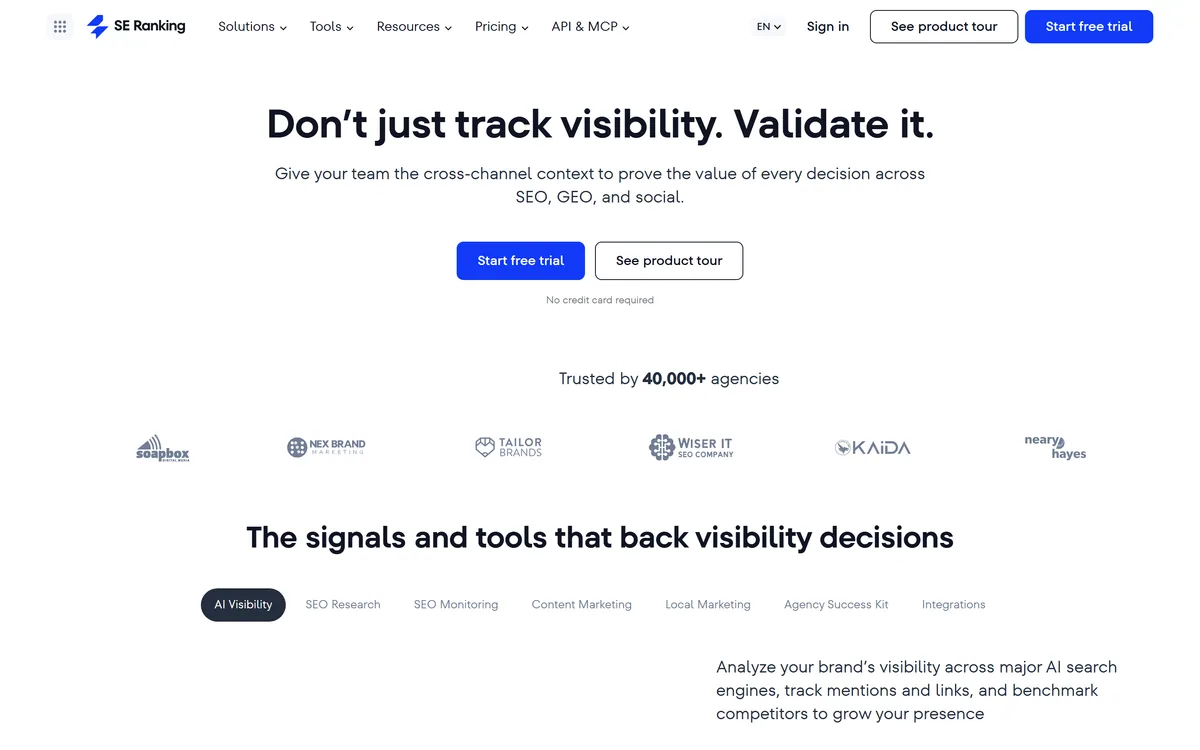
The headline is a distinction rather than a feature list: do not just track visibility, validate it — with cross-channel context to prove the value of every decision across SEO, generative engines and social.
The word validate is doing specific work, and it identifies a real gap in how SEO tools are used.
Rank tracking tells you a position changed. It does not tell you whether the change came from your work, a competitor's, an algorithm update or seasonality — and for an agency reporting to a client, that ambiguity is the entire problem.
The gap between a metric moving and a decision being justified is where SEO relationships break down, because the practitioner knows what they did and cannot demonstrate that it caused anything.
Cross-channel context is the proposed answer: linking organic search, AI answer surfaces and social so that a change can be read against everything else happening at once. That is a reporting argument as much as a measurement one, and for the stated audience of 40,000-plus agencies it is the right argument to make.
Rank tracking tells you a position moved. It cannot tell you whether your work caused it — and that gap is where agency relationships break down.
Sampling An Answer Engine Reliably
AI visibility tracking is genuinely harder than rank tracking, and understanding why should shape how much weight you put on any number in this category.
A search result page is comparatively stable. Query the same term from the same location twice and you get substantially the same page, which is what makes rank tracking possible at all.
An assistant answer is not stable in that way. The same question asked twice can produce different responses, different sources and different brand mentions, because the underlying models are probabilistic and the retrieval step varies. There is no single correct answer to record.
What that means practically is that every AI visibility metric is a sample rather than a measurement, and its reliability depends on how many times the query was run, from where, with what phrasing.
None of that makes the data useless — a brand appearing in eight of ten samples is meaningfully more visible than one appearing in one — but it does mean the appropriate unit is a trend across many observations, not a position on a Tuesday. Specialist tools such as MaxAEO exist for exactly this measurement problem, and the same sampling caveat applies to all of them.
What Is AI Visibility And How Is It Sampled?
The trackers are named specifically: an AI Visibility Tracker, an AI Overviews Tracker, a ChatGPT Tracker and an AI Mode Tracker, with monitoring of where a brand appears and how AI platforms describe it.
That last clause is the interesting one, and it is a genuinely new category of question.
Traditional SEO asked whether you ranked. Answer engines raise a different question: whether you are mentioned, and in what terms. A brand can be cited as the leading option, as one of several, or as the expensive alternative — and all three are visibility while only one is good.
There is no equivalent in rank tracking, where position ten is simply position ten regardless of what the page says about you.
The strategic consequence is that the work changes shape. If assistants summarise rather than link, the objective becomes being the source a model draws on and being described accurately when it does. That favours clear factual content, consistent claims across the web, and being covered by sources the models trust — closer to public relations than to keyword optimisation. Enterprise platforms like Conductor are converging on similar ground from the content side.
- Treat AI visibility figures as samples, and watch trends not single readings.
- Track how you are described, not only whether you appear.
- Check database coverage for the countries you actually operate in.
- Use the API rather than exporting spreadsheets by hand.
- Read absolute accuracy claims sceptically, from any vendor.
Databases, Coverage And What They Support
The data claims are specific: 188 country databases, a 5.5 billion keyword database, 2.2 billion domain profiles, and 100 percent accurate keyword rankings.
The first three are the kind of figures worth checking against your own needs, and the fourth is the one to set aside.
Country coverage is the number that matters most and gets least attention. Every SEO platform is excellent for the United States and United Kingdom; the differences appear when a client sells in Poland, Vietnam or Chile, and a database that is thin there produces keyword research that is quietly wrong.
Anyone evaluating a suite should test their actual markets rather than trusting a headline count, because 188 databases does not mean 188 equally deep databases.
The accuracy claim is different in kind. Search results are personalised by history and location, vary by device, and change continuously — so there is no fixed ranking that a tracker could be 100 percent accurate about. What a good tracker does is query consistently from a defined location and report what it saw, which is a reasonable and useful thing that no absolute figure describes. The G2 awards referenced on the page are a real external signal, and awards measure reviewer sentiment rather than data quality.
An API And MCP For Your Own Stack
The integration story is the most forward-looking part of the platform: rankings, keywords, backlinks and AI visibility available via API with no manual exports, reporting connectors for common dashboard tools, automation through the usual workflow platforms, and an MCP server exposing live data inside AI assistants.
MCP is the piece worth dwelling on, because of what it implies about where this work is going.
A standard interface means an analyst can ask an assistant a question in plain language and have it query the platform directly — no export, no dashboard, no learning the interface. One of the named testimonials describes precisely that: keyword classification work that took days now taking hours.
There is a neatness to it that is easy to miss. The same shift that created the AI visibility problem is being used to solve the analysis problem, and a platform that ships an MCP server is betting its customers will increasingly work inside assistants rather than inside dashboards.
The agency tooling around it is conventional but complete: white label reporting, client seats, a catalog listing and lead generation. The published case studies lean heavily on reporting time saved rather than on rankings gained, which is an honest reflection of where an agency's costs actually sit. Clearscope covers the content grading side that this suite touches more lightly.
Proving A Content Decision Worked
The platform's own framing is validation rather than tracking, and that only happens if the measurement is set up before the work.
This sequence produces evidence rather than a coincidence.
- Test database depth in your real markets before committing to the suite.
- Record a baseline across search, AI answers and social before you change anything.
- Note how assistants currently describe the brand, not just whether they mention it.
- Make one change at a time, and date it in the reporting.
- Read AI visibility as a trend across many samples, never a single reading.
- Pull data through the API so the report is reproducible next month.
SE Ranking: Databases And Trackers
| Category | SEO platform with AI visibility and cross-channel reporting |
|---|---|
| AI trackers | AI Visibility, AI Overviews, ChatGPT and AI Mode trackers |
| AI coverage | Monitors where a brand appears and how AI platforms describe it |
| Core SEO | Rank tracking, keyword research, site audit, on-page checker, backlink checker |
| Databases | 188 country databases stated |
| Keyword data | A stated 5.5 billion keyword database |
| Domain data | A stated 2.2 billion domain profiles |
| Accuracy claim | 100 percent accurate keyword rankings, stated on the homepage |
| Programmatic access | API for rankings, keywords, backlinks and AI visibility data |
| MCP | An MCP server exposing live data inside AI assistants |
| Agency tools | White label reporting, client seats, agency catalog and lead generator |
| Adoption | Stated as trusted by 40,000-plus agencies, with users in 150-plus countries |
Key features of SE Ranking
AI Overviews, AI Mode and assistant answer tracking
Conventional rank tracking across engines
Keyword research and competitor analysis
Website audit, on-page checker and backlink data
API access to rankings, keywords, backlinks and AI visibility
An MCP server for querying data inside AI assistants
White label reporting and client seats
Local marketing, content and social workflow tools
Pros & cons
Pros
7- Treats AI answer surfaces as first-class rather than as an add-on
- Tracking how a brand is described, not just whether it appears, is the right new metric
- An MCP server puts the data where analysts increasingly work
- API access removes manual exports from agency reporting
- 188 country databases is a genuine breadth advantage outside the major markets
- Agency tooling covers the full client cycle rather than reporting alone
- Named practitioner testimonials rather than anonymous quotes
Cons
7- 100 percent accurate keyword rankings is not a testable claim
- A headline database count says nothing about depth in a specific country
- AI visibility figures are samples, and the sampling method is not published
- Breadth across many tools means less depth than a specialist in any one
- Cross-channel reporting only helps teams that work across those channels
- Case study figures are customer-reported without stated methodology
- Agencies with embedded workflows face a real migration cost
Best For
- Agencies reporting to clients across several channels
- SEO teams whose traffic is being affected by AI answers
- Analysts who want platform data inside their AI assistant
- Businesses operating outside the major English-language markets
- RevOps and marketing teams building their own dashboards
SE Ranking Beside Other SEO Suites
Search tools differ by breadth and by how they expose their data.
| Tool | Covers | Data access | Best for |
|---|---|---|---|
| SE Ranking | SEO, AI visibility and social | API and MCP | Agencies reporting across channels |
| MaxAEO | Answer engine visibility only | Focused | Depth on AI mentions |
| Conductor | Enterprise organic marketing | Enterprise integrations | Large in-house teams |
| Clearscope | Content grading against what ranks | Editor integrations | Writers optimising a single page |
| Search Console alone | Your own performance data | Free API | Truth about your site, and nothing else |
More SEO And Visibility Tools
Other platforms for search and answer engine visibility.
- MaxAEO — answer engine visibility as a specialism
- Conductor — enterprise organic marketing at scale
- Clearscope — content grading for individual pages
- Surfer SEO — on-page optimisation guidance
- SEOwind — briefs built from search research
Does Your Agency Need This Suite?
Track visibility here when
- You report to clients and need to justify decisions, not just show ranks.
- AI answer surfaces are already affecting your clients' traffic.
- You want data in your own dashboards rather than the vendor's.
- Your analysts would work faster querying data from an assistant.
- White label reporting and client seats are part of your delivery.
Keep your current suite when
- You run one site and Search Console already answers your questions.
- Your markets are thinly covered by the keyword databases.
- Your existing suite is embedded in workflows nobody wants to rebuild.
- You need content grading depth more than breadth of tracking.
- AI visibility is not yet material to how your audience searches.
SE Ranking: Checked On The Data Pages
Last checked . Read from seranking.com in a browser session on the date above, with the screenshot captured at the same time.
- Positioned as validating visibility rather than only tracking it, across SEO, generative engines and social
- Adoption stated as trusted by 40,000-plus agencies, with users in 150-plus countries
- Four AI trackers named: AI Visibility, AI Overviews, ChatGPT and AI Mode
- AI monitoring described as covering where a brand appears and how AI platforms describe it
- Data claims of 188 country databases, a 5.5 billion keyword database and 2.2 billion domain profiles
- A stated claim of 100 percent accurate keyword rankings
- API access described for rankings, keywords, backlinks and AI visibility, with no manual exports
- An MCP server described as making structured data queryable inside AI assistants
- Reporting connectors and workflow automation platforms named as integrations
- Agency Pack described with a catalog listing, white label reporting, lead generator and client seats
- Named testimonials from identified SEO practitioners, including one describing MCP saving days of work
- Footer showing SER Acquisition Inc. with a 2013 to 2026 copyright, privacy statement, cookie and legal pages
What we could not confirm: how the 100 percent ranking accuracy claim is defined or could be tested; database depth in individual countries beyond the headline count of 188; how AI visibility queries are sampled, from where and how often; how the 40,000-agency figure is counted; and pricing. Case study figures are customer-reported. We did not start a trial or run a report.
Editor's Verdict
4.3/5SE Ranking has read the shift correctly. When a meaningful share of queries are answered without a click, rank tracking measures a shrinking part of the picture, and building trackers for AI Overviews, AI Mode and assistant answers is the right response rather than a bolt-on. Shipping an MCP server is the more forward-looking decision — it makes the platform's data available inside the assistants that are themselves becoming the discovery channel. The one claim we would not repeat is 100 percent accurate keyword rankings, which is not a testable property of a personalised, continuously changing system. AInexfinder Editor Score: 4.3/5.
SE Ranking pricing
AInexfinder does not list plan prices or billing details. For current pricing, plans, and trials, visit the official SE Ranking website.
Visit official website for pricingVendor pricing, credits, and billing policies change over time. Always confirm on the official site before you buy.
Frequently asked questions
What does SE Ranking do?
It combines conventional SEO tooling — rank tracking, keyword research, audits, backlinks — with trackers for AI answer surfaces including AI Overviews, AI Mode and assistant responses, plus API and MCP access to the data.
What is AI visibility?
Whether and how your brand appears in generated answers. Unlike a rank it includes description: being cited as the leading option and as the expensive alternative are both visibility, and only one helps.
Why is AI visibility harder to measure than rankings?
Because assistant answers are not stable. The same question asked twice can produce different responses and different sources, so every figure is a sample rather than a measurement of a fixed position.
How should I read AI visibility numbers?
As trends across many observations, not as a position on a given day. A brand appearing in eight of ten samples is meaningfully more visible than one appearing in one, which is the useful comparison.
Is the 100 percent accuracy claim credible?
It is not a testable property. Results are personalised by history and location, vary by device and change continuously, so there is no fixed ranking to be accurate about. Consistent querying from a defined location is what a good tracker actually does.
Why does MCP matter here?
It lets an analyst query the platform in plain language from inside an assistant rather than exporting from a dashboard. One named testimonial describes keyword classification work dropping from days to hours.
How many countries does it really cover?
188 databases are stated. That count says nothing about depth, and depth is what matters — every platform is excellent for the major English markets and they diverge sharply elsewhere. Test yours.
What is GEO?
Generative engine optimisation: influencing what assistants say about you rather than where your pages rank. In practice it resembles public relations more than keyword work — clear facts, consistent claims, coverage in trusted sources.
Do I still need rank tracking?
Yes, but it measures a shrinking share of the picture. When a query is answered without a click, a page can hold its position while its traffic falls, and rank alone will not show you that.
Who does not need this?
Anyone running one site whose questions Search Console already answers, teams whose markets are thinly covered, and organisations with existing suites embedded in workflows nobody wants to rebuild.
Reviews
Log in to write a review.
User Reviews
No reviews yet. Be the first to share your experience with SE Ranking.
Reviewed by Daniel Reed
Assigned reviewer
Daniel ReedSenior AI Tools Reviewer
Daniel reviews AI tools the slow way — by actually using them on real projects. His reviews cover what works, what breaks, and who each tool is genuinely a good fit for.
Hands-on reviewsProduct testingAI software
Daniel and the AInexfinder editorial team research SE Ranking using public product information, listing evidence, and (when available) hands-on checks. Scores reflect listing completeness and transparency — not paid placement.
- Last verified
- Methodology
- How we review AI tools
- Sources used
- seranking.com
- AInexfinder listing fields (features, pros/cons, description)
- Public vendor pages when available
- Editorial policy
- Listings may include affiliate or sponsored placements, which are labeled when present. Editorial scores and cons are not sold. See our affiliate disclosure and review methodology.
Related tools
MarketMuse is a content planning platform from MarketMuse, Inc. built on patented topic modelling rather than keyword correlation. It scores Personalized Difficulty against your own site's authority, generates content briefs, analyses inventory and maps clusters.
Clearscope is a content optimisation platform from Mushi Labs, combining search intent analysis and query discovery with Prompt Tracking that monitors brand visibility across ChatGPT, Gemini, and Claude.

Surfer SEO analyses top-ranking results to guide content optimisation through its Content Editor and Content Score, and has expanded into AI visibility — tracking brand mentions in ChatGPT, Claude, Gemini, Perplexity, and Google AI Overviews.

Listomize is an Etsy SEO platform that generates titles, tags, and descriptions within Etsy's own limits, scores listings, optimises 100+ listings from a CSV, tracks competitors and trends, and auto-generates Pinterest pins.
FreemiumBusiness & Marketing

Lahjty (لهجتي) is an Arabic-first marketing platform for MENA campaigns. From one brief it produces dialect-aware ad copy, headlines, campaign images with Arabic text rendered in, dialect-aware voice, and SEO articles grounded in your own brand sources — with a Partner API and an MCP server for teams that want it inside their own workflow.
FreemiumBusiness & Marketing
Compare:SE Ranking vs GrowthPro AISE Ranking vs MarketMuseSE Ranking vs ClearscopeSE Ranking vs Surfer SEO
SE Ranking alternatives Explore More
Embed this listing on your site
Featured on AInexfinder