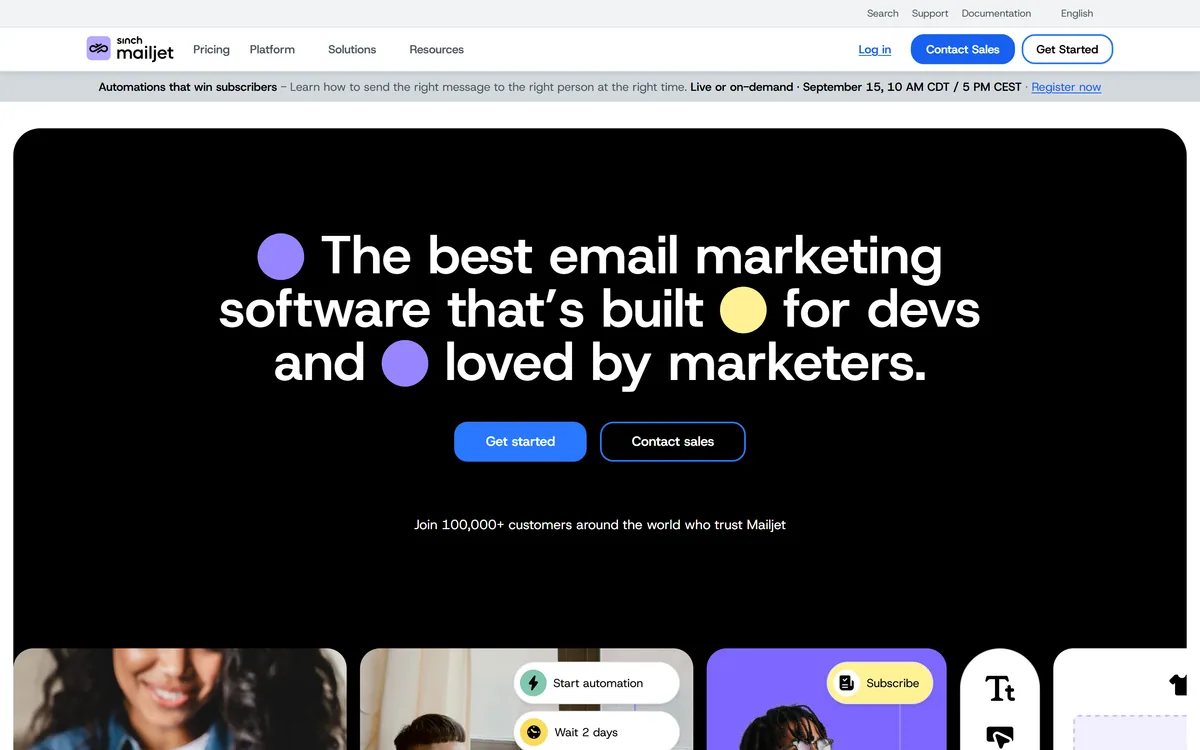
Mailjet is a Sinch-owned email platform handling both marketing campaigns and transactional sending from one account. It offers a collaborative drag-and-drop editor, an email API with SMTP relay, AI generation and segmentation, and EU-based data centres.
mailjet.com10 viewsAdded June 6, 2025148K visitors
Most companies end up sending two completely different kinds of email. There are campaigns — newsletters, promotions, the things a marketer schedules — and there are transactional messages: password resets, receipts, order confirmations, the ones a developer triggers from code and nobody notices until they stop arriving.
These are usually bought separately, from different vendors, by different people, with two sets of domain reputation to manage. Mailjet's proposition is that they should not be.
This review covers whether the unified model actually pays off, why real-time co-editing solves a real organisational problem, what EU data residency changes for a European buyer, and where the Sinch ownership overlaps with HubSpot-style all-in-one alternatives.
Two email problems, one account — which is either the point or the compromise.
One Account, Two Kinds Of Email
Mailjet is an email platform that handles marketing campaigns and transactional sending from a single account, with tools for marketers and an API for developers.
Owned by Sinch, alongside Mailgun and Email on Acid — worth knowing, because the sibling products overlap.
Real-time co-editing in the email builder is genuinely rare and solves the marketer-designer-developer handoff.
EU data centres with a 99.99% SLA, ISO 27001 and SOC 2 — which is why it wins European procurement against US-hosted rivals.
The AI layer is practical rather than headline: campaign generation, tone rewriting, plain-language segmentation, and an MCP server for querying analytics from Claude.
Platform, Compliance And Ownership
Owner
Sinch
Sibling products
Mailgun, Email on Acid
Category
Email marketing and transactional sending platform
Marketing tools
Drag-and-drop editor with real-time co-editing, automation, segmentation, A/B testing, landing pages, form builder, preference centre
Developer tools
Email API with SDKs, SMTP relay, Parse API for inbound mail, webhooks
AI features
AI Email Generator, Mailjet AI Assistant, AI Segmentation, MCP server for Claude Desktop
Deliverability
Email validation, dedicated IP, domain authentication with DKIM and SPF, Certified Sender Alliance participation
Data residency
EU-based data centres
Uptime SLA
99.99%
Certifications
ISO 27001, SOC 2
Multi-brand
Subaccounts
Markup language
MJML
Named customers
DHL, American Express, Microsoft, Wikipedia, Urban Outfitters, among a stated 100,000+
Does One Platform For Both Actually Help?
The unified pitch is easy to state and worth examining, because it is genuinely right for some companies and genuinely wrong for others.
The strongest argument is sending reputation. Email deliverability depends on the reputation of the domain and IP you send from, and managing that across two vendors means two sets of authentication records, two warm-up processes and two places a problem can originate. One platform means one reputation to look after.
The second argument is visibility. When a customer says they did not receive something, being able to look in one place — was it the campaign or the receipt? — rather than two is a real support saving.
A dedicated campaign tool such as Hoppy Copy goes deeper on the writing and touches none of the sending. The counter-argument is specialisation. A pure transactional service optimises hard for throughput and latency; a pure marketing platform optimises for campaign tooling and CRM depth. A combined product is competent at both rather than exceptional at either.
The practical test: if the same team owns both kinds of email, unify. If your marketers and your engineers do not talk to each other and have different requirements, two specialised tools will each be better and the reputation overhead is manageable.
The real argument for one platform is not the feature list. It is having one sending reputation to protect instead of two.
Real-Time Co-Editing Solves An Organisational Problem
This is the feature least likely to appear on a comparison chart and most likely to change how a week goes.
Email production is a handoff problem. A marketer drafts, a designer adjusts, a developer fixes something in the template, someone in legal wants a line changed — and traditionally each step means exporting, sending, waiting and re-importing, with version confusion at every hop.
Co-editing in the builder collapses that into one document that several people are in at once, which is what Google Docs did to written documents fifteen years ago and email tooling has been slow to copy.
MJML support belongs to the same story. It is a markup language that compiles to the tortured table-based HTML email actually requires, and it means a developer can work in something maintainable rather than hand-editing nested tables.
Together they signal a platform designed for a team rather than for one person, which matches the subaccount feature for agencies and multi-brand companies.
EU Data Residency, And Why It Wins Deals
EU-based data centres, a 99.99% SLA, ISO 27001 and SOC 2, plus Certified Sender Alliance participation.
In an American review this reads as procurement filler. In a European one it is frequently the entire decision. Email lists are personal data, and a data protection officer who will not approve US-hosted processing will approve EU-hosted processing — regardless of which product has better campaign tooling.
The Certified Sender Alliance detail is more specialised and worth knowing. It is a German-led whitelist programme, and participation improves inbox placement with several major European mailbox providers. If your audience is in the DACH region that is a concrete deliverability advantage rather than a badge.
The deliverability toolkit around it is standard but complete: email validation before sending, dedicated IPs, domain authentication with DKIM and SPF, and reputation monitoring. Nothing exotic — and email deliverability is a field where doing the standard things properly beats doing clever things.
The AI Layer, Assessed Honestly
Four AI features, and they are unusually practical for a category that has attached AI to everything.
AI Segmentation — describe an audience in plain language instead of building filter logic. This is the one that saves real time, because segment-building is fiddly and most marketers under-segment as a result.
Mailjet AI Assistant — rewriting and tone adjustment inside the editor. Useful at the point of writing rather than as a separate tool.
AI Email Generator — campaigns from a prompt. Fine as a starting point, and the usual caveat applies: generated marketing copy reads as generated unless you rewrite it.
MCP server — query your campaign analytics from Claude Desktop. Genuinely novel, and the most interesting of the four for anyone who would rather ask a question than build a report.
Choosing Between Mailjet And Its Siblings
Because Sinch owns Mailjet, Mailgun and Email on Acid, an obvious question arises: which one are you supposed to buy?
The rough division is that Mailgun is the developer-first transactional product and Mailjet is the one with the marketing platform attached. If you only send transactional email and no human will ever open a campaign builder, the sibling is likely the better fit.
Against the wider market, the comparison depends on what else you need. HubSpot AI puts email inside a CRM, which is a much larger commitment and the right one if email is part of a sales motion rather than a channel of its own.
One thing worth verifying yourself: the customer list includes DHL, American Express, Microsoft and Wikipedia, and the site cites 100,000+ customers. Those are Mailjet's own figures, and logos on a marketing page usually mean somebody at that company has an account rather than that the company runs on it. Test deliverability with your own list instead — it is the only number that will matter to you.
Decide first whether one team owns both marketing and transactional email. That answers the unify-or-specialise question.
Check data residency requirements with whoever owns data protection before evaluating features.
Warm a dedicated IP properly if you are moving volume — reputation does not transfer between providers.
Set up DKIM and SPF authentication on day one rather than after the first deliverability problem.
Test inbox placement to your actual audience's mailbox providers, not to a test account.
Try AI Segmentation on a segment you already built by hand, to see whether it matches.
If several people touch an email before it sends, use co-editing rather than exporting — that is the workflow the platform is built around.
Key features of Mailjet
Drag-and-drop email editor with real-time co-editing
Behaviour-triggered email automation
Segmentation with plain-language AI descriptions
A/B testing on subject lines and content
Email API with SDKs, SMTP relay and Parse API for inbound mail
Webhooks for real-time event tracking
AI Email Generator and in-editor AI Assistant
MCP server for querying analytics from Claude Desktop
Email validation, dedicated IPs and DKIM/SPF authentication
Landing pages, form builder and preference centre
Subaccounts for agencies and multi-brand senders
Pros & cons
Pros
5
One sending reputation to manage instead of two across separate vendors
Real-time co-editing removes the export-and-reimport handoff that slows email production
EU data centres and ISO 27001 clear European procurement that US-hosted rivals stall at
Certified Sender Alliance participation is a concrete deliverability advantage in DACH
AI segmentation addresses the reason most marketers under-segment
Cons
5
Competent at both marketing and transactional rather than exceptional at either
Sibling product Mailgun may fit better if you only send transactional email
Less CRM depth than an all-in-one platform where email is part of a sales motion
Generated campaign copy reads as generated without rewriting
Customer figures and logos are vendor claims, not evidence of fit
Best For
Teams where one group owns both campaign and transactional email
European companies with data residency requirements
Agencies and multi-brand senders needing subaccounts
Marketing teams where several people edit an email before it sends
Developers who want MJML rather than hand-written table HTML
Where Mailjet Sits In The Email Market
Email tools split by who is meant to use them, and the split is sharper than the feature lists suggest.
Anomaly AI — reporting across email and ad performance with traceable numbers
Platform Details, Verified
Last checked . Read from mailjet.com during this check, with the screenshot above captured at the same time.
Ownership by Sinch, alongside Mailgun and Email on Acid, stated on the site
Marketing features including the drag-and-drop editor with real-time co-editing, automation, segmentation, A/B testing, landing pages, form builder and preference centre
Developer features including the Email API with SDKs, SMTP relay, Parse API and webhooks
AI features named as AI Email Generator, Mailjet AI Assistant, AI Segmentation and an MCP server for Claude Desktop
EU-based data centres with a 99.99% SLA, ISO 27001 and SOC 2 certification, and Certified Sender Alliance participation
MJML support and subaccounts for multi-brand management
The customer figure of 100,000+ and the named logos are Mailjet's own presentation and are described as such here
Platform, resources, company and legal sections present in the site footer
No plan prices published here, in line with this site's pricing policy
Customer counts and named logos are the vendor's own and are not independently verified. Commentary on unified versus specialised sending, and on how deliverability reputation works, describes standard email practice rather than measured behaviour of this platform.
Editor's Verdict
4.2/5
Mailjet has an AInexfinder Editor Score of 4.2/5.
Mailjet pricing
AInexfinder does not list plan prices or billing details. For current pricing, plans, and trials, visit the official Mailjet website.
Vendor pricing, credits, and billing policies change over time. Always confirm on the official site before you buy.
Frequently asked questions
Can Mailjet handle both marketing and transactional email?
Yes — that is its main proposition. The real benefit is not the feature list but having one sending reputation to protect rather than two, which is what deliverability actually depends on.
Who owns Mailjet?
Sinch, which also owns Mailgun and Email on Acid. Worth knowing because the siblings overlap: Mailgun is the developer-first transactional product, so if no human will ever open a campaign builder, that may be the better fit.
Is Mailjet GDPR compliant?
It uses EU-based data centres and holds ISO 27001 and SOC 2 certification, with a 99.99% SLA. For European buyers this is frequently the deciding factor — a DPO who will not approve US-hosted processing will approve EU-hosted, regardless of feature comparisons.
What is the Certified Sender Alliance and does it matter?
A German-led whitelist programme, and participation improves inbox placement with several major European mailbox providers. If your audience is in the DACH region that is a concrete deliverability advantage rather than a badge on a page.
What does Mailjet's AI actually do?
Four things: generate campaigns from a prompt, rewrite and adjust tone inside the editor, build segments from a plain-language description, and query campaign analytics from Claude Desktop via an MCP server. The segmentation one saves the most real time.
Mailjet vs HubSpot — which should I pick?
Different commitments. <a href="/ai-tools/hubspot-ai">HubSpot AI</a> puts email inside a CRM, which is right when email is part of a sales motion. Mailjet is an email platform, which is right when email is its own channel and you also send transactional messages.
How do I test whether deliverability is good enough?
Send to your actual audience's mailbox providers, not to a test account. Warm a dedicated IP properly if you are moving volume — reputation does not transfer between providers — and set up DKIM and SPF on day one rather than after the first problem.
Daniel reviews AI tools the slow way — by actually using them on real projects. His reviews cover what works, what breaks, and who each tool is genuinely a good fit for.
Daniel and the AInexfinder editorial team research Mailjet using public product information, listing evidence, and (when available) hands-on checks. Scores reflect listing completeness and transparency — not paid placement.
Listings may include affiliate or sponsored placements, which are labeled when present. Editorial scores and cons are not sold. See our affiliate disclosure and review methodology.
Listomize is an Etsy SEO platform that generates titles, tags, and descriptions within Etsy's own limits, scores listings, optimises 100+ listings from a CSV, tracks competitors and trends, and auto-generates Pinterest pins.
Lahjty (لهجتي) is an Arabic-first marketing platform for MENA campaigns. From one brief it produces dialect-aware ad copy, headlines, campaign images with Arabic text rendered in, dialect-aware voice, and SEO articles grounded in your own brand sources — with a Partner API and an MCP server for teams that want it inside their own workflow.
MaxAEO is an answer engine optimisation platform from HIII PTE. LTD. It tracks how ChatGPT, Gemini, Claude, Perplexity, Copilot, Grok and Google's AI surfaces mention a brand, with sentiment, competitor benchmarking and citation tracing.
Outranking is an AI SEO content platform that writes briefs and first drafts and optimises them with real-time scoring, grounding content in live SERP data through its Concepts feature, with keyword clustering, internal linking and content workflows.
PitchBud is a press outreach tool that drafts a release with Claude Sonnet, publishes it to a newsroom URL with NewsArticle schema and RSS, matches relevant journalists by their recent work, and drafts personal pitches you review and send yourself.
Helium 10 is an all-in-one platform for Amazon, Walmart and TikTok Shop sellers, covering product research, keywords, listing optimisation, advertising, operations and analytics — now fronted by an AI agent and an MCP connector.