
Copy.ai has become an AI-native go-to-market platform: workflows and agents that run prospecting, lead processing, deal coaching, ABM, and CRM enrichment across Salesforce, HubSpot, Gong, Outreach, and 2,000+ integrations.
FreemiumWriting & Content
TextCortex is an enterprise AI platform for building, deploying and governing agents across an organisation. It combines a no-code visual agent builder, a model hub with no single-vendor lock-in, knowledge search across internal and external sources, and European data sovereignty with SOC 2 and ISO 27001 certification.
The enterprise AI problem in 2026 is not scarcity. Most large companies have a copilot licence, a handful of departmental tools and an unmeasured amount of staff using consumer chatbots on work data.
TextCortex names all three conditions on its homepage — generic copilots that miss complex workflows, in-house bots nobody owns, and shadow AI everywhere — and sells itself as the layer that consolidates them.
That framing is worth taking seriously, because it is a more accurate description of what CIOs are dealing with than most vendors in this category manage.
| Company | TextCortex AI, developed in Berlin per the footer |
|---|---|
| Positioning | Enterprise agent infrastructure that delivers ROI |
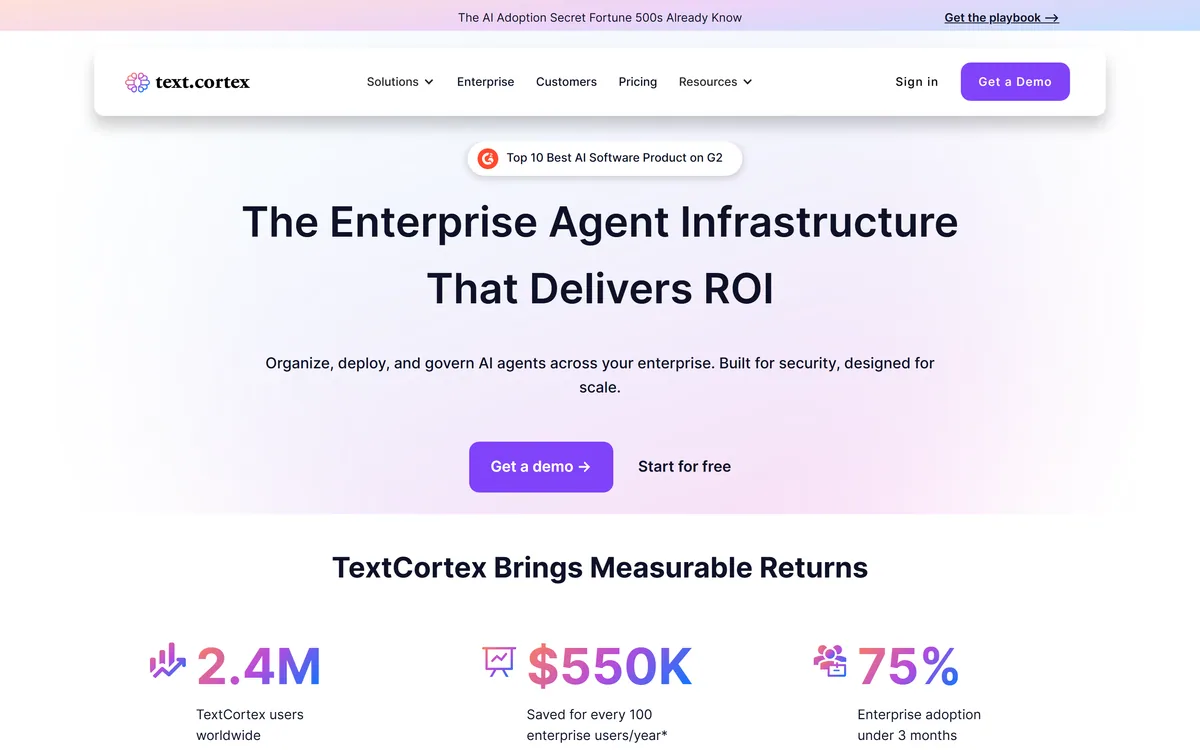
| Claimed users | 2.4 million worldwide |
| Savings claim | 550,000 dollars saved per 100 enterprise users per year, from a study of 2,000 enterprise users |
| Adoption claim | 75% enterprise adoption in under three months |
| Agent builder | Visual, no-code, connected to company data |
| Interaction | @mention agents in Slack, Teams and elsewhere |
| Automation | Scheduled agents delivering results daily, weekly or monthly |
| Model access | Model hub across major providers, stated as no lock-in |
| Data policy | Zero data training, stated on the site |
| Certifications | SOC 2 and ISO 27001, with GDPR alignment stated |
| Integrations | 30,000+ apps and sites via a browser extension |
TextCortex names shadow AI as one of three hidden frictions: no central platform, employees using unapproved tools, risky data use.
It is worth being precise about why that matters, because the phrase gets used loosely and the real risk is narrower than the panic suggests.
The exposure is not that staff use AI. It is that nobody knows which data left the building, under whose terms, and whether it can be recalled. A pasted contract, a customer list in a prompt, a codebase fragment — each is a disclosure that no log records.
The second exposure is quieter and more expensive. When every team solves the same problem with a different tool, the organisation pays several times for one capability and gets no compounding benefit, because none of it is shared.
Banning tools does not fix either. It moves usage to personal devices where visibility drops to zero, which is why the credible answer is a sanctioned platform good enough that people prefer it — a governance argument that Typeface makes in marketing and TextCortex makes across the whole company.
Banning AI tools moves the usage to personal devices, where your visibility drops to zero. The fix is a sanctioned platform people prefer.
Data sovereignty appears as a first-class feature here rather than a compliance footnote, alongside GDPR, ISO and SOC 2, and the Berlin origin is stated in the footer.
For a large part of the European market this is the whole purchasing conversation.
The reason is structural. A GDPR-covered organisation has to establish a lawful basis and a transfer mechanism for personal data leaving the EU, and every AI vendor whose inference runs elsewhere makes that a project rather than a checkbox.
A stated zero-training policy addresses the other half of the question, which is whether your data improves someone else's model. It is a policy commitment rather than a technical guarantee, and it should be verified in the contract rather than from a homepage.
The strategic read is that European sovereignty is a durable differentiator rather than a passing one. Regulatory divergence is widening, not narrowing, and vendors built inside that constraint have an advantage that a US platform cannot easily retrofit. Self-hostable tools such as Khoj answer the same question a different way, at a much smaller scale.
The headline states 550,000 dollars saved for every 100 enterprise users per year, footnoted as measured across a study of 2,000 enterprise users, alongside 2.4 million users worldwide and 75 percent adoption in under three months.
Attaching a footnote with a sample size puts this ahead of most vendor ROI claims, and it still needs reading carefully.
The figure works out to a substantial annual saving per user, which implies a specific conversion: hours saved multiplied by a loaded labour rate. That conversion is where every productivity study becomes contestable.
Time saved only becomes money saved if the time is redeployed to something valuable or the headcount changes. In practice it is often absorbed, which is a genuine quality-of-work improvement and not a line in a budget.
The supporting case study figures are more useful precisely because they are narrower: five hours saved per employee per week, a 71 percent activation rate, 94 percent reporting increased work quality. Activation rate in particular is the honest metric, because it measures whether people actually use the thing.
The platform pairs infrastructure with what it calls a hands-on partnership: centralising agents, aligning them with workflows and helping teams adopt them safely, plus an adoption playbook claiming 75 percent-plus user adoption in the first 90 days.
That combination is unusual and it addresses the actual failure mode of enterprise AI.
Governance without adoption produces an expensive, compliant platform nobody opens. Adoption without governance produces exactly the shadow AI problem the product exists to solve, with a corporate logo on it.
Most vendors sell one and hope the customer supplies the other. Selling both — with named framework, training academy and implementation support — is a services-shaped answer to a software problem, and it is probably the right shape.
The caution is that this makes the vendor relationship deeper than a licence. Change management delivered by the platform provider is genuinely useful and also creates a dependency worth pricing into the decision, alongside the more obvious question of what happens to your agents if you leave.
The model hub is described as secure access to all major models with no lock-in to one provider, and it is a more consequential feature than it first appears.
The obvious benefit is commercial: you are not exposed to a single vendor's pricing or terms, and you can move if either changes.
The less obvious benefit is that models are not interchangeable. One handles long-context reasoning, another follows structured formats reliably, another is cheap enough to run on volume. An organisation running one model for everything is overpaying for simple tasks and underserving hard ones.
There is also a continuity argument. Model versions get deprecated on the provider's schedule, and a platform that can route elsewhere absorbs that disruption instead of passing it to whoever built the agent.
The cost of agnosticism is depth. A platform abstracting over many providers exposes the common denominator, so provider-specific capabilities arrive late or not at all — an acceptable trade for governed enterprise deployment, and a poor one for a team pushing the edge of what a single model can do — which is why a developer tool like Pieces makes the opposite choice deliberately.
Enterprise AI rollouts fail predictably: a broad launch, an enthusiastic first fortnight, then a platform that shows up in the budget and nowhere else.
This sequence follows the order that adoption data actually supports.
No-code visual agent builder
Model hub across major providers with no lock-in
Knowledge search across internal documents and the web
Node-based multi-step workflow automation
Agents callable by @mention in Slack and Teams
Scheduled agents running unattended
Browser extension reaching 30,000+ apps and sites
European data sovereignty with SOC 2 and ISO 27001
Enterprise AI platforms differ by what they centralise.
| Tool | Scope | Governance | Best for |
|---|---|---|---|
| TextCortex | Agents across the whole company | SOC 2, ISO 27001, EU sovereignty | Consolidating scattered AI usage |
| Typeface | Marketing campaigns end to end | Brand guardrails and approvals | Enterprise marketing organisations |
| Khoj | Personal AI over your documents | Self-hostable | Individuals and small teams |
| Pieces | Developer workflow context | Local-first capture | Engineers rather than whole companies |
| Conductor | Orchestrating coding agents | Repository scoped | Engineering teams specifically |
Other approaches to deploying AI across an organisation.
Last checked . Read from textcortex.com in a browser session on the date above, including the full footer. The screenshot was captured at the same time.
What we could not confirm: how the 550,000-dollar figure converts time into money, or at what labour rate; who conducted the 2,000-user study and whether it is published; what the 2.4 million user count includes, given the company's consumer history; where inference physically runs for each model in the hub; how the zero-training policy is enforced contractually; and pricing, which sits behind a separate page we did not reproduce. A promotional countdown on the page had expired when we read it.
TextCortex has picked the right problem. Most enterprises do not lack AI tools — they have too many, unsanctioned, with nobody owning adoption, and the platform names that condition directly rather than pretending the answer is a better assistant. Model-agnostic access, European data sovereignty and published certifications are the things that decide enterprise purchases, and all three are here. The reservation is the ROI figure: a specific savings number from a two-thousand-user study is more evidence than most vendors offer, and still not evidence about your organisation. AInexfinder Editor Score: 4.2/5.
AInexfinder does not list plan prices or billing details. For current pricing, plans, and trials, visit the official TextCortex website.
Visit official website for pricingVendor pricing, credits, and billing policies change over time. Always confirm on the official site before you buy.
Log in to write a review.
No reviews yet. Be the first to share your experience with TextCortex.
Assigned reviewer
Daniel ReedSenior AI Tools Reviewer
Daniel reviews AI tools the slow way — by actually using them on real projects. His reviews cover what works, what breaks, and who each tool is genuinely a good fit for.
Daniel and the AInexfinder editorial team research TextCortex using public product information, listing evidence, and (when available) hands-on checks. Scores reflect listing completeness and transparency — not paid placement.
Copy.ai has become an AI-native go-to-market platform: workflows and agents that run prospecting, lead processing, deal coaching, ABM, and CRM enrichment across Salesforce, HubSpot, Gong, Outreach, and 2,000+ integrations.

Writesonic has become an AI search growth platform — tracking whether your brand appears across 10 AI platforms, running optimisation and citation work through an Action Center, and reporting results against traffic and revenue.
LogicBalls is an AI writing and content platform whose central idea is verification before generation — it asks clarifying questions rather than assuming intent. It offers thousands of task-specific tools across writing, research, analysis and explanation, and claims 15M+ clarified generations.
Smartcat combines AI translation across 280+ languages with a CAT tool, translation memory, a marketplace of 500,000+ linguists, and AI agents for writing, auditing and maintaining content — integrated with Figma, Contentful, WordPress, Git and Salesforce.

Jasper has moved from AI copywriting to orchestrating marketing agents, with 100+ specialised agents, Content Pipelines, the Jasper IQ context hub, Jasper Studio for custom agents, and brand governance across everything a marketing team produces.
Spiral, a product from Every, uses stylometry to build a voice profile from your existing writing, then drafts tweets, blog posts, LinkedIn updates and newsletters in that voice. It adds shareable team styles, a knowledge base, and MCP and API access.