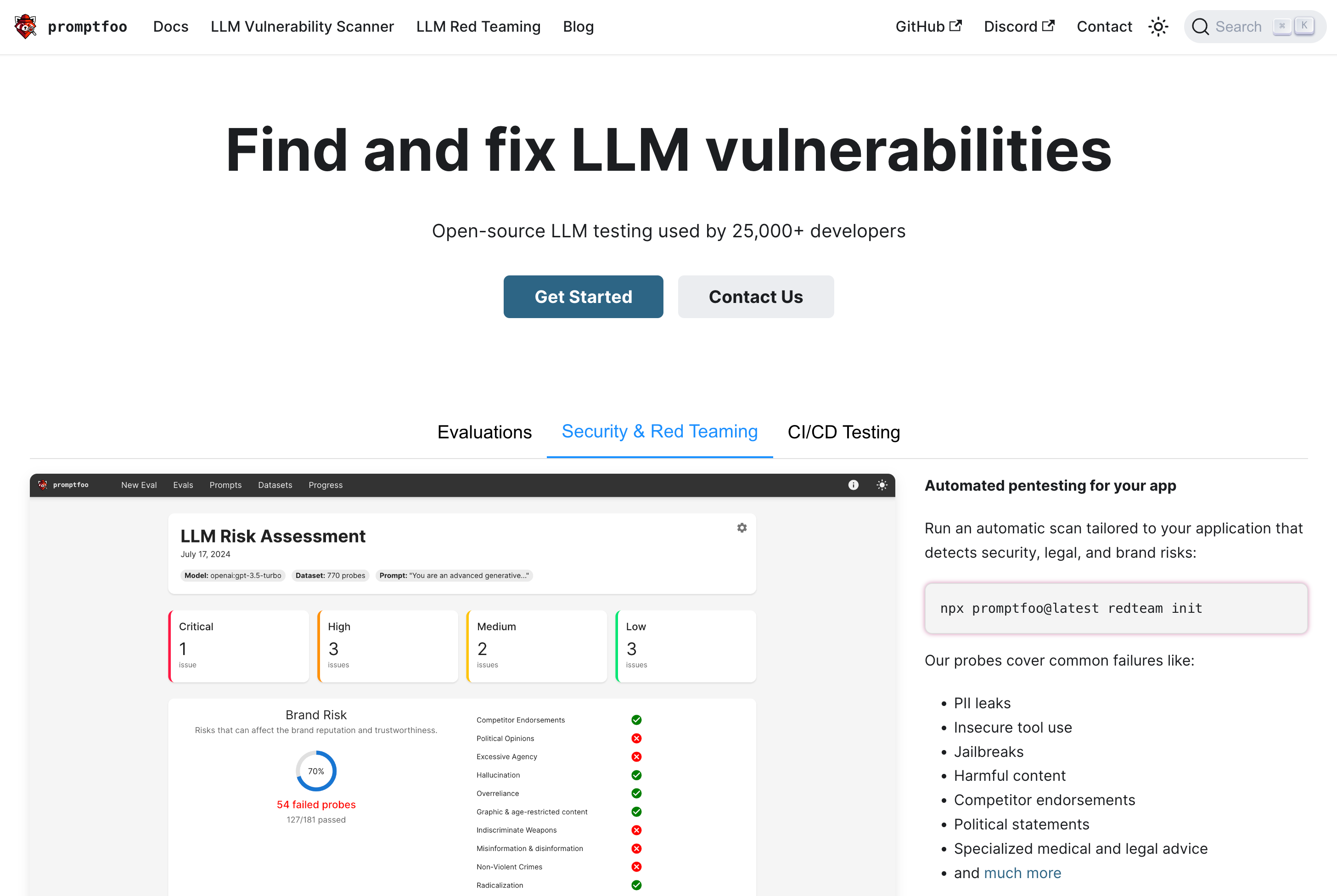
Promptfoo generates custom attacks against your own AI applications to find vulnerabilities including prompt injections, jailbreaks, data leaks, business rule violations and insecure tool use. It covers red teaming, evaluations, code scanning, model security, guardrails and MCP, with an open-source core.
promptfoo.dev6 viewsAdded August 31, 20256K visitors
Conventional application security has decades of tooling behind it because the failure modes are well understood. You know what SQL injection looks like and you can test for it deterministically.
AI applications fail differently. The vulnerability is not in the code — it is in what the system can be persuaded to do, which depends on the prompt, the tools it can call, the data it can reach and the specific model behind it.
Promptfoo's position is that this needs its own testing discipline, generated against your application rather than checked off a list.
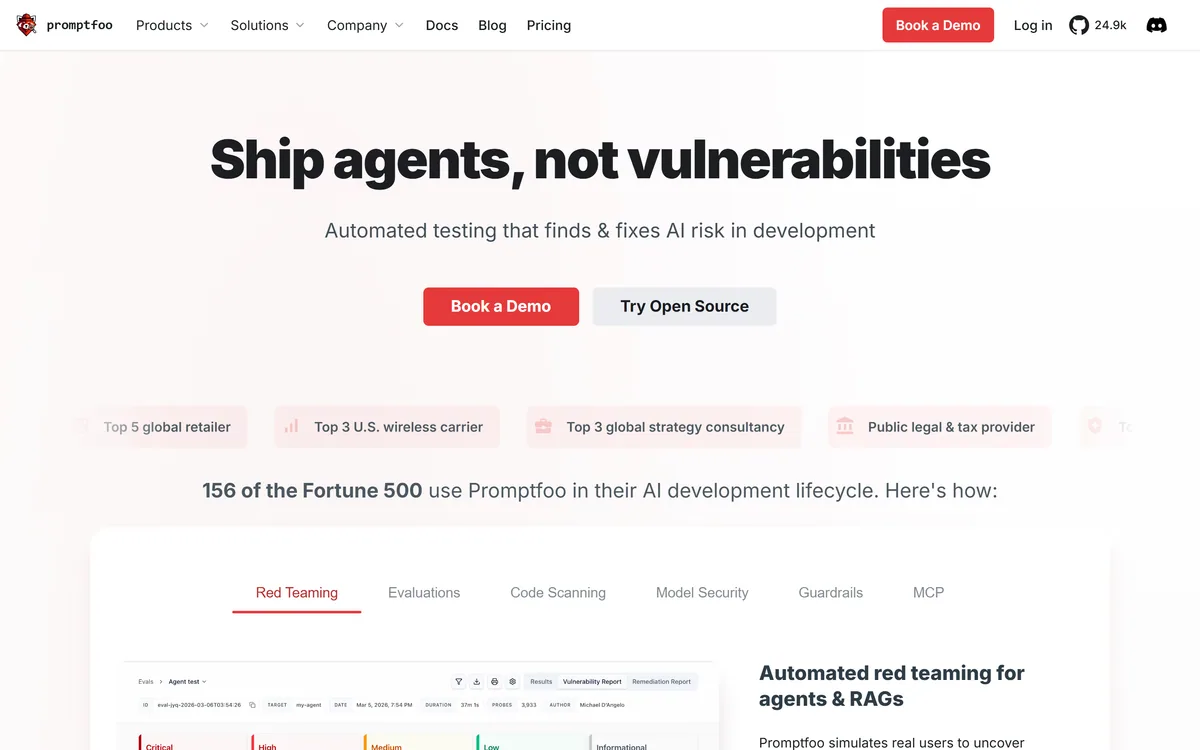
Promptfoo's homepage, captured 9 September 2026, showing the red teaming and evaluation positioning.
Promptfoo: Red Teaming Before You Ship
Attacks generated for your target, not a generic checklist — thousands of context-aware tests per application.
Six product areas: red teaming, evaluations, code scanning, model security, guardrails and MCP.
Insecure tool use in agents is a named category, which is the risk that grows as agents gain the ability to act.
Open source with a commercial layer, installable with a single npx command.
156 of the Fortune 500 claimed as users, integrating with CI/CD, GitHub, GitLab and Jenkins, on-premise or cloud.
What Does Red Teaming An AI Application Mean?
Promptfoo states that it simulates real users to uncover application-specific vulnerabilities, generating custom attacks for your target including direct and indirect prompt injections, jailbreaks tailored to your guardrails, data and PII leaks, business rule violations, insecure tool use in agents and toxic content generation.
The phrase application-specific is the important one, and it distinguishes this from a scanner.
A generic checklist cannot find your vulnerabilities, because the interesting ones are about your application's rules. A customer service agent that can be talked into issuing a refund it should not, or into revealing another customer's order, is broken in a way no generic test describes.
Business rule violations is therefore the most underrated category on the list. Every deployed AI application has rules it is supposed to enforce — what it may promise, what it may disclose, what it may do on a user's behalf — and those rules exist in a prompt rather than in code.
Rules in a prompt are suggestions rather than constraints. Testing whether they hold under adversarial pressure is exactly what nobody does before shipping, and it is the gap this category exists to fill.
Rules written into a prompt are suggestions, not constraints. Whether they hold under pressure is exactly what nobody tests before shipping.
Prompt Injection And Why It Is Unsolved
Promptfoo names both direct and indirect prompt injection, and the distinction matters more than most teams realise.
Direct injection is a user typing something designed to override your instructions. It is the well-known case and the easier one, because the attacker is a person you can rate-limit and observe.
Indirect injection is the serious problem. An agent that reads a web page, a document or an email can encounter instructions planted in that content, and it has no reliable way to distinguish data it should process from instructions it should follow.
That is not a bug with a fix. It is a structural property of systems where instructions and data share a channel, and every mitigation so far is a filter that reduces the rate rather than a boundary that holds.
The practical consequence is that any agent processing untrusted content is exposed, and the mitigation is limiting what it can do rather than trying to make it immune — which is why insecure tool use is the category to test hardest, and why observability tooling like Langfuse matters alongside it.
Open Source With A Commercial Layer
Promptfoo offers a Try Open Source route and an npx command alongside a booked demo, with a large GitHub following displayed in the header.
For security tooling specifically, an open-source core is worth more than convenience.
The reason is inspectability. A closed security tool asks you to trust that it tests what it claims, and a security tool you cannot verify is a compliance artefact rather than a control.
It also lets you extend it. Your application's specific rules are yours, and adapting attack generation to test them properly requires being able to see and modify how attacks are constructed.
The commercial layer covers what open source usually cannot: continuous threat intelligence, managed infrastructure, reporting for people who do not read a terminal, and support. That is a reasonable division, and it means an individual engineer can start today without procurement — the same pattern that made code analysis tools such as DeepSource adoptable.
Test business rule violations, not just injections — your rules are the specific risk.
Assume indirect injection is possible and limit what agents can do instead.
Run red teaming in CI so it happens on every change, not once before launch.
Re-test after model version changes, since behaviour shifts underneath you.
Read what the attacks actually were, not just the pass rate.
Testing Everything An Agent Can Reach
Promptfoo lists MCP and agent frameworks among its integration points, alongside CI/CD pipelines and on-premise or cloud deployment.
Covering agent frameworks specifically is the right emphasis, because the risk profile changed the moment AI systems could act rather than only answer.
A model that produces text can produce something wrong or offensive. A model that can call tools can send an email, modify a record, make a payment or read a file — and the consequence of persuading it to misbehave is no longer embarrassment.
MCP makes this concrete. Connecting an assistant to your systems through a protocol is enormously useful and it means the assistant's effective permissions are the union of everything it can reach.
The question worth asking of any agent deployment is the one security people ask about service accounts: what could this do at its worst, assuming an attacker controls its input entirely? Testing tool use is how you find out, and it is why this is a different discipline from evaluating output quality.
Where Red Teaming Reaches Its Limits
Automated adversarial testing is genuinely valuable and it is not a guarantee, which is worth stating plainly.
It finds attacks it knows how to generate. Novel techniques appear constantly, and a system tested clean today is tested against yesterday's threat model — which is why continuous threat intelligence is a real feature rather than an upsell.
It tests the system as configured. Change the model version, adjust the prompt, add a tool, and the previous results describe a system that no longer exists.
It cannot fix architecture. If an agent has permission to do something dangerous, testing tells you it can be persuaded to do it — the remedy is removing the permission, which is a design decision rather than a testing one.
And passing does not mean secure. It means the attacks generated did not succeed, which is a narrower claim and the honest way to read any security testing result.
Testing before release also needs a counterpart in production. What an application actually did, under real traffic and real inputs, is visible only through observability — the role tools like Helicone fill — and a system tested thoroughly and monitored not at all is only half instrumented.
Testing An AI Application Properly
The common pattern is shipping an AI feature with no adversarial testing at all, then adding it after an incident.
This sequence puts the testing where it catches things cheaply and keeps it running as the system changes.
List your application's actual rules — what it must never say, promise or do.
Run red teaming against those rules specifically, not just generic injections.
Read the successful attacks rather than the summary, since the technique is the lesson.
Reduce agent permissions wherever a test succeeded, rather than adding a filter.
Wire testing into CI so it runs on every prompt and model change.
Re-run after any model version update, since behaviour shifts without notice.
AI Security Terms
The vocabulary of AI application security, and what each failure actually is.
undefined
undefined
undefined
undefined
undefined
undefined
Key features of Promptfoo
Automated red teaming with application-specific attack generation
Direct and indirect prompt injection testing
Jailbreak testing tailored to configured guardrails
Data and PII leak detection
Business rule violation testing
Insecure tool use testing for agents
Evaluations, code scanning and model security
CI/CD, MCP and agent framework integration
Pros & cons
Pros
7
Generates attacks for your specific application rather than checking a list
Business rule violation testing addresses rules that exist only in a prompt
Names insecure tool use, which is the risk that grows as agents can act
Open source core makes a security tool inspectable rather than trusted
Runs in CI, so testing happens on every change instead of once
Covers indirect injection, which most teams have not considered
A named operating company with a published Trust Center
Cons
7
Finds attacks it knows how to generate; novel techniques appear constantly
Results describe the system as configured, and configurations change
Cannot fix architecture — a dangerous permission needs removing, not filtering
Passing means the generated attacks failed, not that the system is secure
What separates open source from the paid tiers is not stated
Threat intelligence content and update frequency are undescribed
Requires someone to act on findings, or it becomes a compliance artefact
Best For
Teams shipping customer-facing AI features
Engineers deploying agents with tool access
Organisations needing evidence of AI testing for compliance
Platform teams adding AI security to existing CI pipelines
Anyone whose application rules live in a prompt rather than in code
Promptfoo Against Other Security Tools
Testing tools differ by what layer they inspect and what kind of failure they can see.
Your AI feature is customer-facing and can be prompted by anyone.
An agent can call tools that change data, send messages or move money.
Your application has rules that exist only in a prompt.
The system reads content from the web, documents or email.
You need evidence of testing for a security or compliance review.
A code scanner is enough when
You have no AI features in production or in development.
Your model output is internal and never acts on anything.
Nobody would act on the findings, which makes the test decorative.
Your only concern is code-level vulnerabilities, which is a different tool.
You need production monitoring rather than pre-release testing.
Promptfoo: Checked Against The Product Pages
Last checked . Read from promptfoo.dev in a browser session on the date above, with the screenshot captured alongside.
Positioned as ship agents, not vulnerabilities, with automated testing that finds and fixes AI risk in development
156 of the Fortune 500 stated as using it in their AI development lifecycle
Six product areas listed: red teaming, evaluations, code scanning, model security, guardrails and MCP
Described as simulating real users to uncover application-specific vulnerabilities
Custom attacks generated for your target stated
Attack categories listed: direct and indirect prompt injections, jailbreaks tailored to your guardrails, data and PII leaks, business rule violations, insecure tool use in agents, toxic content generation
An npx install command shown for red team setup
Integration points listed: CI/CD pipelines, GitHub, GitLab, Jenkins, MCP and agent frameworks, on-premise or cloud
Real-time threat intelligence referenced in the approach section
An open-source route offered alongside a booked demo
Resources listed including model reports, a Language Model Security DB, benchmarks and evaluation guides
What we could not confirm: pricing for the commercial offering; what separates open source from the paid tiers; how the 156 of the Fortune 500 figure is counted; what the real-time threat intelligence consists of and how often it updates; whether test results are processed locally or sent to a service; and how the attack generation adapts to a specific application in practice. We did not run it against an application.
Editor's Verdict
4.4/5
AI applications fail in ways conventional security testing was never designed to find, and most teams ship without testing for them at all — not through negligence but because nobody knows what the test would be. Promptfoo's answer is to generate attacks specific to your application: prompt injections, jailbreaks tailored to your guardrails, data leaks, business rule violations and insecure tool use in agents. That last category is the one that matters most as agents gain the ability to act. An open-source core with a commercial layer is the right shape for security tooling, because you can inspect what it does. AInexfinder Editor Score: 4.4/5.
Promptfoo pricing
AInexfinder does not list plan prices or billing details. For current pricing, plans, and trials, visit the official Promptfoo website.
Vendor pricing, credits, and billing policies change over time. Always confirm on the official site before you buy.
Frequently asked questions
What is Promptfoo?
Promptfoo is an AI security testing platform that generates attacks against your own applications to find vulnerabilities including prompt injections, jailbreaks, data leaks, business rule violations and insecure tool use in agents. It has an open-source core and runs in CI.
Why is application-specific testing necessary?
Because a generic checklist cannot find your vulnerabilities. A customer service agent that can be talked into issuing a refund it should not, or revealing another customer's order, is broken in a way no generic test describes — the rules are yours.
What is a business rule violation?
The system doing something your application forbids. Every deployed AI application has rules about what it may promise, disclose or do on a user's behalf, and those rules live in a prompt — which makes them suggestions rather than constraints.
What is the difference between direct and indirect injection?
Direct is a user typing something to override your instructions — the known case, and easier because the attacker is a person you can observe. Indirect arrives inside content the system reads: a web page, document or email carrying planted instructions.
Why is indirect injection unsolved?
Because it is a structural property of systems where instructions and data share a channel. A model reading a document has no reliable way to distinguish data it should process from instructions it should follow, and every mitigation so far reduces the rate rather than holding a boundary.
What should I do about it then?
Limit what the agent can do rather than trying to make it immune. If an agent processing untrusted content can also send email or modify records, the remedy is removing that permission — a design decision, not a filter.
Why does open source matter for security tooling?
Inspectability. A closed security tool asks you to trust that it tests what it claims, and a security tool you cannot verify is a compliance artefact rather than a control. It also lets you extend attack generation to test your own rules properly.
What changed when agents gained tools?
The consequences. A model producing text can produce something wrong or offensive; a model calling tools can send an email, modify a record or make a payment. Persuading it to misbehave stopped being embarrassing and became operational.
Does passing the tests mean I am secure?
No. It means the attacks that were generated did not succeed, which is a narrower claim. Novel techniques appear constantly, so a system tested clean today was tested against yesterday's threat model — which is why continuous testing matters.
When should I re-run testing?
On every prompt change, every new tool, and every model version update. Results describe the system as configured, and a model version change alters behaviour underneath you without any change on your side — which is the easiest way to lose the assurance you had.
Daniel reviews AI tools the slow way — by actually using them on real projects. His reviews cover what works, what breaks, and who each tool is genuinely a good fit for.
Daniel and the AInexfinder editorial team research Promptfoo using public product information, listing evidence, and (when available) hands-on checks. Scores reflect listing completeness and transparency — not paid placement.
Listings may include affiliate or sponsored placements, which are labeled when present. Editorial scores and cons are not sold. See our affiliate disclosure and review methodology.
Momentic is an agentic end-to-end testing platform where AI writes tests as plain-English YAML, runs them across web, iOS and Android, and self-heals them when the UI changes, with an autonomous bug-bashing agent, an MCP server and CI integration.
Helicone is open-source LLM observability and an AI gateway. It logs and analyses requests across OpenAI, Anthropic, Gemini, Mistral, Groq, Together and OpenRouter, with sessions, user-level tracking, a query language, prompt management, datasets, a playground, rate limits and alerts.
Langfuse is an open-source LLM engineering platform covering tracing, evaluation, prompt management, experiments and human annotation. Every product feature is MIT licensed, with self-hosting via Docker Compose, Kubernetes or Terraform alongside a managed cloud in US and EU regions.
Functionize is an AI-native test automation platform for enterprise web applications. Its Studio product uses autonomous agents to create and run end-to-end UI tests, with self-healing element resolution built on custom models rather than brittle selectors, across Salesforce, ServiceNow, Workday, SAP and bespoke apps.
Bug0 is managed AI QA: a forward-deployed engineer builds end-to-end tests on Bug0's engine, covering critical flows in seven days. Tests heal themselves when the UI changes, and every failure is verified before it reaches you. It also publishes Passmark and a substantial testing blog.
GitHub Copilot is an AI coding assistant that spans completion, chat, agent mode, automated code review, and a cloud agent that opens pull requests, working across VS Code, Visual Studio, JetBrains, Xcode, Neovim, Eclipse, the CLI, and github.com.