

Copy.ai has become an AI-native go-to-market platform: workflows and agents that run prospecting, lead processing, deal coaching, ABM, and CRM enrichment across Salesforce, HubSpot, Gong, Outreach, and 2,000+ integrations.
FreemiumWriting & Content
Typeface is an enterprise marketing AI platform built on four Arc products: a graph that grounds content in brand guidelines and audience context, agents that handle work across channels, spaces for review and approval workflow, and a forge for turning workflows into custom agents via MCP and APIs.
Ask an enterprise marketing team what slows them down and almost nobody says writing. They say approvals, brand inconsistency across markets, and the fifty variations a campaign needs that nobody has time to make.
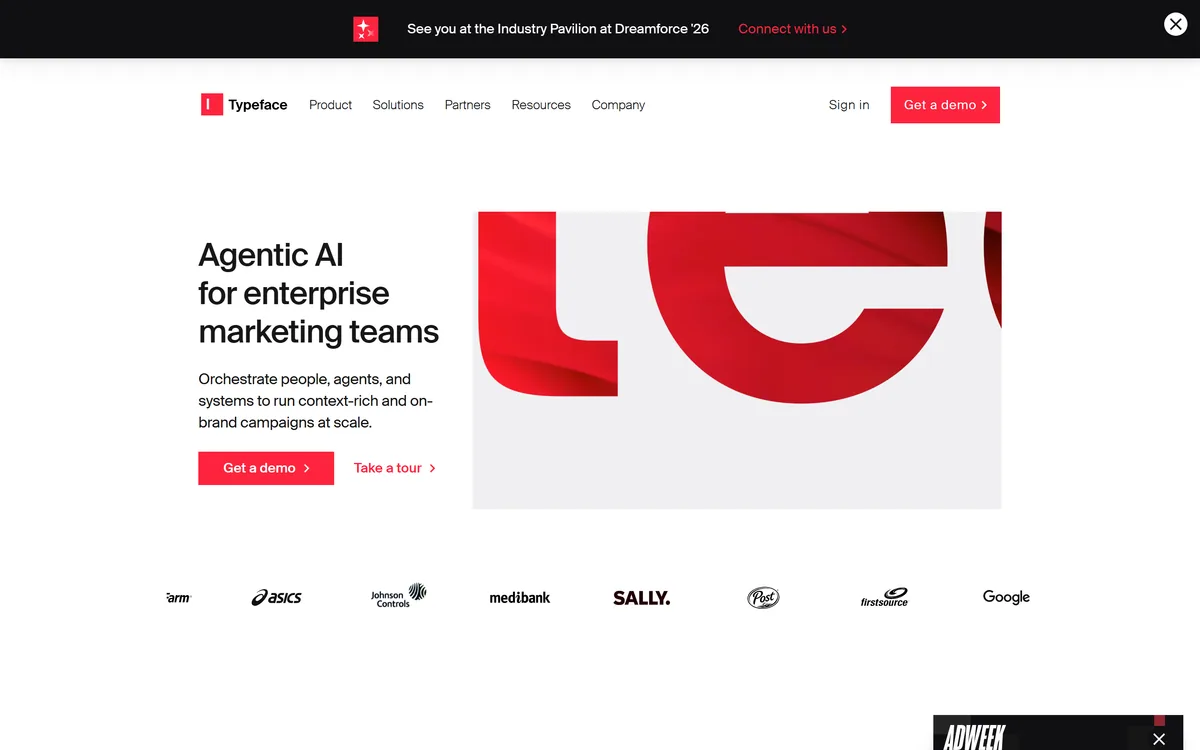
Typeface builds for that answer rather than the obvious one. Its own framing is orchestrating people, agents and systems to run context-rich, on-brand campaigns at scale.
The product is organised as four Arc components, and the split between them tells you more about the company's thinking than any feature list would.
Arc Graph is described as automatically grounding content in brand guidelines, approved layouts and audience context.
The word doing the work is automatically, and understanding why requires knowing how brand consistency currently fails.
A brand guideline is a document. Documents are read once, half-remembered, and applied inconsistently by twelve people across six markets working to different deadlines. The failure is not ignorance but retrieval — nobody looks it up mid-task.
A graph inverts that. Instead of asking a person to remember constraints, the constraints are attached to the generation itself, so an output arrives already conditioned on the brand rather than being checked against it afterwards.
That distinction is why this is architecture rather than a feature. Checking after the fact is what the review queue does today, and it is the step that makes enterprise marketing slow. Moving the constraint upstream is the only structural fix — the same argument that puts brand containers at the centre of tools like Hypernatural for video.
Brand guidelines fail on retrieval, not on ignorance. Nobody looks them up mid-task, which is why they belong in the generation.
Arc Forge turns workflows into custom agents and extends each step via MCP, APIs and integrations, which is the most technically revealing line on the site.
MCP is a standard for connecting AI systems to external tools and data. Naming it explicitly on a marketing platform's homepage signals a specific bet about how these systems will be built.
The bet is that no single vendor will own the enterprise stack. A marketing platform that cannot reach the DAM, the PIM, the CMS and the analytics warehouse is an island, and building bespoke connectors to each is how integration projects consume years.
A standard protocol makes the platform a participant in someone else's architecture rather than a replacement for it, which is the correct posture for anything selling into an enterprise that already owns twelve systems.
The practical question to ask a vendor is which direction the support runs — whether the platform consumes external tools, exposes itself to other systems, or both. They are very different capabilities and the word covers all three.
The four components divide the problem cleanly. Graph holds context. Agents do work across stages and channels. Spaces manage planning, creation, review, approval and publishing. Forge turns any of that into a reusable custom agent.
Read as a set, they describe a company that concluded generation is a commodity and everything around it is the product.
That conclusion is correct and it is not obvious. Three years ago an enterprise marketing AI platform would have led with output quality; leading with orchestration means the buyer has changed and now asks operational questions instead.
Spaces is the component that will decide most evaluations, because approval workflow is where campaigns actually die. A single pane covering planning through publishing either fits how your organisation works or fights it, and there is little middle ground.
Agents being multi-modal and multi-channel matters for a specific reason: the variation problem. One campaign becomes dozens of assets across formats and markets, and doing that by hand is where marketing operations time goes. Catalogue-scale product copy is the extreme case, and where a specialist like Describely beats a general platform.
Arc Spaces manages planning, creation, reviews, approvals and publishing in one workflow, and the site pairs it with a promise of campaigns without chaos.
Nobody buys software because approvals are exciting. They buy it because approvals are where six weeks disappear.
The mechanics are familiar to anyone who has worked in a regulated or multi-market brand. An asset is created, sent for brand review, sent for legal review, revised, re-sent, localised, reviewed again in market, and published — with every handoff in email and every version in a different folder.
AI generation makes this worse before it makes it better, which is the part vendors rarely say. Producing ten times the assets means ten times the reviews, and a review process that was merely slow becomes the binding constraint on the whole operation.
So a platform that generates without governing the review is selling a bottleneck. Typeface putting workflow at the centre rather than at the edge is the single most credible thing about the product.
The site sets out three enterprise foundations: AI with guardrails and oversight for accountable outputs, brand-safe models aligned to your guidelines, and a data position of dedicated models, compliance, encryption and strict access controls.
These are the terms that decide enterprise creative AI purchases, and they deserve unpacking rather than acceptance.
Dedicated models is the phrase worth pressing on. It can mean a genuinely isolated deployment, a tenant-scoped fine-tune, or a shared base model with your context injected at request time. All three are legitimate; they are not equivalent for a security review.
Guardrails and oversight similarly cover a range. Automated brand checking, human approval gates and content policy filtering are different mechanisms with different failure modes, and the homepage necessarily compresses them.
The absent term is worth naming too. Enterprise creative platforms are increasingly judged on indemnification for generated output, and that is a contract question rather than a homepage one — but it belongs on your evaluation list beside everything above. Pencil makes indemnification an explicit headline term, which is the standard worth comparing against.
Orchestration platforms fail in a specific way: bought at the top, piloted in one team, and never adopted because the workflow it enforces is not the workflow that exists.
This sequence tests fit against your organisation rather than against the demo.
Arc Graph for automatic brand and audience grounding
Arc Agents across stages, formats and channels
Arc Spaces for planning, review, approval and publishing
Arc Forge for custom agents via MCP and APIs
Multi-modal and multi-channel content generation
Localised campaign variation at scale
Guardrails, oversight and brand-safe model alignment
Implementation support through advisors and systems integrators
Marketing AI splits by whether it generates, governs or both.
| Tool | Centre of gravity | Workflow | Best for |
|---|---|---|---|
| Typeface | Orchestration and brand grounding | Planning to publishing in Spaces | Enterprise marketing at multi-market scale |
| Pencil | Ad creative with indemnification | Creative testing loop | Performance advertising teams |
| TextCortex | Agents across the whole company | Governance and adoption | Consolidating enterprise AI usage |
| Describely | Product content at catalogue scale | Bulk generation | Digital shelf specifically |
| Hypernatural | Branded video | Brand container per series | Video rather than full campaigns |
| Company | Typeface Inc., per the footer copyright |
|---|---|
| Positioning | Agentic AI for enterprise marketing teams |
| Platform name | Typeface Arc, the marketing orchestration engine |
| Arc Graph | Grounds content in brand guidelines, approved layouts and audience context |
| Arc Agents | Handles tasks across every stage and channel, multi-modal and multi-channel |
| Arc Spaces | Planning, creation, reviews, approvals and publishing in one workflow |
| Arc Forge | Turns workflows into custom agents, extended via MCP, APIs and integrations |
| Audiences | Marketing teams, IT teams and creative teams |
| Enterprise foundations | Guardrails and oversight, brand-safe models, dedicated models with encryption and access controls |
| Change management | AI advisors, marketing engineers and systems integrator partnerships |
| Named partnership | Typeface and Cognizant, announced on the site |
| Recognition | Named a 2026 Tech Stack Award winner by ADWEEK, per the site |
Alternatives across creative production, governance and product content.
Last checked . Read from typeface.ai in a browser session on the date above, including the full footer. The screenshot was captured at the same time.
What we could not confirm: what dedicated models means technically — isolated deployment, tenant fine-tune or shared base with injected context; which direction MCP support runs; whether indemnification for generated output is offered, since the homepage does not address it; how the customer quotes translate into measured outcomes, as several describe expectations rather than results; and pricing, which is not published and requires a demo. We did not run a campaign through the platform.
Typeface has correctly identified that generation stopped being the bottleneck in enterprise marketing some time ago. What large organisations are short of is not copy but a way to keep hundreds of assets on brand, get them reviewed, and publish them across markets without the whole thing collapsing into a chase for approvals. Arc addresses exactly that, with a graph holding brand context, spaces holding the workflow and a forge for extending both. The catch is that a platform of this shape only pays off at genuine scale, and it needs change management to land at all. AInexfinder Editor Score: 4.2/5.
AInexfinder does not list plan prices or billing details. For current pricing, plans, and trials, visit the official Typeface website.
Visit official website for pricingVendor pricing, credits, and billing policies change over time. Always confirm on the official site before you buy.
Log in to write a review.
No reviews yet. Be the first to share your experience with Typeface.
Assigned reviewer
Daniel ReedSenior AI Tools Reviewer
Daniel reviews AI tools the slow way — by actually using them on real projects. His reviews cover what works, what breaks, and who each tool is genuinely a good fit for.
Daniel and the AInexfinder editorial team research Typeface using public product information, listing evidence, and (when available) hands-on checks. Scores reflect listing completeness and transparency — not paid placement.
Copy.ai has become an AI-native go-to-market platform: workflows and agents that run prospecting, lead processing, deal coaching, ABM, and CRM enrichment across Salesforce, HubSpot, Gong, Outreach, and 2,000+ integrations.

Writesonic has become an AI search growth platform — tracking whether your brand appears across 10 AI platforms, running optimisation and citation work through an Action Center, and reporting results against traffic and revenue.
LogicBalls is an AI writing and content platform whose central idea is verification before generation — it asks clarifying questions rather than assuming intent. It offers thousands of task-specific tools across writing, research, analysis and explanation, and claims 15M+ clarified generations.
Smartcat combines AI translation across 280+ languages with a CAT tool, translation memory, a marketplace of 500,000+ linguists, and AI agents for writing, auditing and maintaining content — integrated with Figma, Contentful, WordPress, Git and Salesforce.

Jasper has moved from AI copywriting to orchestrating marketing agents, with 100+ specialised agents, Content Pipelines, the Jasper IQ context hub, Jasper Studio for custom agents, and brand governance across everything a marketing team produces.
Spiral, a product from Every, uses stylometry to build a voice profile from your existing writing, then drafts tweets, blog posts, LinkedIn updates and newsletters in that voice. It adds shareable team styles, a knowledge base, and MCP and API access.