Pencil is an enterprise AI platform for marketing that aggregates models from OpenAI, Google, Adobe, Runway and Bria into one orchestration layer, and enforces governance including SOC 2 Type II, a no-train policy, IP indemnification, regional data compliance and brand safety guardrails.
trypencil.com7 viewsAdded January 22, 202616K visitors
Most conversations about AI creative are about whether the output is good enough. Inside a large brand, that is rarely the question that stops a project.
The questions that stop it are: who owns this, was our data used to train anything, where was it processed, and what happens if a generated asset turns out to copy something protected. Legal asks those, and a beautiful demo does not answer any of them.
Pencil's positioning is built entirely around that reality — the models are aggregated rather than chosen, and the governance is the product.
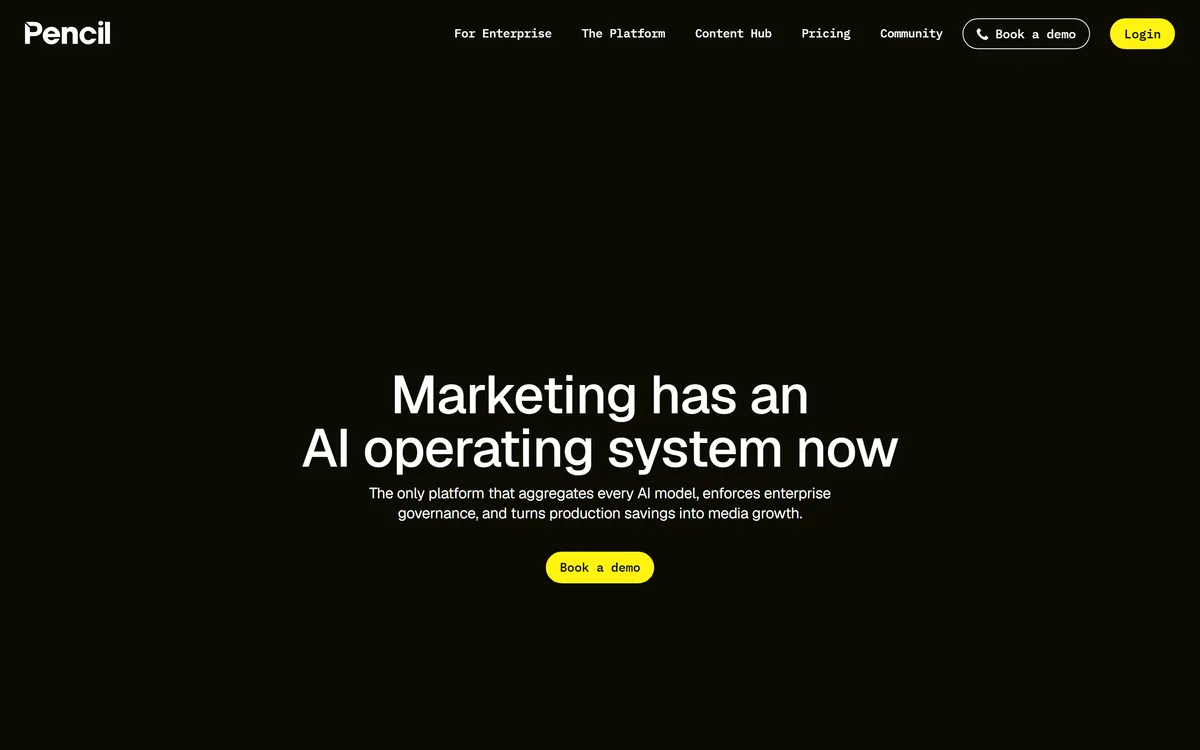
Pencil's homepage, captured 9 September 2026, showing the AI operating system positioning.
Pencil: One Layer Over Every Ad Model
Model aggregation, not model choice — OpenAI, Google, Adobe, Runway and Bria behind one orchestration layer.
Governance included by default: SOC 2 Type II, no-train policy, full IP indemnification, regional data compliance.
Brand safety guardrails and role-based access, which is what makes generated creative approvable at scale.
Published enterprise outcomes — 50% reduction in production costs, 79% ROAS improvement, 24 markets scaled simultaneously.
Named case studies from Experian, Diageo and L'Oréal, plus a brand featured in Google's Veo 3 launch.
Why Would A Brand Want Model Neutrality?
Pencil states that AI moves fast and walled gardens lock you into one vendor, and that it brings the best models from OpenAI, Google, Adobe, Runway and Bria into one orchestration layer so you can always use the right model.
The argument is stronger in creative work than almost anywhere else, for a specific reason: leadership changes hands frequently and visibly.
One model handles product photography best, another handles motion, another handles text in images, and the ranking shifts with every release. Committing to a single vendor means being wrong about a third of your work at any given moment.
For an enterprise the switching cost is what makes this acute. Prompts, workflows, brand configurations and trained staff all attach to a platform, so being locked to one model means either accepting worse output or repeating an integration project.
An orchestration layer converts that into a routing decision, which is the right level to make it. The same reasoning drives multi-model video products like Pollo AI, though there the buyer is an individual rather than a procurement committee.
Committing to a single model means being wrong about a third of your work at any given moment, and the ranking changes with every release.
Governance Is The Actual Product
Pencil lists SOC 2 Type II certification, a no-train policy, full IP indemnification, regional data compliance across EU, US and APAC, role-based access and brand safety guardrails — described as every control IT, legal and procurement require, included by default.
Two of those are unusually substantive and deserve singling out.
The no-train policy — your data never trains models — addresses the question every legal team asks first. Brand assets, unreleased products and campaign strategy are exactly the material a company cannot allow into someone else's training corpus.
Full IP indemnification is the stronger commitment. It means the vendor accepts liability if generated output turns out to copy protected material, which shifts a risk that most creative AI tools leave entirely with the customer.
That single term is frequently what decides an enterprise purchase, because the alternative is a brand running national advertising with no idea whether an asset resembles something protected. Indemnification does not make that outcome impossible; it makes the risk somebody else's problem contractually, which is what procurement is actually buying.
Reading Enterprise Creative Metrics
Pencil publishes three figures across global brands: 50% reduction in creative production costs, 79% ROAS improvement, and 24 markets scaled simultaneously.
The three are very different kinds of claim and deserve different levels of confidence.
The production cost reduction is the most believable, because generating variants is genuinely cheaper than shooting them and the mechanism is obvious. It is also the least interesting, since cost savings do not grow revenue.
The 79% ROAS improvement is the one to interrogate. Return on ad spend depends on targeting, bidding, market conditions and offer at least as much as on creative, and attributing a change of that size to creative production alone requires a controlled comparison the page does not describe.
The 24 markets figure is the most useful, because it describes a capability rather than an outcome. Producing localised creative for two dozen markets simultaneously was previously a logistics problem, and removing that constraint changes what a campaign can be — which is a more durable argument than any percentage.
Judge enterprise creative tools on indemnification and data terms first.
Read ROAS claims as directional; creative is one input among many.
Confirm regional data residency covers the markets you actually operate in.
Test brand guardrails against your most restrictive brand rule.
Check which models are available and how routing decisions are made.
Where Generated Creative Actually Helps
Even with governance solved, generated creative is better at some jobs than others, and the difference is worth being explicit about.
Variant production is where it wins outright. A campaign needing forty sizes, twelve languages and six seasonal treatments is a volume problem, and volume is exactly what generation removes.
Localisation is the second. Adapting a concept across markets historically meant reshooting or compromising, and generation makes market-specific versions economically possible for the first time.
Testing is the third and most underrated. Performance advertising works by iteration, and the constraint has always been how many variants you can afford to produce — so cheaper variants means more learning per pound of media.
Where it does not help is the original idea. The concept, the strategic insight, the reason a campaign is worth running — none of that is a production problem, and a platform that makes execution free makes the idea relatively more important rather than less.
The ecommerce equivalent runs on the same logic with tighter constraints. Product imagery has to be accurate as well as on-brand, which is why catalogue-scale tools like Photoroom enforce brand kits at the image level, and why the line between constructed context and misrepresented product is drawn more strictly there.
Video sits in between. Producing branded video at length with consistent identity is a different problem again — the one Hypernatural addresses — and an enterprise creative stack usually ends up spanning all three rather than consolidating onto one.
What An AI Operating System Has To Deliver
Pencil describes itself as an AI operating system for marketing, which is an ambitious framing worth testing rather than accepting.
An operating system implies other things run on top of it — that it is infrastructure rather than an application, and that its value grows as more work passes through it.
For that to be true it has to actually intermediate. If teams are still going directly to individual model providers for some work, the governance is partial, and partial governance is close to no governance from a legal standpoint.
Content Hub and brand-safe agents suggest the intended shape: workflows rather than one-off generations, with brand rules applied to everything that passes through.
The question to ask in procurement is what happens to work done outside it. A platform that catches ninety per cent of creative and leaves ten per cent ungoverned has improved the average and not removed the risk, which is a different purchase from the one being described.
Rolling Out Generated Creative Safely
Enterprise creative AI fails at legal review far more often than at output quality, and it fails late — after a team has built a workflow around it.
This sequence puts the questions that kill projects at the start.
Get legal to review indemnification and the no-train policy before any pilot.
Confirm data residency covers every market you operate in, not just your headquarters.
Test brand guardrails against your single most restrictive rule.
Start with variant production and localisation, where generation clearly wins.
Measure production cost honestly rather than adopting the published figure.
Establish what work is permitted outside the platform, since partial governance is fragile.
Enterprise Creative AI Terms
The vocabulary procurement uses, and what each term actually commits a vendor to.
undefined
undefined
undefined
undefined
undefined
undefined
Pencil: Governance And Models
Operating company
Pencil AI Limited
Product type
Enterprise AI platform for marketing creative
Positioning
The AI operating system for marketing
Models aggregated
OpenAI, Google, Adobe, Runway and Bria, per the site
Certification
SOC 2 Type II
Data policy
No-train policy — your data never trains models
Legal
Full IP indemnification, stated as owning everything you create
Compliance
Regional data compliance across EU, US and APAC
Controls
Role-based access with granular permissions, brand safety guardrails
Published outcomes
50% reduction in creative production costs, 79% ROAS improvement, 24 markets scaled simultaneously
Named customers
Experian, Diageo, L'Oréal and Moodlings case studies
Legal documents
Core & Growth Terms, Pro Terms, Sub-Processors, DPA, Privacy Policy and an Enterprise Legal Hub
What we could not confirm: pricing, which routes through sales; the scope and limits of the IP indemnification, which is the term that matters most and which lives in contract rather than on a marketing page; how models are routed and whether that choice is configurable; the methodology behind the 50% and 79% figures, neither of which states a comparison; what the named brands actually produced with it; and which sub-processors are used. We did not use the platform.
Editor's Verdict
4.1/5
Pencil is not really selling creative generation, which is now a commodity. It is selling the paperwork that lets a large brand use it — SOC 2 Type II, a no-train policy, full IP indemnification, regional data residency, role-based access and brand guardrails. For an enterprise, those are the reasons a project gets approved or killed, and no amount of output quality substitutes for them. Aggregating models rather than picking one is the other correct call, because the best model changes every few months and lock-in is a real cost. It is unambiguously enterprise software. AInexfinder Editor Score: 4.1/5.
Pencil pricing
AInexfinder does not list plan prices or billing details. For current pricing, plans, and trials, visit the official Pencil website.
Vendor pricing, credits, and billing policies change over time. Always confirm on the official site before you buy.
Frequently asked questions
What is Pencil?
Pencil is an enterprise AI platform for marketing that aggregates models from OpenAI, Google, Adobe, Runway and Bria into one orchestration layer, with governance included by default: SOC 2 Type II, a no-train policy, full IP indemnification, regional data compliance and brand guardrails.
Why does model neutrality matter for a brand?
Because leadership changes constantly. One model handles product photography best, another motion, another text in images, and the ranking shifts with every release. Committing to one vendor means being wrong about a third of your work at any given moment.
What is IP indemnification and why does it matter?
The vendor accepting liability if generated output turns out to copy protected material. It matters because the alternative is a brand running national advertising with no idea whether an asset resembles something protected — and it frequently decides an enterprise purchase on its own.
What does a no-train policy commit to?
That your uploaded material is never used to train models. Brand assets, unreleased products and campaign strategy are exactly the material a company cannot allow into someone else's training corpus, which is why legal asks about it first.
Should I believe the 79% ROAS improvement?
Treat it as directional. Return on ad spend depends on targeting, bidding, market conditions and offer at least as much as on creative, and attributing a change of that size to production alone requires a controlled comparison the page does not describe.
Which published figure is most useful?
The 24 markets scaled simultaneously, because it describes a capability rather than an outcome. Producing localised creative for two dozen markets at once was a logistics problem, and removing that constraint changes what a campaign can be.
Where does generated creative genuinely win?
Variant production, localisation and testing. Forty sizes in twelve languages is a volume problem, and volume is what generation removes. Cheaper variants also mean more learning per pound of media, which is how performance advertising actually improves.
What can it not help with?
The idea. The concept, the strategic insight, the reason a campaign is worth running — none of that is a production problem. A platform that makes execution nearly free makes the idea relatively more important, not less.
What does an AI operating system have to prove?
That it actually intermediates. If teams still go directly to model providers for some work, the governance is partial — and partial governance is close to none from a legal standpoint. Ask what happens to work done outside the platform.
How should an enterprise evaluate it?
Get legal to review indemnification scope and the no-train policy before any pilot, and confirm data residency covers every market you operate in rather than just your headquarters. Those two reviews decide the purchase more than any output test.
Daniel reviews AI tools the slow way — by actually using them on real projects. His reviews cover what works, what breaks, and who each tool is genuinely a good fit for.
Daniel and the AInexfinder editorial team research Pencil using public product information, listing evidence, and (when available) hands-on checks. Scores reflect listing completeness and transparency — not paid placement.
Listings may include affiliate or sponsored placements, which are labeled when present. Editorial scores and cons are not sold. See our affiliate disclosure and review methodology.
Listomize is an Etsy SEO platform that generates titles, tags, and descriptions within Etsy's own limits, scores listings, optimises 100+ listings from a CSV, tracks competitors and trends, and auto-generates Pinterest pins.
Lahjty (لهجتي) is an Arabic-first marketing platform for MENA campaigns. From one brief it produces dialect-aware ad copy, headlines, campaign images with Arabic text rendered in, dialect-aware voice, and SEO articles grounded in your own brand sources — with a Partner API and an MCP server for teams that want it inside their own workflow.
MaxAEO is an answer engine optimisation platform from HIII PTE. LTD. It tracks how ChatGPT, Gemini, Claude, Perplexity, Copilot, Grok and Google's AI surfaces mention a brand, with sentiment, competitor benchmarking and citation tracing.
Mailjet is a Sinch-owned email platform handling both marketing campaigns and transactional sending from one account. It offers a collaborative drag-and-drop editor, an email API with SMTP relay, AI generation and segmentation, and EU-based data centres.
Outranking is an AI SEO content platform that writes briefs and first drafts and optimises them with real-time scoring, grounding content in live SERP data through its Concepts feature, with keyword clustering, internal linking and content workflows.
PitchBud is a press outreach tool that drafts a release with Claude Sonnet, publishes it to a newsroom URL with NewsArticle schema and RSS, matches relevant journalists by their recent work, and drafts personal pitches you review and send yourself.
.webp)