
Runway is an AI video platform built around generative world models — Gen-4.5, Aleph 2.0, and Act-Two for performance capture — split across Runway Creative for filmmakers, Runway Dev for builders, and Runway Robotics.
FreemiumVideo & Audio
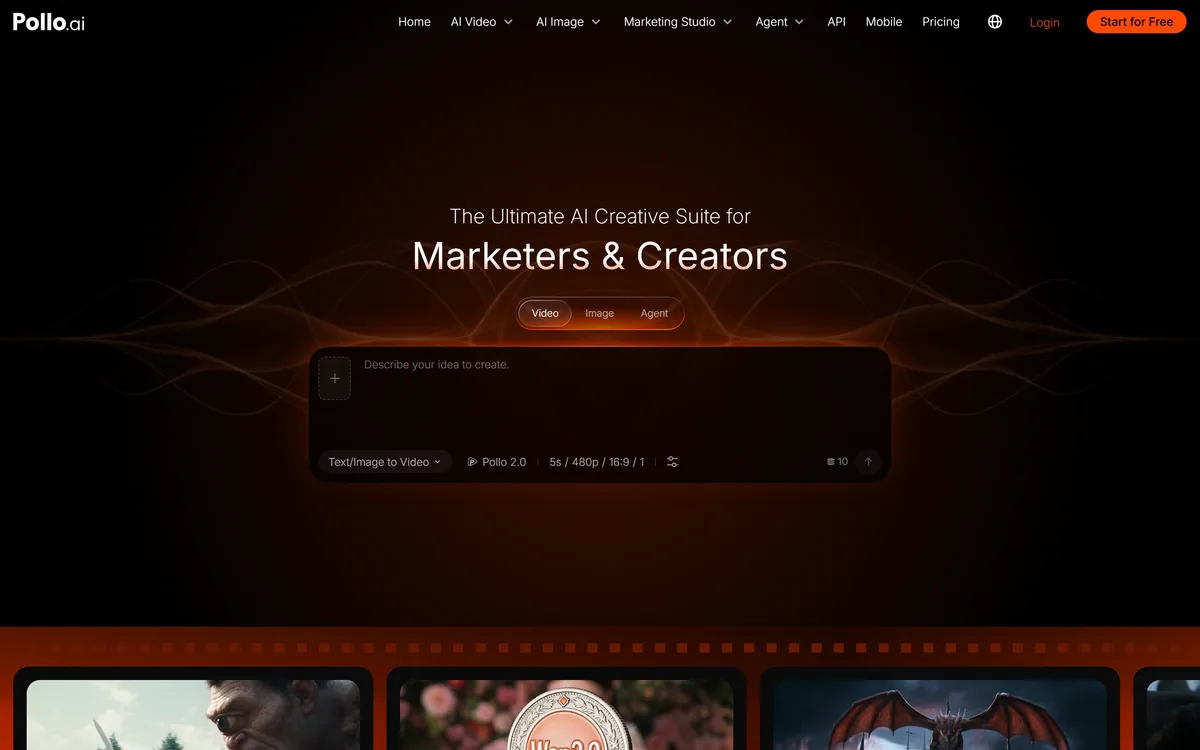
Pollo AI is a creative suite offering its own Pollo model alongside third-party generators including MiniMax, WAN, Seedance, Flux and Nano Banana. It adds a Marketing Studio of product-video templates, an agent that runs a brief end to end, an API and mobile apps.
There is no best AI video model, and there has not been one for two years. There is a model that is best this quarter at photorealism, another at motion, another at following a complicated prompt, and the ranking reshuffles every time somebody ships.
That creates a real problem for anyone producing video commercially. Committing to one vendor means committing to its weaknesses, and switching means a new account, new credits and relearning what prompts work.
Pollo AI's answer is not to pick. It puts several rival models behind one interface and one balance, which is a reasonable response to a fast-moving field — and a different product from any of the models it resells.
| Product type | AI creative suite for video and image generation |
|---|---|
| Positioning | The ultimate AI creative suite for marketers and creators |
| Own model | Pollo 2.0 |
| Third-party models listed | MiniMax H3, WAN 3.0, Seedance 2.5, Flux 3, Nano Banana 2 Lite |
| Marketing Studio | Templates for product films, ad creatives, UGC, unboxing, tutorials, try-on, TVC, brand story, selling points, URL to Video Ads, clone video ads, money shot |
| Pollo Agent | Takes a brief and produces finished marketing videos, story videos, e-commerce creatives, social content and designs |
| Output | Stated as production-grade visuals up to 4K |
| Audio | Music, dialogue, sound effects and ambience |
| Consistency | Reusable assets for products, scenes and styles across videos |
| Surfaces | Web, API and mobile |
| Navigation | Home, AI Video, AI Image, Marketing Studio, Agent, API, Mobile, Pricing |
Pollo AI's homepage lists its own Pollo 2.0 alongside MiniMax H3, WAN 3.0, Seedance 2.5, Flux 3 and Nano Banana 2 Lite — competing models from different vendors, selectable from one interface.
The case for this is straightforward. Different models are genuinely better at different things, and finding out which suits your material means running the same prompt through several. Doing that across separate accounts is tedious enough that most people simply do not, and settle for whichever they signed up to first.
One interface with one balance removes that friction entirely. Comparison becomes a dropdown rather than a procurement exercise, and the answer for your specific kind of shot is something you can establish in an afternoon.
It also insulates you from the churn. A model that degrades, raises prices or is deprecated is a setting you change rather than a migration you plan, which is a meaningful reduction in dependency for anyone whose business depends on generated output.
The costs are equally real. You are one step further from the model vendor, so support, terms and any dispute run through Pollo rather than through the company that built the thing. And an aggregator's margin sits between you and the underlying price — which may still be cheaper than several separate subscriptions, and is not free.
It is worth contrasting this with a reseller that discloses nothing. Kling 3.0 at kling3ai.co follows the same pattern and names no operating company at all, which is the difference between aggregation and opacity.
Comparison becomes a dropdown rather than a procurement exercise. That is what an aggregator is actually selling.
Marketing Studio is where Pollo turns model access into a product, with templates for product films, ad creatives, UGC, unboxing, tutorials, try-on video, TVC, brand stories, selling points and URL-to-video ads.
The reason this is the commercial centre is that raw generation has no defensible margin. Anyone can resell a model; the value has to sit in what you wrap around it, and a template that knows what an unboxing video looks like is worth more than a blank prompt box.
Advertising is also the use case where generated video's economics genuinely work. Ad creative is judged on whether it converts, produced in volume, and discarded quickly — none of which describes a film, and all of which describes something a model should make.
URL to Video is the template that does most work, because it starts from a product page that already contains the images, the name, the features and the positioning. That is most of an ad brief, assembled by someone else.
The honest limit is the same one every automated ad tool hits: a generated script from a product page is accurate and generic, because product pages describe rather than persuade. The winning variants are the ones where a human supplied the angle.
Aggregation is a legitimate business, and there is a short list of things a good aggregator provides that a poor one does not.
The first is honesty about what you are using. If the interface says Seedance 2.5, that should be Seedance 2.5 at the version and settings the model's own vendor documents, not a quantised or truncated variant. You cannot verify this from outside, which is exactly why it matters.
The second is portable output. Generated assets should download at full quality in standard formats, so leaving the platform costs you nothing but the credits you already spent.
The third is clear credit accounting. Different models cost different amounts to run, so a single balance necessarily prices them differently — and you should be able to see what a generation will cost before you commit to it, not discover it afterwards.
The fourth is restraint in the marketing. Pollo's homepage carries a rotating set of promotional banners — discounts, challenges, unlimited offers — and while none of that is dishonest, a page selling urgency makes it harder to judge the underlying product. Read past it to the specifications.
The alternative is a first-party suite. Runway ML trains its own models and sells editing around them, so support and terms come from the company that built the thing.
The most expensive mistake with a multi-model platform is generating a hundred clips on the wrong model because it was the default.
Fifteen minutes of comparison saves the entire budget that follows.
If the ad needs a presenter rather than generated scenes, an avatar platform such as JoggAI covers that shape of brief instead.
Pollo Agent takes a brief and handles the creative process end to end — story videos, video ads, product visuals, social posts and designs — rather than generating a single clip.
That is a meaningfully different interaction. Generation asks you to specify a shot; an agent asks you to specify an outcome, and works out the shots itself. For someone who knows what they want the video to achieve and not what it should look like, the second is far more usable.
It is also where the most editing effort lands afterwards. An agent making structural decisions on your behalf — how long, what order, which shots — will get some of them wrong, and disagreeing with a finished sequence is harder than disagreeing with one clip.
The realistic pattern is to use the agent for the first structure and generation for the specific shots it got wrong. That is the same division that works in every generative workflow: automation for the arrangement, human judgement for the parts that carry the argument.
It is worth noting what the agent cannot supply. It has no knowledge of your customers, your positioning or what your last campaign taught you, and those are the things that decide whether an ad works.
Access to several competing video and image models from one interface
Pollo 2.0 as the platform's own generation model
Marketing Studio templates covering product film, UGC, unboxing, TVC and ad formats
URL to Video Ads, starting from a product page rather than a script
Pollo Agent for taking a brief through to finished output
Music, dialogue, sound effects and ambience alongside visuals
Reusable assets for consistency across products, scenes and styles
API and mobile apps in addition to the web interface
The choice is between one company's model and a layer that sells access to several.
| Tool | What you get | Who you deal with | Best for |
|---|---|---|---|
| Pollo AI | Several rival models plus marketing templates | Pollo, not the model vendors | Comparing models and producing ad variants |
| Runway ML | One vendor's models with a creative suite | The company that trained them | Production work with editing around it |
| Luma AI | First-party generation | The model's developer | Direct access with published terms |
| Kling 3.0 | A third-party interface to Kling and Seedance | An unnamed operator | The same pattern with far less disclosure |
| JoggAI | Avatar-led product video | A named company | Ads with a presenter rather than generated scenes |
Last checked . Read from pollo.ai in a browser session, since the site returns 403 to automated fetchers. The screenshot above was captured alongside.
What we could not confirm: the operating company, its legal name or location, since the site returned 403 to our fetcher and we read it in a browser without reaching a footer; how credits are priced per model; whether the third-party models are served at the versions and settings their own vendors document; output duration limits; commercial usage and ownership terms for generated assets; and how uploads and prompts are retained. We did not generate anything, so nothing here reflects tested output quality.
Generated video is reached through first-party services, aggregators, or workflow tools built on top.
Pollo AI's actual product is choice. Rather than betting on one generation model, it puts several competing ones behind a single interface and credit balance — MiniMax, WAN, Seedance, Flux and Nano Banana alongside its own — which is genuinely useful when no single model wins at everything and the leader changes every quarter. The Marketing Studio is the commercial layer, turning that access into product films, UGC and ad variants. It scores where it does because an aggregator adds a party between you and the model, and because the promotional framing around discounted model access makes it harder to judge what you are actually buying. AInexfinder Editor Score: 3.7/5.
AInexfinder does not list plan prices or billing details. For current pricing, plans, and trials, visit the official Pollo AI website.
Visit official website for pricingVendor pricing, credits, and billing policies change over time. Always confirm on the official site before you buy.
Log in to write a review.
No reviews yet. Be the first to share your experience with Pollo AI.
Assigned reviewer
Daniel ReedSenior AI Tools Reviewer
Daniel reviews AI tools the slow way — by actually using them on real projects. His reviews cover what works, what breaks, and who each tool is genuinely a good fit for.
Daniel and the AInexfinder editorial team research Pollo AI using public product information, listing evidence, and (when available) hands-on checks. Scores reflect listing completeness and transparency — not paid placement.
Runway is an AI video platform built around generative world models — Gen-4.5, Aleph 2.0, and Act-Two for performance capture — split across Runway Creative for filmmakers, Runway Dev for builders, and Runway Robotics.
LipSync.video generates lip-synchronised video from a face and an audio track. It offers two model tiers, accepts uploaded video, uploaded or recorded audio, or a typed script with generated speech, and provides over 300 prebuilt avatars. Credits can be earned through daily actions as well as bought.
Viggle animates characters from a still image driven by motion from a video, built on its Joint Space-Time model — described as a physics-native world model that generates characters, motion and scenes together in shared 4D space. It offers a Meme Maker, the PINOC motion-capture tool, games and an API, and states 50 million users.
BeatViz.ai turns music into video through three tools — Chat, Workflow and Editor. Chat 2.0 is positioned as an AI music video director, and the site names the models it draws on, including Veo, Sora, Kling, Seedance, Nano Banana and GPT Image 2.
Argil is an AI video platform built around three surfaces: a Playground for generating images and video model by model, a Director that takes an idea to a finished video, and Templates that turn a repeated video format into a reusable recipe with variables.

The workspace at www-flux3.com generates 5–20 second AI videos with native audio from text or a starting image, routing across FLUX 3, MiniMax H3, Seedance, Wan 3.0 and Kling 3.0 Pro, at 720p or 1080p with video extension.