
Runway is an AI video platform built around generative world models — Gen-4.5, Aleph 2.0, and Act-Two for performance capture — split across Runway Creative for filmmakers, Runway Dev for builders, and Runway Robotics.
FreemiumVideo & Audio
JoggAI is an AI avatar video platform from JOGG PTE. LTD. It spans avatar generation, voice cloning, talking photos, video translation and lip sync, with URL to Video and Product Avatar aimed squarely at e-commerce advertising rather than corporate presenting.
Avatar video platforms mostly serve one customer: a company that needs a person on screen saying a script, for training or internal communication, without booking a studio.
That is a real need and it is not the only one. The other, much larger market is performance advertising, where a brand needs forty variations of a product video this week and will discard thirty-eight of them.
JoggAI is built for the second. The tools that give it away are URL to Video and Product Avatar — paste a product link, get a video — and the whole product makes more sense once you read it that way.
Among the two dozen tools JoggAI lists, URL to Video is the one that explains what the platform is for.
The workflow it replaces is genuinely tedious. To make a product ad you pull the images, write a script from the description, record or generate a voiceover, assemble the shots, and repeat that for every product and every angle you want to test. For a catalogue of any size it is unmanageable by hand.
Starting from the product URL collapses that. The page already contains the images, the name, the features and the price positioning, which is most of what a short ad needs. What the tool adds is the script structure and a presenter.
This is a better fit for generated video than almost anything else, and the reason is economic. Ad creative has a short life and is judged on performance rather than craft, so the bar is whether it converts rather than whether it is beautiful. Producing forty variants cheaply and killing thirty-eight is the actual workflow.
The limit is the same one every automated ad tool hits. A generated script from a product page will be accurate and generic, because the page is written to describe rather than to persuade. The variants that win are usually the ones where a human supplied the angle and the tool supplied the volume.
That is the opposite of how a corporate avatar platform such as Synthesia is used, where one video is made carefully and everybody watches it. Neither approach is wrong; they are answers to different questions.
Ad creative is judged on whether it converts, not whether it is beautiful. That is exactly the economics generated video suits.
JoggAI lists Custom Avatar, AI Twin, Photo to Avatar, Talking Photo and Face Swap, and these deserve treating as one topic because they share a single obligation.
Every one of them animates a likeness. That is unremarkable when the likeness is your own and it is a serious matter when it is not, because a video of a person saying words they never said is exactly the artefact that consent frameworks and, increasingly, statute exist to govern.
The practical rule is simple and worth writing into your process rather than remembering ad hoc: get explicit written permission from anyone whose face or voice you put into these tools, covering the specific use, and keep it. A model release for photography does not automatically cover synthesising new performances.
Talking Photo raises it most sharply, because a still photograph is the easiest thing in the world to obtain and the hardest to have permission for. A photo you are entitled to publish is not necessarily a photo you are entitled to animate.
For advertising specifically there is a second layer: platform policy. The major ad networks have their own rules about synthetic media and disclosure, and those change faster than the law does.
JoggAI's footer lists more than two dozen named tools, and breadth on this scale is worth thinking about rather than admiring.
There is a real argument for it. If you are producing marketing video, needing an image generated, a voice cloned, a video translated and a presentation converted in the same week is normal, and paying four subscriptions to do it is worse than paying one.
There is an equally real argument against. Twenty-five tools built by one team means most of them are thin, and the pattern in this category is that two or three are genuinely good while the rest exist to be listed. From outside you cannot tell which is which.
The way to find out is to identify the two tools you would use weekly and evaluate only those. If URL to Video and Video Translator are your workflow, their quality decides the purchase, and Baby Podcast and Avatar VFX are irrelevant regardless of how well they work.
It is also worth checking which tools the platform itself foregrounds. A vendor's homepage tends to lead with what it is proud of, and JoggAI leads with avatars and product video rather than with the long tail.
The contrast worth drawing is with a platform that picked one thing. HeyGen made translation its centre of gravity and is judged on it; a platform listing two dozen tools is implicitly asking you to judge it on all of them.
Three material facts were absent from the pages we read, and each of them changes an evaluation.
The first is the avatar count. Stock avatar libraries vary from dozens to several hundred, and the number matters because reused faces get recognised — an avatar appearing across many brands' ads stops reading as a person and starts reading as stock.
The second is the language count for translation and voice. Translation quality is not uniform across languages, and a platform's list usually reflects where its voice models are strongest. Without the list, the only way to know is to test the languages you actually sell in.
The third is the underlying model. Avatar generation, voice cloning and translation may each be built in-house or licensed, and that determines both quality and where your uploaded likeness data goes.
None of this is unusual for the category, and none of it is disqualifying. It does mean the trial is doing more work than the marketing page, so plan a real one rather than reading feature lists.
The comparison is instructive against a tool like Pictory, which names its accepted input formats explicitly, so you can tell before signing up whether your source material is supported.
The strongest evaluation of an ad tool is against creative whose performance you already know.
That removes the hardest question — whether a generated ad works — from the realm of opinion.
| Operating company | JOGG PTE. LTD. |
|---|---|
| Product type | AI avatar video platform |
| Positioning | Turning ideas into AI avatar videos without filming or editing |
| E-commerce tools | URL to Video, Product Avatar, Product Photo Shoot, Product Video Shoot |
| Avatar tools | AI Avatar, Custom Avatar, Stock Avatars, AI Twin, Photo to Avatar, Talking Photo, AI Human Generator, Face Swap, Avatar VFX |
| Voice tools | AI Voice Cloning, AI Lip Sync Video |
| Localisation | Video Translator |
| Presentation tools | AI Presentation Maker, Animated Presentation, PPT to Video |
| Writing | AI Script Writer |
| Other formats | Podcast Video, Baby Podcast, Video Agent |
| Support | support@jogg.ai |
| Footer sections | Features, AI Tools, Use Cases, Resources, Contact, Social, Legal (Privacy Policy, Terms of Use) |
URL to Video, turning a product page directly into an avatar ad
Product Avatar, Product Photo Shoot and Product Video Shoot for e-commerce creative
Custom Avatar and AI Twin for presenting as yourself without filming
Talking Photo and Photo to Avatar for animating a still image
AI Voice Cloning and AI Lip Sync Video
Video Translator for taking one video into other markets
AI Presentation Maker, Animated Presentation and PPT to Video
AI Script Writer for generating the copy the avatar delivers
Avatar tools differ mostly in who they were built for, and that shows up in which shortcuts exist.
| Tool | Built for | Signature shortcut | Best for |
|---|---|---|---|
| JoggAI | Performance advertising and e-commerce | URL to Video, Product Avatar | Producing many ad variants from a catalogue |
| Synthesia | Corporate communication and training | Enterprise-grade presenter video | Internal video at scale with governance |
| HeyGen | Marketing and localisation | Video translation with lip sync | Taking one video into many languages |
| Colossyan | Workplace learning | Scenario and course video | Training content specifically |
| Pictory | Repurposing written and long-form content | Script, blog and URL to video without an avatar | Content marketing rather than presenter video |
The avatar category splits sharply by intended audience, and the alternatives are strong in different directions.
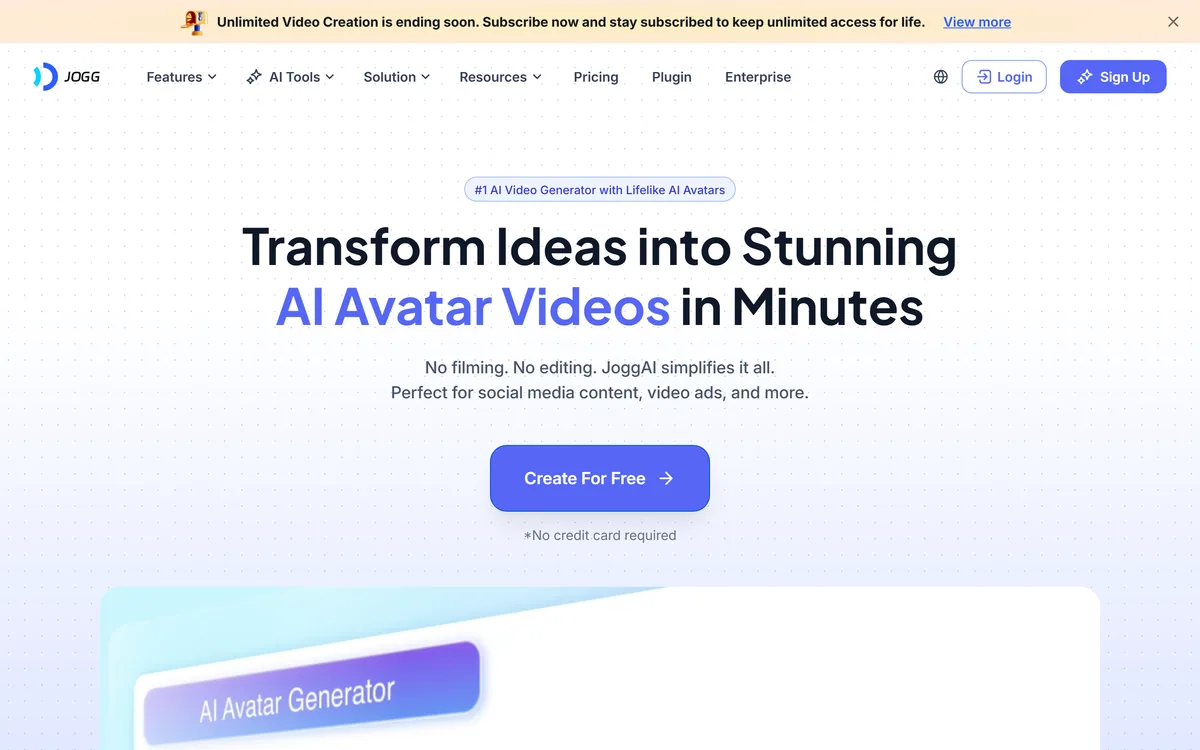
Last checked . Read from jogg.ai and its footer navigation, with the screenshot above captured in the same session.
What we could not confirm from the vendor's own pages: the stock avatar count; the number of languages supported for translation and voice; which underlying models power avatar generation, voice cloning or translation; output resolution and duration limits; how custom avatar and voice data is stored, retained or deleted; pricing and plan structure; a registered address for the operating company; and any independent measurement of lip-sync or translation quality. We did not generate a video, so nothing here reflects tested output.
JoggAI's distinguishing choice is who it is for. Most avatar platforms are built for corporate communication — training, onboarding, internal updates — where a presenter reads a script in a neutral room. JoggAI is built for performance advertising, and URL to Video plus Product Avatar make that explicit: paste a product link, get an ad. That matters because ad creative is consumed at volume and discarded, which is exactly the economics generated video suits. It scores where it does because the feature list is enormous and shallow in places, and because the vendor page states no avatar count, language count or model. AInexfinder Editor Score: 3.8/5.
AInexfinder does not list plan prices or billing details. For current pricing, plans, and trials, visit the official JoggAI website.
Visit official website for pricingVendor pricing, credits, and billing policies change over time. Always confirm on the official site before you buy.
Log in to write a review.
No reviews yet. Be the first to share your experience with JoggAI.
Assigned reviewer
Daniel ReedSenior AI Tools Reviewer
Daniel reviews AI tools the slow way — by actually using them on real projects. His reviews cover what works, what breaks, and who each tool is genuinely a good fit for.
Daniel and the AInexfinder editorial team research JoggAI using public product information, listing evidence, and (when available) hands-on checks. Scores reflect listing completeness and transparency — not paid placement.
Runway is an AI video platform built around generative world models — Gen-4.5, Aleph 2.0, and Act-Two for performance capture — split across Runway Creative for filmmakers, Runway Dev for builders, and Runway Robotics.
LipSync.video generates lip-synchronised video from a face and an audio track. It offers two model tiers, accepts uploaded video, uploaded or recorded audio, or a typed script with generated speech, and provides over 300 prebuilt avatars. Credits can be earned through daily actions as well as bought.
Viggle animates characters from a still image driven by motion from a video, built on its Joint Space-Time model — described as a physics-native world model that generates characters, motion and scenes together in shared 4D space. It offers a Meme Maker, the PINOC motion-capture tool, games and an API, and states 50 million users.
BeatViz.ai turns music into video through three tools — Chat, Workflow and Editor. Chat 2.0 is positioned as an AI music video director, and the site names the models it draws on, including Veo, Sora, Kling, Seedance, Nano Banana and GPT Image 2.
Argil is an AI video platform built around three surfaces: a Playground for generating images and video model by model, a Director that takes an idea to a finished video, and Templates that turn a repeated video format into a reusable recipe with variables.

The workspace at www-flux3.com generates 5–20 second AI videos with native audio from text or a starting image, routing across FLUX 3, MiniMax H3, Seedance, Wan 3.0 and Kling 3.0 Pro, at 720p or 1080p with video extension.