CreateUGC turns a product link or script into UGC-style video ads using AI avatars, voiceover and product imagery. It routes across Seedance 2.5, Veo 3, Kling 3 and Topview, and is aimed at TikTok, Instagram and marketplace listings.
AdCreative.ai
Verified
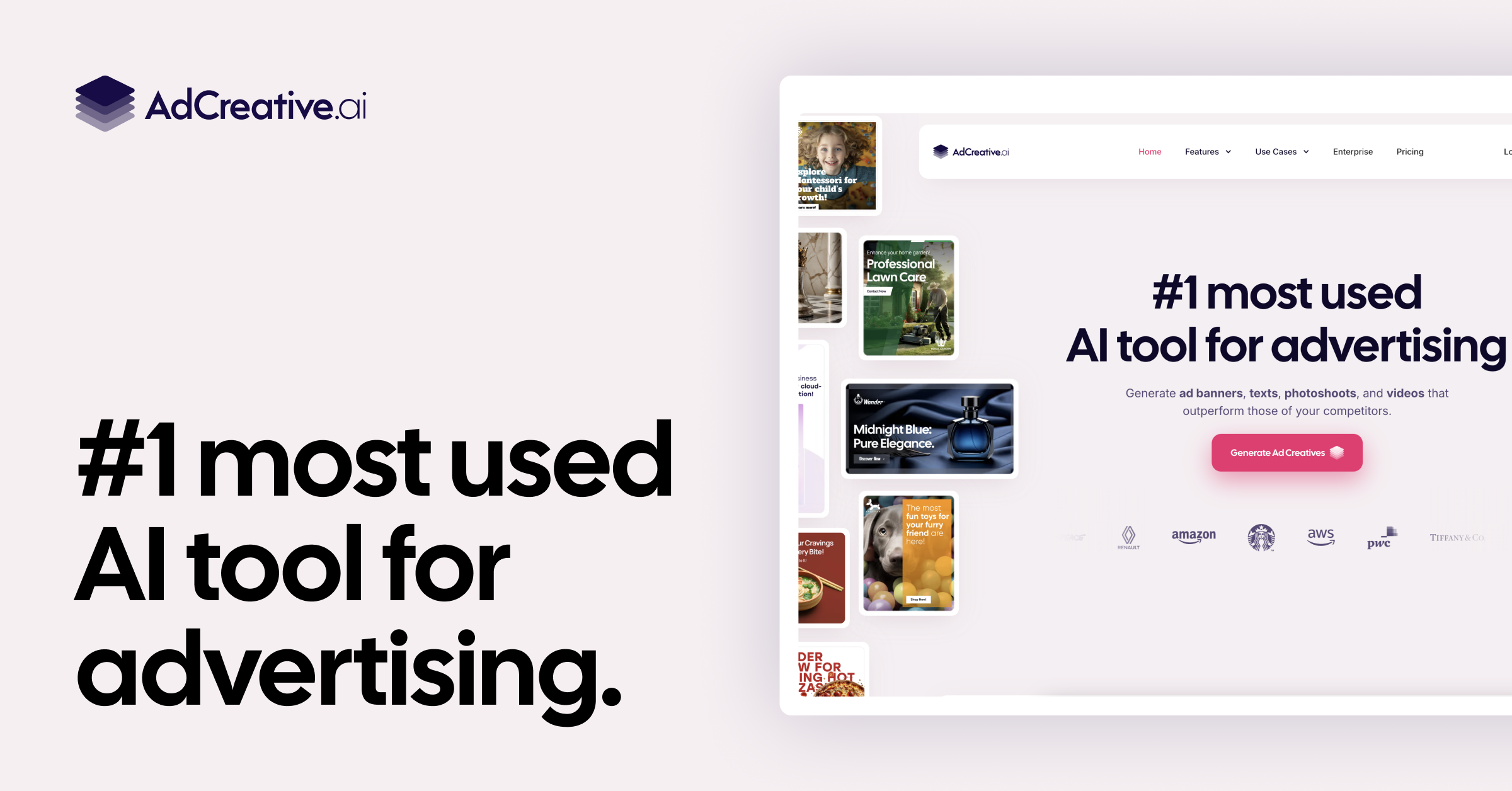
AdCreative.ai generates conversion-focused ad creative — images, video, product photoshoots, UGC-style clips and copy — then scores each one for predicted performance before launch. It pulls brand assets automatically, surfaces competitors' best-performing ads, and analyses creative insights drawn from a large body of ad spend data.
3.7Editor Score
adcreative.ai6 viewsAdded March 17, 202624K visitors
Paid social has a production problem that most teams underestimate. Creative fatigues — the same ad shown repeatedly stops working — so testing properly means producing dozens of variants, and producing dozens of variants by hand is where the process actually stops.
Design tools such as Canva AI do not fix this. The result is familiar: three creatives running for two months, performance slowly declining, and everyone knowing they should test more while nobody has the design hours to do it.
AdCreative.ai attacks that directly, and adds something more interesting on top — scoring each creative before you spend on it. The generation is the obvious half. The scoring is the half that deserves scrutiny.
What Does AdCreative.ai Generate?
- Ad creative across formats: static images, product photoshoots, UGC-style clips, fashion video, stock visuals and ad copy.
- Creative Scoring predicts performance before launch, which is the feature the whole product is built around.
- Brand kit extraction is automatic — it pulls your logo, colours, fonts and style in one click rather than asking you to configure them.
- Competitor Insights shows rival ads that are performing well across platforms, which is research most teams do manually or not at all.
- Credit-based subscription across four tiers, with stated scale of more than four million users and over a billion creatives generated.
How Much Should You Trust A Predicted Score?
The site states Creative Scoring AI with over 90 per cent accuracy on performance prediction, and Creative Insights drawn from more than 35 billion dollars in ad spend data.
The data volume claim is plausible and meaningful. Patterns in what performs — layout, contrast, where text sits, whether a face is present — genuinely do exist and genuinely are learnable at that scale. There is real signal here.
The accuracy figure is the part that needs unpacking, because accuracy is not a defined quantity for a prediction like this. Accurate at what? Ranking two creatives correctly against each other is a much easier task than predicting a click-through rate, and both could be described with the same word.
No methodology, test set or definition is published, so the number cannot be interpreted, let alone verified.
The way to use scoring sensibly is as a prior rather than a verdict. It is reasonable to let a score decide which six of twenty generated creatives you test first — that is a cheap decision and a prediction is better than a coin toss. It is not reasonable to let a score decide what runs for a month, because within days you will have real performance data from your own audience, which beats any model's estimate about anyone's audience.
Put differently: the score is useful before you have data and worthless afterwards. Most of the value is in the first 48 hours.
A predicted score is useful until you have real numbers. After that it is a guess about someone else's audience competing with facts about yours.
The Conversion Claims Need The Same Treatment
Alongside scoring, the site cites up to 14 times more conversions, a 44.5 per cent higher click-through rate and a 111 per cent performance improvement for a named client.
These are the standard shape of marketing-tool claims and they should be read with the standard caution. Up to is doing considerable work in the first figure — it describes a best case, not an expectation.
The client-specific figures are more credible because they are attached to a real campaign, but they are still uncontrolled. A campaign that improved 111 per cent changed its creative, and probably also its targeting, its budget, its offer and its timing.
The mechanism, though, is sound and does not need the numbers. Teams that test more creative variants do get better results, because paid social rewards finding the outlier that works. A tool that makes twenty variants practical instead of three plausibly improves outcomes for that reason alone.
Judge it on that mechanism and on your own before-and-after, not on a percentage whose baseline you cannot see.
Brand Kit Extraction Solves A Small Real Problem
AdCreative.ai pulls your logo, colours, fonts and style in one click, and this unglamorous feature is more valuable than it sounds.
Anyone who has used a generative design tool knows the friction: before producing anything you spend twenty minutes uploading a logo, finding hex codes, identifying fonts and configuring templates. That setup is small enough to be annoying and large enough to stop people trying the tool at all.
Removing it changes the first-session experience, which for a tool sold on volume matters — the value only appears once you have generated a lot, and anything delaying the first generation reduces the odds you get there.
The consequence to manage is consistency in the other direction. Automatic extraction gets you approximately on brand, and approximately is a problem when creative runs at volume. Twenty ads that are slightly off-palette is a worse brand outcome than three that are exactly right.
Check the extracted kit against your actual brand guidelines before generating in bulk. It is a five-minute step that prevents a month of subtly wrong advertising.
- Verify the extracted colours against your real hex values before generating at volume.
- Check fonts specifically, since substituted typefaces are the most visible brand error.
- Generate three creatives and hold them beside an existing approved ad before making twenty.
- Keep one human approval step before anything runs paid, however good the score.
- Re-check the kit after any rebrand, since extraction happened once.
Competitor Insights Is The Underrated Feature
The Competitor Insights tool surfaces competitors' best-performing ad creatives across platforms, and this may be the most immediately useful thing in the product.
The reason is that it substitutes for research most teams know they should do and do not. Understanding what is currently working in your category — the formats, the angles, the offers — is genuinely informative, and the alternative is manually browsing ad libraries, which is tedious enough that it happens once a quarter at best.
The right use is directional rather than imitative. Creator-format tools such as CreateUGC have made that worse. Seeing that everyone in your category runs the same testimonial format tells you two useful things at once: that the format works, and that differentiating from it may be the opportunity.
The risk is convergence. A category where every advertiser uses the same tool to study the same competitors and generate the same formats produces advertising that all looks identical — at which point the tool has removed the differentiation it was supposed to create.
The defence is to use competitor data to understand the baseline and then deliberately depart from it. What you know about your product that competitors do not is the thing no generative tool can supply.
Testing It Against Ads You Already Ran
This tool is unusually easy to evaluate honestly, because you have historical performance data and it produces a score you can check against it.
The bar is step two. A scoring model that ranks your own past ads wrongly is not one to trust on your future ones.
- Take five ads you have already run, where you know exactly how each performed.
- Score them in the tool without telling it the results, and compare its ranking with your actual performance order. That is a direct test of the scoring claim on your audience.
- Verify the extracted brand kit against your real guidelines — colours, fonts, logo usage — before generating anything.
- Generate twenty variants for one live campaign and shortlist six using the scores.
- Run those six on a small budget and let real data override the predictions within 48 hours.
- Compare your creative production time and your test count against the previous month. That, rather than any conversion percentage, is the honest measure of what the tool changed.
Credits, Tiers And What They Cover
Access is a credit-based subscription across four tiers, with monthly credit allocations; amounts are not disclosed on the pages we read.
The meter matters because generation types cost very differently. A static image is cheap; a product video or a fashion videoshoot is not — and a dedicated tool such as Pebblely may cost less for product scenes alone. A plan sized around static ads will not survive a month of video production, and video is where the category is heading.
The unlimited framing on the site — generate unlimited on-brand ads for every format and platform — should be read against that credit structure rather than instead of it. Check what your tier's monthly allocation actually permits for the format you intend to produce most.
The stated scale, more than four million users and over a billion creatives generated, indicates a mature product with a large user base. Read those as vendor counts, since no methodology accompanies them.
We do not publish amounts, since tiers and credit rates change. Run one representative month's worth of generation during evaluation and note the credits it consumed — that figure decides the tier, not the feature list.
Key features of AdCreative.ai
Ad creative generation across static images, video, product shots and copy
Creative Scoring predicting performance before a campaign launches
One-click brand kit extraction of logo, colours, fonts and style
Competitor Insights surfacing rivals' best-performing creatives across platforms
Creative Insights analysing patterns from a large body of ad spend data
Product photoshoots and fashion photo and videoshoots for ecommerce
UGC-style content generation for creator-format placements
Instant Ads generated by scanning an existing webpage, plus Buyer Personas AI
Pros & cons
Pros
6- Removes the production bottleneck that stops most teams testing creative properly
- Scoring is genuinely useful for choosing which variants to test first, which is a cheap decision
- Automatic brand kit extraction removes the setup friction that stops people using generative design tools
- Competitor research substitutes for work teams know they should do and rarely do
- Breadth across static, video, product and copy covers a real advertising workflow
- Large user base indicates a mature product rather than an experiment
Cons
6- The 90% accuracy claim has no published definition or methodology, and accuracy is undefined for this kind of prediction
- Conversion and CTR figures carry no baselines, controls or campaign context
- Automatic brand extraction gets you approximately on brand, which compounds badly at volume
- Category-wide use of the same competitor data and generation tools drives creative convergence
- No credit-per-generation table, so cost cannot be modelled before subscribing
- No company legal name, headquarters or funding detail is published on the pages we read
Best For
- Performance marketers whose creative production limits how much they test
- Teams running enough spend that a better variant pays for the tool many times over
- Ecommerce advertisers needing product imagery and video at volume
- Anyone who wants competitor creative research without manual ad-library browsing
- Agencies producing many format and platform variants of one concept
AdCreative.ai Against Other Creative Tools
These tools differ on whether they predict performance, who they are built for, and how much brand control they give you.
| Tool | Focus | Predicts performance? | Best for |
|---|---|---|---|
| AdCreative.ai | Ad creative at volume with scoring | Yes — its central feature | Performance marketers who need many variants to test |
| CreateUGC | UGC-style video ads specifically | No | Creator-style video where authenticity is the format |
| Canva AI | General design with brand controls | No | Teams wanting design control rather than volume |
| Pebblely | Product photography scenes | No | Ecommerce imagery rather than ad units |
| Phygital+ | Multi-model creative pipelines | No | Repeatable creative production across a catalogue |
AdCreative.ai In Numbers
| Product type | AI ad creative generation with performance scoring |
|---|---|
| Creative formats | Static images, product photoshoots, product videos, fashion photo and videoshoots, UGC-style content, stock visuals, ad copy |
| Scoring | Creative Scoring AI, stated at over 90% accuracy on performance prediction |
| Insights data | Creative Insights drawn from a stated 35 billion dollars in ad spend data |
| Competitor research | Competitor Insights across platforms |
| Brand handling | One-click brand kit extraction of logo, colours, fonts and style |
| Additional tools | Instant Ads from a webpage scan, Buyer Personas AI, AI image generation |
| Ad platforms referenced | Meta, Google, LinkedIn |
| Stated scale | More than 4,200,000 users; over 1 billion ad creatives generated |
| Stated results | Up to 14x more conversions; a client case citing 44.5% higher CTR and 111% ad performance |
| Pricing model | Credit-based subscription across four tiers |
| Published links | Cookies Policy, pricing, enterprise contact, ROI calculator, client stories, affiliate programme |
Which Advertisers It Helps
Worth the subscription when
- Creative production is the bottleneck stopping you from testing properly on paid social.
- You run enough ad spend that finding a better-performing variant pays for the tool many times over.
- You need many format and platform variants of the same concept, which is tedious by hand.
- You would benefit from seeing what competitors are currently running without browsing ad libraries manually.
- You have someone who will approve creative before it runs, keeping brand quality intact.
Skip the subscription when
- You would treat the predicted score as a verdict rather than letting real performance override it within days.
- Your advertising depends on a distinctive creative voice, where generated variants converge toward category norms.
- You run very little ad spend, where the subscription costs more than the improvement it could produce.
- You need precise brand control, since automatic extraction gets you approximately right rather than exactly.
- You have no approval step, in which case volume produces a lot of slightly-off advertising quickly.
Checking The AdCreative Numbers
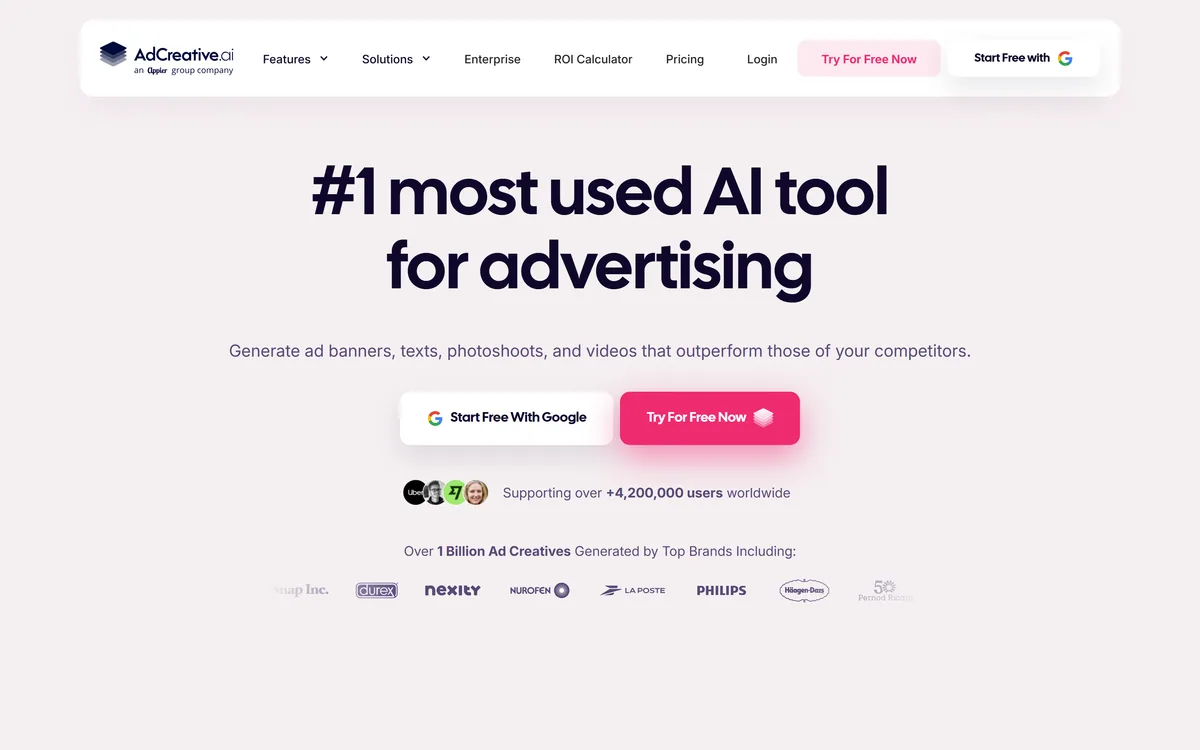
Last checked . Read from adcreative.ai, including the footer, with the screenshot above captured in the same session.
- Product described as generating AI-powered advertising creatives including ad banners, texts, photoshoots and videos
- Creative Scoring AI stated on the site as having over 90% accuracy on performance prediction
- Creative Insights described as analysing performance data from more than 35 billion dollars in ad spend
- Competitor Insights confirmed as discovering competitors' best-performing ad creatives across platforms
- Brand kit functionality confirmed as pulling logo, colours, fonts and style with one click
- Production tools confirmed including product photoshoots, fashion photo and videoshoots, AI image generation, ad copy generation, product videoshoots, Instant Ads from a webpage scan and Buyer Personas AI
- Ad platforms referenced on the site as Meta, Google and LinkedIn
- Stated scale read from the site as more than 4,200,000 users and over 1 billion ad creatives generated
- Stated results read from the site: up to 14x more conversions, and a client case citing 44.5% higher click-through rate and 111% ad performance
- Pricing confirmed as credit-based subscription across four tiers, with amounts not disclosed on the page we read
- Footer read directly and confirmed to carry a cookies policy, pricing, enterprise contact, ROI calculator, client stories and an affiliate programme
What we could not confirm: the 90% scoring accuracy claim has no published definition, methodology or test set, and accuracy is not a well-defined quantity for this kind of prediction; the conversion and click-through figures carry no baselines or controls; no company legal name, headquarters or funding detail appears on the pages we read; the user and creative counts are vendor figures with no stated basis; no credit-per-generation table is published, so cost cannot be modelled; and we did not generate creative, so nothing here reflects tested output quality.
Other Creative And Advertising Tools
Compare on what part of the creative problem each one owns — volume, format, or control.
- CreateUGC — creator-style video ads, where the format itself is the differentiator
- Canva AI — more design control, less automated volume
- Pebblely — product photography scenes rather than complete ad units
- Phygital+ — repeatable creative pipelines across a whole catalogue
- HubSpot AI — where the leads these ads produce actually land
Editor's Verdict
3.7/5AdCreative.ai scores fairly because volume genuinely is the constraint in paid social — creative fatigue is real, testing needs many variants, and producing them by hand is the bottleneck that stops most teams from testing properly. Automatic brand-kit extraction and competitor ad research are practically useful, and the breadth across images, video, product shots and copy covers a real workflow. It loses ground because the headline claims — over 90 per cent scoring accuracy, up to 14 times more conversions — carry no published methodology, and a predicted score is at best a prior that your own results should immediately override. AInexfinder Editor Score: 3.7/5.
AdCreative.ai pricing
AInexfinder does not list plan prices or billing details. For current pricing, plans, and trials, visit the official AdCreative.ai website.
Visit official website for pricingVendor pricing, credits, and billing policies change over time. Always confirm on the official site before you buy.
Frequently asked questions
What is AdCreative.ai?
AdCreative.ai generates advertising creative — static images, product photoshoots, videos, UGC-style clips and ad copy — and scores each one for predicted performance before you spend on it. It extracts your brand kit automatically, surfaces competitors' best-performing ads, and offers creative insights drawn from a large body of ad spend data.
How accurate is AdCreative.ai's performance scoring?
The site states over 90 per cent accuracy, but publishes no definition, methodology or test set — and accuracy is not a well-defined quantity here. Ranking two creatives correctly is a much easier task than predicting a click-through rate, and both could be described that way. Test it by scoring five ads you have already run and comparing the ranking with your real results.
Should I trust the score over my own campaign data?
No. A predicted score is useful before you have data and worthless afterwards. Use it to choose which six of twenty generated creatives to test first — a cheap decision where a prediction beats a coin toss. Within 48 hours of running them you will have real numbers from your own audience, and those override any model's estimate.
Is AdCreative.ai free?
No. It is a credit-based subscription across four tiers with monthly credit allocations; amounts are not disclosed on the page we read. The important detail is that generation types cost very differently — a static image is cheap and a product video is not — so size your tier around the format you will actually produce most.
Does AdCreative.ai really increase conversions by 14x?
The site says up to 14 times, and up to is doing a great deal of work in that sentence — it describes a best case rather than an expectation. The underlying mechanism is sound though: teams that test more creative variants get better results, because paid social rewards finding the outlier. Judge it on your own before-and-after, not the percentage.
Will AdCreative.ai match my brand guidelines?
Approximately, via one-click extraction of your logo, colours, fonts and style. Approximately is a problem at volume — twenty slightly off-palette ads is a worse brand outcome than three exactly right ones. Verify the extracted hex values and fonts against your real guidelines before generating in bulk, and keep one human approval step before anything runs.
What is Competitor Insights used for?
It surfaces competitors' best-performing ad creatives across platforms — research most teams know they should do and rarely do, because browsing ad libraries manually is tedious. Use it directionally rather than imitatively: seeing that everyone runs the same format tells you it works and that departing from it may be the opportunity.
Which ad platforms does AdCreative.ai support?
Meta, Google and LinkedIn are referenced on the site as ad platform integrations, and the tool generates in the formats and dimensions those placements require. Producing the right variants for each platform automatically is one of the more practically useful parts, since doing it by hand is where creative testing usually stalls.
Will using AdCreative.ai make my ads look like everyone else's?
That is the real risk of the category. When every advertiser in a sector studies the same competitor data and generates through the same tools, the output converges — and at that point the tool has removed the differentiation it was meant to create. The defence is knowing something about your product that no generative tool can supply, and building creative around that.
Who is AdCreative.ai not suitable for?
Advertisers running very little spend, where the subscription costs more than any improvement it could produce; brands whose advertising depends on a distinctive creative voice, which generation flattens toward category norms; and teams with no approval step, because volume without review produces a lot of slightly wrong advertising very quickly.
Reviews
Log in to write a review.
User Reviews
No reviews yet. Be the first to share your experience with AdCreative.ai.
Reviewed by Daniel Reed
Assigned reviewer
Daniel ReedSenior AI Tools Reviewer
Daniel reviews AI tools the slow way — by actually using them on real projects. His reviews cover what works, what breaks, and who each tool is genuinely a good fit for.
Hands-on reviewsProduct testingAI software
Daniel and the AInexfinder editorial team research AdCreative.ai using public product information, listing evidence, and (when available) hands-on checks. Scores reflect listing completeness and transparency — not paid placement.
- Last verified
- Methodology
- How we review AI tools
- Sources used
- adcreative.ai
- AInexfinder listing fields (features, pros/cons, description)
- Public vendor pages when available
- Editorial policy
- Listings may include affiliate or sponsored placements, which are labeled when present. Editorial scores and cons are not sold. See our affiliate disclosure and review methodology.
Related tools
Codeless AI infrastructure for performance marketing Category: Business & Marketing.

Listomize is an Etsy SEO platform that generates titles, tags, and descriptions within Etsy's own limits, scores listings, optimises 100+ listings from a CSV, tracks competitors and trends, and auto-generates Pinterest pins.
FreemiumBusiness & Marketing

Lahjty (لهجتي) is an Arabic-first marketing platform for MENA campaigns. From one brief it produces dialect-aware ad copy, headlines, campaign images with Arabic text rendered in, dialect-aware voice, and SEO articles grounded in your own brand sources — with a Partner API and an MCP server for teams that want it inside their own workflow.
FreemiumBusiness & Marketing

MaxAEO is an answer engine optimisation platform from HIII PTE. LTD. It tracks how ChatGPT, Gemini, Claude, Perplexity, Copilot, Grok and Google's AI surfaces mention a brand, with sentiment, competitor benchmarking and citation tracing.
Mailjet is a Sinch-owned email platform handling both marketing campaigns and transactional sending from one account. It offers a collaborative drag-and-drop editor, an email API with SMTP relay, AI generation and segmentation, and EU-based data centres.
FreemiumBusiness & Marketing
Compare:AdCreative.ai vs CreateUGCAdCreative.ai vs PixisAdCreative.ai vs ListomizeAdCreative.ai vs Lahjty
AdCreative.ai alternatives Explore More
Embed this listing on your site
Featured on AInexfinder