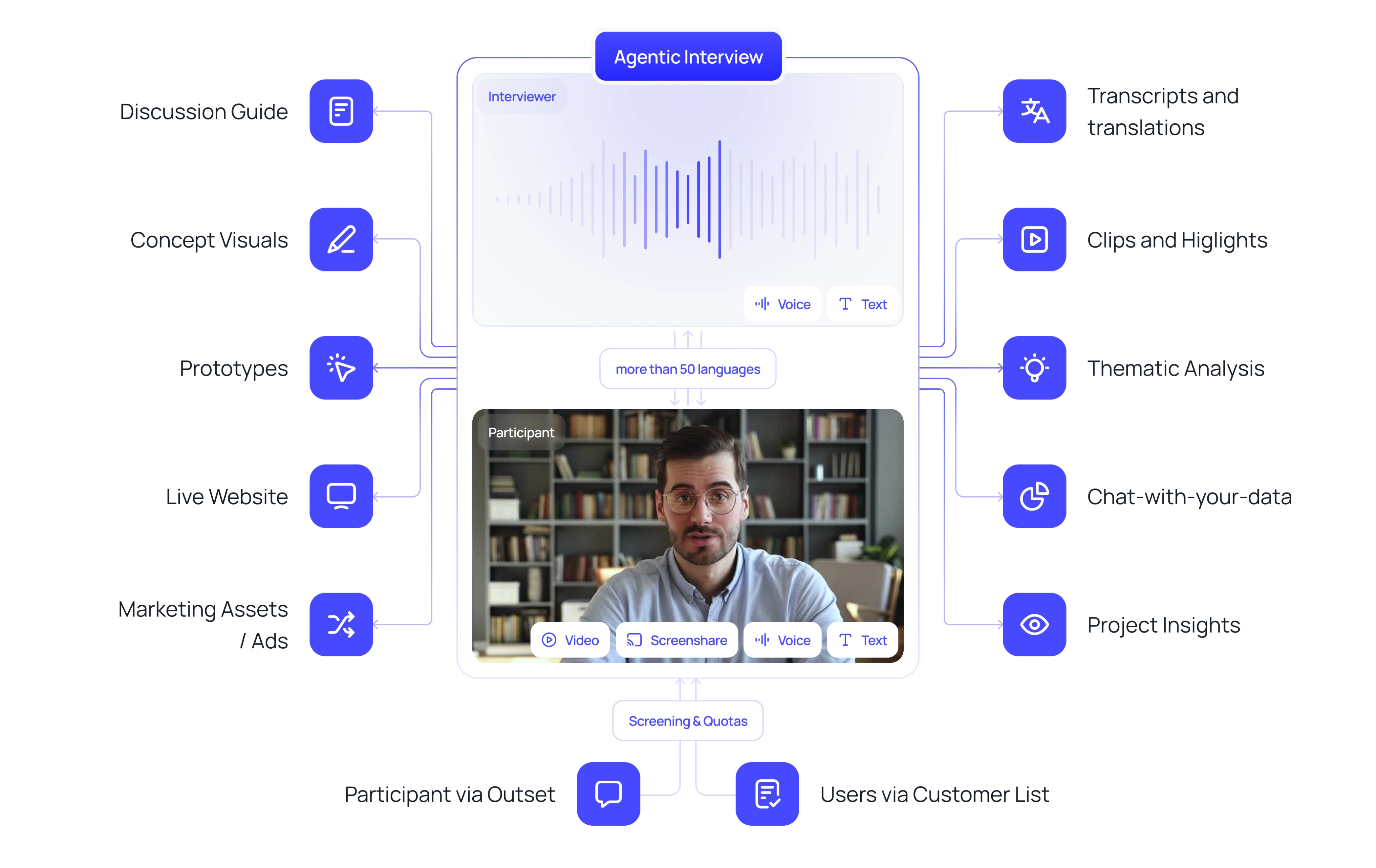
Outset runs AI-moderated research interviews in video, voice or text, probing dynamically like a human moderator, then synthesises and tags the results automatically. It draws participants from a very large pool across 85+ countries and offers simulated respondents grounded in real human data.
Qualitative research has always been rationed by a single constraint. A skilled moderator can run perhaps six or eight in-depth interviews in a day, and each one produces an hour of recording somebody then has to analyse.
Everything about the practice follows from that, which is why so much customer understanding gets outsourced to listening tools such as Brandwatch instead. Sample sizes stay small, so findings are directional. Studies take weeks, so research happens before a decision rather than during it. And because it is expensive, it gets commissioned for large questions and skipped for the hundred smaller ones where it would also have helped.
Outset's proposition is that an AI moderator removes the constraint. That is a substantial claim about a practice built by people who take moderation seriously, and it deserves examining on both sides: what genuinely improves when you can run hundreds of conversations, and what a machine asking the questions cannot do.
AI Moderation Is The Real Product
An AI moderator runs the interview in video, voice or text, probing follow-up questions dynamically rather than reading a fixed script.
Scale is the point — hundreds of conversations where a human moderator could run a handful, which changes the kind of question research can answer.
Synthesis is automatic, with tagging, reports and highlight reels produced without someone watching forty hours of video.
Digital Twins simulate participants grounded in real human data — a genuinely different thing from interviewing people, and the part to treat most carefully.
Compliance is real: SOC 2, GDPR and HIPAA stated, with screening for non-genuine participants, plus a participant pool spanning 85+ countries.
Research Terms Worth Defining
Five terms that decide whether a study's findings will hold up.
Moderated interview
A conversation guided by a moderator who can follow up in the moment, as opposed to a fixed survey. The follow-up is where the value sits.
Dynamic probing
Asking unscripted follow-up questions based on what the participant just said. The capability that separates AI moderation from an automated survey.
Digital twin
A simulated participant generated from data about real people. Useful for piloting a guide; not observation of anyone, and never to be reported as what customers said.
Say-do gap
The persistent divergence between what people report they would do and what they actually do. The reason stated preference data — simulated or not — needs behavioural validation.
Skip logic
Rules that route a participant past irrelevant questions based on earlier answers, keeping a long guide tolerable and the data clean.
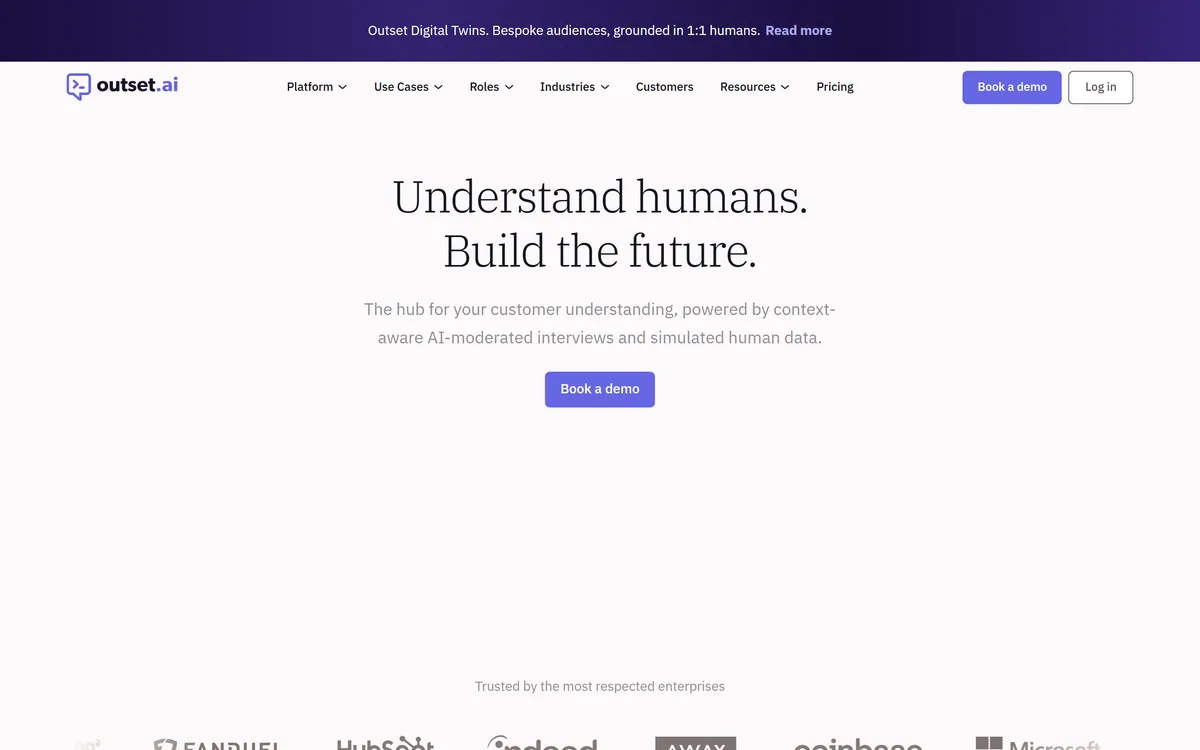
Outset's homepage, captured 9 September 2026. AI-moderated interviews and simulated data are presented together, though they are very different things.
Scale Changes What Research Can Ask
The most interesting consequence of AI moderation is not cheaper interviews. It is that a different class of question becomes answerable.
With eight interviews you can explore a theme and form a hypothesis. You cannot compare segments, because you do not have enough people in any one of them. With three hundred you can — and comparison is where most product decisions actually live.
Speed compounds this. Research that returns in days rather than weeks can inform a decision while it is still being made, instead of validating one already taken. Every researcher knows the experience of delivering findings a fortnight after the team shipped.
Multilingual capability matters for the same structural reason. International qualitative research has historically meant either recruiting moderators in each market or accepting that everyone is interviewed in English, which quietly filters your sample to the more educated and more Anglophone. An AI moderator conducting interviews in the participant's own language removes a real distortion.
The honest counterpoint is that scale does not convert qualitative research into quantitative research. Three hundred AI-moderated conversations is still not a representative sample unless it was recruited to be one, and a large number of interviews can produce misplaced confidence in exactly the way a small number does not.
The constraint on qualitative research was never the questions. It was that one skilled person could only ask them eight times a day.
What An AI Moderator Cannot Do
Skilled moderation is not the delivery of questions, which is why a transcription tool such as Otter.ai captures a session without replacing the moderator. It is noticing what is not being said.
A good moderator registers a hesitation before an answer, a shift in posture, a topic the participant steers away from twice, an answer that contradicts something said fifteen minutes earlier. They then decide, in the moment, whether to pursue it — and the decision draws on judgement about what this particular person is comfortable with.
Dynamic probing on stated content is a genuine capability and Outset has it. Probing on the unsaid is a different order of problem, and it is where the most valuable qualitative findings have always come from.
There is also a candour question that cuts both ways. People sometimes disclose more to a machine, particularly on embarrassing or sensitive topics, because there is no social judgement in the room. They also invest less effort, give shorter answers and disengage more readily, because there is no person whose time they feel obliged to respect.
The practical consequence is not that AI moderation is inferior; it is that it is different, and it suits some studies far better than others. Concept testing and structured comparison work well. An exploratory study into something people find difficult to talk about is where a human moderator still earns their fee.
Digital Twins Deserve A Careful Look
Alongside real interviews, Outset offers Digital Twins — simulated participants described as grounded in real human data.
This deserves the most scrutiny of anything in the product, and the reason is not that simulation is illegitimate. It is that simulated responses arrive in the same interface, in the same format, and read exactly like interview data from actual people.
Used deliberately, there are reasonable applications — one being to check what published work already established, which a literature tool such as Elicit does better still. Piloting a discussion guide before spending real recruitment budget. Stress-testing whether a question is ambiguous. Getting a rough directional read on a decision too small to justify a study at all.
Used carelessly, the failure mode is severe. A model trained on how people describe their preferences reproduces stated preferences, and the gap between what people say and what they do is the single most important fact in consumer research. A simulation cannot surprise you with the thing nobody thought to ask, and being surprised is what research is for.
The rule worth adopting is a firm one: never present simulated output as what customers said. If a finding reaches a decision-maker, it must be labelled as simulation, and any decision that matters should rest on data from actual people.
The site's own framing — grounded in real humans — is doing careful work. Grounded in is not the same as collected from, and buyers should hold that distinction more firmly than the marketing does.
Use simulation to pilot a guide, never to produce a finding you will act on.
Label simulated data unmistakably in every artefact that leaves the research team.
Ask what data the twins are grounded in, how recent it is, and how it was collected.
Validate any simulated finding against a small real sample before it influences a decision.
Never use simulation for anything involving a protected characteristic or a regulated claim.
Method Coverage And Where It Actually Fits
Outset supports concept testing, usability and UX evaluation, creative testing, brand research, market strategy, persona development and diary studies, across video, voice and text with intelligent skip logic.
That is a broad list and the methods are not equally suited to AI moderation. It is worth being specific rather than accepting the list wholesale.
Concept and creative testing fit best. The participant reacts to a stimulus, the questions are largely known in advance, and the value comes from volume and comparison — exactly what this removes the constraint on.
Usability testing works with an important caveat: what people say about an interface and what they do with it diverge sharply, and observation of behaviour remains the higher-value data. AI moderation captures the account rather than the action.
Diary studies are an interesting fit, because the burden there is longitudinal contact rather than depth in any single session — an area where automation genuinely helps and where human moderators are underused anyway.
The weakest fit is deep exploratory work: understanding a difficult experience, researching a sensitive category, or any study whose value depends on the moderator noticing something nobody anticipated.
Designing A Study That Tests The Tool
The way to evaluate a research platform is to run a study whose answer you already know, so you can grade the output rather than admire it.
The bar is step four. If the AI-moderated study misses a finding your existing method surfaced, that gap tells you exactly which studies you can trust it with.
Choose a study you have already run with human moderation in the last year, where you know what the findings were.
Rebuild the discussion guide in Outset and run it with a comparable sample — same segment, same size where budget allows.
Read the raw transcripts before reading the automatic synthesis. Judge whether the probing followed up the things you would have followed up.
Compare the findings against your known result. Note specifically what the AI-moderated study missed, because that gap defines its safe scope for you.
Separately, run the same guide against Digital Twins and compare all three. The difference between simulated and real is the most useful number you will get from this exercise.
Only then decide which of your study types move to this method and which stay with a human moderator.
Costing It Against Your Current Research Spend
Access is subscription-based, with no published amounts and no self-serve entry visible — the route in is a conversation with the vendor.
In research platforms this normally means the figure scales with study volume, seats, and whether participants are recruited from the vendor's pool or supplied by you. Bringing your own participants via shareable links is supported, and that changes the cost structure substantially.
The comparison to make is not against other software. It is against what you currently pay for the same research — moderator time, recruitment, incentives and analysis. That comparison is where AI moderation makes its case, and it is a calculation only you can run.
Two things to establish before committing: whether participant incentives are included or billed separately, since they are frequently the largest line in a research budget, and whether Digital Twin usage is metered differently from real interviews. The second matters because the cheaper option is the one you must use most carefully.
We do not publish amounts, as terms change and are negotiated per customer.
Outset: The Platform Details
Product type
AI-moderated research platform with simulated participant data
Interview modes
Video, voice and text
Moderation
AI moderator with dynamic probing and intelligent skip logic
Methods supported
Concept testing, usability and UX evaluation, creative testing, brand research, market strategy, persona development, diary studies
Analysis
Instant synthesis with automated tagging, custom reports and highlight reels
Simulated data
Digital Twins, described as grounded in real humans
Participant sourcing
A very large pool spanning 85+ countries, or your own participants via shareable links
Languages
Multilingual, with interviews described as conducted in any language
Integrations
Model Context Protocol support for team workflows
Compliance
AICPA SOC 2, GDPR and HIPAA stated, plus participant-integrity screening
Finding out what published research already established
Which Research Teams Outset Fits
Commission a study if
You need to compare segments, which small human-moderated samples have never supported properly.
Your research turnaround is too slow to inform decisions while they are still being made.
You run international studies and want participants interviewed in their own language rather than in English.
Concept and creative testing is a large share of your work, which is the method this suits best.
You have compliance requirements that a stated SOC 2, GDPR and HIPAA posture needs to satisfy.
Use a human moderator if
The study explores something people find difficult to talk about, where reading hesitation is the moderator's core skill.
You need to observe behaviour rather than collect accounts of it — what people do with an interface, not what they say about it.
Anyone on the receiving end might mistake simulated Digital Twin output for what real customers said.
Your sample is small and specialist, where a skilled moderator with domain knowledge extracts far more per session.
The research must withstand external or regulatory scrutiny on methodology, where AI moderation is still an unsettled question.
Checking Outset's Claims
Last checked . Read from outset.ai, including the footer and security pages, with the screenshot above captured in the same session.
Product described as a hub for customer understanding powered by context-aware AI-moderated interviews and simulated human data
Interview modes confirmed as video, voice and text, with dynamic probing and intelligent skip logic
Methods listed on the site include concept testing, usability testing, UX evaluation, creative testing, brand research, market strategy, persona development and diary studies
Analysis features confirmed as instant synthesis with automated tagging, custom report generation and highlight reels
Digital Twins confirmed as simulated participants, described by the vendor as grounded in real humans
Participant sourcing confirmed from the platform's own pool spanning 85+ countries, or via shareable links for your own participants
Multilingual interviewing described on the site
Model Context Protocol integration confirmed for team collaboration
Compliance stated as AICPA SOC 2, GDPR and HIPAA, with a participant-integrity screening system
Named customers listed on the site including Microsoft, HubSpot, Indeed, Glassdoor, Coinbase, Ipsos, Nestlé and WeightWatchers
Footer read directly and confirmed to link platform features, industries, use cases, roles, resources, FAQ, security, partner programme, careers, contact, privacy policy and terms of service
Operating entity identified on the site as Parnassus Labs, Inc.
What we could not confirm: no AI model or provider is named; the data underlying Digital Twins is described only as grounded in real humans, with no detail on its source, recency or collection method; no published validation compares Digital Twin output against real participant responses; the SOC 2 report is not public, so its type and scope are unknown; and no pricing is published, so the comparison against conventional research costs cannot be made from outside.
Other Research And Insight Tools
Different routes to understanding customers — asking, listening and reading are not substitutes for one another.
Brandwatch — listens to unprompted public opinion instead of asking questions
Otter.ai — transcription and summary for interviews you moderate yourself
Elicit — finds out what published research has already established before you commission more
Aviso — the commercial forecasting side of the same customer picture
HubSpot AI — where research findings meet the CRM data on what customers actually did
Editor's Verdict
4.0/5
Outset scores well because AI moderation removes the constraint that has always shaped qualitative research: a human moderator can run maybe eight interviews a day, so studies get small and findings stay directional. Running hundreds of dynamically-probed conversations changes what a research question can be, and the customer list — Microsoft, HubSpot, Coinbase, Nestlé, Ipsos — indicates the method survives professional scrutiny. It loses ground because Digital Twins produce data that reads exactly like research while not being observation of anyone, and the site does not draw that line as firmly as it should; and because an AI moderator cannot read a hesitation, which is where the best qualitative insight has always come from. AInexfinder Editor Score: 4.0/5.
Outset pricing
AInexfinder does not list plan prices or billing details. For current pricing, plans, and trials, visit the official Outset website.
Vendor pricing, credits, and billing policies change over time. Always confirm on the official site before you buy.
Frequently asked questions
What does Outset do?
It runs research interviews moderated by AI rather than by a person, in video, voice or text, probing with unscripted follow-up questions, then synthesises and tags the results automatically. It recruits from a large international participant pool or works with participants you supply, and also offers simulated respondents called Digital Twins.
Is Outset free?
No. It is a subscription with no published amounts and no self-serve entry — access begins with a vendor conversation. Costs in this category typically scale with study volume, seats and whether participants come from the vendor's pool. Establish whether incentives are included and whether Digital Twin usage is metered separately before committing.
Can AI moderation replace a human moderator?
For some study types, largely yes; for others, no. Concept testing, creative testing and structured comparison work well, because the questions are largely known and the value comes from volume. Deep exploratory work does not, because skilled moderation is mostly about noticing what is not being said — a hesitation, an avoided topic — which dynamic probing on stated content cannot replicate.
What are Digital Twins, and can I trust them?
Simulated participants generated from data about real people. Use them to pilot a discussion guide, test whether a question is ambiguous, or get a directional read on something too small for a study. Never report their output as what customers said, and validate anything that will influence a decision against real participants. The site's phrase — grounded in real humans — is not the same as collected from them.
How many interviews can Outset run?
The site states a participant pool of more than a billion possible participants across 85+ countries, and the platform is designed for study sizes far beyond what human moderation supports. The useful caution is that a large number of interviews does not make a study representative — that depends on how the sample was recruited, not on how many people answered.
Is Outset secure enough for regulated research?
It states AICPA SOC 2, GDPR compliance and HIPAA compliance, plus a participant-integrity screening system that filters non-genuine respondents. That is the right set for research handling personal or health-related data. As with any vendor, ask for the SOC 2 report itself along with its type and scope, and confirm data residency and retention terms in writing.
Do people answer AI moderators honestly?
The evidence cuts both ways and it is worth knowing both directions. People sometimes disclose more to a machine on embarrassing or sensitive topics, because there is no social judgement present. They also invest less effort, give shorter answers and disengage sooner, because there is no person whose time they feel obliged to respect. Which effect dominates depends on your topic.
Daniel reviews AI tools the slow way — by actually using them on real projects. His reviews cover what works, what breaks, and who each tool is genuinely a good fit for.
Daniel and the AInexfinder editorial team research Outset using public product information, listing evidence, and (when available) hands-on checks. Scores reflect listing completeness and transparency — not paid placement.
Listings may include affiliate or sponsored placements, which are labeled when present. Editorial scores and cons are not sold. See our affiliate disclosure and review methodology.
PitchBud is a press outreach tool that drafts a release with Claude Sonnet, publishes it to a newsroom URL with NewsArticle schema and RSS, matches relevant journalists by their recent work, and drafts personal pitches you review and send yourself.
Brandwatch is a Cision-owned enterprise suite covering consumer intelligence, social media management, influencer marketing and media intelligence. It monitors over 100 million sources, applies its Iris AI layer to the results, and is bought by large brands as a single platform rather than as point tools.
Lakmoos AI builds a private reasoning model from a client's existing survey data, then answers new questions as a simulated panel — reporting a similarity score above 98 percent across 20 benchmarking studies, and handling what it says is 20 million questions a week for 50-plus enterprise teams.
Klue is an AI platform that unites competitive intelligence and win-loss programs: a Compete Agent that collects intel and answers sellers in real time, living battlecards, and a Win-Loss Suite of verified buyer interviews, so revenue teams know why they win and lose and what to do about it.
Synthetic Users is an AI user-research platform that simulates research participants, from procurement officers to clinicians, so teams can run fast, cheap interviews to explore problems and refine questions. The vendor positions it as a discovery co-pilot, not a replacement for research with real people.
Listomize is an Etsy SEO platform that generates titles, tags, and descriptions within Etsy's own limits, scores listings, optimises 100+ listings from a CSV, tracks competitors and trends, and auto-generates Pinterest pins.