Warp is an agentic development platform spanning an open-source terminal, an agent CLI and Factories — fleets of coding agents defined in a factory.yaml, triggered from Slack, Jira or GitHub, scored by evals on your own work, and benchmarked across models to find the cheapest configuration that still passes.
warp.dev8 viewsAdded September 13, 2025117K visitors
Every company selling coding agents in 2026 promises a productivity gain and almost none of them will tell you how to measure it. That is the gap Warp has built into.
Its factories are fleets of agents defined in a configuration file, triggered from the tools your team already uses, and scored on every run against your own codebase.
The measurement is not a dashboard bolted on afterwards. It is the product, and the automation is what the measurement makes safe to trust.
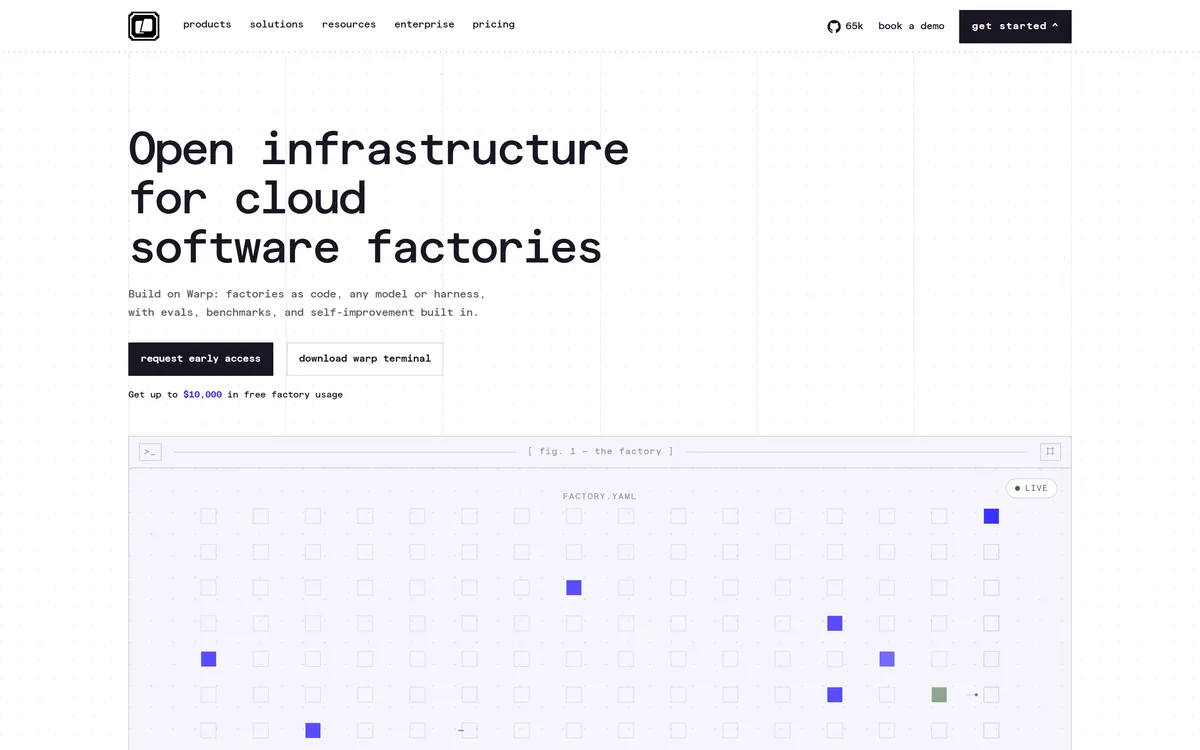
Warp's homepage, captured 9 September 2026, showing the software factory dashboard.
Warp: From Terminal To Software Factory
Factories as code — repos, agents, models, permissions and checkpoints in a factory.yaml checked into your repository.
Evals on your own work, plus benchmarks comparing models on your tasks rather than public leaderboards.
Self-improvement loops: observer agents open pull requests against the factory config itself.
Open at four layers — any MCP-capable agent, any model, your compute or theirs, your data storage.
800,000-plus developers on the terminal, with Factories in closed early access.
What Is A Software Factory As Code?
Warp's own definition is precise: a fleet of agents wired to your development lifecycle, triggered by an issue, a Slack message or a schedule, and coordinated from triage through review to a mergeable pull request. It is defined as code in a factory.yaml plus supporting agent files, checked into your repository like any other configuration.
The as-code part is what separates this from a chat interface with tools attached.
A configuration file in version control gets reviewed, diffed, reverted and audited. When an agent does something unexpected, the definition that produced it is in git with an author and a date, and that is the difference between a system you can operate and one you can only hope about.
It also makes the automation portable between repositories and teams, which a UI-configured agent never is.
The design choice underneath is the one worth noticing: work arrives from Slack, Teams, Linear, Jira, GitHub and GitLab, and status flows back to wherever it came from. Nobody has to adopt a new interface, which is the most reliable predictor of whether engineering tooling survives its pilot — the same insight behind Conductor keeping agent orchestration inside the repository.
A factory in version control gets reviewed, diffed and reverted. A UI-configured agent gets none of those, which is why it never scales past one team.
The Twenty To Thirty Percent Answer
Warp's FAQ states that most organisations start with around 20 to 30 percent of pull requests fully automated, beginning with simple tasks, and that this rises as models improve and the factory self-improves.
That is a remarkable thing to put on a marketing site, and it is the single strongest credibility signal on the page.
Every competing vendor has an incentive to imply a far higher number, and any engineering leader who has actually deployed coding agents knows that 20 to 30 percent of pull requests — dependency bumps, flaky test triage, small well-specified fixes — is both achievable and genuinely valuable.
It also sets the right expectation internally. A team told to expect 80 percent automation concludes the tool failed; a team told to expect a quarter of routine pull requests measures a real win.
The recommended starting point follows the same honesty — a single low-risk workflow like dependency bumps or flaky test triage before expanding. That is exactly how this should be adopted, and exactly what most organisations will be tempted to skip.
Evals, Benchmarks And Self-Improvement Loops
Three measurement mechanisms run alongside the automation: evals scoring runs against your own work, benchmarks comparing models on your tasks with a cost figure attached to each, and self-improvement loops where memory updates and prompt changes are tracked with their effect on score.
The benchmark-on-your-own-tasks piece is the most valuable and the least common.
Public model leaderboards measure performance on public problems. Your codebase has its own conventions, its own framework choices and its own peculiarities, and a model that leads a leaderboard can be worse on your work than one that does not.
Attaching a cost to each benchmarked run turns that into an economic decision rather than a quality one. Warp's own case study describes using this to cut cost per pull request substantially by choosing models per pipeline stage, which is precisely the optimisation nobody can perform without measurement.
The self-improvement loop closes it: observer agents score runs, then open pull requests against the factory configuration. Improvements arrive as reviewable changes rather than silent drift, which is the right architecture — the same discipline that makes evaluation tools like Promptfoo useful rather than decorative.
Start with one low-risk workflow, not broad coverage.
Run benchmarks on your own tasks before choosing a model.
Read cost per pull request as an economic metric, not a vanity one.
Review observer-agent pull requests like any other config change.
Set expectations at a quarter of routine pull requests, not most of them.
Why Warp Calls Itself Open Infrastructure
Openness is claimed at four distinct layers: any MCP-capable coding agent including Claude Code, Codex and Cursor; any model, frontier or open-weight, chosen per pipeline stage; Warp's cloud or self-hosted in your own VPC; and data storage described as pluggable, zero-retention, in your VPC.
Naming four layers separately is more useful than a general no-lock-in claim, because each one fails differently.
Agent-level openness means the platform is not betting on which coding harness wins, which matters in a field where the leader changes every few months. Model-level openness protects against a provider's pricing or deprecation schedule.
Compute and data openness are the two that decide enterprise procurement. Self-hosting inside your own VPC under your existing retention rules removes the single largest objection to agentic coding — that your source code is being processed somewhere you cannot see.
The site is explicit that Factories works without the Warp terminal, and that nobody at your company has to adopt the terminal to use it. Separating those products rather than using one to sell the other is a straightforward, credible position.
Governance And Proving The Work
Two features address the thing that actually worries engineering leaders about agent fleets, which is not capability but control.
The first is a single control plane showing every agent run across every source — orchestration, Claude Code, Slack, Codex — with the model used, the initiator and the elapsed time, plus cost broken into compute, platform and inference.
That matters because agentic coding sprawls invisibly. Different teams adopt different harnesses, spend appears across several bills, and nobody can answer what the organisation is spending or what it got. Centrally configured agent access and centrally managed permissions are the antidote.
The second is verification through computer use: every factory agent captures a screenshot or video so you can check its work before shipping a pull request.
That is a better answer to agent trust than any amount of confidence scoring. An agent claiming it fixed a page is an assertion; an agent showing you the page working is evidence, and it moves review from reading a diff to checking an outcome. Release gates in tools like Testsigma make the same move from assertion to evidence.
Running Agents Against A Real Codebase
Agent adoption fails on trust and on cost, usually in that order, and both are measurement problems rather than technology problems.
This sequence follows the order Warp's own documentation recommends, which is the honest one.
Pick one low-risk workflow — dependency bumps or flaky test triage.
Define it in factory.yaml and check it into the repository.
Wire triggers to the tools your team already uses, not a new interface.
Run evals on your own work before trusting any output.
Benchmark two or three models on your tasks and compare cost per result.
Expand coverage only after the first workflow runs unattended for a month.
Warp: Platform And Adoption
Positioning
Open platform for automating development; open infrastructure for cloud software factories
Products
Factories, an open-source terminal, and an agent CLI for any terminal
Factory definition
factory.yaml plus agent files, checked into your repository
Triggers
Issues, Slack messages or schedules, from Slack, Teams, Linear, Jira, GitHub and GitLab
Interfaces
API, CLI, SDK and MCP; runs viewable from web, mobile, terminal or IDE
Agent support
Any MCP-capable coding agent, including Claude Code, Codex and Cursor
Model support
Frontier or open-weight, selectable per pipeline stage
Deployment
Warp cloud or self-hosted in your own VPC
Data
Described as pluggable, zero-retention, stored in your VPC
Measurement
Evals on your own work, model benchmarks with cost, and self-improvement loops
Verification
Screenshot or video capture via computer use before a pull request ships
Adoption
800,000-plus developers stated; FAQ states most orgs automate 20–30% of PRs initially
Key features of Warp
Factories defined as code in factory.yaml
Triggers from Slack, Teams, Linear, Jira, GitHub and GitLab
Evals scoring every run against your own work
Model benchmarks with cost attached per run
Observer agents opening PRs against the factory config
Computer-use verification with screenshot or video capture
A single control plane across every agent and harness
Self-hosting in your own VPC with zero data retention
Pros & cons
Pros
7
Measurement built in before the automation, not bolted on after
Benchmarks run on your own tasks rather than a public leaderboard
Factory definitions live in version control, so they are reviewable and revertible
Openness claimed and detailed at four separate layers
Self-hosting removes the largest enterprise objection to agentic coding
The FAQ states a realistic automation ceiling instead of implying a higher one
Computer-use verification is stronger evidence than any confidence score
Cons
7
Factories is in closed early access with no stated timeline
Eval scoring methodology is not explained on the page
Model benchmark methodology is similarly undisclosed
The developer count spans a terminal much older than the platform
Case study figures are not stated as independently verified
Requires a codebase with tests for scoring to mean anything
Needs an internal owner treating factory config as production configuration
Best For
Engineering organisations with uncontrolled agent adoption
Platform teams asked to govern and cost AI coding
Companies that cannot let source code leave their VPC
Teams drowning in routine, well-specified pull requests
Leaders who want model choice decided by measurement
Warp Against Other Engineering Platforms
Developer AI tooling differs by where in the lifecycle it acts.
CodeScene — where risk accumulates in the codebase
Warp: Read From The Factory Pages
Last checked . Read from warp.dev in a browser session on the date above, including the full footer and FAQ. The screenshot was captured at the same time.
Positioned as the open platform for automating development and as open infrastructure for cloud software factories
A factory defined as a fleet of agents wired to the SDLC, triggered by an issue, Slack message or schedule
Factories stated as defined in code via factory.yaml plus agent files, checked into your repository
API, CLI, SDK and MCP listed, with the site stating it is built as a platform rather than a vertical product
Openness claimed at four layers: any MCP-capable agent, any model, your compute or theirs, and your data storage
Self-hosting inside your own VPC stated, with data described as pluggable and zero-retention
Evals on your own work, benchmarks across models with per-run cost, and self-improvement loops all shown
Observer agents described as opening pull requests against your factory configuration
A control plane shown listing agent runs across orchestration, Claude Code, Slack and Codex with model and cost breakdown
Computer use described as capturing a screenshot or video so an agent's work can be verified before a PR ships
FAQ states most organisations start with around 20–30% of pull requests fully automated, beginning with low-risk workflows
What we could not confirm: how eval scores are computed or what a passing score represents; the methodology behind the model benchmark comparisons; whether the customer case studies' figures were independently verified; what the 800,000 developer count includes, given the terminal has been available far longer than Factories; how closed early access is granted or how long the wait is; and the cost per agent run, since pricing is usage-based and not published as figures we would reproduce. We did not define a factory or run an agent.
Editor's Verdict
4.4/5
Warp has done the thing almost nobody in agentic coding has done: build the measurement layer before selling the automation. Every run is scored against your own work, models are benchmarked on your tasks rather than a public leaderboard, and observer agents open pull requests against the factory config itself. It is genuinely open at four separate layers — any agent, any model, your compute, your data — and the FAQ states that most organisations automate 20 to 30 percent of pull requests rather than promising more. Factories is still closed early access, which is the one real caveat. AInexfinder Editor Score: 4.4/5.
Warp pricing
AInexfinder does not list plan prices or billing details. For current pricing, plans, and trials, visit the official Warp website.
Vendor pricing, credits, and billing policies change over time. Always confirm on the official site before you buy.
Frequently asked questions
What is a software factory?
Warp's term for a fleet of agents wired into your development lifecycle — triggered by an issue, a Slack message or a schedule, and coordinated from triage through review to a mergeable pull request, all defined in a configuration file in your repository.
Why does defining it as code matter?
Because a file in version control gets reviewed, diffed, reverted and audited. When an agent does something unexpected, the definition that produced it has an author and a date, and it moves with the repository between teams.
How much can actually be automated?
Warp's own FAQ says most organisations start around 20 to 30 percent of pull requests, beginning with simple tasks. That is an unusually honest number for a vendor page and matches what teams deploying coding agents actually achieve.
Do I need the Warp terminal?
No, and the site says so directly — Factories is a separate product and nobody at your company has to adopt the terminal. Work arrives through Slack, Linear, Jira, GitHub and GitLab instead.
What makes evals on your own work different?
Public leaderboards measure models on public problems. Your codebase has its own conventions and peculiarities, so a model that leads a leaderboard can be worse on your work than one that does not. Only your own tasks settle that.
How does the self-improvement loop work?
Observer agents score runs and then open pull requests against your factory configuration — memory updates, prompt changes, caught regressions. Improvements arrive as reviewable changes rather than silent drift, which is the right architecture.
What does open at every layer mean?
Four separate things: any MCP-capable coding agent, any model chosen per pipeline stage, Warp's cloud or self-hosting in your VPC, and data stored where you choose with zero retention. Each protects against a different kind of lock-in.
Can we keep source code inside our own infrastructure?
Yes — self-hosting inside your own VPC under your existing retention and compliance rules is stated explicitly. That removes the single largest objection most enterprises raise about agentic coding tools.
How do I verify what an agent did?
Every factory agent captures a screenshot or video through computer use, so you check an outcome rather than read a diff and trust a claim. That is a better answer to agent trust than any score attached to a run.
Where should we start?
One low-risk workflow — dependency bumps or flaky test triage — defined in code and left to run unattended for a month before expanding. The site recommends exactly this, and it is the step most organisations will be tempted to skip.
Daniel reviews AI tools the slow way — by actually using them on real projects. His reviews cover what works, what breaks, and who each tool is genuinely a good fit for.
Daniel and the AInexfinder editorial team research Warp using public product information, listing evidence, and (when available) hands-on checks. Scores reflect listing completeness and transparency — not paid placement.
Listings may include affiliate or sponsored placements, which are labeled when present. Editorial scores and cons are not sold. See our affiliate disclosure and review methodology.
GitHub Copilot is an AI coding assistant that spans completion, chat, agent mode, automated code review, and a cloud agent that opens pull requests, working across VS Code, Visual Studio, JetBrains, Xcode, Neovim, Eclipse, the CLI, and github.com.
Replit AI turns a written description into a working application — the Agent writes the code, and Replit supplies the database, authentication, hosting, and monitoring, so a prototype goes live without a local setup or a deployment pipeline.
Tabnine is an enterprise AI coding assistant offering context-aware code completion, chat and agents with private deployment and a codebase-wide context engine. In July 2026 it was acquired by Tricentis, and tabnine.com now routes to the Tricentis agentic quality engineering platform.
Zencoder is an AI orchestration platform for engineering work: agents plan with one model, build with another and review with a third, across multi-repo indexing and full dependency mapping, inside VS Code and JetBrains. It adds scheduled automation and a work layer spanning Jira, Slack and Notion.
Kiro is an agentic software-engineering toolset, an IDE, a CLI and cloud sessions, that turns prompts into executable specs, validates code correctness, and works across large codebases with parallel agents, positioned as a step beyond basic AI code completion.
Cline is an open-source AI coding agent that works in your editor as a VS Code extension, in the terminal as a CLI, as a desktop app and through an SDK, using any model including open-weight ones, with a plan-and-act workflow where you approve its actions.