Kiro is an agentic software-engineering toolset, an IDE, a CLI and cloud sessions, that turns prompts into executable specs, validates code correctness, and works across large codebases with parallel agents, positioned as a step beyond basic AI code completion.
AI coding has mostly meant autocomplete, helpful, but it still leaves the engineer holding the intent and the correctness. Kiro's pitch is to move up a level, to "agentic engineering" built around specs rather than loose prompts.
It is a toolset spanning an IDE, a CLI and cloud sessions that turns prompts into executable specs, validates code correctness, and works across a codebase with parallel agents. It sits among coding agents like OpenCode and IDE-native assistants such as JetBrains Junie, distinguished by its spec-first approach.
This review covers how Kiro builds across a codebase, who agentic engineering suits, how its credits work, and the honest caveat that its public page is light on detail. We weigh it on what is verifiable.
Kiro turns a prompt into an executable spec before it writes code.
Kiro Agentic Engineering Facts
What it is
An agentic software-engineering toolset
Surfaces
IDE, CLI and cloud sessions
Core idea
Spec-driven development from prompts
Correctness
Validation to catch bugs tests miss
Scale
Parallel agents across large codebases
Config
Specs, steering files, hooks, trust model
Connection
Linked to Amazon tools / Builder ID
Pricing
Freemium with credits
Kiro, The Engineering Brief
Kiro is an agentic engineering toolset: an IDE, a CLI and cloud sessions, not just an autocomplete.
Spec-driven is the idea: prompts become executable specs, so the agent builds against a defined intent.
It validates correctness: checks aimed at catching bugs that unit tests miss, across large codebases.
It runs parallel agents: and resumable local or cloud sessions, with an Amazon-tools connection.
Turning Prompts Into Specs, Then Code
Kiro's organising concept is the spec. Rather than reacting to a one-off prompt, it turns your intent into an executable spec, a defined description of what to build, and then has agents work against that, which is a more disciplined pattern than freeform chat-to-code.
The appeal is that a spec is reviewable and reusable: you can see what the agent understood before it acts, and correct the intent rather than untangle the output afterward. For non-trivial work, that front-loaded clarity is where agentic coding either earns trust or loses it.
A fair caveat up front: Kiro's public page leans heavily on terminal visuals and is sparse on hard detail, and it connects to Amazon tools via a Builder ID. We describe what is verifiable and keep the claims modest where the evidence is thin.
A spec is reviewable: you can see what the agent understood before it acts, and correct the intent rather than untangle the output afterward.
How Does Kiro Build Across A Codebase?
Two capabilities define the workflow beyond the spec itself.
Spec-Driven Work And Correctness Checks
From a spec, Kiro scaffolds and edits a project and runs code-correctness validation intended to catch bugs that unit tests miss, with steering files and hooks to shape how it behaves and a trust model governing what it may do.
Correctness-checking beyond tests is the ambitious part, and the right way to judge it is on your own code. A coding agent like Cosine approaches deep codebase understanding from a different angle, so comparing them on a real task is more useful than comparing feature lists.
Parallel Agents And Cloud Sessions
Kiro can run parallel agents across a large codebase and offers resumable local and cloud sessions, with a cloud workspace you populate with your own agents, MCP servers and hooks rather than one that is pre-filled.
That explicit, you-configure-it cloud model is a sensible trust choice for engineering teams wary of an agent with unbounded access. It is a more deliberate posture than a one-click assistant, and it suits teams that want to see and control what the agent can reach.
Who Agentic Engineering Suits
Kiro suits developers and teams ready to work in a spec-first way, those building non-trivial features where defining intent up front pays off, rather than people wanting a quick inline suggestion.
It also appeals to teams that value an explicit trust model and configurable cloud sessions over a black-box agent, and to anyone already in the Amazon developer ecosystem given the Builder ID connection.
It suits less well a developer who just wants autocomplete in their editor, or anyone who needs a mature, heavily documented tool today, given how sparse the public information currently is. The concept is strong; the evidence base, from the site alone, is still thin.
How Kiro Structures Its Credits
Kiro is freemium with paid plans and sign-up credits, plus bonus credit for social login or a Builder ID and promotional credit-earning. We do not publish prices, which change; check the site.
A credit model is normal for agentic coding, since agent runs consume real compute, so the practical question is how far your typical workflow draws down credits, which only real use reveals.
Because there is a free entry, the low-risk move is to run Kiro on a real task and watch both the quality of its spec-driven output and the credit burn before committing to a plan.
A Grounded Way To Trial Kiro
Because the public detail is limited, judge Kiro on a real feature in a real repo rather than on the marketing.
Start free and give Kiro a genuine, non-trivial task from your own codebase.
Review the executable spec it produces before letting it build, and correct the intent there.
Let it scaffold and run its correctness checks, then verify the output against your own tests.
Configure the trust model, hooks and cloud session, and confirm you control what it can reach.
Try a parallel-agent run on a larger change and judge whether it holds together.
Pass/fail: Kiro is worth it if the spec-first flow produces correct code you trust on real work.
Watch the credit consumption of a realistic task before choosing a plan.
Kiro Agentic-Engineering Terms
Spec-driven development
Turning a prompt into an executable specification the agent builds against, so intent is defined and reviewable first.
Correctness validation
Checks aimed at finding bugs that unit tests miss, rather than relying only on the tests you wrote.
Trust model
The configuration governing what an agent is allowed to do and reach during a session.
Steering files
Config that guides how Kiro's agents behave across a project, alongside hooks and MCP servers.
Key features of Kiro
Spec-driven development from prompts
Executable specs you review before building
Code-correctness validation
Parallel agents across a codebase
IDE, CLI and cloud sessions
Steering files, hooks and trust model
Resumable local and cloud workspaces
Amazon Builder ID connection
Pros & cons
Pros
5
Spec-first approach makes intent reviewable
Correctness checks aim beyond unit tests
Explicit, configurable trust model
Parallel agents for larger changes
Free entry to try the workflow
Cons
5
Public page is thin on hard detail
More setup than a simple autocomplete
Credit burn needs real-use measurement
Newer tool with a limited evidence base
Best value tied to the Amazon ecosystem
Best For
Spec-first developers
Teams wanting a trust model
Non-trivial feature work
Amazon-ecosystem devs
Early-adopter engineers
Kiro Against Other Coding Agents
The useful comparison is with other coding agents and IDE assistants.
Developers ready to work spec-first on non-trivial features
Teams that want an explicit, configurable trust model
Engineers who value reviewing intent before code
Those already in the Amazon developer ecosystem
People comfortable evaluating a newer, evolving tool
When Kiro Does Not Fit
Developers who just want inline autocomplete
Anyone needing a mature, heavily documented tool today
Teams unwilling to configure cloud sessions and hooks
People who will not verify output against their own tests
Those who need full feature detail before trying
How We Probed Kiro
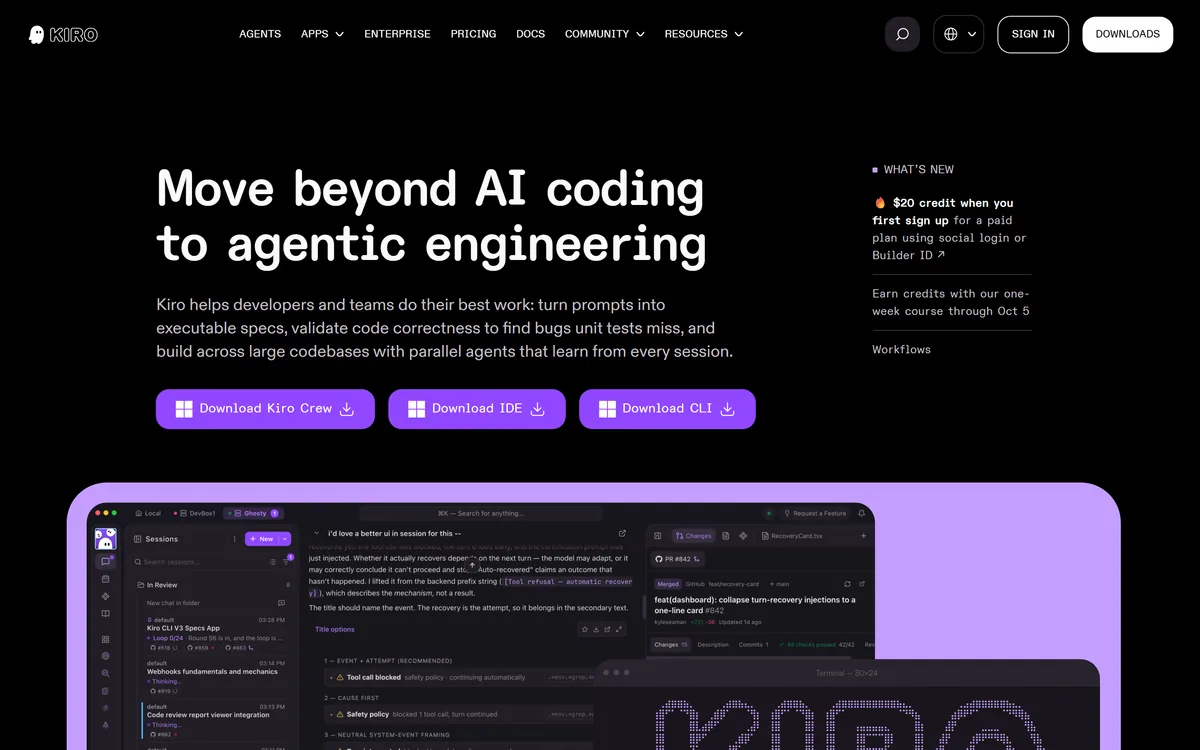
Last checked . Read from kiro.dev during this check, with the screenshot above captured at the same time.
An agentic engineering toolset spanning IDE, CLI and cloud sessions
Spec-driven development that turns prompts into executable specs
Code-correctness validation aimed at bugs unit tests miss
Parallel agents across large codebases
Steering files, hooks and a configurable trust model
Resumable local and cloud sessions you populate yourself
A connection to Amazon tools via a Builder ID
A freemium model with credits and sign-up bonuses
No plan prices reproduced here, in line with this site's pricing policy
Kiro's public page is sparse (heavy on terminal visuals), so our evidence is limited; we describe what is verifiable and keep claims modest where detail is thin.
Other Coding Agent Tools
An open-source agent, an IDE-native agent and a codebase-understanding agent to weigh alongside Kiro.
OpenCode — a transparent, open-source coding agent
Kiro earns 4.1 for a genuinely sharper idea than autocomplete: spec-driven agentic engineering, where prompts become reviewable executable specs, backed by correctness checks, parallel agents and a configurable trust model across IDE, CLI and cloud. The honest limit is that its public page is sparse, so the evidence is thin and claims stay modest; the concept suits spec-first teams who will judge it on real code and watch the credit burn. AInexfinder Editor Score: 4.1/5.
Kiro pricing
AInexfinder does not list plan prices or billing details. For current pricing, plans, and trials, visit the official Kiro website.
Vendor pricing, credits, and billing policies change over time. Always confirm on the official site before you buy.
Frequently asked questions
What is Kiro?
Kiro is an agentic software-engineering toolset, an IDE, a CLI and cloud sessions, that turns prompts into executable specs, validates code correctness, and works across large codebases with parallel agents. It positions itself as a step beyond basic AI code completion toward spec-driven engineering.
What does spec-driven development mean in Kiro?
It means Kiro turns your prompt into an executable spec, a defined description of what to build, and has agents work against that rather than reacting to loose chat. The benefit is that you can review and correct the intent before any code is written, which builds trust for non-trivial work.
Is Kiro connected to Amazon?
The site references Amazon tools and a Builder ID sign-in that grants bonus credits, indicating an Amazon-affiliated product. If you already work in the Amazon developer ecosystem, that connection may add value, though the public page is light on the specifics of the relationship.
How is Kiro different from autocomplete tools?
Autocomplete suggests code inline; Kiro aims to take a whole task, define it as a spec, build across the codebase with parallel agents, and validate correctness. It is a heavier, more deliberate workflow suited to building features rather than finishing individual lines.
How much does Kiro cost?
Kiro is freemium with paid plans and sign-up credits, plus bonus credit for social login or a Builder ID and promotional credit-earning. We do not publish prices, which change; check the site, and watch how far a realistic task draws down credits before committing.
Is Kiro ready for production use?
The concept is strong, but its public page is sparse and heavy on terminal visuals, so the available evidence is limited and it reads as a newer, evolving tool. The sensible approach is to trial it on a real but bounded task and verify its output against your own tests before relying on it.
Does Kiro control what the agent can access?
Yes. It offers a configurable trust model, steering files and hooks, and a cloud workspace you populate with your own agents and MCP servers rather than one pre-filled with access. That explicit, you-configure-it posture suits teams wary of an agent with unbounded reach.
Can Kiro work on large codebases?
It is designed to, running parallel agents across a large codebase and offering resumable local and cloud sessions. As with any agentic tool, judge how well it holds together on a genuinely large change in your own repository rather than on the marketing claims.
Who should use Kiro?
Developers and teams ready to work spec-first on non-trivial features, who value reviewing intent before code and want a configurable trust model, and those in the Amazon ecosystem. It is less suited to anyone who just wants inline autocomplete or a fully mature, documented tool today.
Does Kiro replace writing tests?
No. It adds correctness validation aimed at catching bugs unit tests miss, but that complements your tests rather than replacing them. The reliable way to judge its correctness claims is to verify its output against your own test suite on real tasks before trusting it.
Daniel reviews AI tools the slow way — by actually using them on real projects. His reviews cover what works, what breaks, and who each tool is genuinely a good fit for.
Daniel and the AInexfinder editorial team research Kiro using public product information, listing evidence, and (when available) hands-on checks. Scores reflect listing completeness and transparency — not paid placement.
Listings may include affiliate or sponsored placements, which are labeled when present. Editorial scores and cons are not sold. See our affiliate disclosure and review methodology.
GitHub Copilot is an AI coding assistant that spans completion, chat, agent mode, automated code review, and a cloud agent that opens pull requests, working across VS Code, Visual Studio, JetBrains, Xcode, Neovim, Eclipse, the CLI, and github.com.
Replit AI turns a written description into a working application — the Agent writes the code, and Replit supplies the database, authentication, hosting, and monitoring, so a prototype goes live without a local setup or a deployment pipeline.
Tabnine is an enterprise AI coding assistant offering context-aware code completion, chat and agents with private deployment and a codebase-wide context engine. In July 2026 it was acquired by Tricentis, and tabnine.com now routes to the Tricentis agentic quality engineering platform.
Zencoder is an AI orchestration platform for engineering work: agents plan with one model, build with another and review with a third, across multi-repo indexing and full dependency mapping, inside VS Code and JetBrains. It adds scheduled automation and a work layer spanning Jira, Slack and Notion.
Cline is an open-source AI coding agent that works in your editor as a VS Code extension, in the terminal as a CLI, as a desktop app and through an SDK, using any model including open-weight ones, with a plan-and-act workflow where you approve its actions.
Pieces runs in the background on your computer forming a searchable memory of your work, capturing what you see and what you copy by default and what you hear only if you opt in. It builds a chronological timeline across Gmail, Outlook, browsers and Slack, and generates standups, briefs and recaps from real context.