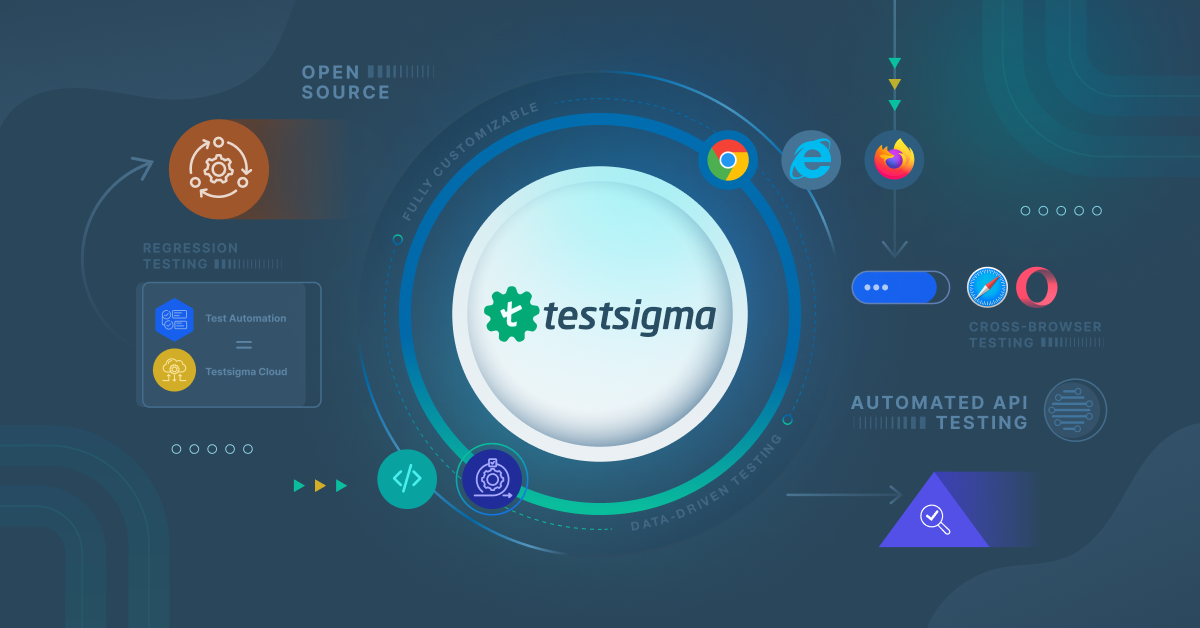
Testsigma is an agentic test automation platform covering web, mobile, API and Salesforce. Named agents map every commit to the stories and specs behind it, generate test plans in plain English, run them across thousands of real browsers and devices, self-heal locators when the UI changes, and produce a coverage and confidence score at the release gate.
testsigma.com5 viewsAdded February 22, 202664K visitors
Test automation has a well-known dirty secret: writing the tests is the cheap part. Keeping them running as the application changes is what consumes a QA team.
Testsigma builds around that fact. Agents map each commit to the stories and specs behind it, generate a plan for review, run it across real devices, and repair broken locators as the interface moves.
The output is not a pass or fail but a release gate with a confidence score attached, which is a considerably more ambitious claim than test generation.
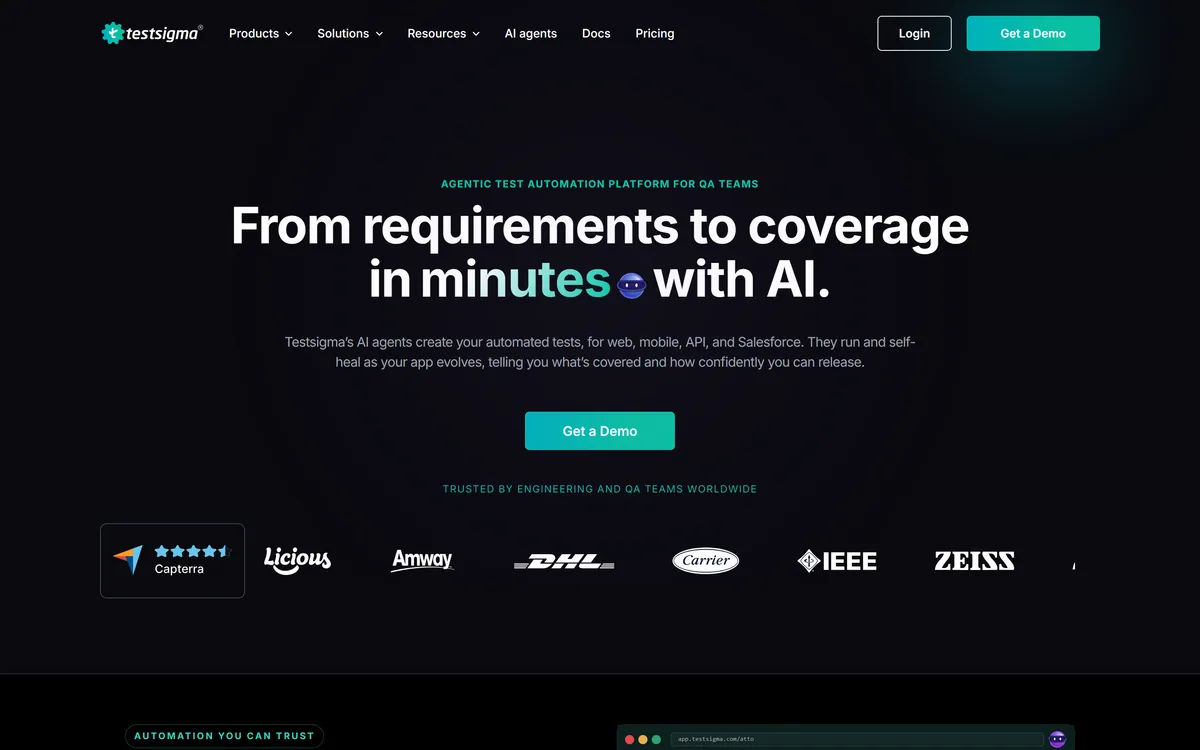
Testsigma's homepage, captured 9 September 2026, showing the commit-to-release agent flow.
Testsigma: Tests That Write And Heal Themselves
Agents across the whole loop — mapping commits, planning, authoring, executing, healing and reporting.
Four surfaces in one platform: web, mobile, API and Salesforce, including shadow DOM and CPQ.
Self-healing locators, which addresses the maintenance backlog rather than the authoring cost.
A release gate with a number — coverage, pass rate and a confidence score instead of a hunch.
Testsigma Technologies Inc., claiming 25M+ test executions across 10K+ QA teams.
What Does Self-Healing Test Automation Mean?
Testsigma states that self-healing updates locators when the UI changes, with no maintenance backlog, and shows healing events in its run output.
To see why this is the important feature, consider what actually kills automation programmes.
A team writes four hundred tests over two quarters. A designer renames some components. Two hundred tests fail overnight, none because the application is broken. Someone spends a week fixing selectors, and the next redesign does it again.
That cycle is why so many suites end up abandoned rather than deleted, quietly excluded from the pipeline because nobody has time to repair them.
Self-healing attacks exactly this. When it works, a rename becomes a log line rather than a sprint of repair work — the same shift in economics that DeepSource and other automated-fix tools brought to static analysis findings.
Writing four hundred tests takes two quarters. A single redesign can break two hundred of them overnight. That is the real cost.
Where Healing Can Go Wrong
Automatic repair carries a risk that deserves stating, because no vendor page will state it for you.
A healed locator is a guess that the element it now points at is the one the test meant. Usually it is. Occasionally it is not, and the test continues passing against the wrong thing.
That failure mode is worse than a broken test, because a broken test is loud and a silently mis-targeted test is not. It reports green while checking nothing.
The mitigation is visibility, and Testsigma's run output does show healing events rather than hiding them — the interface displays a locator healed notice alongside the result.
So the practical discipline is to treat healing events as a review queue rather than as noise. A test that heals repeatedly is telling you the underlying element is unstable, which is information worth having whether or not the test passes.
Confidence Scores And The Release Decision
The platform's most distinctive claim is that its agents score release confidence: coverage crossing a threshold opens the gate, and when it does not, the report states exactly which flows are missing.
The site frames the alternative bluntly — no I think we're good, no Slack message to the QA lead — and that framing is fair.
Release decisions in most organisations are made on a mixture of test results, someone's judgement and the calendar. Replacing the middle term with a number is genuinely valuable if the number is trustworthy.
Whether it is depends entirely on the coverage model. Coverage measured against generated tests derived from commits and tickets is coverage of what was specified, and the bugs that hurt most live in what nobody specified.
So the honest reading is that a confidence score is a better instrument than a hunch and not a guarantee. Used well it makes the conversation concrete; used badly it launders an assumption into a metric, which is a worse outcome than the hunch it replaced. The same caution applies to eval scores in tools like Promptfoo: a number is only as good as what it measures.
Ask what the coverage percentage is measured against.
Treat healing events as a review queue, not as noise.
Check Salesforce shadow DOM support against your own org.
Run the generated plan past someone who knows the edge cases.
Wire the gate into CI before trusting the number.
Web, Mobile, API And Salesforce In One Place
The platform covers four surfaces: web across 2,000+ browser and OS combinations, mobile across 800+ real iOS and Android devices including native, hybrid and Flutter, API generated from a Postman collection or OpenAPI spec, and Salesforce covering Lightning, Classic, CPQ and custom objects with shadow DOM.
Salesforce being named as a first-class surface is the most revealing item on that list.
Testing Salesforce is notoriously painful. The interface is generated, element identifiers change between releases, shadow DOM defeats ordinary selectors, and CPQ configurations are deeply customer-specific. Tools that handle it well tend to have been built for it deliberately.
Its presence tells you who buys this platform: large enterprises where Salesforce is business-critical and where a broken quote configuration costs real revenue.
API generation from an OpenAPI spec is the quiet efficiency on the list. A specification already describes the contract, so deriving validations and request chains from it is close to free — and it is the layer most teams under-test because the UI gets all the attention.
What The Commit-First Flow Changes
The flow runs commit, generate, execute, automate, scale, release — and the starting point matters more than the sequence.
Beginning at the commit means the platform maps a change to the sprint, the code, and the stories, designs and specs behind it, drawing on sources including pull requests and issue tickets.
Traditional automation starts from a test plan written in advance and drifts from the application immediately. Starting from the commit inverts that: the tests follow what actually changed rather than what someone thought would change.
The consequence is that coverage becomes a moving measurement of the current sprint rather than a static number about a plan, which is a more useful thing to put in front of a release meeting.
The dependency is discipline elsewhere. If commits are not linked to tickets, if pull requests have no description, or if specs live in someone's head, the mapping has nothing to map — and the platform will be quietly less useful than the demo suggests. Review-time tools such as Cubic carry the same dependency on a tidy pull request.
Introducing Agentic Testing To A QA Team
Automation initiatives fail on trust rather than technology. A suite people do not believe gets bypassed, and bypassing it once makes bypassing it routine.
This sequence builds the trust before it builds the coverage.
Start on one product area with well-linked commits and tickets.
Review the first generated plans line by line before accepting any.
Run against real devices early — emulators hide the failures that matter.
Audit every healing event for the first month, then sample.
Wire the gate into CI in reporting mode before it can block anything.
Compare its confidence score against your own judgement for a few releases.
Testsigma: What The Platform Covers
Company
Testsigma Technologies Inc., per the footer
Positioning
Unified agentic test automation platform for QA teams
Surfaces
Web, mobile, API and Salesforce
Web scale
2,000+ browser and OS combinations, run in parallel
Mobile
800+ real iOS and Android devices; native, hybrid and Flutter
Device cloud
3,000+ real web and mobile devices stated overall
API testing
Validations and request chains from a Postman collection or OpenAPI spec
Salesforce
Lightning, Classic, CPQ and custom objects, shadow DOM included
Named agents
Test planning, test authoring, coverage analysis, generator, healer, executor, analyst, report writer and bug reporter
Test plans
Smoke, feature, regression and deep regression, in plain English
CI triggers
GitHub Actions, Jenkins and Azure DevOps
Claimed scale
25M+ tests executed across 10K+ QA teams, with 70% reduced testing effort
Key features of Testsigma
Agents that map each commit to code, stories and specs
Generated test plans in plain English for review
Self-healing locators across UI changes
Web testing across thousands of browser and OS combinations
Mobile testing on real iOS and Android devices
API validations from Postman collections or OpenAPI specs
Salesforce support including CPQ and shadow DOM
Coverage, pass rate and confidence scores at a release gate
Pros & cons
Pros
7
Attacks maintenance, which is the real cost of test automation
Healing events shown in run output rather than hidden
Starting from the commit keeps coverage tied to what actually changed
Salesforce treated as a first-class surface, which is genuinely hard
API generation from an existing spec is close to free coverage
Plain-English test steps are editable before anything is locked in
Release gate replaces a hunch with a number and its evidence
Cons
7
A confidence score can launder an assumption into a metric
Coverage of generated tests is coverage of what was specified
Self-healing can silently re-target a test onto the wrong element
Depends on commits, tickets and specs being linked in the first place
The 70% effort reduction figure carries no stated methodology
Named agents may be role labels rather than distinct systems
No pricing on the pages we read
Best For
QA teams drowning in test maintenance rather than authoring
Organisations testing web, mobile and API together
Enterprises where Salesforce is business-critical
Teams that want a measurable release gate in CI
Engineering leaders replacing judgement calls with evidence
Testsigma Against Other QA Automation
Quality tooling differs by which failure it is designed to catch.
Conductor — orchestrating coding agents around the work
Testsigma: Verified From Testsigma Technologies
Last checked . Read from testsigma.com in a browser session on the date above, including the full footer. The screenshot was captured at the same time.
Positioned as a unified agentic test automation platform for QA teams
AI agents stated as creating automated tests for web, mobile, API and Salesforce
Self-healing described as updating locators when the UI changes, with no maintenance backlog
Confidence scores described as telling you to ship now or hold and fix first
Flow shown as commit, generate, execute, automate, scale and release
Commits stated as auto-mapping to sprint, code, stories, designs and specs, with pull requests and issue tickets as sources
Four plan types listed: smoke, feature, regression and deep regression, in plain-English steps
Web coverage stated as 2,000+ browser and OS combinations run in parallel
Mobile stated as 800+ real iOS and Android devices, supporting native, hybrid and Flutter
Salesforce support stated across Lightning, Classic, CPQ and custom objects including shadow DOM
Headline figures shown as 25M+ tests executed, 10K+ QA teams and 70% reduced testing effort
Footer confirms Testsigma Technologies Inc., with terms, privacy policy, status, community and support links
What we could not confirm: what the coverage percentage is measured against, which determines whether the confidence score means anything; how often self-healing repairs a locator onto the wrong element; whether the named agents are distinct models or one system with role labels; how the 70% reduced testing effort figure was measured and across how many teams; what the displayed customer logos represent; and pricing, which sits behind a separate page we did not reproduce. We did not run a test suite.
Editor's Verdict
4.3/5
Testsigma's real argument is not that AI writes your tests — plenty of tools claim that — but that the whole loop from commit to release gate belongs to agents, with a human approving the plan rather than authoring the scripts. Self-healing locators attack the actual cost of automation, which is maintenance rather than creation. The confidence score is the boldest idea here and the one to interrogate hardest: a number that says ship or hold is only as good as the coverage model behind it, and that is exactly what a demo cannot show you. AInexfinder Editor Score: 4.3/5.
Testsigma pricing
AInexfinder does not list plan prices or billing details. For current pricing, plans, and trials, visit the official Testsigma website.
Vendor pricing, credits, and billing policies change over time. Always confirm on the official site before you buy.
Frequently asked questions
What is Testsigma?
An agentic test automation platform from Testsigma Technologies covering web, mobile, API and Salesforce. Agents map each commit to its context, generate test plans for approval, run them on real devices, heal broken locators and score release confidence.
What is self-healing and why does it matter?
Automatically updating a test's locator when the UI changes, so a component rename does not break hundreds of tests overnight. Maintenance is what kills automation programmes, and this attacks it directly rather than making authoring faster.
Can self-healing go wrong?
Yes, and it is worth knowing how. A healed locator is a guess that the new element is the one the test meant. When that guess is wrong the test keeps passing against the wrong thing, which is quieter and worse than a visible failure.
How reliable is the confidence score?
It depends entirely on what the coverage model measures. Coverage of tests generated from commits and tickets is coverage of what was specified, and the bugs that hurt most usually live in behaviour nobody specified.
Why does starting at the commit matter?
Because a test plan written in advance drifts from the application immediately. Mapping from the commit means tests follow what actually changed, which makes coverage a live measurement rather than a static number about an old plan.
What does it need from our process?
Linked commits and tickets, and descriptions on pull requests. The mapping is only as good as the trail it follows, so a team with untidy commit hygiene will get noticeably less than the demo suggests.
Does it handle Salesforce properly?
The site states Lightning, Classic, CPQ and custom objects with shadow DOM included. Salesforce testing is notoriously hard for exactly those reasons, and naming CPQ and shadow DOM specifically suggests it was built for rather than adapted to.
What about API testing?
Validations and request chains generate from a Postman collection or an OpenAPI spec. That is the most efficient coverage available, since the specification already describes the contract — and it is the layer most teams under-test.
How should we roll it out?
One product area first, with every generated plan reviewed line by line and every healing event audited for a month. Put the gate in CI in reporting mode before it can block anything, and compare its score against your judgement for a few releases.
Who should not buy it?
Teams whose suite is small and stable enough to maintain by hand, and teams whose engineers write tests as part of development and want to keep doing so. The value scales with maintenance pain, not with test count alone.
Daniel reviews AI tools the slow way — by actually using them on real projects. His reviews cover what works, what breaks, and who each tool is genuinely a good fit for.
Daniel and the AInexfinder editorial team research Testsigma using public product information, listing evidence, and (when available) hands-on checks. Scores reflect listing completeness and transparency — not paid placement.
Listings may include affiliate or sponsored placements, which are labeled when present. Editorial scores and cons are not sold. See our affiliate disclosure and review methodology.
Momentic is an agentic end-to-end testing platform where AI writes tests as plain-English YAML, runs them across web, iOS and Android, and self-heals them when the UI changes, with an autonomous bug-bashing agent, an MCP server and CI integration.
Helicone is open-source LLM observability and an AI gateway. It logs and analyses requests across OpenAI, Anthropic, Gemini, Mistral, Groq, Together and OpenRouter, with sessions, user-level tracking, a query language, prompt management, datasets, a playground, rate limits and alerts.
Langfuse is an open-source LLM engineering platform covering tracing, evaluation, prompt management, experiments and human annotation. Every product feature is MIT licensed, with self-hosting via Docker Compose, Kubernetes or Terraform alongside a managed cloud in US and EU regions.
Functionize is an AI-native test automation platform for enterprise web applications. Its Studio product uses autonomous agents to create and run end-to-end UI tests, with self-healing element resolution built on custom models rather than brittle selectors, across Salesforce, ServiceNow, Workday, SAP and bespoke apps.
Bug0 is managed AI QA: a forward-deployed engineer builds end-to-end tests on Bug0's engine, covering critical flows in seven days. Tests heal themselves when the UI changes, and every failure is verified before it reaches you. It also publishes Passmark and a substantial testing blog.
GitHub Copilot is an AI coding assistant that spans completion, chat, agent mode, automated code review, and a cloud agent that opens pull requests, working across VS Code, Visual Studio, JetBrains, Xcode, Neovim, Eclipse, the CLI, and github.com.