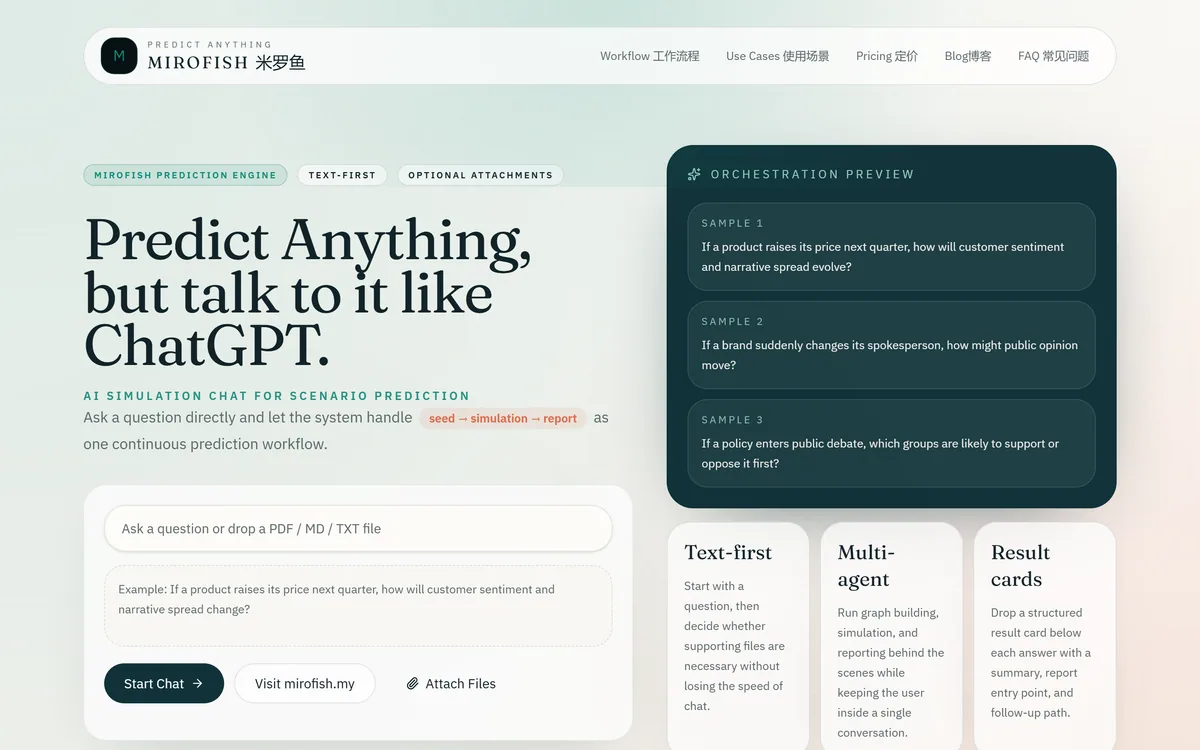
MiroFish is a multi-agent simulation platform for scenario prediction. You ask a plain-language question, attach supporting files, and it returns a structured report covering likely reactions, narrative paths, risk signals and follow-up questions.
Every organisation has a version of the same meeting. Someone proposes a change — new pricing, a policy, a public statement — and the room tries to imagine how people will react. It is guesswork performed by five people who share assumptions, and its main weakness is that nobody in the room thinks like the people who will be angry.
MiroFish attacks that with multi-agent simulation. You describe the scenario in plain language, attach supporting material, and several AI agents work through likely reactions from different positions, producing a structured prediction report.
This review covers what the five-stage workflow actually does, why the report's structure is the interesting design decision, how much confidence the output deserves, and where it beats simply asking a chatbot.
The output is a structured report with risk signals and narrative paths — not a single confident answer.
MiroFish, Described Plainly
It simulates reactions to a decision — a price change, a policy, a campaign — using multiple AI agents rather than one answer.
Files act as reality seeds. Attaching your own documents is what separates a grounded simulation from a well-written guess.
Output is a structured report: executive summary, risk signals, narrative paths and follow-up questions.
The follow-up questions may be the best part, because the value of a simulation is usually the objection you had not considered.
Treat it as structured stress-testing, not prediction. Nothing here forecasts what will actually happen.
The Five Stages, And What Each Contributes
MiroFish describes a workflow of Seed Material, Knowledge Graph, Agent Simulation, Prediction Report and Deep Interaction. The names are neat; the value is unevenly distributed across them.
Seed Material And Knowledge Graph
Seed material is what you supply — the question, and any files that establish the actual situation. The platform's own guidance about using files as reality seeds is the right emphasis, because this is where a simulation is either grounded in your circumstances or floating free.
A question asked without documents produces a generic answer about how people generally react to price rises. The same question with your pricing page, your customer segments and last year's complaints attached produces something about your price rise. The knowledge graph stage structures that material into relationships the agents can reason over.
Agent Simulation
This is the part doing the differentiating work. Rather than one model producing one answer, multiple agents reason from different positions — which is a structural way of forcing the disagreement that a room of like-minded colleagues does not produce.
The honest caveat is that these agents share an underlying model, so their independence is real but bounded. They are not genuinely different minds; they are the same reasoning approached from different framings. That still surfaces more than a single pass, and it is less than the diversity of actual people.
Prediction Report And Deep Interaction
The report arrives structured as executive summary, risk signals, narrative paths and follow-up questions, with deep interaction available to push on any part of it.
Being able to interrogate the report matters more than the report itself. A static document invites acceptance; a document you can argue with becomes a working session.
Why The Report Structure Is The Real Design
The four sections are a considered answer to how simulation output goes wrong.
Risk signals force the analysis to name what could go badly rather than producing a balanced summary that offends nobody. Balanced summaries are the standard failure of AI analysis and they are useless in a decision.
Narrative paths is the sharpest idea here. It acknowledges that reactions are not a distribution of independent opinions but stories that spread — and a modestly held objection that turns into a shareable narrative does far more damage than a widely held indifference.
Follow-up questions is the section experienced users will come to value most. The point of stress-testing a decision is rarely the answer; it is discovering the question nobody in the room asked.
And the executive summary exists because these reports have to survive being forwarded to someone who will read four sentences of it.
The useful output is not 'people will react badly'. It is the specific objection you had not thought of, phrased the way someone angry would phrase it.
How Much Confidence The Output Deserves
Considerably less than the word 'prediction' invites, and this is the section that matters most.
Agent simulations produce plausible reactions, not probable ones. A language model reasoning about how a customer segment will respond is drawing on how such responses are generally written about, which is a real signal and not the same thing as evidence about your customers.
The failure mode is subtle and specific: the output is coherent, well structured and confidently expressed, and none of those properties correlate with accuracy. A report that reads like analysis gets treated like analysis.
Read it as a structured brainstorm with unusual discipline. It is genuinely better than a room of colleagues at surfacing angles nobody occupies, and genuinely worse than talking to five actual customers at telling you what will happen. Both statements are true simultaneously.
It also cannot know anything unusual about your situation that you did not put in the files. That is the whole argument for taking the seed material seriously.
Good for: surfacing objections nobody in the room would raise
Good for: pressure-testing an announcement before it is final
Good for: generating the follow-up questions worth asking real people
Weak for: anything presented as a forecast of what will occur
Weak for: situations turning on facts you did not supply
Where To Actually Use It
The published use cases — campaign testing, pricing reactions, policy stress tests and market narrative — share a shape worth noticing. Each is a decision that is expensive to reverse, affects people who are not in the room, and normally gets made on intuition.
That is the sweet spot. A campaign can be tested cheaply with real audiences; a pricing change cannot be tested at all without making it, and a policy announcement gets exactly one launch.
The right sequence is to simulate first and then verify. Use MiroFish to generate the objections, then take the two or three most serious to actual customers or affected staff. That way the simulation is doing what it is good at — finding the question — while people supply the answer.
Using it the other way round, as the final check before shipping, is where organisations get into trouble.
Write the scenario as the real decision, including the parts that are awkward. A sanitised question produces a sanitised report.
Read the risk signals before the executive summary, so you engage with objections rather than the reassuring overview.
Push back through deep interaction on anything that seems too neat, and see whether it holds.
Extract the two or three sharpest follow-up questions and take those to real people.
Decide using the human answers, with the simulation as the thing that told you what to ask.
Keep the report afterwards and compare it against what actually happened — that is the only way to learn how much to trust the next one.
Three Terms Behind The Method
The approach is easier to judge once these are clear.
Multi-agent simulation
Several AI agents reasoning from different positions rather than one model producing one answer. It structurally forces disagreement, though the agents share an underlying model and are not genuinely independent minds.
Reality seed
Documents you attach that anchor the simulation in your actual situation. Without them you get a generic answer about how people react to things in general.
Narrative path
How a reaction spreads and mutates as a story, rather than as an isolated opinion. Often more consequential than how many people hold a view, since a shareable objection travels further than a common indifference.
Key features of mirofish
Multi-agent simulation of audience reactions to a scenario
Plain-language question input with attached supporting files
Knowledge graph construction from supplied material
Structured prediction report with executive summary and risk signals
Narrative path analysis of how reactions might spread
Generated follow-up questions to pursue with real people
Deep interaction for interrogating the report after generation
Playbooks for prompt writing and file-based grounding
Scenario templates for campaigns, pricing, policy and market narrative
Pros & cons
Pros
5
Multiple agents structurally force the disagreement a like-minded team cannot produce
Risk signals stop the output collapsing into a balanced summary that helps nobody
Narrative paths recognise that reactions spread as stories, not as independent opinions
The generated follow-up questions are a genuinely useful artefact in their own right
Being able to interrogate the report turns a document into a working session
Cons
5
Produces plausible reactions rather than probable ones, and reads more confident than it should
Agents share an underlying model, so their independence is bounded
Output quality depends entirely on the documents you supply as grounding
The word 'prediction' invites more confidence than the method can support
No substitute for asking real people whenever asking them is possible
Best For
Strategy teams pressure-testing a decision that cannot be piloted
Product managers weighing a pricing change before committing
Policy and communications teams preparing an announcement with one launch
Teams that share assumptions and need something to argue against them
Anyone wanting a sharper list of questions to take to real customers
MiroFish Versus Other Ways To Test A Decision
Simulation, synthetic research and real research answer overlapping questions with very different evidential weight.
Tool
What it produces
Grounded in
Evidential weight
MiroFish
Structured prediction report with risks and narrative paths
Playbooks on writing sharper prediction prompts and using files as reality seeds
Interaction
Deep interaction to interrogate the report after it is produced
Comparison framing
Positioned against a single chat answer and against manual research
Named audiences
Strategists, product managers, policy teams
When Is Simulation The Right Move?
Genuinely Useful When
The decision is expensive or impossible to reverse once made
You cannot test it with real people before committing — a price change, a policy
Your team shares assumptions and struggles to argue against itself
You have real documents to ground the simulation in
You want a list of objections worth taking to actual customers
Reach For Something Else When
You could simply ask real customers, which beats any simulation
You would present the output as evidence to a board
The situation depends on specifics you cannot put in a file
You want a forecast rather than a set of possibilities
The decision is reversible and cheap to test for real
Other Ways To Find Out What People Think
Simulated, survey-anchored, observed and directly asked — in ascending order of evidential weight.
neuroflash — simulated respondents anchored in real survey profiles rather than reasoning alone
Outset — AI-moderated research with actual participants
Brandwatch — what audiences have already said, observed rather than predicted
Klue — competitive intelligence for the market context around a decision
Anomaly AI — the internal data side of a decision, with numbers you can trace
What The Site Describes
Last checked . Read from mirofish.homes during this check, with the screenshot above captured at the same time.
The five-stage workflow — Seed Material, Knowledge Graph, Agent Simulation, Prediction Report, Deep Interaction — presented on the site
Report structure covering executive summary, risk signals, narrative paths and follow-up questions, shown in the site's report preview
Use cases named as Campaign Test, Pricing Reaction, Policy Stress Test and Market Narrative
Playbooks on writing sharper prediction prompts and using files as reality seeds, published on the site
Inputs described as a plain-language question with optional attached files
The site's own comparison framing against a single chat answer and against manual research
Stated audiences of strategists, product managers and policy teams
No plan prices published here, in line with this site's pricing policy
Judgements about how much confidence agent simulation deserves reflect the state of the technique generally rather than measured performance of this platform. We have not tested output accuracy against real-world outcomes, and say so rather than implying otherwise.
Editor's Verdict
3.7/5
mirofish has an AInexfinder Editor Score of 3.7/5.
mirofish pricing
AInexfinder does not list plan prices or billing details. For current pricing, plans, and trials, visit the official mirofish website.
Vendor pricing, credits, and billing policies change over time. Always confirm on the official site before you buy.
Frequently asked questions
What does MiroFish actually do?
You describe a scenario in plain language and attach supporting files, and multiple AI agents work through likely reactions from different positions. The output is a structured report covering risk signals, narrative paths and follow-up questions rather than a single answer.
How is this different from asking ChatGPT?
Two things. Multiple agents reason from different positions rather than one model producing one response, and the report is structured to force uncomfortable content — risk signals and narrative paths — instead of a balanced summary. The grounding in your own uploaded documents is the third difference.
Can I trust the predictions?
Treat them as plausible rather than probable. A model reasoning about how a segment will react is drawing on how such reactions are generally written about, which is a real signal and not evidence about your customers. The output reads confident; that confidence is not a measure of accuracy.
Why do the attached files matter so much?
Because without them you get a generic answer about how people react to price rises in general. With your pricing page, your segments and last year's complaints attached, you get something about your situation. The platform's own guidance about files as reality seeds is the right emphasis.
What is the most useful part of the report?
The follow-up questions, for most users. The point of stress-testing a decision is rarely the answer — it is discovering the question nobody in the room thought to ask, and then taking that question to real people.
When should I use real research instead?
Whenever you can. If the decision is reversible and testable with actual customers, do that — it beats any simulation. Simulation earns its place when testing is impossible before committing, as with a price change or a policy that launches once.
Can I present this output to a board?
Not as evidence. It is a structured brainstorm with unusual discipline, and describing it as research would misrepresent what it is. Use it to find the objections, verify the serious ones with people, and present those findings instead.
Daniel reviews AI tools the slow way — by actually using them on real projects. His reviews cover what works, what breaks, and who each tool is genuinely a good fit for.
Daniel and the AInexfinder editorial team research mirofish using public product information, listing evidence, and (when available) hands-on checks. Scores reflect listing completeness and transparency — not paid placement.
Listings may include affiliate or sponsored placements, which are labeled when present. Editorial scores and cons are not sold. See our affiliate disclosure and review methodology.
axess is a free AI job-search tool that scans LinkedIn, Indeed and Glassdoor daily, scores each role against your profile on both relevance and likelihood, researches the employer, and prepares a tailored CV and cover letter for the matches worth pursuing.
Otter.ai transcribes meetings live, writes summaries and action items, and organises everything into searchable Channels — with OtterPilot joining Zoom, Teams, and Google Meet, plus role-specific agents for sales, recruiting, and SDR work.
CrewAI is an enterprise platform to build and run AI agents: a Discovery layer that finds automation opportunities, a no-code canvas and code-first Python API for building role-based multi-agent workflows, and a control plane that adds tracing, RBAC, audit and human-in-the-loop approvals.
AudioNotes is an AI note-taker that turns voice, audio, video and text into structured notes, transcripts and summaries in 99+ languages, with custom templates, chat-with-your-notes, integrations, and a clear no-AI-training privacy stance.
Goodnotes is a handwriting-first note-taking app spanning iPad, iPhone, Mac, Windows, Android and web. It converts handwriting to text, searches across typed text, handwriting and sketches, annotates PDFs, records and transcribes audio, and turns notes into mind maps and project plans.
Pitch is a cloud presentation workspace built around collaboration rather than authorship: live co-editing, slide assignments, a shared brand library, bulk personalised decks from imported customer data, custom deal rooms and viewer analytics, used by a stated 4 million-plus teams.