Nabla is a clinical AI platform for ambient documentation, dictation and coding. It generates structured notes from patient-clinician conversations, integrates with Epic, athenahealth, Oracle Health, NextGen and others, and states 85,000+ clinicians and 20M+ annual encounters.
Clinicians spend a substantial part of every day writing notes, and almost none of that time is spent on the patient in front of them.
The documentation burden is not a minor irritation. It is one of the most consistently cited drivers of clinical burnout, it extends the working day past the last appointment, and it turns a conversation into a typing exercise conducted over a screen.
Ambient documentation is the most convincing application of language models in medicine precisely because it does not practise medicine. It listens, and it writes down what was said — which is the part of the job nobody trained for and nobody wanted.
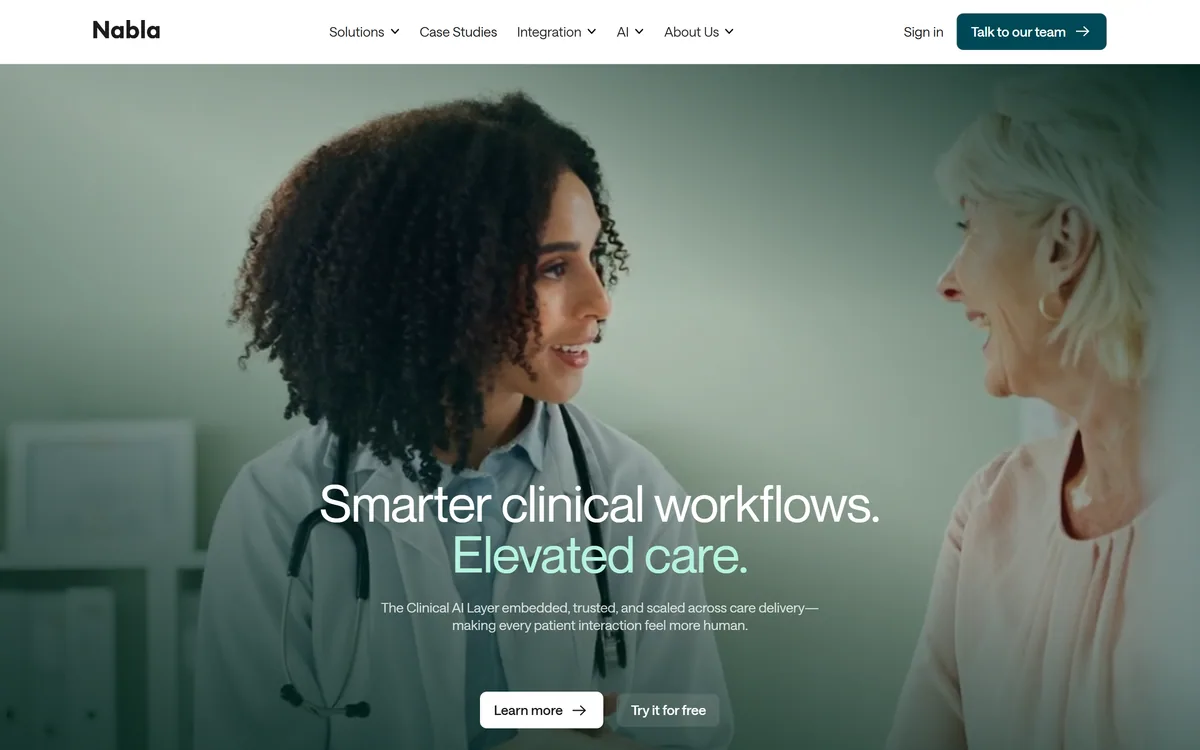
Nabla's homepage, captured 9 September 2026, showing the ambient documentation and EHR positioning.
What Nabla Ships Today
Ambient documentation — it listens to the consultation and produces a structured clinical note without the clinician typing.
Dictation and coding too: clinical-grade speech recognition inside the EHR, plus E/M and ICD-10 suggestions aligned with AMA guidelines.
Deep EHR integration with Epic, athenahealth, Oracle Health, NextGen, Arya EHR and Greenway Health.
Deployment at real scale: 130+ health organisations, 85,000+ clinicians, 20M+ patient encounters annually, with CVS Health, Carle Health and Denver Health named.
HIPAA, SOC 2 Type 2, ISO 27001 and GDPR, with offices in Brooklyn and Paris.
What Does Ambient Documentation Actually Change?
Nabla's ambient documentation captures the patient-clinician conversation and generates a structured clinical note from it automatically.
The change is in where the clinician's attention goes. Typing during a consultation splits it — the clinician is listening, deciding and transcribing at once, and the patient is talking to someone looking at a monitor. Removing the transcription lets the consultation be a conversation again.
That is a quality-of-care argument as much as an efficiency one, and it is the more durable of the two. Patients disclose more to someone looking at them, and a clinician not composing a sentence while listening catches more of what was said.
The efficiency case is real too and is usually stated as time reclaimed after hours. Documentation that would otherwise be finished in the evening — the phenomenon clinicians call pyjama time — is largely done by the end of the appointment.
The critical distinction is what the tool does not do. It does not diagnose, does not decide, and does not carry any clinical responsibility. It records a conversation and structures it, and every word of the resulting note remains the clinician's — which is why review before signing is not optional.
The distinction from general transcription is worth holding. A meeting tool like Otter.ai produces a record of a conversation; a clinical note is a legal document with a required structure.
Ambient documentation is convincing precisely because it does not practise medicine. It writes down what was said, which is the part nobody trained for.
Coding Suggestions And Where The Money Is
Nabla also offers coding: E/M and ICD-10 suggestions aligned with AMA guidelines, and this is where the platform touches revenue rather than time.
Coding decides what a visit is reimbursed at, and clinicians are systematically bad at it — not through carelessness but because the guidelines are complex, they change, and nobody became a doctor to study billing taxonomy.
The characteristic error is under-coding. A clinician who did the work of a higher-level visit but documented it at a lower level loses the difference, and does so quietly and repeatedly. Suggestions drawn from what the note actually contains correct that asymmetry.
The risk is the mirror image and needs saying plainly: coding above what the documentation supports is not an administrative error but a compliance problem, and in some contexts a serious one. A suggestion is a prompt for a human decision, never a justification.
The honest framing is that this feature is where ambient AI most obviously pays for itself, and also where it needs the most governance. A clinic deploying it should decide in advance who reviews coding suggestions and against what standard.
EHR Integration Is The Whole Ballgame
Nabla lists integrations with Epic, athenahealth, Oracle Health, NextGen, Arya EHR and Greenway Health, and this list matters more than any accuracy claim.
The reason is what happens without it. A documentation tool that produces excellent notes in its own interface has created a copy-and-paste task, and a clinician who must move a note manually between systems has saved very little and gained a second place for things to go wrong.
Integration is also brutally hard in healthcare. Epic in particular is a substantial engineering and commercial undertaking, and the presence of a working integration is itself evidence that a vendor has cleared reviews most cannot.
The list's composition tells you who Nabla is built for. Epic and Oracle Health cover large health systems; athenahealth, NextGen and Greenway cover ambulatory and independent practices. That is deliberate breadth rather than a single-segment bet.
The practical question for any specific buyer is not whether an integration exists but how deep it goes — whether the note lands in the right encounter, in the right template, with the right metadata, or whether it arrives as a block of text somebody has to file.
Anyone tempted to build this themselves on a speech API such as Deepgram or AssemblyAI should price the EHR integration first, because that is where the effort actually lives.
Confirm not just that your EHR integrates but how deeply the note lands in it.
Decide in advance who reviews coding suggestions and against what standard.
Treat every generated note as a draft the clinician is legally responsible for.
Check language coverage against your actual patient population.
Establish patient consent practice for recording before the first pilot session.
Reading 130 Organisations And 85,000 Clinicians
Nabla states 130+ health organisations deployed, 85,000+ clinicians using the platform, and 20M+ patient encounters annually, naming CVS Health, Carle Health, Denver Health, Tia Health and the University of Toledo Health.
These figures are more informative than most vendor numbers, because healthcare procurement is exceptionally slow and exceptionally thorough. A hospital system does not deploy a tool that touches the clinical record without security review, legal review, clinical governance and a pilot.
The encounter figure is the most useful of the three. Organisations and clinicians can be counted generously; 20 million encounters a year is a usage measure, and usage is what distinguishes a deployment from a purchase that nobody opened.
Denver Health is a notable name for a specific reason: it is a safety-net institution serving a complex, diverse patient population, which is a harder environment for speech recognition than a well-resourced private practice.
None of this is audited, and all of it is vendor-stated. But the combination of named customers, an encounter-volume figure and integrations with Epic is a considerably stronger evidence base than a percentage claim, and it is the right thing to weight.
The patient-facing half of the same encounter is a separate product category, served by tools such as Soula, and it carries entirely different risks.
Piloting Ambient AI In A Clinic
Ambient documentation succeeds or fails on details that never appear in a demo: accents, noisy rooms, interruptions, and the clinician who talks in fragments.
A pilot that runs in a quiet office with a cooperative patient proves nothing about a Tuesday afternoon.
Settle patient consent practice for recording first, with your legal team, before a single session.
Pilot with clinicians who document differently from each other, including the fastest and the most thorough.
Include your genuinely hard consultations — strong accents, background noise, interpreters, patients who interrupt.
Have each clinician compare the generated note against what they would have written, and record what was missing rather than what was right.
Verify the note lands in the correct encounter and template in your EHR without manual filing.
Audit a sample of coding suggestions against your compliance standard before letting anyone accept them routinely.
Nabla: Deployment And Compliance
Product type
Clinical AI platform for documentation, dictation and coding
Ambient Documentation
Structured clinical notes generated from the consultation
Dictation
Clinical-grade speech recognition integrated into the EHR
Coding
E/M and ICD-10 suggestions aligned with AMA guidelines
EHR integrations
Epic, athenahealth, Oracle Health, NextGen, Arya EHR, Greenway Health
Languages
English and French
US office
1 Dock 72 Way, Brooklyn, NY 11249
France office
22 rue Chapon, 75003 Paris
Organisations
130+ health organisations deployed
Clinicians
85,000+
Encounters
20M+ patient encounters annually
Named customers
CVS Health, Carle Health, Denver Health, Tia Health, University of Toledo Health
Compliance
HIPAA, SOC 2 Type 2, ISO 27001, GDPR
Footer sections
Solutions, Resources, Company, Legal
Should Your Clinic Deploy Nabla?
A fit for your clinic when
Documentation is measurably extending your clinicians' working day.
You run Epic, athenahealth, Oracle Health, NextGen or Greenway Health.
Your consultations are conducted in English or French.
Under-coding is costing you revenue you can demonstrate.
You have the governance capacity to review notes and coding suggestions properly.
Not yet when
Your patient population speaks languages the platform does not support.
Your EHR is not on the integration list, which turns notes into a filing task.
You cannot establish clear patient consent practice for recording consultations.
Nobody will own the review standard for generated notes and codes.
Your documentation burden is administrative rather than clinical, which this does not touch.
Key features of Nabla Copilot
Ambient documentation producing structured clinical notes from the consultation
Clinical-grade dictation integrated into the EHR
E/M and ICD-10 coding suggestions aligned with AMA guidelines
Integrations with Epic, athenahealth, Oracle Health, NextGen, Arya EHR and Greenway Health
English and French language support
HIPAA, SOC 2 Type 2, ISO 27001 and GDPR compliance
Deployment across large health systems and independent practices alike
Pros & cons
Pros
7
Deployment evidence is unusually concrete: named systems, clinician counts and encounter volume
20M+ annual encounters is a usage measure rather than a purchase count
Integration with Epic and five other EHRs, which is the hardest part of this category
Attacks documentation burden, one of the most cited drivers of clinical burnout
Coding suggestions address systematic under-coding, where the revenue case is clear
Full compliance set including HIPAA, SOC 2 Type 2, ISO 27001 and GDPR
Named physical offices in Brooklyn and Paris rather than an anonymous site
Cons
6
Only English and French, which rules out much of the world's clinical work
Every generated note remains the clinician's legal responsibility on attestation
Coding suggestions carry compliance risk if accepted without review
Supported specialties are not enumerated on the pages we read
Audio retention and deletion policy is not stated
No independent accuracy benchmark, including across accents, is published
Best For
Health systems running Epic or Oracle Health
Ambulatory practices on athenahealth, NextGen or Greenway
Clinics where documentation extends the working day past the last patient
Organisations losing revenue to systematic under-coding
English and French-speaking clinical environments
Nabla Against Other Clinical AI
Tools that touch the clinical record are judged on integration and governance long before they are judged on accuracy.
Tool
What it does
Where the output lands
Best for
Nabla
Ambient notes, dictation and coding
Directly in Epic, athenahealth and others
Health systems and practices wanting documentation removed
Last checked . Read from nabla.com and its footer navigation, with the screenshot above captured in the same session.
Product positioned as a clinical AI platform automating medical documentation
Ambient Documentation confirmed as capturing patient-clinician conversations and generating structured clinical notes
Dictation confirmed as clinical-grade speech recognition integrated into EHRs
Coding confirmed as E/M and ICD-10 suggestions aligned with AMA guidelines
EHR integrations confirmed for Epic, athenahealth, Oracle Health, NextGen, Arya EHR and Greenway Health
Languages confirmed as English and French
US address confirmed as 1 Dock 72 Way, Brooklyn, NY 11249
France address confirmed as 22 rue Chapon, 75003 Paris
130+ health organisations stated as deployed
85,000+ clinicians stated as using the platform
20M+ patient encounters annually stated
Named customers confirmed on the site as CVS Health, Carle Health, Denver Health, Tia Health and University of Toledo Health
Compliance stated as HIPAA, SOC 2 Type 2, ISO 27001 and GDPR
Footer sections confirmed for Solutions, Resources, Company and Legal
What we could not confirm: which underlying speech and language models are used, and whether processing is on-device or in the cloud; medical specialties explicitly supported, which the pages we read did not enumerate; pricing or licensing structure; how audio recordings are retained or deleted after a note is produced; measured transcription accuracy, including across accents; how deeply each EHR integration writes into the record; and independent verification of the deployment figures or certifications. We did not use the product, so nothing here reflects tested note quality.
Editor's Verdict
4.4/5
Nabla is one of the strongest listings in this category because the deployment evidence is unusually concrete: 130+ health organisations, 85,000+ clinicians, 20M+ encounters a year, and named customers including CVS Health, Carle Health and Denver Health. Healthcare buyers do not adopt at that scale casually, and the integration list — Epic, athenahealth, Oracle Health, NextGen, Greenway — is the part that decides whether ambient AI is usable or a second screen. HIPAA, SOC 2 Type 2, ISO 27001 and GDPR cover the compliance floor. What keeps it short of the top is that only English and French are supported, and a generated note remains the clinician's legal responsibility. AInexfinder Editor Score: 4.4/5.
Nabla Copilot pricing
AInexfinder does not list plan prices or billing details. For current pricing, plans, and trials, visit the official Nabla Copilot website.
Vendor pricing, credits, and billing policies change over time. Always confirm on the official site before you buy.
Frequently asked questions
What is Nabla?
Nabla is a clinical AI platform covering ambient documentation, dictation and coding. It generates structured clinical notes from patient-clinician conversations, integrates with Epic, athenahealth, Oracle Health, NextGen, Arya EHR and Greenway Health, and states deployment across 130+ health organisations and 85,000+ clinicians.
What does ambient documentation actually do?
It listens to the consultation and produces the clinical note, so the clinician is not typing while listening. The change is in attention: a patient talking to someone looking at a monitor discloses less, and a clinician composing a sentence catches less. Removing the transcription lets the consultation be a conversation again.
Does Nabla diagnose or make clinical decisions?
No. It records the conversation and structures it, and that limit is why ambient documentation is the most convincing clinical application of language models — it does not practise medicine. Every word of the resulting note remains the clinician's responsibility on attestation, which is why review before signing is not optional.
Which EHRs does Nabla integrate with?
Epic, athenahealth, Oracle Health, NextGen, Arya EHR and Greenway Health. That list matters more than any accuracy claim: a tool producing excellent notes in its own interface has created a copy-and-paste task. Ask not only whether your EHR is supported but how deeply the note lands — right encounter, right template, right metadata.
How does the coding feature work?
It suggests E/M and ICD-10 codes aligned with AMA guidelines, based on what the note contains. The value is correcting under-coding, where a clinician did higher-complexity work and documented it lower, losing the difference quietly and repeatedly. The risk is the mirror image, and coding above what documentation supports is a compliance problem, not a clerical one.
What languages does Nabla support?
English and French. That is a genuine limitation for anywhere with a multilingual patient population, and it is the first thing to check against your own caseload. A tool that cannot document a consultation conducted through an interpreter, or in a patient's first language, does not remove the documentation burden for those visits.
How reliable are the 130 organisations and 85,000 clinicians figures?
They are vendor-stated and unaudited, but more informative than most such numbers because healthcare procurement is slow and thorough — a hospital system does not deploy a tool touching the clinical record without security, legal and clinical review. The 20M+ annual encounters figure is the strongest, because usage distinguishes a deployment from a purchase.
What security certifications does Nabla hold?
HIPAA, SOC 2 Type 2, ISO 27001 and GDPR. In healthcare that is a floor rather than a differentiator — no organisation would begin an evaluation without it. What is not stated is how audio recordings are retained or deleted once a note has been produced, which is worth resolving before a pilot.
Do patients need to consent to being recorded?
Consent practice varies by jurisdiction and by institution, and settling it with your legal team is the first step rather than an afterthought. It is also a clinical matter as much as a legal one: a patient who is uncomfortable being recorded may disclose less, which defeats the point of the tool.
How should a clinic pilot this?
With your hard consultations, not your easy ones — strong accents, background noise, interpreters, patients who interrupt. Pilot across clinicians who document differently, including the fastest and the most thorough. Have each compare the generated note against what they would have written, and record what was missing rather than what was right.
Daniel reviews AI tools the slow way — by actually using them on real projects. His reviews cover what works, what breaks, and who each tool is genuinely a good fit for.
Daniel and the AInexfinder editorial team research Nabla Copilot using public product information, listing evidence, and (when available) hands-on checks. Scores reflect listing completeness and transparency — not paid placement.
Listings may include affiliate or sponsored placements, which are labeled when present. Editorial scores and cons are not sold. See our affiliate disclosure and review methodology.
RecipeScan is an Apple-only cooking app that builds a pantry from photos, suggests recipes against what you already have, and coordinates three dishes onto one timeline. It adds grocery lists, budget tracking, calorie estimates and a hands-free cooking mode.
RelaxFrens is a personalised meditation and sleep app that builds a plan around your goals, schedule and daily mood check-ins. Its companion, Fren, guides breathing exercises and conversations, and the app uses streaks, badges, nature sounds and adjustable voices and session lengths.
moonbird is a tactile, screen-free handheld breathing coach that expands and contracts in your palm to pace your breath, reads your pulse and HRV, and pairs with an app whose Aura AI coach personalises the rhythm, aimed at calm and sleep as a wellbeing tool.
Youper is an AI emotional-health assistant built around conversational check-ins, mood tracking and journaling. The company has announced it is shutting down on 30 September 2026, after which accounts, chat history and personal data are permanently deleted.
Aura is a personalised mental-wellness and sleep app bundling meditation, sleep tracks, hypnosis, CBT-style content, coaching, breathwork and more, with AI-driven recommendations and live coach and therapist sessions, offered as a freemium subscription and framed here as a wellbeing aid, not medical care.
Insight Timer offers a very large free audio library for meditation, sleep, yoga and breathwork, contributed by psychologists, spiritual leaders and mindfulness teachers. Live yoga and breathwork sessions run alongside courses, with a Member Plus subscription above a genuinely free core.