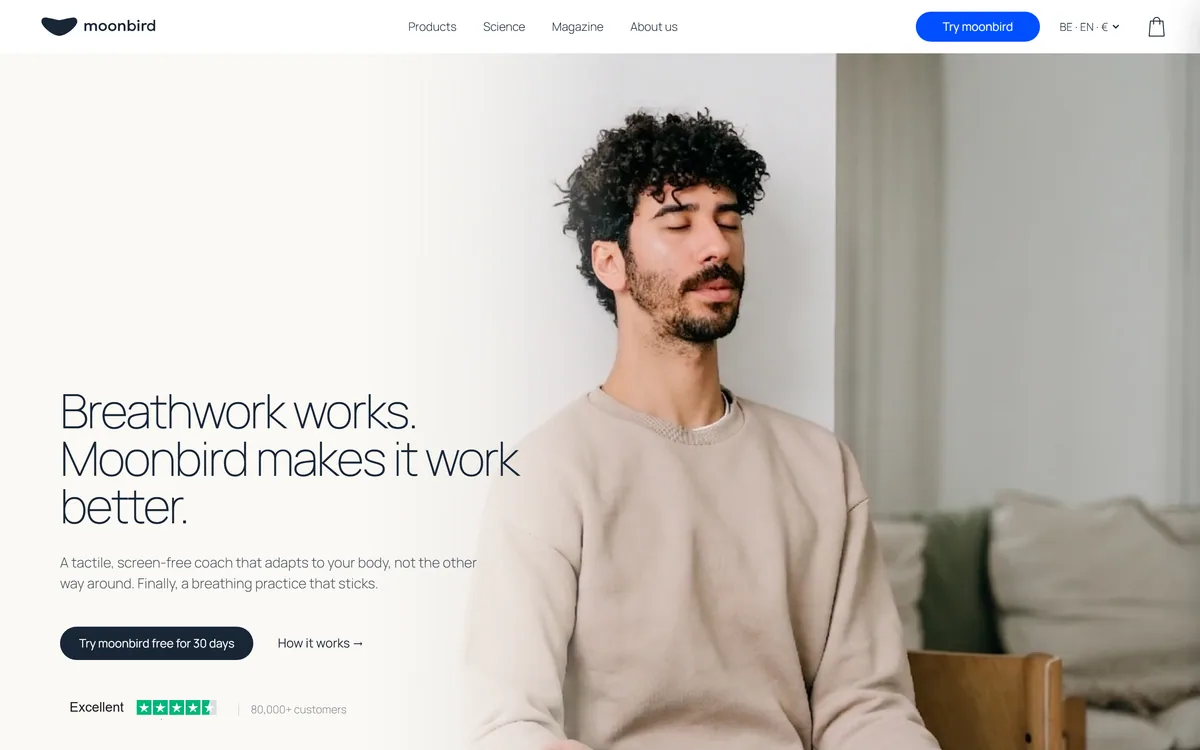
moonbird is a tactile, screen-free handheld breathing coach that expands and contracts in your palm to pace your breath, reads your pulse and HRV, and pairs with an app whose Aura AI coach personalises the rhythm, aimed at calm and sleep as a wellbeing tool.
moonbird.life11 viewsAdded October 12, 20254K visitors
A note on what this is moonbird is a wellbeing and relaxation tool, not a medical device or a treatment. It is not a substitute for professional care, and it is not for a mental-health crisis. We review it as a calm-and-sleep aid, and any health or reimbursement claims are the vendor's, to verify for your situation.
Breathing exercises work, but most of us abandon them because following a counting app with your eyes open defeats the point. moonbird's answer is physical: a device that does the pacing for you, by touch.
It is a screen-free handheld coach that expands and contracts in your palm so you breathe along with it, reads your pulse to find a pace that suits you, and pairs with an app whose AI coach, Aura, personalises the rhythm. It belongs with calm-and-sleep tools like a breathwork app such as Brizzy, but its distinguishing feature is that it is a thing in your hand, not another screen.
This review covers how moonbird paces and reads your breath, what it is honestly for and what it is not, how the device and app are priced, and who it suits, treating its health claims as claims.
moonbird paces your breathing by touch, so you can close your eyes and follow it.
A Breathing Coach You Hold In Your Hand
The core insight behind moonbird is simple and good: the moment you have to watch a screen or count, you are no longer relaxing. By moving the pacing into a physical object that expands and contracts against your palm, it lets you close your eyes and simply follow.
That tactile approach is the whole reason it exists, and it is a genuine point of difference in a category crowded with apps. You feel the rhythm rather than track it, which is both easier to sustain and more conducive to actually calming down.
It is a hardware-plus-app product, with a kids' companion called moonbuddy, and it is used by individuals, therapists alongside their own practice, and in some schools and hospitals, which gives a sense of how broadly the simple idea travels.
The moment you have to watch a screen or count, you are no longer relaxing. moonbird moves the pacing into something you feel in your palm, so you can close your eyes and follow.
How Does moonbird Pace And Read Your Breath?
The device and app split the work: one guides the breath, the other reads how your body responds.
A Device That Expands And Contracts
You rest your thumb on the sensor, and the device gently expands and contracts to lead your inhale and exhale, no screen, no counting. Over an onboarding period it uses your pulse to find a breathing pace suited to you rather than a one-size standard.
That personalised pace is a thoughtful touch, because the 'correct' breathing rhythm is not the same for everyone. A meditation library like Insight Timer offers guided sessions, but moonbird's value is the physical pacing that needs no attention on a screen.
HRV Biofeedback And The Aura Coach
Open the app and you get real-time heart-rate-variability biofeedback and a coherence score, plus session logging that tracks duration, HRV and mood over time. Aura, the AI coach, reads your data, picks a protocol and adapts the pace as you go.
The biofeedback loop is what turns a nice gadget into something you can actually see working, session to session. For the quieter, mindfulness side of a wind-down routine, pairing it with a calm app like StillMind is a reasonable combination.
What moonbird Is For, And What It Is Not
moonbird is a wellbeing tool for calm, stress relief and better sleep. It is honest, in its own terms, about living in that space, and this review keeps it there: it is not a medical device and not a treatment for a clinical condition.
Its site cites peer-reviewed studies and mentions insurer reimbursement in some regions. Those are meaningful signals, but they are the vendor's claims; whether a health benefit or reimbursement applies to you is something to verify with the relevant study or your own provider, not to assume from a product page.
Most importantly, a breathing device is not help in a crisis. If you are dealing with severe anxiety, trauma or thoughts of self-harm, that calls for professional care, and moonbird neither claims nor should be treated as a substitute for it.
How moonbird Charges For Device And App
moonbird is a one-time hardware purchase for the device and accessories, plus a freemium app: a basic app comes with the device, and a Premium tier (Aura and advanced insights) is a subscription with a free trial, alongside a money-back guarantee and a warranty. We do not publish prices; check the site.
Because there is a physical product involved, the value question is different from pure software: you are buying an object you will either reach for or leave in a drawer. The honest test is whether the tactile pacing makes you actually practise.
The money-back guarantee lowers the risk of finding that out, and the free app trial means you can judge whether the Aura coaching is worth the subscription on top of the hardware.
A Careful Way To Try moonbird
Because this is hardware you build a habit around, judge it over a couple of weeks of honest use, not a single try.
Use the device nightly or at a set stress point for a week, following the expansion with eyes closed.
Let the onboarding find your personal pace rather than forcing a standard rhythm.
Open the app and watch the HRV and coherence feedback to see whether your body is responding.
Try the Aura coach on the free trial before deciding the Premium tier is worth it.
Notice honestly whether you reach for it, which is the real test for any wellbeing device.
Pass/fail: moonbird is worth it if it gets you practising calm regularly and you feel the benefit.
If your need is clinical rather than everyday stress, seek professional care, not a gadget.
moonbird, The Plain Summary
moonbird is a handheld breathing coach: a screen-free device that expands and contracts in your palm to pace your breath.
It reads your body: it senses your pulse and finds a breathing pace suited to you, with HRV biofeedback in the app.
An AI coach, Aura, personalises it: it adapts the rhythm in real time and remembers past sessions.
It is a wellbeing aid, not medical care: aimed at calm and sleep, not treatment, and not for a crisis.
Key features of Moonbird
Tactile expand-and-contract breathing pacing
Screen-free, eyes-closed use
Pulse-based personalised pace
Real-time HRV biofeedback
Aura AI breathing coach
Session logging and trends
moonbuddy kids' companion
Wearable integrations
Pros & cons
Pros
5
Tactile pacing removes the screen that breaks relaxation
Personalises the pace from your own pulse
HRV feedback makes progress visible
Honest about being a wellbeing aid
Money-back guarantee lowers the risk of trying
Cons
5
A hardware purchase, not a free app
Health and reimbursement claims are vendor-stated
Not for crises or clinical treatment
Premium coaching is a separate subscription
Only works if you build the habit
Best For
People who quit breathing apps
Screen-averse relaxers
HRV-motivated users
Sleep wind-down routines
Families wanting a kids' version
moonbird Against App-Only Breathing Tools
The useful comparison is between a physical device and the screen-based calm tools it competes with.
People who start breathing apps but never stick with them
Anyone who finds screens get in the way of relaxing
Those who like seeing HRV feedback to stay motivated
People building a wind-down routine for better sleep
Parents wanting a kid-friendly version via moonbuddy
When moonbird Is Not The Tool
Anyone in a mental-health crisis, who needs professional care
People seeking a medical treatment rather than a wellbeing aid
Those who will not build a regular practice
Anyone unwilling to buy hardware over a free app
Users expecting guaranteed clinical outcomes
What We Confirmed About moonbird
Last checked . Read from moonbird.life during this check, with the screenshot above captured at the same time.
A screen-free handheld device that paces breathing by touch
Pulse sensing to find a personalised breathing pace
Real-time HRV biofeedback and a coherence score in the app
An AI coach, Aura, that adapts the rhythm and remembers sessions
Session logging for duration, HRV and mood over time
A kids' companion, moonbuddy, and wearable integrations
A one-time device purchase plus a freemium app with a Premium tier
A money-back guarantee and a device warranty
No plan prices reproduced here, in line with this site's pricing policy
moonbird is a wellbeing aid, not medical care, and not for a crisis. Its peer-reviewed and insurer-reimbursement claims are the vendor's; verify them for your own situation.
Other Calm And Wellbeing Tools
A breathwork app, a meditation library and a mindfulness app to weigh alongside moonbird.
StillMind — quiet mindfulness and wind-down content
Editor's Verdict
3.9/5
moonbird earns 3.9 for a genuinely clever idea executed well: moving breath pacing into a screen-free device you feel in your palm, backed by pulse-based personalisation, HRV biofeedback and an adaptive AI coach. It is a wellbeing aid rather than medical care, its health and reimbursement claims are the vendor's to verify, and it only works if you build the habit, but for people who abandon breathing apps it solves the real problem. AInexfinder Editor Score: 3.9/5.
Moonbird pricing
AInexfinder does not list plan prices or billing details. For current pricing, plans, and trials, visit the official Moonbird website.
Vendor pricing, credits, and billing policies change over time. Always confirm on the official site before you buy.
Frequently asked questions
What is moonbird?
moonbird is a screen-free handheld breathing coach. The device expands and contracts in your palm to pace your inhale and exhale, senses your pulse to personalise the rhythm, and pairs with an app that shows HRV biofeedback and an AI coach, Aura, aimed at calm and better sleep.
Is moonbird a medical device?
No. moonbird is a wellbeing and relaxation tool, not a medical device or a treatment, and it is not a substitute for professional care. We review it as a calm-and-sleep aid; any health benefit or insurer-reimbursement claims are the vendor's and should be verified for your situation.
How does moonbird pace my breathing?
You rest your thumb on its sensor and the device gently expands and contracts to lead your breath, with no screen or counting required. During onboarding it uses your pulse to find a breathing pace suited to you rather than applying a single standard rhythm.
What does the Aura AI coach do?
Aura reads your biofeedback data, selects a breathing protocol, adapts the pace in real time, and remembers past sessions so the coaching improves with use. It is part of the Premium app tier, so you can trial it before deciding whether it is worth the subscription.
Can moonbird help with a mental-health crisis?
No. A breathing device is not help in a crisis. If you are dealing with severe anxiety, trauma or thoughts of self-harm, that needs professional care, and moonbird neither claims to be nor should be treated as a substitute for it. Contact a professional or a crisis line.
How is moonbird priced?
It is a one-time purchase for the device and accessories, plus a freemium app: a basic app comes with the device and a Premium tier adds Aura and advanced insights on subscription, with a free trial, a money-back guarantee and a warranty. We do not publish prices; check the site.
Does moonbird really track how my body responds?
Yes. The app provides real-time heart-rate-variability biofeedback and a coherence score, and logs session duration, HRV and mood over time. That feedback loop is what lets you see whether your body is actually settling, session to session, rather than just following a rhythm.
Is there a version for children?
Yes. moonbuddy is a kids' companion with simpler breathing rhythms and a child-friendly design, without lights, alarms or an app. It applies the same tactile pacing idea in a form aimed at younger users, which parents may find easier than a screen-based tool.
Does moonbird need my phone to work?
The device paces your breathing on its own, so you can use it without a phone. The app adds the extras, HRV biofeedback, session history and the Aura coach, so you need it only for the data and personalised coaching, not for the basic breathing guidance.
Who should not buy moonbird?
Anyone looking for a medical treatment rather than a wellbeing aid, anyone in crisis who needs professional help, and people who will not build a regular practice. Because it is a hardware purchase, it is only worth it if you will actually reach for it.
Daniel reviews AI tools the slow way — by actually using them on real projects. His reviews cover what works, what breaks, and who each tool is genuinely a good fit for.
Daniel and the AInexfinder editorial team research Moonbird using public product information, listing evidence, and (when available) hands-on checks. Scores reflect listing completeness and transparency — not paid placement.
Listings may include affiliate or sponsored placements, which are labeled when present. Editorial scores and cons are not sold. See our affiliate disclosure and review methodology.
RelaxFrens is a personalised meditation and sleep app that builds a plan around your goals, schedule and daily mood check-ins. Its companion, Fren, guides breathing exercises and conversations, and the app uses streaks, badges, nature sounds and adjustable voices and session lengths.
Aura is a personalised mental-wellness and sleep app bundling meditation, sleep tracks, hypnosis, CBT-style content, coaching, breathwork and more, with AI-driven recommendations and live coach and therapist sessions, offered as a freemium subscription and framed here as a wellbeing aid, not medical care.
Insight Timer offers a very large free audio library for meditation, sleep, yoga and breathwork, contributed by psychologists, spiritual leaders and mindfulness teachers. Live yoga and breathwork sessions run alongside courses, with a Member Plus subscription above a genuinely free core.
StillMind is an iOS and Android meditation app that generates a session from what you describe — choosing technique, length and script to match the moment. It adds a voice journal, mood-tagged entries, AI-composed courses and pattern tracking without streaks.
Brizzy is a guided-breathing app with 30 evidence-rated techniques, an AI coach that tailors sessions in 70+ languages, and an unusually honest, four-level evidence rating for each technique. It runs instantly in the browser and is a wellness tool, not medical care.