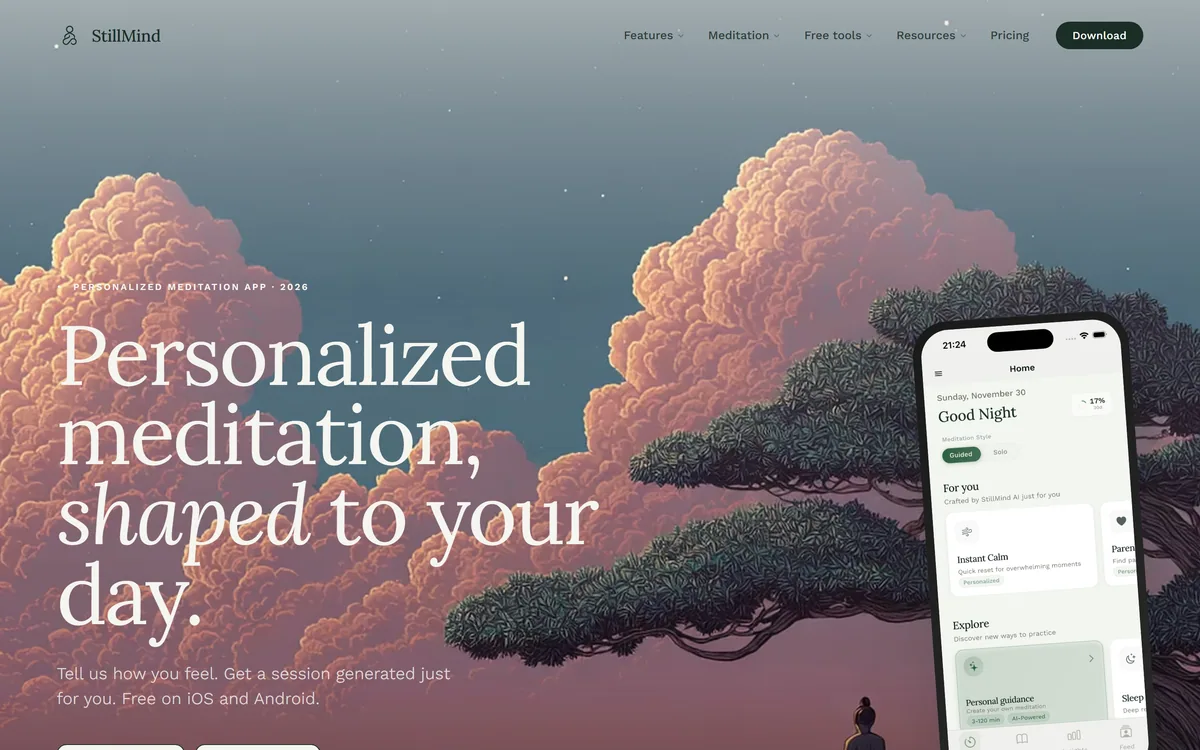
StillMind is an iOS and Android meditation app that generates a session from what you describe — choosing technique, length and script to match the moment. It adds a voice journal, mood-tagged entries, AI-composed courses and pattern tracking without streaks.
getstillmind.com11 viewsAdded September 2, 20252K visitors
The problem with meditation libraries is the browsing. You open the app already agitated, scroll through forty sessions trying to guess which one fits, pick wrong, and spend eight minutes being guided towards a state you were not in.
StillMind's answer is to remove the choosing. You describe what is going on — wound up before a meeting, awake at 2am, flat and unmotivated — and it generates a session with a technique, a length and a script chosen for that description rather than for a category on a shelf.
This review covers whether generated guidance holds up against recorded sessions, what the journalling side adds, why the deliberate absence of streaks is a real design decision, and where a small independent app has limits worth knowing about.
The premise: describe the state you are in, and the session is built around it rather than selected from a shelf.
StillMind In Under A Minute
Sessions are generated, not selected. You describe the state you are in and the app builds the technique, length and script around it.
Eight named techniques — body scan, breath focus, Yoga Nidra, loving-kindness, intention setting, affirmations, manifestation and gratitude.
No streaks. Pattern tracking shows a weekly view deliberately without the streak mechanics that make missing a day feel like failure.
Privacy is a design position: end-to-end encryption, no ads, no data selling, offline use, and journal export to PDF, text or CSV.
Made by a small team — Jamie Murphy and Ágnes Marschalek at Prioritised Labs in Budapest — which is worth knowing either way.
Generated Guidance Versus A Recorded Library
The trade is straightforward once you name it. A recorded library gives you a human voice, professionally produced, from a teacher with years of practice behind the words. Generation gives you a session shaped to your actual situation, produced in the moment.
For a beginner the generated version usually wins, because a beginner does not know which technique suits which state. Being handed 'this is a body scan and here is why it suits how you have described feeling' does the selection work that is genuinely hard when you are new.
For an experienced practitioner the calculation flips. If you already know that you want Yoga Nidra when you cannot sleep, a library gives you a better-produced version of exactly that. StillMind's silent timer — which lets you switch between guided and self-directed practice mid-session — is a sensible acknowledgement that guidance is training wheels for some people and a permanent preference for others.
The value is not that a model meditates better than a teacher. It is that it removes the eight minutes of scrolling that happen while you are already agitated.
The Techniques, And What Each Is Actually For
Eight techniques is a real range, and they are not interchangeable. Knowing roughly what each does is the difference between a session that lands and one that irritates you.
Body scan — moving attention systematically through the body. The reliable default for physical tension and for getting out of your head.
Breath focus — the anchor practice. Best for acute anxiety, where a single simple object of attention is all you can manage.
Yoga Nidra — a lying-down practice aimed at deep rest. This is the sleep one, and it is genuinely different from a body scan despite the resemblance.
Loving-kindness — directed goodwill towards yourself and others. Suits rumination about a person, and self-criticism specifically.
Intention setting — forward-looking rather than settling. A morning practice more than an evening one.
Affirmations and manifestation — the most contested pair on the list, closer to self-talk than to attention training. Take them or leave them.
Gratitude — attention deliberately redirected towards what is working. Effective against a flat, low-grade bad mood; less so against acute distress.
The Journal Is Doing More Work Than You Expect
StillMind pairs practice with two capture mechanisms. The voice journal records insights during a session, catching the thought that arrives mid-practice and would otherwise be gone by the time you open your eyes. The written journal takes rich-text entries with mood tags, and attaches weather and location automatically.
That automatic context is the quietly clever part. Nobody records the weather in a mood journal, and yet the correlation between a run of grey days and a run of flat entries is exactly the kind of pattern a person cannot see from the inside.
Pattern tracking then shows a weekly view of practice — and the product explicitly avoids streak pressure. This is a considered position, not an omission. Streaks are effective at driving daily engagement and actively harmful in a wellbeing context, where a broken streak reliably turns a missed day into a fortnight of avoidance. An app that wanted your attention would use streaks. This one does not.
Privacy Claims Worth Reading Closely
StillMind states end-to-end encryption using AES-256-GCM, no advertising, no data selling, offline functionality, core features free permanently, and journal export to PDF, plain text or CSV. Social features exist but are optional and user-controlled.
The export line is the one to weigh most heavily, for reasons anyone following this category will recognise. Wellbeing apps close — and when they do, the users who lose years of journalling are the ones whose app had no export. A working export in three formats is a practical guarantee rather than a marketing claim, and it is checkable on day one.
Offline functionality is the second thing worth noting, because it constrains the architecture. A meditation you can run without a connection is a meditation not being streamed from a server that is logging it.
How To Give It A Fair Trial
A fortnight is enough to know, provided you use it the way it is designed rather than the way you used your last meditation app.
Describe your state honestly and specifically. 'Anxious about a conversation tomorrow' produces a better session than 'stressed', because the specificity is the input the whole product runs on.
Let it choose the technique for the first week, even when you think you know better — the selection is the part being tested.
Use the voice journal at least three times, since that feature is invisible until the session where you actually need it.
Run the export once in the first week. Confirm it works and contains your entries before you have anything worth losing.
Try the silent timer mid-session to see whether you prefer guidance throughout or only at the start.
Look at the weekly pattern view after two weeks, and notice whether the absence of a streak counter changed how you felt about the days you skipped.
Where The Limits Are
The obvious one: this is a wellbeing app, not treatment. The site lists anxiety, insomnia, burnout, depression, chronic pain and ADHD among the situations people bring to it, and meditation genuinely helps with all of those — as an adjunct. Anyone treating a generated meditation as a substitute for care is using it wrong, and no app can prevent that.
The second is that generated voice guidance does not match a well-produced recording from an experienced teacher on production quality. If the voice matters to you, that gap will be the deciding factor.
The third is the team size. A two-person studio can build something more considered than a venture-funded competitor — the no-streaks decision is evidence of exactly that — but it is also a smaller base for long-term continuity. The strong export story is the right answer to that risk, and it is the reason to use it from the start rather than eventually.
Finally, the affirmations and manifestation techniques sit further from evidence-based practice than the rest of the list. They are optional, and nothing forces you to use them, but their presence tells you the app is aimed at a general wellbeing audience rather than a strictly clinical one.
Should This Be Your Meditation App?
Good Match If
You open a meditation app already agitated and lose the session to browsing
You are new enough that choosing the right technique is genuinely hard
Streak mechanics have made you abandon a habit app before
You want a journal whose contents you can export and keep
Privacy and offline use matter more to you than production polish
Wrong Tool If
A specific teacher's voice is why you meditate at all
You already know exactly which practice you want and just need to press play
You want live classes, community sessions or a human teacher
You are looking for treatment rather than a supportive daily practice
You need the reassurance of a large company behind the app you commit years of journalling to
Platform, Privacy And Practice Details
Made by
Jamie Murphy and Ágnes Marschalek, Prioritised Labs, Budapest
Platforms
iOS 12.0 and later, Android 8.0 and later
Distribution
App Store and Google Play
Core approach
Sessions generated from your described state rather than selected from a library
People who want a structured course rather than one-off sessions
Details Read From The Site
Last checked . Taken from getstillmind.com during this check, with the screenshot above captured at the same time.
Personalised session generation from a described state, listed as the core feature
The eight named techniques — body scan, breath focus, Yoga Nidra, loving-kindness, intention setting, affirmations, manifestation and gratitude
Voice journal, rich-text journal with mood tags, and automatic weather and location context
Weekly pattern tracking described explicitly as being without streak pressure
Silent timer allowing a switch between guided and self-directed practice mid-session
AES-256-GCM end-to-end encryption, no ads, no data selling, and offline functionality stated on the site
Journal export in PDF, plain text and CSV formats
Platform requirements of iOS 12.0 and later and Android 8.0 and later
Built by Jamie Murphy and Ágnes Marschalek of Prioritised Labs in Budapest, with privacy, terms, refund, accessibility, support and contact pages present in the footer
No plan prices published here, in line with this site's pricing policy
Comments on technique suitability reflect general meditation practice rather than claims made by StillMind. Nothing here is medical advice — meditation supports treatment for conditions like anxiety, insomnia or depression, it does not replace it.
Editor's Verdict
4.4/5
StillMind has an AInexfinder Editor Score of 4.4/5.
StillMind pricing
AInexfinder does not list plan prices or billing details. For current pricing, plans, and trials, visit the official StillMind website.
Vendor pricing, credits, and billing policies change over time. Always confirm on the official site before you buy.
Frequently asked questions
How is this different from a normal meditation app?
You do not choose a session. You describe the state you are in, and StillMind generates one — picking the technique, length and script for that description. The selection work that a library leaves to you is the part being automated.
Is generated guidance as good as a recorded teacher?
Not on production quality. It is better on fit. For a beginner who does not know that Yoga Nidra suits insomnia and loving-kindness suits rumination, having that chosen for you is worth more than a nicer voice. For an experienced practitioner who already knows what they want, a library wins.
Why does it not have streaks?
Because streaks are a deliberate design choice this app declined to make. They drive daily engagement well and work badly for wellbeing, where a broken streak reliably turns one missed day into weeks of avoidance. The weekly pattern view shows practice without turning it into a score.
Can I get my journal out?
Yes — PDF, plain text or CSV. Run the export in your first week rather than eventually. Wellbeing apps do close, and the users who lose years of entries are always the ones whose app had no export or who never tested it.
Does it work without a connection?
Offline functionality is supported, which also constrains how much can be happening on a server. Combined with the stated end-to-end encryption and no-ads, no-data-selling position, it is a coherent privacy story rather than a single claim.
Can it help with insomnia or anxiety?
Meditation genuinely helps with both, and Yoga Nidra in particular is a sleep-oriented practice. Treat it as support alongside care rather than instead of it — the app is a wellbeing tool and does not present itself as anything more.
Who makes StillMind?
Jamie Murphy and Ágnes Marschalek at Prioritised Labs in Budapest. A small team is why some of the decisions are unusually thoughtful, and also why the export feature matters more than it would with a large publisher behind the app.
Daniel reviews AI tools the slow way — by actually using them on real projects. His reviews cover what works, what breaks, and who each tool is genuinely a good fit for.
Daniel and the AInexfinder editorial team research StillMind using public product information, listing evidence, and (when available) hands-on checks. Scores reflect listing completeness and transparency — not paid placement.
Listings may include affiliate or sponsored placements, which are labeled when present. Editorial scores and cons are not sold. See our affiliate disclosure and review methodology.
RelaxFrens is a personalised meditation and sleep app that builds a plan around your goals, schedule and daily mood check-ins. Its companion, Fren, guides breathing exercises and conversations, and the app uses streaks, badges, nature sounds and adjustable voices and session lengths.
moonbird is a tactile, screen-free handheld breathing coach that expands and contracts in your palm to pace your breath, reads your pulse and HRV, and pairs with an app whose Aura AI coach personalises the rhythm, aimed at calm and sleep as a wellbeing tool.
Aura is a personalised mental-wellness and sleep app bundling meditation, sleep tracks, hypnosis, CBT-style content, coaching, breathwork and more, with AI-driven recommendations and live coach and therapist sessions, offered as a freemium subscription and framed here as a wellbeing aid, not medical care.
Insight Timer offers a very large free audio library for meditation, sleep, yoga and breathwork, contributed by psychologists, spiritual leaders and mindfulness teachers. Live yoga and breathwork sessions run alongside courses, with a Member Plus subscription above a genuinely free core.
Brizzy is a guided-breathing app with 30 evidence-rated techniques, an AI coach that tailors sessions in 70+ languages, and an unusually honest, four-level evidence rating for each technique. It runs instantly in the browser and is a wellness tool, not medical care.