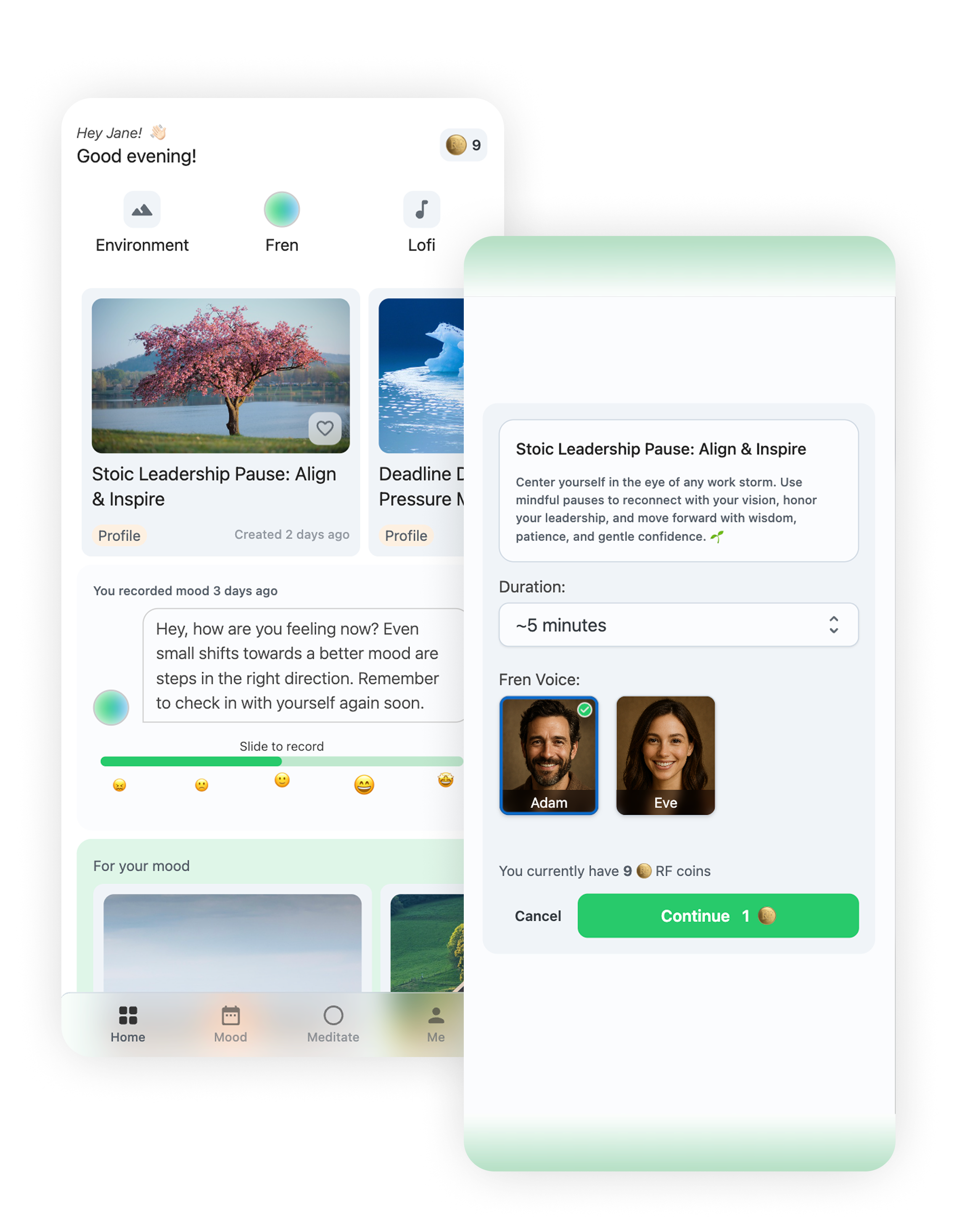
RelaxFrens is a personalised meditation and sleep app that builds a plan around your goals, schedule and daily mood check-ins. Its companion, Fren, guides breathing exercises and conversations, and the app uses streaks, badges, nature sounds and adjustable voices and session lengths.
relaxfrens.com13 viewsAdded August 12, 20254K visitors
The problem with meditation apps is not the meditation. It is the moment before it — opening a library of two hundred sessions when you are already agitated, and having to choose one.
That choice is a small decision made at the worst possible time, and it is where a lot of intended practice ends. The session you needed was probably in there.
RelaxFrens' answer is to ask how you are first, then decide for you — which is a modest idea and the right one.
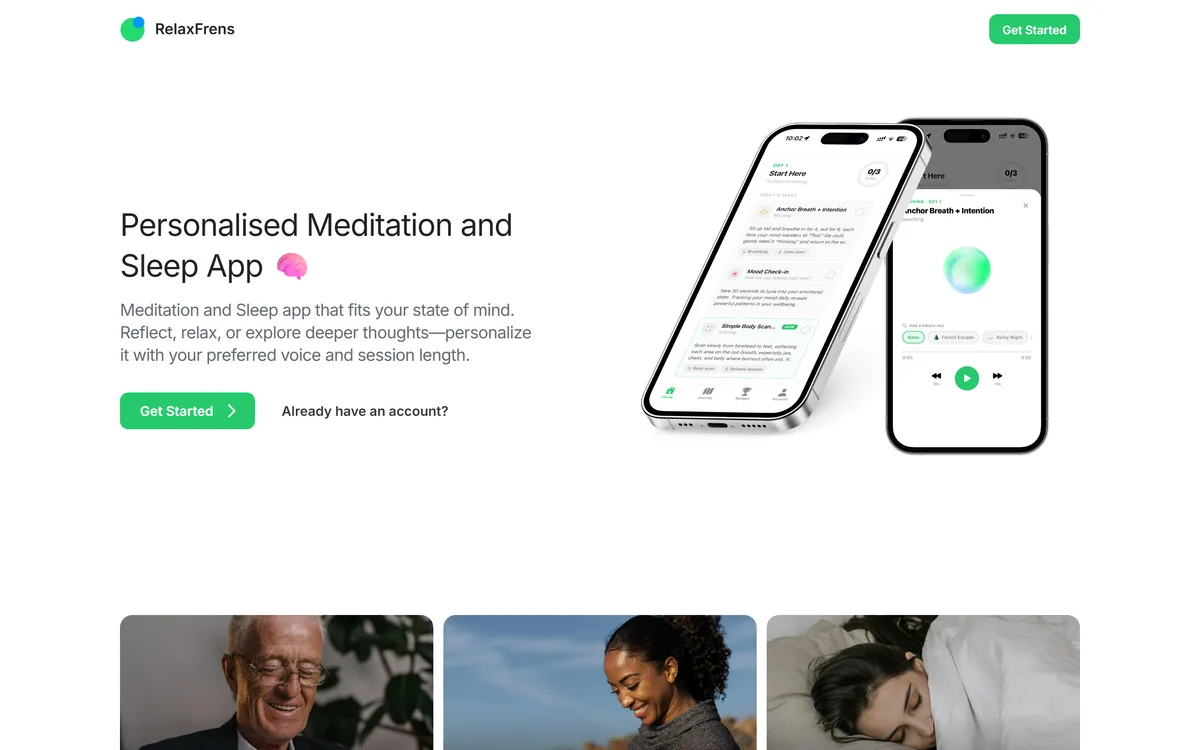
RelaxFrens' homepage, captured 9 September 2026, showing the personalised meditation positioning.
RelaxFrens: Meditation That Adapts To Your Mood
A daily mood check-in shapes which meditations you are offered, rather than leaving you to browse a library.
Fren, a companion that guides breathing exercises and conversations and checks in when your mind feels heavy.
A plan built from goals, schedule and current state instead of a fixed programme.
Streaks, badges and daily tasks, plus nature sounds you can mix and adjustable voices and session lengths.
A two-week improvement claim stated on the site without a described basis, which is worth reading carefully.
Can A Meditation App Personalise Usefully?
RelaxFrens states that a quick daily check-in shapes your whole experience, offering meditations that meet you where you are, and that calm is not one-size-fits-all.
This is a better idea than it sounds, because state genuinely determines what helps.
Anxiety, low mood, restlessness before sleep and post-work agitation call for different practices. Breath-focused work suits acute anxiety; body scans suit physical restlessness; something gentler suits a flat day where the goal is showing up rather than achieving anything.
A library assumes you know which you need and can identify your own state accurately, which is exactly what people are worst at when they most need help.
The honest limit is that self-reported mood is a crude signal. Asking someone how they feel produces an answer shaped by how they think they should feel, and personalisation from a rough input is a rough personalisation — helpful, and not the same as assessment.
A library assumes you know which practice you need. That is exactly what people are worst at when they most need help.
Streaks, Badges And Whether Gamifying Calm Works
RelaxFrens describes maintaining streaks, gentle reminders, daily tasks to complete, and badges celebrating wins from a first streak to mastering techniques.
This is where the product is in tension with itself, and it is worth being direct about why.
Habit mechanics work. Streaks produce consistency, consistency is what makes meditation effective, and almost nobody sustains a practice on intention alone — so as a retention device it is doing something real.
But meditation is specifically about not achieving. Contemplative practice teaches attention without evaluation, and attaching a score to it introduces the exact goal-orientation the practice is designed to loosen.
The practical failure is recognisable to anyone who has kept a streak: a session done at 11:58pm to protect a number is not a session, and losing a long streak reliably ends practice entirely rather than pausing it. The freeze-day approach that language apps such as Language Reactor rely on is a partial fix, and the deeper answer is holding the number lightly.
Reading A Two-Week Improvement Claim
The site states that most users report noticeable improvements in stress and anxiety within two weeks, alongside sections headed lower stress, lower anxiety and longer sleep.
That claim deserves careful reading, and not because it is implausible.
The underlying research on meditation is genuinely reasonable — regular practice has measurable effects on stress markers and self-reported anxiety, and two weeks is a plausible timescale for someone to notice something.
What the sentence actually says is that most users report improvements, which is self-report from people who chose to use a meditation app and are therefore disposed to expect benefit. That is not evidence of effect; it is evidence of satisfaction.
Nothing on the pages we read describes how this was measured, on how many people, or against what. In a wellbeing context that matters more than in most categories, because the claim is about a health outcome — and the honest framing is that meditation is well supported generally while this specific figure is unsubstantiated.
Let the check-in choose your session rather than browsing a library.
Hold the streak lightly — a session done to protect a number is not a session.
Read wellbeing claims for what they measure: satisfaction is not effect.
Try several voices and lengths early, since fit matters more than content.
Treat a companion as a prompt to reflect, never as support in a crisis.
Fren And What A Companion Can Be
RelaxFrens describes Fren as guiding breathing exercises and personalised meditations, and checking in when your mind feels heavy.
Companion framing in wellbeing apps is common and it needs handling carefully, because the appeal and the risk come from the same place.
The appeal is real and not silly. A named presence lowers the barrier to engaging — people who would not open a settings menu will answer a friendly question, and getting someone to check in at all is most of the battle.
The risk is that the framing invites reliance that the underlying system cannot support. Somebody genuinely struggling at two in the morning, talking to something that responds warmly, may feel supported by something that cannot assess risk or escalate.
The distinction worth holding is between a prompt and a relationship. A companion that asks how you are and suggests a breathing exercise is a useful nudge. Anything that positions itself as somebody to talk to during a crisis is in a category where a person is required, and no consumer app changes that.
Where Meditation Apps Genuinely Help
It is worth being clear about what this category does well, because the criticism above is about framing rather than about meditation.
Accessibility is the strongest case. Learning to meditate traditionally meant finding a teacher, attending sessions and persisting through an awkward beginning, and an app removes every one of those barriers.
Consistency is the second. Practice benefits accrue from regularity rather than duration, and a phone in your pocket with a five-minute session is a better vehicle for that than a weekly class.
Sleep is the third and the most immediately measurable. Wind-down routines and body scans have a reasonable evidence base for sleep onset, and it is the use case where people notice an effect fastest — which is why apps like SleepQ approach the same problem from measurement.
What it cannot do is treat anything. Meditation is not a treatment for a diagnosed anxiety disorder, depression or insomnia, and an app is not a clinician — a boundary this category collectively blurs and individual users have to hold themselves.
Writing is the obvious complement rather than the competitor. Journalling apps like Reflection address the same underlying goal through reflection rather than guided audio, and people who cannot sit still with a session often find the written form easier to sustain.
Building A Meditation Habit That Holds
Meditation apps are installed enthusiastically and abandoned within a month, usually because the first sessions were too long and the streak became the point.
This sequence keeps the practice small and the mechanics in their place.
Do the mood check-in honestly rather than reporting how you think you should feel.
Start with five-minute sessions, since length is what makes practice skippable.
Try several voices early — fit matters more than the content of a session.
Use it before sleep, where the effect is most noticeable soonest.
Let a streak break without stopping; the number is not the practice.
See a professional for anything a meditation app should not be carrying.
RelaxFrens: Features And Claims
Product type
Personalised meditation and sleep app
Positioning
Meditation and sleep that fits your state of mind
Personalisation
A plan built from your goals, schedule and how you are feeling
Daily input
A mood check-in shaping the sessions offered
Companion
Fren, guiding breathing exercises, meditations and check-ins
Habit mechanics
Streaks, gentle reminders, daily tasks and badges
Customisation
Preferred voice and session length
Audio
Nature sounds that can be mixed to preference
Stated benefits
Lower stress, lower anxiety and longer sleep
Stated claim
Most users report noticeable improvements in stress and anxiety within two weeks
Is RelaxFrens The Right Calm App?
Give it two weeks when
Choosing a session from a library is what stops you meditating.
You want something matched to how you feel today rather than a fixed programme.
Sleep onset is the problem you are trying to solve.
Habit mechanics genuinely help you rather than stress you.
You want adjustable voices and session lengths rather than one format.
See a professional when
You are dealing with a diagnosed anxiety disorder, depression or insomnia.
Streaks and badges would make you anxious rather than consistent.
You have an established practice and want depth rather than personalisation.
You would treat a companion as support during a crisis.
You prefer silence to guided sessions, which many experienced practitioners do.
Key features of RelaxFrens
Personalised meditation plans from goals and schedule
A daily mood check-in shaping session recommendations
Fren, a conversational companion
Guided breathing exercises
Streaks, reminders and daily tasks
Progress badges
Mixable nature sounds
Adjustable voices and session lengths
Pros & cons
Pros
7
The mood check-in removes the choice that stops most sessions happening
Matching practice to state is genuinely better than a browsable library
Adjustable voice and length address the fit that decides whether people continue
Sleep is the use case where users notice an effect fastest
A companion lowers the barrier to engaging at all
Mixable nature sounds suit people who dislike guided speech
Habit mechanics do produce the consistency meditation depends on
Cons
7
Gamifying calm is in tension with what contemplative practice is for
A session done to protect a streak is not a session
Self-reported mood is a crude input, so personalisation is correspondingly rough
The two-week claim reports satisfaction rather than measured effect
No stated method, sample or comparison behind that claim
Companion framing can invite reliance the system cannot support
No operating company named and no data retention described
Best For
People who stall at choosing a session from a library
Beginners who want something matched to how they feel today
Anyone whose main goal is falling asleep more easily
Users who respond well to streaks and daily prompts
People who want short sessions rather than long ones
RelaxFrens Against Other Calm Apps
Wellbeing apps differ by what they ask of you and what they give back.
Adjacent apps for reflection, sleep and daily practice.
Insight Timer — a large meditation library for experienced practitioners
Reflection — reflection through writing rather than guided audio
Clarity — mood tracked over time rather than session by session
SleepQ — measuring sleep rather than guiding wind-down
DreamSync — a structured programme for insomnia specifically
RelaxFrens: Claims Checked On The Page
Last checked . Read from relaxfrens.com in a browser session on the date above, with the screenshot captured alongside.
Positioned as a personalised meditation and sleep app that fits your state of mind
Sections displayed for lower stress, lower anxiety and longer sleep
Stated that most users report noticeable improvements in stress and anxiety within two weeks
Fren described as guiding breathing exercises, personalised meditations and checking in when your mind feels heavy
A meditation plan described as built from your goals, schedule and how you are feeling
Streaks, gentle reminders and daily meditation tasks described
Badges described for progress from a first streak to mastering techniques
A daily mood check-in described as shaping the whole experience
Nature sounds described as mixable to preference
Preferred voice and session length described as customisable
What we could not confirm: pricing and whether any tier is free; the basis for the two-week improvement claim, which is stated without a described method, sample or comparison; the operating company, which the pages we read do not name; where mood check-in data is stored and how long it is retained; whether Fren conversations are processed by a third party; and whether the app has any published crisis-support signposting. Nothing here is medical advice, and anyone struggling should speak to a professional.
Editor's Verdict
3.5/5
The genuinely good idea here is the daily mood check-in shaping what you get. A generic guided meditation is a poor fit for a specific mental state, and someone anxious at 11pm needs something different from someone flat on a Monday morning — matching the session to the state is a real improvement over a library you browse. The tension is that streaks and badges are also central, and gamifying calm is at odds with what meditation practice is for. The two-week improvement claim is presented without any stated basis, which matters in a wellbeing context. AInexfinder Editor Score: 3.5/5.
RelaxFrens pricing
AInexfinder does not list plan prices or billing details. For current pricing, plans, and trials, visit the official RelaxFrens website.
Vendor pricing, credits, and billing policies change over time. Always confirm on the official site before you buy.
Frequently asked questions
What is RelaxFrens?
RelaxFrens is a personalised meditation and sleep app that builds a plan from your goals, schedule and a daily mood check-in. Its companion, Fren, guides breathing exercises and check-ins, and the app includes streaks, badges, nature sounds and adjustable voices and lengths.
Does personalising by mood actually help?
Yes, because state determines what helps. Breath-focused work suits acute anxiety, body scans suit restlessness, and something gentler suits a flat day. A library assumes you know which you need — which is exactly what people are worst at when they most need help.
What is the limit of that personalisation?
Self-reported mood is a crude signal. Asking someone how they feel produces an answer shaped by how they think they should feel, so personalisation from a rough input is correspondingly rough. Helpful, and not the same as assessment.
Do streaks and badges belong in a meditation app?
They are in tension with the practice. Habit mechanics genuinely produce consistency, and consistency is what makes meditation effective. But contemplative practice teaches attention without evaluation, and attaching a score introduces the goal-orientation it is designed to loosen.
What is the practical problem with a streak?
A session done at 11:58pm to protect a number is not a session. And losing a long streak reliably ends practice entirely rather than pausing it, which is the opposite of what a habit mechanic is supposed to achieve.
Should I believe the two-week improvement claim?
Read what it actually says. Most users report improvements is self-report from people who chose a meditation app and are disposed to expect benefit — evidence of satisfaction rather than of effect. No method, sample or comparison is stated.
Is the underlying idea supported by research?
Meditation generally has a reasonable evidence base for stress markers and self-reported anxiety, and two weeks is a plausible timescale to notice something. That supports the practice; it does not substantiate this specific figure, and the two should not be conflated.
What is Fren for?
Lowering the barrier to engaging. People who would not open a settings menu will answer a friendly question, and getting someone to check in at all is most of the battle. Treat it as a prompt to reflect rather than as somebody to talk to.
When is an app the wrong thing?
For a diagnosed anxiety disorder, depression or insomnia. Meditation is not a treatment and an app is not a clinician, and the risk with warm companion framing is that somebody struggling at two in the morning feels supported by something that cannot assess risk.
How do I build the habit?
Start at five minutes, since length is what makes sessions skippable, and try several voices early because fit matters more than content. Use it before sleep, where the effect shows soonest, and let a streak break without stopping.
Daniel reviews AI tools the slow way — by actually using them on real projects. His reviews cover what works, what breaks, and who each tool is genuinely a good fit for.
Daniel and the AInexfinder editorial team research RelaxFrens using public product information, listing evidence, and (when available) hands-on checks. Scores reflect listing completeness and transparency — not paid placement.
Listings may include affiliate or sponsored placements, which are labeled when present. Editorial scores and cons are not sold. See our affiliate disclosure and review methodology.
moonbird is a tactile, screen-free handheld breathing coach that expands and contracts in your palm to pace your breath, reads your pulse and HRV, and pairs with an app whose Aura AI coach personalises the rhythm, aimed at calm and sleep as a wellbeing tool.
Aura is a personalised mental-wellness and sleep app bundling meditation, sleep tracks, hypnosis, CBT-style content, coaching, breathwork and more, with AI-driven recommendations and live coach and therapist sessions, offered as a freemium subscription and framed here as a wellbeing aid, not medical care.
Insight Timer offers a very large free audio library for meditation, sleep, yoga and breathwork, contributed by psychologists, spiritual leaders and mindfulness teachers. Live yoga and breathwork sessions run alongside courses, with a Member Plus subscription above a genuinely free core.
StillMind is an iOS and Android meditation app that generates a session from what you describe — choosing technique, length and script to match the moment. It adds a voice journal, mood-tagged entries, AI-composed courses and pattern tracking without streaks.
Brizzy is a guided-breathing app with 30 evidence-rated techniques, an AI coach that tailors sessions in 70+ languages, and an unusually honest, four-level evidence rating for each technique. It runs instantly in the browser and is a wellness tool, not medical care.