DreamSync is an iOS sleep app combining tracking and sleep-stage analysis with a 12-week CBT-I programme, an AI coach, smart alarm, snoring detection and behaviour correlation across caffeine, exercise, screen time, stress and alcohol. It works offline, requires no account, and stores all data locally.
apps.apple.com8 viewsAdded December 11, 2025151M+ visitors
Sleep apps have a credibility problem, and it comes from two directions at once. They measure something they cannot measure directly, and they rarely name any method behind their advice.
A phone on a mattress does not read your brain. It infers sleep stages from movement and sound, which is a reasonable proxy and not the same thing as the polysomnography those stage names come from.
DreamSync is more interesting than most of the category because it addresses the second problem squarely: it names CBT-I, which is a specific intervention with a large clinical literature behind it, rather than offering unattributed advice. That is worth taking seriously, and so is the equally unusual decision to keep every byte on your phone.
What Does DreamSync Do Differently?
It runs a 12-week CBT-I programme — cognitive behavioural therapy for insomnia, the intervention with the strongest evidence base for chronic sleep problems.
Everything stays on your device: no servers, no account, no sign-up, no tracking and no ads, with data in files you can inspect, export or delete.
Behaviour correlation is the analytical core — how caffeine, exercise, screen time, stress and alcohol actually affect your sleep, based on your own logged data.
Tracking with sleep-stage analysis, a smart alarm, sleep score, efficiency tracking, and snoring and disturbance detection.
Works completely offline, with data export for healthcare providers and trends across 7, 30 and 90 days.
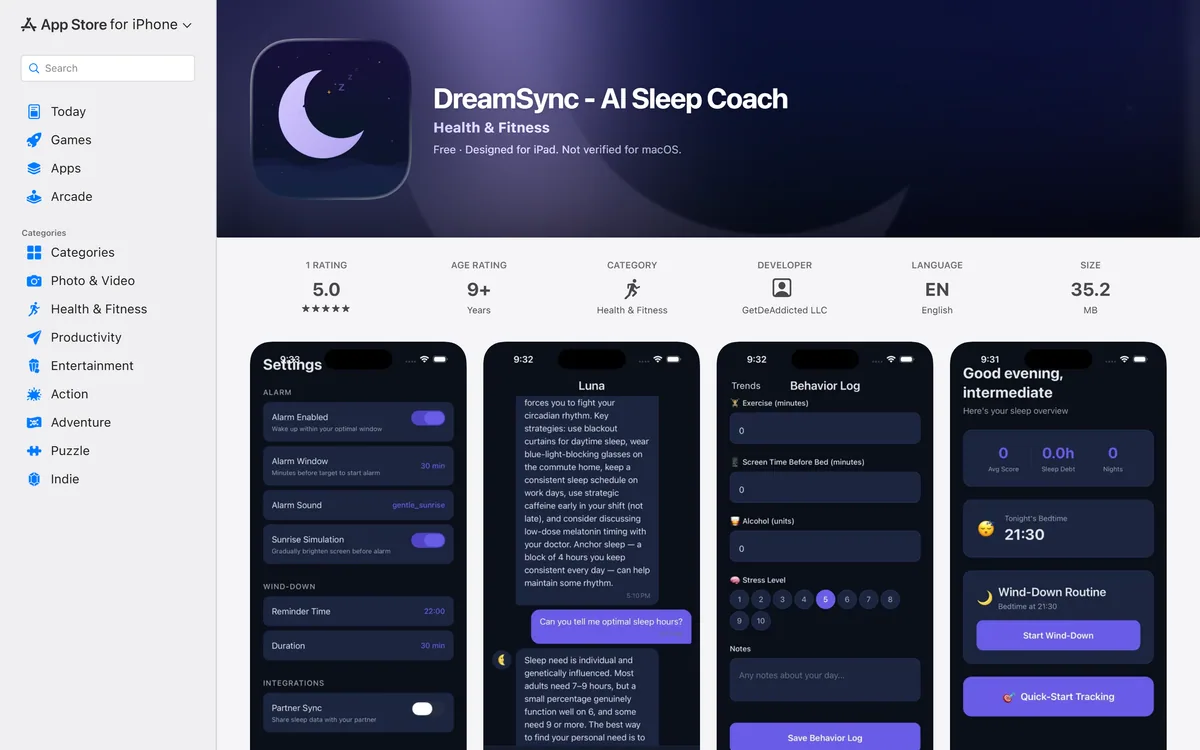
DreamSync's App Store listing, captured 9 September 2026. The CBT-I programme and the offline, no-account model are both stated up front.
Why Naming CBT-I Changes The Conversation
DreamSync includes a 12-week clinical CBT-I programme. Cognitive behavioural therapy for insomnia is not a wellness framework — it is a structured intervention with a substantial evidence base, and major clinical guidelines recommend it as first-line treatment for chronic insomnia, ahead of medication.
That matters because almost nothing else in this category names a method. Most sleep apps offer tracking plus general advice — go to bed earlier, avoid screens — which is unobjectionable and does very little for someone with genuine insomnia.
CBT-I is different because it is counterintuitive in ways that general advice never is. Its core components include sleep restriction, which temporarily reduces time in bed to consolidate sleep, and stimulus control, which means getting out of bed when you cannot sleep. Both feel wrong, and both are what makes the intervention effective.
A twelve-week structure is also the right shape. CBT-I works over weeks rather than days, and the early stage frequently makes things feel worse before they improve — which is precisely why an app promising better sleep tonight cannot deliver this.
The honest caveat is that self-guided CBT-I is not the same as clinician-delivered CBT-I. The evidence for digital versions is real and generally weaker than for supervised programmes, and someone who cannot get through the difficult early weeks alone may need actual support. If insomnia is severe or persistent, see a doctor — an app is a reasonable first step, not a substitute for one.
It is worth being clear about the boundary between this and a meditation practice. Apps like StillMind and Insight Timer help you wind down, which is genuinely useful and is not an insomnia intervention.
CBT-I works partly because it is counterintuitive. An app promising better sleep tonight cannot deliver an intervention whose first weeks make things harder.
What Phone-Based Sleep Staging Can And Cannot Tell You
DreamSync offers sleep-stage analysis, a sleep score and efficiency tracking, and the limits of phone-based measurement deserve stating plainly.
Sleep stages are defined by brain activity, measured in a laboratory with electrodes. A phone infers them from movement and sound, which correlates with sleep depth well enough to be interesting and not well enough to be diagnostic.
The practical consequence is about which numbers to trust. Total sleep time and sleep efficiency — time asleep as a proportion of time in bed — are reasonably robust from movement data, and efficiency is also the number CBT-I actually uses. Stage breakdowns are much softer, and a chart telling you precisely how much deep sleep you had is more confident than the method supports.
Snoring and disturbance detection sits somewhere useful in between. A phone genuinely can record sound, and knowing you snore heavily or wake repeatedly is real information — occasionally important information, since loud snoring with pauses in breathing is a reason to see a doctor about sleep apnoea rather than to adjust your bedtime.
Read the trend rather than the night. A single night's figures are noise; a pattern across ninety days is the signal these tools genuinely provide.
How Serious Is A No-Servers Privacy Position?
DreamSync stores all sleep data locally on the device in files you can inspect, export or delete, with no account, no tracking and no ads, and works completely offline.
That is an unusually strong position and it deserves crediting, because of what sleep data actually contains. Combined with the behaviour logging this app encourages, the dataset covers when you sleep, how badly, how much you drink, how stressed you are and how much caffeine you consume.
That is health data by any reasonable definition, and it is exactly the kind of information that has commercial value to insurers, employers and advertisers. Most consumer health apps hold it on a server under a privacy policy that can change.
Local-only storage removes the question entirely rather than answering it. There is no server to breach, no policy to change, and no acquisition that transfers your data to someone whose practices you never agreed to.
Two practical consequences follow. Your data is only as safe as your phone and your backups — losing the device means losing the history, so use the export. And no cloud means no sync, so this is a single-device product by design. Both are reasonable trades for what you get.
Export periodically, since local-only means a lost phone is a lost history.
Expect no sync across devices; this is single-device by design.
Use the healthcare export if you are seeing a doctor about sleep — real data beats recollection.
Log behaviours honestly, including alcohol, since the correlations are only as good as the inputs.
Treat loud snoring with breathing pauses as a reason to see a doctor, not to adjust your bedtime.
Behaviour Correlation Is The Genuinely Useful Output
DreamSync logs caffeine, exercise, screen time, stress and alcohol, and correlates them with your own sleep data.
This is the most valuable thing it does, and the reason is that general sleep advice is true on average and unhelpfully so. Everyone knows caffeine affects sleep; almost nobody knows whether their own afternoon coffee matters, and the answer varies enormously between individuals for genuine metabolic reasons.
Personal correlation answers the question that generic advice cannot. It may turn out that caffeine has little effect on you and alcohol has an enormous one, or that the variable driving your bad nights is stress rather than anything you consume.
Alcohol is the one most people are wrong about, and the correlation usually shows it. A drink helps you fall asleep and reliably degrades the second half of the night, which is why people who use it as a sleep aid wake at four and cannot understand why.
The caution is statistical rather than technical. Correlation across a handful of nights is noise, and the app cannot separate causes that move together — a stressful week is also a week you drank more and exercised less. Treat a pattern as a hypothesis to test deliberately, by changing one thing for a fortnight, rather than as a finding.
The same logic underlies food and mood tracking. Tools such as MyNetDiary exist because population averages tell you very little about your own body, and sleep is no different.
Running The Twelve Weeks Properly
A CBT-I programme only works if completed, and the first fortnight is where most people stop. That is a feature of the intervention rather than a flaw in the app.
The bar is step four. If you abandon during the hard weeks, you have tested nothing about whether CBT-I works for you.
Track for two weeks before starting the programme, so you have a genuine baseline to measure against.
Log behaviours honestly from the start — especially alcohol, which is the variable people most often under-record.
Read what sleep restriction and stimulus control actually involve before beginning, since both feel wrong and knowing why helps you continue.
Expect the first two to three weeks to feel worse rather than better. That is how the intervention works, and it is where people quit.
Watch sleep efficiency rather than stage breakdowns, since efficiency is both more reliably measured and what CBT-I actually targets.
Export your data before the twelve weeks end, both as a backup and to bring to a doctor if things have not improved.
Where An App Stops And A Doctor Starts
This deserves stating plainly rather than as a disclaimer, because sleep problems are frequently symptoms of something an app cannot address.
Loud snoring with pauses in breathing, or waking gasping, may indicate sleep apnoea — a condition with serious cardiovascular consequences that requires diagnosis and treatment. A sleep app that detects snoring is genuinely useful for surfacing this, and completely unable to treat it.
Persistent insomnia can also be secondary to depression, anxiety, thyroid problems, chronic pain or medication side effects. Treating the sleep without addressing the cause does not work, and the pattern of not improving despite doing everything right is itself information worth taking to a doctor.
The healthcare export is the feature that bridges this properly, and it is worth using. A clinician asking how you have been sleeping gets a far better answer from ninety days of data than from anyone's recollection, which is reliably poor.
None of this argues against the app. Self-guided CBT-I is a reasonable first step for ordinary insomnia, and it is far better than the alternative most people choose, which is nothing. It is a first step rather than the only one.
If low mood rather than sleep is the underlying problem, a support tool like Youper addresses a different part of the same picture. Neither replaces a clinician.
DreamSync: Method And Data Handling
Product type
iOS sleep tracking and coaching app
Clinical method
12-week CBT-I programme
AI coach
Personalised daily guidance based on tracked data
Tracking
Sleep stages, sleep score, sleep efficiency, snoring and disturbance detection
Alarm
Smart alarm with gentle wake, plus partner alarm sync over Bluetooth
Behaviour logging
Caffeine, exercise, screen time, stress and alcohol, with correlation insights
Trends
7, 30 and 90-day views
Journaling
Pre-bed journaling with AI reflection
Data storage
Entirely local on the device, in files you can inspect, export or delete
Account required
None — no sign-up, no tracking, no ads
Connectivity
Works completely offline
Export
Data export for healthcare providers
Requirements
iOS 15.1 or later
Who Should Try DreamSync
A sensible first step when
You have ongoing insomnia and want an intervention with an evidence base rather than general advice.
You are unwilling to put sleep, alcohol and stress data on someone else's servers.
You want to know how your own caffeine and alcohol affect your sleep rather than what affects people on average.
You will see a doctor about sleep and want real data rather than recollection to bring.
You can commit twelve weeks, including two or three that feel worse before they improve.
Go elsewhere when
You snore loudly with pauses in breathing — see a doctor about sleep apnoea rather than starting a programme.
Your sleep problem is likely secondary to depression, anxiety, pain or medication, where treating sleep alone will not work.
You are on Android, since this is an iOS application requiring iOS 15.1 or later.
You need data synced across devices, which local-only storage rules out by design.
You want better sleep tonight, which no CBT-I programme promises or delivers.
Key features of DreamSync
12-week CBT-I programme structured over weeks rather than days
AI sleep coach giving daily guidance based on your tracked data
Sleep tracking with stage analysis, sleep score and efficiency
Snoring and disturbance detection through the device microphone
Smart alarm with gentle wake and partner alarm sync over Bluetooth
Behaviour logging with correlation across caffeine, exercise, screen time, stress and alcohol
Sleep trend views across 7, 30 and 90 days
Fully offline operation with all data stored locally and exportable
Pros & cons
Pros
7
Names CBT-I explicitly, which is the intervention clinical guidelines recommend first for chronic insomnia
A twelve-week structure matches how the intervention actually works rather than promising overnight results
Local-only storage removes the privacy question entirely rather than answering it with a policy
No account, no tracking and no ads is the strongest position available for health data
Personal behaviour correlation answers what generic sleep advice cannot
Healthcare export turns ninety days of data into something a doctor can actually use
Works offline, so it functions in aeroplane mode overnight
Cons
6
Phone-based sleep staging is inferred from movement and sound rather than measured
Self-guided CBT-I has weaker evidence than clinician-delivered programmes
Local-only means no sync and a lost phone is a lost history unless you export
No developer, company name or privacy policy could be established from the listing
No clinical adviser or validation is named behind the programme
iOS only, requiring iOS 15.1 or later
Best For
People with ongoing insomnia who want an evidence-based method
Anyone unwilling to store sleep and alcohol data on a server
Users who want personal correlations rather than general advice
Preparing real data to bring to a doctor
iOS users able to commit to a twelve-week programme
DreamSync Against Other Wellbeing Apps
Sleep and wellbeing apps differ on whether they name a method and where your data lives — both matter more than the interface.
Tool
Method
Data location
Best for
DreamSync
12-week CBT-I programme, named explicitly
Entirely local, no account or servers
Chronic sleep problems, with privacy as a priority
Conversational support drawing on therapeutic techniques
Cloud
Mood, where poor sleep is often a symptom
Other Sleep And Wellbeing Tools
Sleep sits at the intersection of several things — practice, mood, nutrition — and different tools address different parts.
StillMind — meditation for winding down, which complements rather than replaces CBT-I
Insight Timer — a large free library of sleep audio and bedtime content
Youper — for mood, where persistent poor sleep is frequently a symptom rather than the cause
MyNetDiary — the nutrition side, including the caffeine and alcohol this app correlates
Pattrn — if the obstacle is consistency rather than the sleep itself
Sourcing The DreamSync Details
Last checked . Read from the App Store listing for DreamSync, with the screenshot above captured in the same session.
Product described as an AI sleep coach with personalised daily guidance
A 12-week clinical CBT-I programme confirmed in the listing
Sleep tracking with sleep stage analysis, sleep score and efficiency tracking confirmed
Smart alarm with gentle wake-up confirmed, alongside partner alarm sync via Bluetooth
Snoring and disturbance detection confirmed
Behaviour logging confirmed across caffeine, exercise, screen time, stress and alcohol, with personalised correlation insights
Sleep trends confirmed across 7, 30 and 90-day views
Pre-bed journaling with AI reflection confirmed
Data handling stated in the listing: no servers, all sleep data stored locally on the device in files you can inspect, export or delete, with no account required, no tracking and no ads
Offline operation confirmed
Data export for healthcare providers confirmed
Platform requirement stated as iOS 15.1 or later
What we could not confirm: the product is distributed through the App Store rather than a company website, so we could not read a vendor site, footer, privacy policy or terms; no developer or company name was established; no pricing model or subscription structure could be confirmed; the local-only data claim is a listing statement rather than an audited control; no clinical adviser or validation is named behind the CBT-I programme; and we did not use the app, so nothing here reflects tested tracking accuracy.
Editor's Verdict
4.0/5
DreamSync scores well for two decisions that are unusual together. It builds on CBT-I, which is the intervention with the strongest evidence base for insomnia and is recommended ahead of medication by major clinical guidelines — naming a method rather than gesturing at wellness is rare in this category. And it stores everything locally with no servers, no account and no tracking, which for a dataset covering your sleep, alcohol intake and stress is the strongest privacy position available. It loses ground because phone-based sleep staging is inferred from movement and sound rather than measured, and because a self-guided programme is not clinical care. AInexfinder Editor Score: 4.0/5.
DreamSync pricing
AInexfinder does not list plan prices or billing details. For current pricing, plans, and trials, visit the official DreamSync website.
Vendor pricing, credits, and billing policies change over time. Always confirm on the official site before you buy.
Frequently asked questions
What is DreamSync?
DreamSync is an iOS sleep app combining tracking and sleep-stage analysis with a 12-week CBT-I programme, an AI coach, smart alarm, snoring detection and behaviour correlation across caffeine, exercise, screen time, stress and alcohol. It works offline, requires no account, and stores all data locally on your device.
What is CBT-I, and why does it matter?
Cognitive behavioural therapy for insomnia — a structured intervention with a substantial evidence base, which major clinical guidelines recommend as first-line treatment for chronic insomnia, ahead of medication. Naming a specific method matters because almost nothing else in this category does; most sleep apps offer tracking plus general advice that helps very little with genuine insomnia.
Where is my sleep data stored?
Entirely on your device, in files you can inspect, export or delete. There are no servers, no account and no tracking. For a dataset covering when you sleep, how much you drink and how stressed you are, that removes the privacy question rather than answering it with a policy that could change. Export periodically, since a lost phone means a lost history.
How accurate is phone-based sleep tracking?
Total sleep time and sleep efficiency are reasonably robust from movement data. Stage breakdowns are much softer, because sleep stages are defined by brain activity measured with electrodes, and a phone infers them from movement and sound. Read trends across weeks rather than any single night's numbers, and weight efficiency over stage charts.
Will the CBT-I programme make my sleep worse at first?
Quite possibly, and that is how the intervention works rather than a sign something is wrong. Sleep restriction temporarily reduces time in bed to consolidate sleep, and stimulus control means getting out of bed when you cannot sleep. Both feel counterintuitive, both are effective, and the first two to three weeks are where most people quit.
Can DreamSync tell me if alcohol affects my sleep?
It correlates alcohol with your own sleep data, which answers a question generic advice cannot. Alcohol is the variable most people are wrong about — a drink helps you fall asleep and reliably degrades the second half of the night, which is why people using it as a sleep aid wake at four. Log honestly, since the correlation is only as good as the input.
Is DreamSync a substitute for seeing a doctor?
No. Self-guided CBT-I is a reasonable first step for ordinary insomnia and better than the alternative most people choose, which is nothing. But loud snoring with breathing pauses may indicate sleep apnoea, and persistent insomnia can be secondary to depression, anxiety, pain or medication. Use the healthcare export and take the data to a doctor.
Does DreamSync work without an internet connection?
Yes, completely — it is designed to work offline with no account and no server. That is a consequence of the local-only storage model rather than a separate feature. The trade is that there is no sync across devices, so this is a single-device product by design.
Is DreamSync available on Android?
No. It is distributed through the App Store and requires iOS 15.1 or later. Because the product has no company website that we could find, the App Store listing is the only source of information about it — which also means no developer name, privacy policy or pricing structure could be established.
Is the CBT-I programme clinically validated?
CBT-I itself has a strong clinical evidence base; this specific implementation of it is not accompanied by any named clinical adviser or published validation that we could find. The evidence for digital, self-guided CBT-I is real and generally weaker than for clinician-delivered programmes — so treat it as a good first step rather than as equivalent to supervised treatment.
Daniel reviews AI tools the slow way — by actually using them on real projects. His reviews cover what works, what breaks, and who each tool is genuinely a good fit for.
Daniel and the AInexfinder editorial team research DreamSync using public product information, listing evidence, and (when available) hands-on checks. Scores reflect listing completeness and transparency — not paid placement.
Listings may include affiliate or sponsored placements, which are labeled when present. Editorial scores and cons are not sold. See our affiliate disclosure and review methodology.
SleepQ is an iOS sleep coach that runs structured seven-night experiments across eight sleep elements — wind-down, screens, caffeine, light and others — measuring before and after via Apple Health, with an AI coach reachable by chat and voice.
RecipeScan is an Apple-only cooking app that builds a pantry from photos, suggests recipes against what you already have, and coordinates three dishes onto one timeline. It adds grocery lists, budget tracking, calorie estimates and a hands-free cooking mode.
RelaxFrens is a personalised meditation and sleep app that builds a plan around your goals, schedule and daily mood check-ins. Its companion, Fren, guides breathing exercises and conversations, and the app uses streaks, badges, nature sounds and adjustable voices and session lengths.
moonbird is a tactile, screen-free handheld breathing coach that expands and contracts in your palm to pace your breath, reads your pulse and HRV, and pairs with an app whose Aura AI coach personalises the rhythm, aimed at calm and sleep as a wellbeing tool.
Youper is an AI emotional-health assistant built around conversational check-ins, mood tracking and journaling. The company has announced it is shutting down on 30 September 2026, after which accounts, chat history and personal data are permanently deleted.
Aura is a personalised mental-wellness and sleep app bundling meditation, sleep tracks, hypnosis, CBT-style content, coaching, breathwork and more, with AI-driven recommendations and live coach and therapist sessions, offered as a freemium subscription and framed here as a wellbeing aid, not medical care.