Humanity review on AInexfinder — freemium AI tool for Health & Lifestyle. Features, pricing notes, and alternatives.
FreemiumHealth & Lifestyle
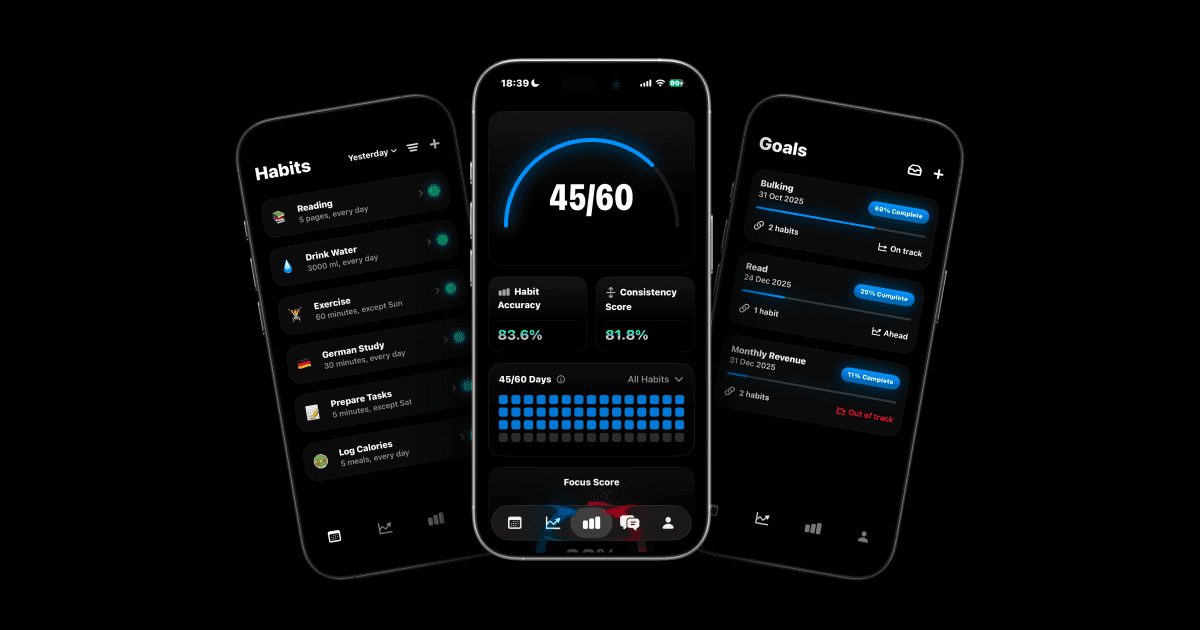
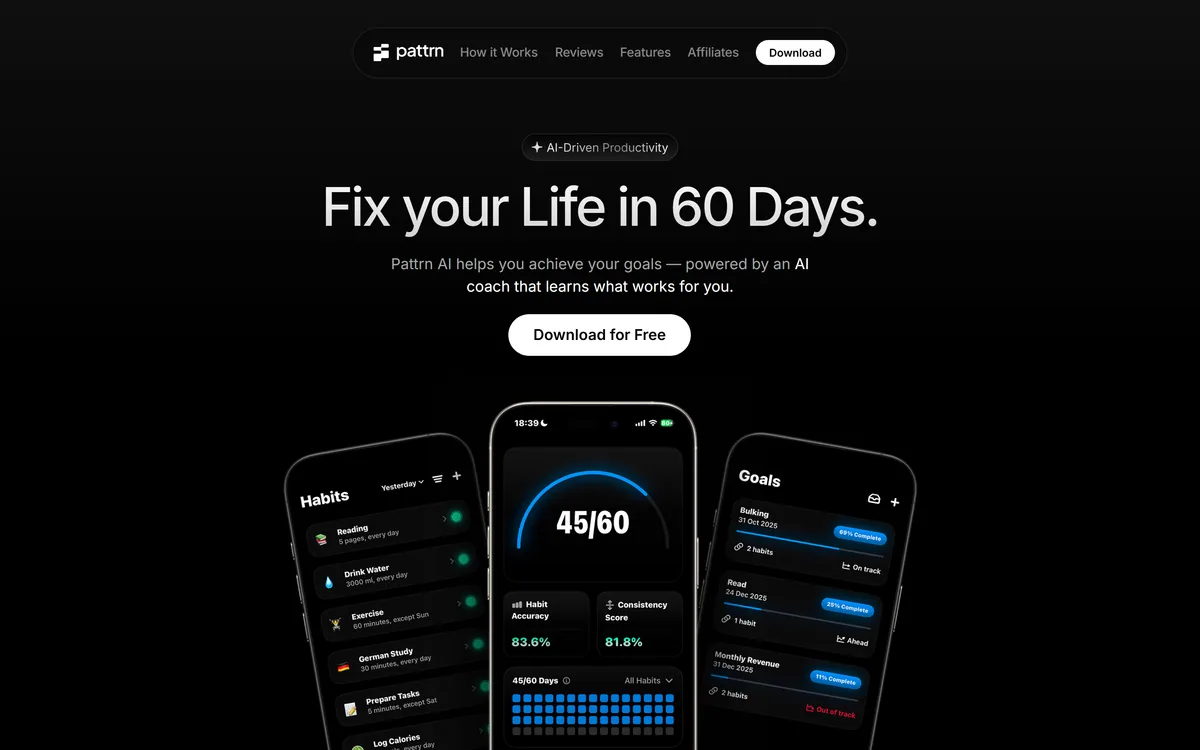
Pattrn is an iOS discipline tracker built around a structured 60-day challenge. An AI agent turns a stated goal into milestones and a routine, you complete one habit a day, and the analytics report consistency, precision and your best-performing days rather than a streak count.
Almost every habit app fails in the same predictable way, and it has nothing to do with the software. Someone sets up six habits on a Sunday evening, manages all six for four days, misses two on Thursday, feels the whole thing collapse, and never opens the app again.
The mistake is over-ambition, and most trackers actively encourage it — outbound coaches such as Habit Coach AI let you run several habits at once — a longer list looks like more progress on the day you write it.
Pattrn is built around refusing that. One habit a day, sixty days, with the goal broken into milestones by an AI agent that also adjusts the plan against how you actually performed rather than how you intended to. Whether that constraint suits you is the only question that matters about this product, and it is worth answering carefully.
The single-habit model is the decision everything else follows from, and it is worth defending properly because most people's first reaction is that it is too limited.
The argument for it is straightforward. Behaviour change is hardest at the point of initiation, and every additional habit multiplies the number of ways a day can go wrong. With one, a day is binary and unambiguous — you did it or you did not, and there is no partial failure to negotiate with yourself about.
It also removes the specific psychological trap that ends most attempts. With six habits, missing two feels like failing, and the honest self-assessment on Thursday evening is that the week has already gone wrong. With one, the day either happened or it did not, and tomorrow is unaffected.
The cost is equally clear, and it is why a training app such as SHRED takes the opposite approach. Goals that genuinely require several daily behaviours — training and nutrition together, or a study routine with multiple components — do not decompose neatly into one thing a day. For those, this model forces an artificial choice.
So the useful question is not whether one habit is enough in the abstract. It is whether the thing you actually want to change can be reduced to one daily action. For a surprising number of goals it can, and the reduction is itself the useful exercise.
Six habits is not six times the progress. It is six ways for Thursday to end the attempt.
You state a goal in conversation, and the agent breaks it into milestones and a routine.
The value here is not intelligence so much as decomposition. Most people are poor at converting a large aim — get fit, write a book, learn a language — into the specific thing to do on Tuesday, and that gap is where motivation quietly drains away.
The app also adjusts targets against actual performance rather than the original plan, which is the behaviour a good coach exhibits and most software does not. An app that keeps demanding what you set on day one while you consistently miss it is training you to ignore it.
The caveat is the usual one for this category. No model is named and no method is cited, so what you get is competent general advice — which is genuinely useful for a common goal, and unlikely to be specific enough for anything unusual or medically constrained.
Pattrn reports weekly consistency patterns, a precision metric, a combined performance score, and identification of the days you perform best.
That last one is the most useful and the least common. A streak counter tells you how many days in a row you managed, which is a number about the past. Knowing that you reliably fail on Wednesdays is a fact about your week that you can actually act on — by moving the habit, reducing it on that day, or looking at what Wednesday contains.
This is the difference between a tracker that records and one that informs. Almost every habit app has enough data to tell you this and almost none of them do, because a streak is a more satisfying number to display.
A combined performance score has the opposite property, and deserves more scepticism. Blending progress, precision and consistency into a single figure produces something that moves for reasons you cannot decompose, which makes it motivating and largely uninformative. Watch the component patterns instead.
The genuinely honest measure in any habit app is the one nobody wants to display: what proportion of days in the last month did you actually do the thing? Everything else is presentation.
Any app built on daily completion has to answer one question, and it determines whether the product helps or harms: what happens on the day you miss?
The design here uses failure alerts, which is a stronger framing than most competitors use, and its effect depends entirely on the person. For some, being told plainly that a day was missed is exactly the corrective they wanted. For others, the language of failure attached to one ordinary bad day is precisely what makes them delete the app rather than continue.
The evidence in behaviour research is reasonably consistent on this point: a single missed day has very little effect on eventual habit formation. What does damage is the abandonment that follows the feeling of having ruined something. The most valuable capability any habit tool can have is making the day after a miss unremarkable.
The practical advice, whatever the app says, is a rule you set for yourself in advance: never miss twice. One missed day is noise. Two consecutive missed days is the beginning of stopping, and it is the only signal worth reacting to.
If the failure framing is the thing that would make you quit rather than continue, that is genuinely useful information about which app you should choose — and it is knowable in the first week.
The free tier is described as offering full functionality, so this can be run without paying. The sequence below is how to give it a fair test.
The bar is step six. Sixty days is the product's own frame, and judging it before day thirty tells you about novelty rather than about the tool.
The model is freemium, and unusually the free version is described as offering full functionality, with a premium tier referenced above it.
That is worth noting because it inverts the category norm. Most habit apps put the analytics — the part that makes tracking worthwhile — behind a subscription, which means the free version records without informing.
For a user, the practical implication is that you can run a complete sixty-day cycle before deciding whether to pay anything, and sixty days is more than enough to know whether the model suits you.
There is also an affiliate programme published on the site. That is not a criticism, but it is worth knowing when reading enthusiastic recommendations of this app elsewhere online — some of them are compensated, which is true across this category and rarely disclosed.
We do not publish amounts, since tiers change. Check what specifically the premium tier adds before subscribing, given that the free version is described as complete.
| Product type | Discipline and habit tracking with AI coaching |
|---|---|
| Core structure | A 60-day challenge with a defined end point |
| Daily model | One habit per day, completed or missed, with failure alerts |
| Goal handling | AI agent converts a stated goal into milestones and a routine |
| Adaptation | Targets adjusted against actual performance rather than the original plan |
| Analytics | Weekly consistency patterns, precision metric, combined performance score, best-performing day identification |
| Platform | iOS |
| Stated users | Over 20,000 active users |
| Pricing model | Freemium, with the free tier described as offering full functionality |
| Published pages | Privacy Policy, Terms of Service, Pricing, Affiliate Programme, Support, Updates, Blog, Brand Assets |
| AI model disclosed | None named on the site |
| Integrations | None listed |
Last checked . Read from pattrn.io, including the footer, with the screenshot above captured in the same session.
What we could not confirm: no behavioural framework, research citation or qualified adviser is named for the sixty-day frame or the coaching approach, so the method cannot be assessed; no AI model or provider is identified; the active user figure is a vendor count with no published basis; no integrations with health platforms or wearables are listed; the site copyright reads 2025, so some material may predate this check; and we did not run a sixty-day cycle, so nothing here reflects sustained use.
A structured 60-day challenge with a defined start and end rather than open-ended tracking
Single habit per day, completed or missed, with alerts when a day is missed
AI agent converting a conversational goal statement into milestones and a routine
Adaptive target adjustment based on how you actually performed
Weekly consistency visualisation showing patterns across days of the week
Precision metric and combined performance score
Identification of the days on which you reliably perform best
Milestone breakdown splitting a large goal into achievable targets
These products differ on the mechanism that keeps you going, which is the only feature that matters after week two.
| Tool | Mechanism | Structure | Suits |
|---|---|---|---|
| Pattrn | A defined commitment with precision analytics | 60 days, one habit per day | People motivated by structure and data rather than encouragement |
| Habit Coach AI | Outbound contact by text and phone | Open-ended, multiple habits | People who ignore apps but answer messages |
| SHRED | Structured training programmes | Programme-length | Fitness specifically, where the plan matters more than the prompt |
| Liven | Wellbeing exercises and courses | Open-ended | Emotional regulation rather than task consistency |
| StillMind | Meditation sessions | Session-based | Attention and calm rather than behavioural targets |
Compare on mechanism rather than features, since mechanism decides whether you are still using one in March.
Pattrn scores fairly because it makes two design choices most habit apps avoid, and both are defensible. One habit a day is a constraint rather than a limitation — it prevents the over-ambition that kills nearly every attempt in the first fortnight — and a sixty-day frame is long enough to be a real commitment without being open-ended. Reporting consistency and precision rather than a streak count is a smarter measure of what is actually happening. It loses ground because no method or evidence is cited for the sixty-day frame or the coaching, because no AI model is disclosed, and because a one-habit-a-day model genuinely does not fit people whose goal requires several daily behaviours. AInexfinder Editor Score: 3.7/5.
AInexfinder does not list plan prices or billing details. For current pricing, plans, and trials, visit the official Pattrn website.
Visit official website for pricingVendor pricing, credits, and billing policies change over time. Always confirm on the official site before you buy.
Log in to write a review.
No reviews yet. Be the first to share your experience with Pattrn.
Assigned reviewer
Daniel ReedSenior AI Tools Reviewer
Daniel reviews AI tools the slow way — by actually using them on real projects. His reviews cover what works, what breaks, and who each tool is genuinely a good fit for.
Daniel and the AInexfinder editorial team research Pattrn using public product information, listing evidence, and (when available) hands-on checks. Scores reflect listing completeness and transparency — not paid placement.
Humanity review on AInexfinder — freemium AI tool for Health & Lifestyle. Features, pricing notes, and alternatives.
Atoms is the official Atomic Habits app from James Clear, built on the book's four laws of behaviour change — identity-based habits, right-sized starts, personalised reminders and daily lessons — to help you build habits in a few minutes a day.
Habit Coach AI pairs habit tracking with a conversational coach you choose from several personalities, reaching you by text message, phone call or web chat. Its top tier adds weekly calls with a human coach, which places it somewhere between a tracking app and a coaching service.

RecipeScan is an Apple-only cooking app that builds a pantry from photos, suggests recipes against what you already have, and coordinates three dishes onto one timeline. It adds grocery lists, budget tracking, calorie estimates and a hands-free cooking mode.
RelaxFrens is a personalised meditation and sleep app that builds a plan around your goals, schedule and daily mood check-ins. Its companion, Fren, guides breathing exercises and conversations, and the app uses streaks, badges, nature sounds and adjustable voices and session lengths.
Youper is an AI emotional-health assistant built around conversational check-ins, mood tracking and journaling. The company has announced it is shutting down on 30 September 2026, after which accounts, chat history and personal data are permanently deleted.