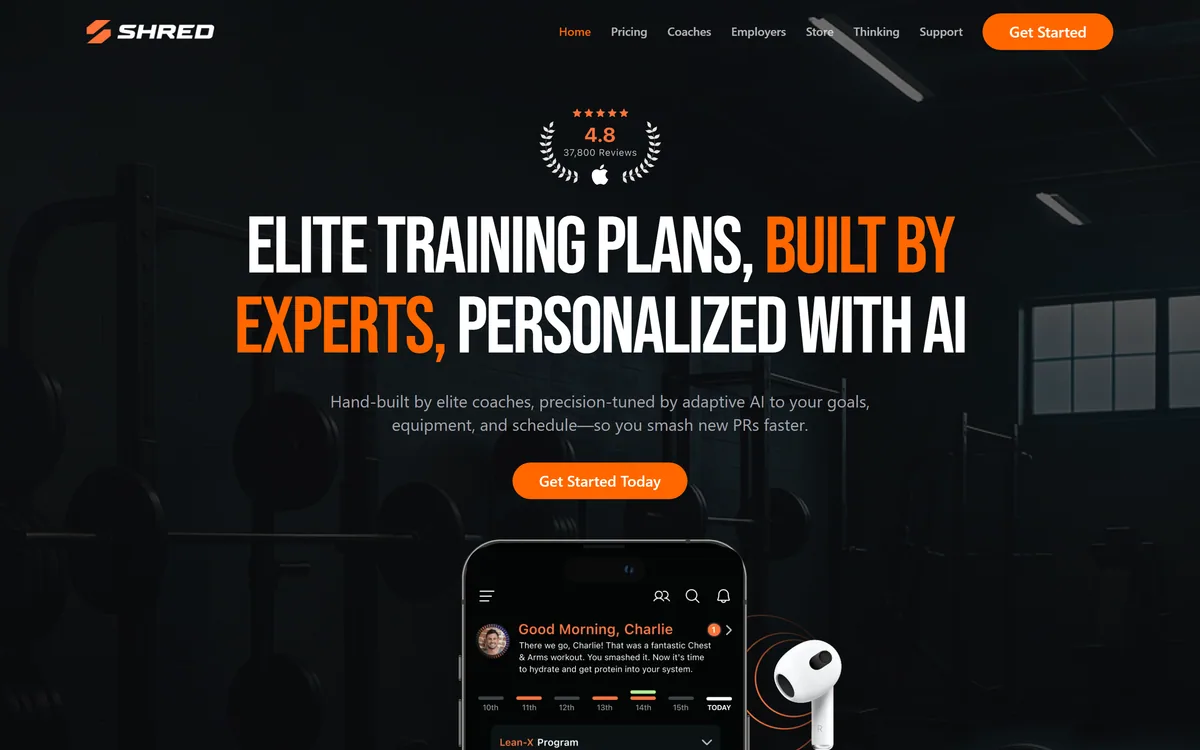
SHRED is a fitness app pairing hand-built coaching programmes with an adaptive engine that adjusts weights, reps, tempo and exercise selection as you train. Workouts rebuild in one tap for dumbbells, barbells, bands or bodyweight, across six named programmes plus studio-style classes.
Not medical or fitness advice. This is a review of a software product. Nothing here is medical, health or training advice. Speak to a doctor before beginning any new exercise programme, particularly if you have an existing condition, an injury, or have not trained recently.
Programmes fail on the day the squat rack is busy. That is the problem worth solving.
Adaptive Training, Summarised
SHRED is a fitness app that delivers coach-designed training programmes and adapts them in real time to your equipment, your gym and your progress, rather than serving a fixed plan.
Equipment adaptation is the standout: one tap rebuilds a workout for dumbbells, barbells, bands or bodyweight only, and for large, small, home or hotel gyms.
Six named programmes — Bulk, Cross-X, Athlete, Signature, Lean-X and Define — alongside studio-style classes covering HIIT, yoga, dance cardio and strength circuits.
The adaptive engine handles weights, reps, tempo, rest, substitutions and plateau detection, which is the work a coach would otherwise do between sessions.
2.7 million active users and 23.5 million workouts are cited by the company, alongside a 4.8 app store rating.
The Equipment Problem Is Why Programmes Fail
Of everything on the feature list, single-tap equipment rebuilding is the one that addresses the actual reason people stop training, and it is worth explaining why.
A written training programme assumes a gym. It says barbell back squat, and it assumes there is a rack free. On a Monday evening in a busy commercial gym there is not, and the person following the programme is standing there with a choice: wait twenty minutes, improvise something they are not confident about, or leave.
Multiply that across travel, hotel gyms with two dumbbells, a home setup with bands, an injury that rules out one movement, and a January when everything is occupied. Programmes do not fail because the programming was wrong. They fail on the specific days when following them was impossible, and each of those days makes the next one easier to skip.
Rebuilding a session in one tap for whatever is actually available removes that decision entirely. You train, the stimulus is close enough, and the streak survives — which matters far more than whether any individual session was optimal.
This is a genuinely good application of software. Bodyweight-first apps like Freeletics sidestep the problem by assuming no equipment at all. A human coach cannot be present to make that substitution at 6pm on a Monday, and a static PDF cannot adapt at all.
The environment presets — large gym, medium, small, home, hotel, bodyweight — take the same idea further. The programme adapts to where you are, rather than assuming where you should be.
Programmes do not fail because the programming was wrong. They fail on the Monday the rack was busy, and every skipped session makes the next one easier to skip.
Adaptive Progression Is The Part A Coach Would Do
The adaptive engine handles weight and rep recommendations, tempo, rest, exercise substitutions, progressive overload and plateau detection. That list describes the work a coach does between your sessions rather than during them.
Progressive overload is the mechanism strength training runs on: to keep adapting, the stimulus has to keep rising. Managing that manually means tracking every lift, remembering what you did three weeks ago, and deciding when to add weight — which is exactly the admin people abandon before they abandon the training.
Automating it removes a real friction, which is the same bet FitnessAI makes on set and rep progression. The app knows what you lifted, knows what the programme intends, and proposes the next load rather than asking you to remember.
Plateau detection is the more interesting inclusion. Noticing that a lift has stalled across several sessions and adjusting — deloading, changing rep ranges, substituting a variation — is genuinely coach-like thinking, and it is the point at which most self-directed trainees either stall indefinitely or push through and get injured.
The honest limit is that the engine only sees what you log. If you record a set as completed when the last two reps were ugly, it reads that as success and adds weight next time. Adaptive systems inherit the honesty of their input, and that is worth knowing before trusting the progression.
The comparison metrics against other users are the least useful feature here. Training is individual, and how your bench compares to strangers on the internet is motivating for some people and actively counterproductive for others.
What An App Cannot See
Being clear about this matters more in fitness than in most software categories, because the failure mode is physical.
It cannot see your form. This is the significant one. The app can tell you to squat 100kg for five; it cannot see that your knees are collapsing inward or your lower back is rounding under load. Those are the things that cause injury, and they are invisible to any app that does not use your camera.
It cannot see fatigue that is not in the log. Sleep, stress, illness, whether you have been on your feet all day. A programme that adds weight because last week went well does not know you slept four hours.
It cannot assess your history. An old shoulder injury, a hypermobile joint, a back that objects to loaded flexion — none of that is visible, and exercise substitution based on available equipment is not the same as substitution based on your body.
Consistency tools like Habit Coach AI address the showing-up half rather than the programming. It cannot diagnose pain. The distinction between productive discomfort and a warning is genuinely difficult and consequential, and no app should be the thing you consult about it.
None of this argues against using it. It argues for the sensible combination: use the app for programming and progression, and get a qualified person to look at your technique on the main lifts at least once. A few sessions with a coach early is the highest-return investment in a training life, and it is exactly what software cannot substitute for.
Speak to a doctor first if you have any existing condition, injury, or have not trained recently.
Have a qualified coach check your form on the main compound lifts before loading them heavily.
Log honestly — including the sets that were harder than they should have been.
Set your equipment profile accurately so substitutions are actually available to you.
Ignore the comparison metrics if competing with strangers pushes you past good technique.
Membership Tiers, Undisclosed
This site does not publish plan prices, and SHRED publishes very little structure either — which is itself worth noting.
The site references membership tiers by name — CrossTrain, Elevate, Bulk and Strength — without describing what distinguishes them, whether a free tier exists, or whether there is a trial period.
Naming tiers after training styles rather than after feature levels suggests the split may be by programme access rather than by capability, which would be an unusual and arguably sensible structure: you subscribe to the training you are doing rather than to a bundle you partly use.
That is an inference rather than something stated, and it is the first question to ask. If tiers gate programmes, then changing training goal — from a strength block to a fat-loss block — might mean changing subscription, which is a genuine consideration for anyone who periodises their training across a year.
In this category the near-universal structure is a monthly or annual subscription with a short free trial, and annual carrying a substantial discount. Fitness apps in particular are bought on impulse in January and abandoned by March, so check the cancellation terms before taking an annual plan.
The comparison worth running is not against other apps. It is against a few sessions with an actual coach, which costs more and does the one thing no app can — watch you move.
Reading The Usage Figures
Three numbers appear prominently and they carry different weight.
2.7 million active users is the headline and it is self-reported. Active is a term that varies enormously by definition — anyone who opened the app this month, this quarter, or ever. Without a definition it describes scale rather than engagement.
23.5 million workouts completed is the more meaningful figure of the two, because a completed workout is a real event rather than an account. Divided across the stated user base it works out at roughly nine workouts each, which is a plausible and rather honest-looking number — fitness apps have notoriously high abandonment, and a figure that reflects that is more credible than one that does not.
A 4.8 app store rating is independently visible and harder to inflate, which makes it the most checkable claim here. App store ratings do skew positive because prompts appear after good sessions, but a high rating across a large base still means something.
The press mentions — GQ, Men's Health, Women's Health, Rolling Stone, Business Insider and others — are coverage rather than endorsement, and worth reading as evidence that the product is established rather than as an assessment of it.
The company is stated as Shred Labs, LLC. Beyond that, founding, team and location are not published on the pages reviewed.
Active users is self-reported with no stated definition of active
Workouts completed is the more meaningful figure and looks plausibly honest
The app store rating is the most independently checkable claim
Press mentions are coverage, not endorsement
Company detail beyond Shred Labs, LLC is not published
Key features of SHRED
Coach-designed auto-progressing training cycles
Single-tap workout rebuilding for available equipment
Environment presets for gym, home, hotel and bodyweight-only
Real-time weight and rep recommendations
Tempo and rest period guidance
Automatic exercise substitution
Progressive overload tracking
Plateau detection and adjustment
Six named programmes with gender-specific variations
Studio-style classes including HIIT, yoga and dance cardio
Personal best and progress visualisation
Friend challenges, gym leaderboards and partner workout sync
Pros & cons
Pros
6
Equipment adaptation solves the specific thing that actually derails training programmes
Environment presets mean travel and busy gyms stop breaking the plan
Automated progressive overload removes the admin people abandon before the training
Plateau detection is genuinely coach-like thinking rather than a tracking feature
Combining structured strength work with class-style sessions covers more of a training week
The completed-workout figure looks plausibly honest rather than inflated
Cons
6
No pricing, trial or free tier detail is published anywhere on the site
Tiers named after training styles may gate programmes rather than features
Cannot observe your form, which is where injury risk actually lives
Progression inherits your logging honesty — a badly logged set leads to added load
Comparison against other users is counterproductive for some trainees
No founding, team or location detail beyond the company name
Best For
People who train across gyms, home and while travelling
Trainees who have abandoned written programmes because of equipment gaps
Anyone who wants structured progression without spreadsheet tracking
Lifters who have stalled and want plateau handling built in
People who want strength programming and classes in one subscription
SHRED Beside Other Training Apps
Compare on who wrote the programme and how much it adapts, not on exercise library size.
You have abandoned programmes before because the equipment was not available
You train across different places — home, commercial gym, hotels
You want structured progression without tracking it in a spreadsheet
You know your form on the main lifts is sound, or will get it checked
You want both strength programming and class-style sessions in one app
Find A Coach If
You are new to lifting and nobody has ever watched your technique
You have an injury or condition that needs individual assessment
You are training for a specific competition with sport-specific demands
You would log sets as clean when they were not, which breaks the progression
You need to know the price before committing, since none is published
Programmes, Adaptation And Scale
Company
Shred Labs, LLC
Category
AI-assisted fitness training and workout programming
Programme approach
Hand-built coach-designed cycles with algorithmic adaptation
Named programmes
Bulk, Cross-X, Athlete, Signature, Lean-X and Define, with gender-specific variations
Class styles
HIIT, yoga, dance cardio and strength circuits
Equipment adaptation
One-tap rebuild for dumbbells, barbells, bands or bodyweight only
Environment presets
Large gym, medium gym, small gym, home gym, hotel gym, bodyweight only
Adaptive engine
Real-time weight and rep recommendations, tempo and rest guidance, exercise substitutions, progressive overload tracking, plateau detection
Tracking
Weight, reps, personal bests, and comparison against other users
Community
Friend challenges, gym leaderboards, live workout feed, partner workout sync
Stated scale
2.7 million active users and 23.5 million workouts completed, per the company
App rating
4.8 out of 5 cited
Press cited
GQ, Apple, Men's Health, Women's Health, Rolling Stone, Business Insider
Charging model
Membership tiers named as CrossTrain, Elevate, Bulk and Strength, with no pricing, trial or free tier detail published. No prices published here
Other Training And Habit Apps
The category divides between programming apps, coaching apps and the behavioural tools that decide whether you use either.
FitnessAI — algorithmic set and rep progression for gym-based strength work
Freeletics — bodyweight-first coaching if equipment access is the constraint
Zing Coach — AI plans with an initial fitness assessment built in
Habit Coach AI — the consistency problem underneath every training app
Cladwell — the same decision-elimination idea applied elsewhere in a daily routine
SHRED's Published Figures
Last checked . Read from shred.app during this check, with the screenshot above captured at the same time.
Approach described as combining hand-built coaching expertise with algorithmic adaptation to goals, equipment and schedule
Six named programmes stated: Bulk, Cross-X, Athlete, Signature, Lean-X and Define, with gender-specific variations
Studio-style classes stated including HIIT, yoga, dance cardio and strength circuits
Single-tap workout rebuilding stated for dumbbells, barbells, bands and bodyweight-only training
Environment adaptation stated for large, medium, small, home and hotel gyms and bodyweight-only
Adaptive engine stated as covering real-time weight and rep recommendations, tempo and rest, exercise substitutions, progressive overload and plateau detection
Tracking stated for weight, reps, personal bests and comparison against other users
Community features stated including friend challenges, gym leaderboards, a live workout feed and partner workout sync
Usage figures cited as 2.7 million active users, 23.5 million workouts completed and a 4.8 app store rating
Company identified as Shred Labs, LLC, with press mentions cited including GQ, Men's Health, Women's Health, Rolling Stone and Business Insider
Membership tiers referenced by name without pricing, trial or free tier detail; no prices published here, in line with this site's pricing policy
Usage figures are self-reported with no stated definition of active, and press mentions are coverage rather than endorsement. No app can observe your technique, and form is where injury risk sits — have a qualified coach check your main lifts. Adaptive progression also inherits the honesty of your logging: recording a hard set as clean leads the engine to add load. Nothing here is medical or training advice.
Editor's Verdict
3.8/5
The equipment-adaptation feature is the one that earns its place — a programme that rebuilds for whatever is free in a busy gym solves the specific thing that derails consistency, which is what actually determines results. It is marked down because membership tiers are named without any pricing detail published, and because an app cannot see your form, which is where injury risk actually sits. AInexfinder Editor Score: 3.8/5.
SHRED pricing
AInexfinder does not list plan prices or billing details. For current pricing, plans, and trials, visit the official SHRED website.
Vendor pricing, credits, and billing policies change over time. Always confirm on the official site before you buy.
Frequently asked questions
What does SHRED do differently from other workout apps?
The equipment adaptation. A workout rebuilds in one tap for dumbbells, barbells, bands or bodyweight, and for large, small, home or hotel gyms — which addresses the specific reason programmes get abandoned, rather than the programming itself.
How much does SHRED cost?
Not published. The site names membership tiers — CrossTrain, Elevate, Bulk and Strength — without pricing, trial or free tier detail. Ask whether tiers gate programmes rather than features, since that would matter if you change training goal during the year.
Can an app replace a personal trainer?
For programming and progression, largely yes. For technique, no — an app cannot see your knees collapsing under a heavy squat, and that is where injury risk lives. The sensible combination is app programming plus a few sessions with a coach who watches you lift.
What is plateau detection and why does it matter?
It notices when a lift has stalled across sessions and adjusts — deloading, changing rep ranges or substituting a variation. That is the point where most self-directed trainees either stall indefinitely or push through and get injured, so handling it automatically is genuinely useful.
Does SHRED work if I only have dumbbells at home?
Yes — bodyweight, bands, dumbbells and barbells are all supported as equipment profiles, with environment presets down to bodyweight-only. Set your profile accurately, because the substitutions the engine can offer depend entirely on what it thinks you have.
Is SHRED suitable for beginners?
The programmes are coach-designed and the adaptive engine handles load selection, which helps. What it cannot do is watch your technique, so a beginner should get a qualified person to check the main compound lifts before loading them — that is the highest-return thing you can do early.
Are SHRED's user numbers reliable?
They are self-reported. 2.7 million active users has no stated definition of active; 23.5 million completed workouts is more meaningful because it counts real events, and works out at roughly nine per user — a plausible figure given how fitness apps are actually used.
Daniel reviews AI tools the slow way — by actually using them on real projects. His reviews cover what works, what breaks, and who each tool is genuinely a good fit for.
Daniel and the AInexfinder editorial team research SHRED using public product information, listing evidence, and (when available) hands-on checks. Scores reflect listing completeness and transparency — not paid placement.
Listings may include affiliate or sponsored placements, which are labeled when present. Editorial scores and cons are not sold. See our affiliate disclosure and review methodology.
Jefit is a workout planner and tracking app with a large exercise database, custom plan building, muscle recovery and one-rep-max metrics, and a community feed. Its adaptive plan analyses strength and fatigue to build the coming week, and periodization now applies to plans members build themselves.
BodBot is an AI personal trainer and nutritionist that builds workouts tailored to your goals, body and progress, adapting with every rep, with joint controls for injuries, wearable integration and data-driven nutrition across web, phone, tablet and watch.
Gymscore analyses lifting technique from phone video, scoring each set from zero to one hundred across five movement categories and giving feedback on range of motion, posture, core stability and movement patterns across more than 2,500 exercises, alongside training plans and an AI coaching chat.
The Running Genie is an AI running coach that syncs from Strava, Garmin, Polar, Suunto and Apple Health, then builds adaptive training plans for 5K through ultra using VDOT, 80/20 polarised training and periodisation principles.
Vici is a free iOS running coach that connects to Strava and your wearable, checks in each morning against recovery, sleep, HRV and resting heart rate, adapts the day's session accordingly, and reads every completed run in two stages before adjusting what comes next.
Dr. Muscle builds and adjusts strength training programmes automatically, picking your weights and reps from what you lifted last time. Built by an exercise scientist, it applies progressive overload and daily undulating periodization, publishes dated release notes going back to 2016, and runs on phone and Apple Watch.